
Systematic review writing services by expert review writers
Hand your review to a specialist. We plan the protocol, run the database search, screen and appraise the studies, then deliver a PRISMA 2020 report you can defend.
Get a free quote- Quote before any work starts
- Free revisions
- Plagiarism reports included
- 15% off your first order
- PRISMA 202027-item checklist and flow diagram
- DatabasesPubMed, Embase, Scopus, Web of Science
- ScreeningCovidence or Rayyan, every decision logged
- AppraisalCochrane, JBI, CASP or AMSTAR
What you receive
Everything our systematic review writing services deliver, in full
Our systematic review writing services do not stop at a draft. You receive the documents examiners and journal editors ask for, so your review stands up to questions.
The review itself
Our systematic review writing services produce a structured manuscript with abstract, introduction, methods, results, discussion and conclusions, written to your word count and format.
A written protocol
Your research question, eligibility criteria, databases and analysis plan, agreed before searching begins and ready for registration.
The full search record
Every search string, database and date, so another researcher can repeat the search and reach the same results.
PRISMA checklist and flow diagram
Completed from your real screening counts, with the reason for each full-text exclusion.
Extraction and appraisal tables
Study characteristics, outcomes and risk of bias judgements in clear tables that are easy to check.
Reference library and reports
A clean reference list in your style, plus plagiarism reports so you can see the originality results yourself.
The method
Our six-stage review process, from research question to report
Our systematic review writing services produce a document at every stage that you can read and challenge. This is how the service works in practice.
Protocol
Frame the research question, set the scope and agree the inclusion and exclusion criteria.
Search
Build search terms for each database and record the full search.
Screen
Remove duplicates, then screen titles, abstracts and full-text articles.
Appraise
Judge study quality and risk of bias with the right tool.
Synthesise
Combine results in a narrative synthesis or a meta-analysis.
Report
Write the manuscript, flow diagram and checklist, then revise with you.
Review types
Which type of review do you need? A quick guide
Pick the review type that matches your question. If you are unsure, our systematic review writing services include a free consultation to help you decide.
| Type of review | What it does | Best for |
|---|---|---|
| Systematic review | Answers one focused question with a repeatable search and appraisal | Dissertations, guidelines and journal papers |
| Meta-analysis | Pools numerical results from similar quantitative studies | Questions with enough comparable data |
| Scoping review | Maps what is known and exposes the research gap | Broad or new topics and PhD proposals |
| Critical literature review | Evaluates theories and arguments, not only study counts | Conceptual dissertation literature chapters |
| Integrative review | Combines qualitative and quantitative evidence | Nursing, education and policy questions |
| Rapid review | Streamlines the method for a short deadline | Policy briefs and urgent decisions |
Standards
Quality standards behind our systematic review writing services
A premium review service is judged on method, honesty and care. These are the standards every project follows.
Reproducible by design
Anyone can repeat your search, and the recorded decisions explain every study that was kept or removed.
Verified sources only
Every citation in our systematic review writing services is traced to its original database record, never to a chatbot summary or an unchecked list.
Plagiarism-free writing
Each review in our systematic review writing services is written from scratch and checked, and you receive the plagiarism reports.
Honest about limits
Our systematic review writing services state weaknesses in the evidence plainly, because an overstated conclusion fails peer review.
Client reviews
What researchers say about our systematic review writing services
Real reviews from clients who ordered systematic reviews and literature reviews from our writers.
- ★★★★★
Excellent systematic review support! The search strategy was comprehensive, and the findings were clearly organised and presented.
- ★★★★★
I was impressed by the quality of the research synthesis. The inclusion and exclusion criteria were clearly defined, the screening process was well documented, and the critical appraisal was thorough. Highly recommended!
- ★★★★★
Very professional work. The PRISMA flow diagram, study selection, and evidence synthesis were handled exceptionally well.
- ★★★★★
My review required analysing evidence from multiple studies and identifying gaps in existing research. The thematic synthesis was insightful, and the discussion was academically strong. Exactly the support I needed!
- ★★★★★
Great experience! The literature search was well structured, and the selected studies were relevant to my research question.
- ★★★★★
Outstanding research support. The methodology was clearly explained, the evidence was critically evaluated, and the final synthesis brought the findings together effectively.
Who we help
Students, clinicians and research teams who need a rigorous review
Our systematic review writing services suit anyone who must show that a review was done properly. Typical clients include:
Postgraduate students
Master’s and PhD candidates who need a systematic review or a phd literature review inside a thesis, with our systematic review writing services guiding the method.
Nurses and clinicians
Practitioners answering an evidence-based healthcare question for a degree, a service review or a journal.
Academics and research teams
Groups that want systematic review writing services as an extra pair of hands for the search, screening and write-up.
Business and policy analysts
Analysts who must summarise research literature and research papers on management, education or public policy.
Subjects we cover: Nursing, psychology, public health, education, business and management, healthcare management, social work, law, economics, marketing, finance, computer science, engineering, sociology and criminal justice.
Ordering
Order systematic review writing services in four clear steps
Ordering our systematic review writing services takes a few minutes. Use the order form, or describe your project in the box at the top of this page.
Share your brief
Send your research question, type of review, word count, citation style and deadline, with any rubric or protocol you already have.
Approve the quote
We reply with a written scope of work and a price for your systematic review writing services. Nothing starts until you say yes.
Follow the work
Your writer shares progress, and you can ask questions at any hour through the support team.
Receive and revise
Download the review and supporting files, then request free revisions until it matches your instructions.
The complete guide to our systematic review writing services
Read how our writers work, what each stage includes and how to get the most from your order.
How our systematic review service works, from brief to delivery
Our systematic review writing services were designed for people who cannot afford to lose months to searching, screening and formatting. Every order goes to a review writer who knows your subject, and every stage of the review process leaves a written record. That record is what makes the final document trustworthy.
Here is how the service works. You send a short brief with your research question, the scope, the deadline and any rules from your university or journal. We reply with a quote and a scope of work. Nothing starts until you approve it, so there is no pressure and no surprise charge.
Once you agree, your writer drafts a protocol, runs the search and reports back as each stage closes. You can message the writer through the platform at any time, upload files securely and ask for free revisions. Our support team is available around the clock, which helps when your deadline sits in another time zone.
Many clients begin with a short consultation about the type of review and the scope. It costs nothing and often saves weeks, because a realistic plan at the start prevents rework later. If your idea needs narrowing, we say so before you spend anything.
Conducting a systematic review is a team activity, even when only one name appears on the title page. Behind our systematic review writing services sits a research team of writers, a methods checker and a support desk, so any question about the systematic review process is answered quickly by someone who knows your file.
The result is a calmer project. You know who is working on your review, what stage it has reached and what happens next, and our systematic review writing services remain available long after the first draft, for example when a supervisor asks for another round of changes.
Literature review service or systematic review: which type of review fits?
A traditional literature review summarises and critiques existing research to give your study a context. A systematic literature review is stricter. It answers a focused question using a written protocol, a full database search, explicit inclusion and exclusion criteria and a recorded appraisal of every included study.
If your instructions mention PRISMA, a protocol, a flow diagram or a risk of bias assessment, you almost certainly need our systematic review service. If you need a themed discussion of sources for a thesis chapter, our literature review service is usually the better match.
The difference matters because the two documents are marked differently. A systematic review is judged on method and reproducibility. A narrative review is judged on argument, coverage and critical thinking. Choosing the wrong one can cost marks even when the writing is strong.
Not sure which one you need? Send your assignment brief and your research objectives. Our systematic review writing services begin with advice on the right type of review, a realistic timeline and a sensible number of databases, before you commit to anything.
Think about your reader as well. A supervisor who asked for a literature review expects an argument, while an editor who asked for a systematic review expects a method. Our systematic review writing services match the document to its reader, and we will tell you plainly if your title promises one thing and your brief asks for another.
PRISMA 2020 and a reproducible review
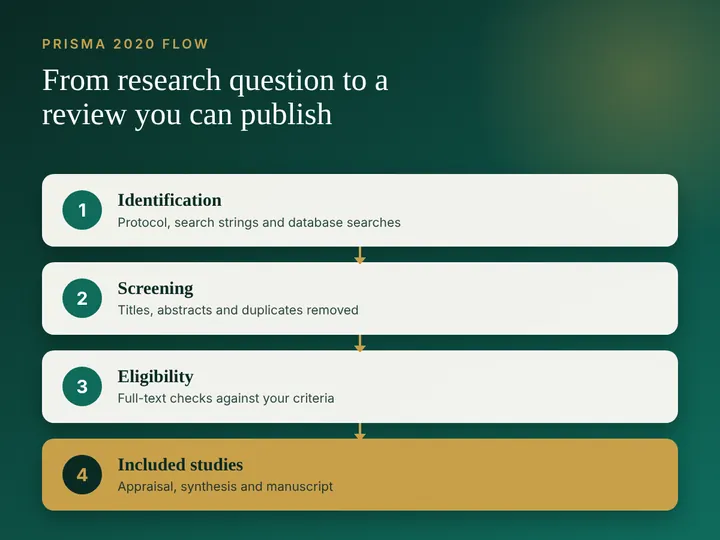
PRISMA is the main reporting guideline for systematic reviews, and the PRISMA 2020 statement replaced the earlier 2009 version. It offers a 27-item checklist and a flow diagram template that show how many records were identified, screened, excluded and included. A reproducible review lets another researcher repeat your steps and reach the same studies.
Within our systematic review writing services, writers complete the checklist alongside your manuscript, draw the flow diagram from your real screening counts and make sure the methods section reports every item clearly. Nothing is added at the end to look complete; the record is built as the work happens.
When your topic calls for another standard, such as an extension for scoping reviews or for reviews of diagnostic accuracy, we use it. For reviews of interventions we also follow the Cochrane handbook, and we advise on protocol registration where your field expects it.
This evidence-based approach is what examiners and peer-reviewed journals now expect. It also protects you in a viva, because every choice you made can be traced to a written decision rather than to memory.
Another benefit of PRISMA 2020 is speed in revision. When a reviewer asks how many records were removed at the full-text stage, the answer is already in the flow diagram. Our systematic review writing services keep the counts, the exports and the reasons together, so updates take hours rather than weeks.
Searching every database like a librarian
A systematic review is only as strong as its search. Our writers build search strategies around your research question, combine search terms and subject headings with Boolean operators, then adapt the syntax for each database, such as PubMed, Embase, Scopus and Web of Science.
Like a university librarian, we record each search, the date it was run, the exact search strings and the number of results. Pages such as LibGuides at university libraries recommend the same habit, because a full search that is written down can be repeated, checked and updated.
Where it is relevant we add grey literature, for example theses, reports and conference papers, and we follow citation trails to avoid missing key studies. We also explain any limit we apply, such as language or date, and justify it in your methods.
You receive the complete search appendix with your review. Examiners and peer reviewers often ask to see it, and it turns an arguable review into one that anyone can audit.
Good librarians never trust a single search. They test search terms on a handful of known papers, check that those papers are found, and refine the strings until nothing obvious is missing. Our systematic review writing services follow the same test, which is why our search appendices hold up under questions.
Screening, the selection process and risk of bias
After the search, records are exported, checked for each duplicate and screened against your inclusion and exclusion criteria. We set up the workflow in Covidence or Rayyan, move from titles and abstracts to full-text screening and note the reason for every exclusion. This selection process feeds your flow diagram.
Next comes data extraction. We design tables for study characteristics, outcomes and key findings, so the evidence is easy to compare. Each study is then appraised with a suitable tool, such as the Cochrane risk of bias tool, JBI checklists, CASP or AMSTAR, depending on the study design.
Judging risk of bias is where many student reviews fall short, because it needs clear criteria and a second opinion. We write down the reasoning behind each judgement, so readers can see how a study was rated and why it was trusted or doubted.
Working this way keeps every decision in our systematic review writing services consistent and auditable, and it gives you answers when a supervisor asks why a study was left out.
Screening judgements are never perfect, so the method builds in checks. Where the budget allows, two people can screen independently and resolve differences by discussion. Our systematic review writing services explain this choice in the methods and report how many records were in doubt, which shows readers that the selection process was careful.
Synthesis, meta-analysis and writing up a systematic literature review
Synthesis is where a review earns its value. Depending on your data, our writers synthesise findings with a narrative or thematic approach, or with a meta-analysis when the studies are similar enough to pool. Each choice is explained in the methods section.
Results appear in clear tables, with forest plots where suitable, and a discussion of heterogeneity and the certainty of the evidence. If your meta-analysis needs advanced statistics, our dissertation statistics help can support the analysis.
When studies differ too much to pool, we say so and use a structured narrative synthesis instead. Forcing mixed data into one chart misleads readers, and a systematic literature review that admits this is more credible than one that hides it.
The discussion links the findings back to your research question, states the limitations honestly and points to the research gap and future research. A balanced conclusion survives peer review far better than an overstated one.
Qualitative evidence needs its own treatment. A thematic synthesis, for instance, groups the findings of several studies into themes and shows how strongly each is supported. Our systematic review writing services cover systematic reviews and meta-analyses of numbers as well as qualitative syntheses of words, and we choose the method that fits your question.
Whichever method fits, the write-up follows a fixed order: aims, methods, results, discussion and conclusion. Our systematic review writing services keep the same terms for the same ideas from start to finish, which makes long reviews of research papers far easier to read and to mark.
Scoping review, custom literature review and other review types
Different questions need different review types. Alongside the full systematic review, our systematic review writing services cover a scoping review to map a field, rapid reviews when time is short, umbrella reviews that summarise other reviews, and integrative reviews that combine qualitative and quantitative evidence.
We also write a custom literature review built around your own theory or framework, and a critical literature review that tests arguments instead of counting studies. These suit conceptual topics where a strict protocol would add little.
Each review uses the same evidence-based method, adapted to your scope and to the reporting standard your field expects. Clinical reviews of interventions, qualitative evidence syntheses and education or business reviews all follow their own conventions.
Tell us your research needs and we will recommend the type of review that fits your question, your timeline and your institution’s rules. That advice is included in every project.
A scoping review does not rank studies by quality, which surprises many students. Its job is to chart what exists, who has studied it and where the research gap sits. Our systematic review writing services produce clear charts and tables for this purpose, and we show how the scoping review can lead into a full systematic review later.
Whichever type of review you choose, the goal is the same: a document that answers your question with evidence rather than opinion. Our systematic review writing services aim for that standard on every order, whatever the length, field or deadline.
Literature review writers for your dissertation, with writing help
Many students need a literature review for your dissertation or a phd literature review as one chapter of a larger project. Our literature review writers keep the chapter consistent with your research objectives, your methodology and your supervisor’s expectations.
Strong dissertation literature does more than list sources. It shows the debate, exposes the gap and leads the reader to your study. We organise the chapter by theme, keep a clear thread and make sure the research and writing that follow rest on it.
If you also need support elsewhere, our research paper writing service and dissertation editing services can follow on, and you can combine them in one order. Need an essay as well? Our essay writing services are available.
This kind of writing help works best when one team understands the whole project. Follow your university’s formatting guide so every chapter matches, and we will apply the same format throughout.
Dissertation committees read a literature chapter with one question in mind: does it justify your study? Our writers connect every theme to your aim, so the reader reaches your research question feeling it is the obvious next step. Strong chapters in our systematic review writing services end by naming the gap and the future research it invites.
Plagiarism-free work, plagiarism reports and AI tools
Every review is written from scratch for your project, so it is plagiarism-free by design. You receive plagiarism reports with your files, and each reference is checked against the original source instead of being copied from another document.
AI tools can help you brainstorm search terms or explain a method, but they invent references and cannot run a full search of a database. They also leave you exposed to integrity checks. Our writers rely on verified, well-researched, peer-reviewed sources.
Universities and journals set different rules on writing support and on AI tools, so please read yours and disclose any help where it is required. We will gladly adjust how we work to stay inside your policy.
Revisions are part of our systematic review writing services. If anything does not match your instructions, request free revisions and your writer will work through them with you until the document does.
A short word on honesty. We encourage you to treat the finished review as your own academic work: read it, question it and learn from it. Our systematic review writing services are meant to guide and support you, and our plagiarism reports and verified references give you the evidence to stand behind every page.
Scope of work, consultation and an affordable literature review
Before any payment you receive a written scope of work: the word count, the databases, the deliverables, the format and the deadline. This avoids surprises and makes it easy to compare us with any other review service.
We aim to give you an affordable literature review without cutting the steps that matter. Your first order includes 15% off, and a free consultation helps you choose only the stages you need, such as the search, the screening or the complete review.
Price depends on the scope, the type of review and the deadline, so a quote takes only a few minutes. If the scope changes halfway, we update the quote in writing before continuing, and you decide whether to proceed.
Citation work is included. We manage your references in EndNote or Zotero and format them in APA, MLA, IEEE or Harvard, so the reference list matches the style your department requires.
Clear scoping prevents most disputes. If a review is meant to cover ten years of research in three databases, the scope of work says so, and any extra database or extra year is priced before it is added. Our systematic review writing services stay transparent about what is included in the word count and what is not.
If you are comparing providers, ask each one for a written scope and a sample of how it records its search. A review service that cannot show its method may not have followed one, and that is the first thing a careful examiner will test.
Literature review help and our literature review writing service
Already part-way through? Our literature review help covers a single chapter, a search that needs fixing or a synthesis that is not working. A dedicated writer reads what you have, suggests changes and fills the gaps without rewriting what already works.
Others prefer a complete literature review writing service. Our review writing service handles the whole project, from the first protocol to the final draft, and keeps you informed at every stage. Both options follow the same quality checks.
Health topics make up a large share of the work. Nursing, public health, psychology and social work questions often need several databases and careful appraisal, because the findings can shape practice. Evidence-based healthcare reviews are matched to writers with that background.
Whatever the field, you never need to share patient-identifiable data. Reviews work with published studies, and if your project uses unpublished results, tell us first so we can agree how to handle them.
Some projects arrive half-written, and that is fine. Our systematic review writing services can pick up from your search, your screening export or your first draft. Tell us what exists, and we will plan the shortest route to a finished, consistent review without throwing away the work you have done.
Publishing your review: manuscripts, journals and your review writer
If you plan to publish your systematic review, we prepare the manuscript for a peer-reviewed journal. We write the abstract, introduction, methods, results and discussion in the order the journal expects, and follow its word limits, headings, tables and figures.
We prepare a cover letter on request, and your review writer can help you answer reviewers, update the search and refresh the flow diagram. Keeping the same writer for revisions saves time, because the full history of the review is already known.
We cannot promise acceptance, because that decision belongs to the journal. What we can do is make sure your review is clear, complete and well reported, which is what editors look for first.
When you are ready, place your order or ask for a quote. If you need a systematic review quickly, the order form is the fastest route, and your writer will confirm the plan before work begins.
Journals differ widely in tone, structure and length, so our writers read the author guidelines before drafting. Our systematic review writing services also check supplementary files, such as the checklist, the search strategy and the data tables, because many editors reject submissions that arrive with missing attachments.
Deadlines, urgent orders and staying in touch
Deadlines are real, and our systematic review writing services plan around them. A full systematic review takes longer than a short literature review, so tell us your date at the start. We confirm what is realistic and what can be shortened without harming the method.
For urgent orders, we can focus on the stages that matter most, such as the search and screening, and deliver the rest in phases. Rushing a protocol never pays, so we protect the first stage even when time is short.
You stay informed throughout. Your writer shares progress, our support team answers messages at any hour, and you can upload new instructions whenever your supervisor changes the brief. Clear, regular contact is the simplest way to keep a long project on track.
FAQs about systematic review writing services
Short, practical answers to what researchers ask about systematic review writing services.
What are the 5 steps of systematic literature review?
A common five-step version is: frame the research question, write a protocol, search the databases, screen and appraise the studies, then synthesise and report the results. Some guides split this into seven steps, but the order is the same. Our systematic review writing services document each step so your review stays reproducible.
What is a systematic literature review?
It is a structured review that uses a written method to find, select and appraise all the research on one question, then combines the findings. Because the search and the selection process are recorded, another researcher can repeat it and reach the same studies. A narrative review has no such protocol.
Can I use ChatGPT for literature review?
You can use it to brainstorm search terms or to explain a method, but never to supply sources. AI chatbots can invent references, and they cannot run a full database search. Check your university rules, disclose any help and verify every citation in the original database.
What are the five C's of literature review writing?
One widely taught framework says a strong literature review should cite, compare, contrast, critique and connect the sources. Citing shows what is known, comparing and contrasting reveal patterns, critique tests quality, and connecting links the studies to your own research question.
Can I use AI to write a literature review?
Some universities allow limited AI help and others ban it, so read your policy first. AI text is often generic and may contain false references, which risks a plagiarism or integrity flag. We use verified sources, and you receive plagiarism reports with your review.
What are the four major types of literature review in research?
They are commonly grouped as narrative, systematic, scoping and integrative reviews. A meta-analysis is a statistical method that can sit inside a systematic review. The right choice depends on your question, your scope and the amount of evidence available, and our team can advise you. Our systematic review writing services cover every one of these.
What are the two main types of literature?
In research, the two main kinds of source are primary sources, which report original data, and secondary sources, which interpret or summarise them. In everyday use, literature is also split into fiction and non-fiction. A literature review draws on both primary and secondary research, and our systematic review writing services use both.
What are the 6 types of research gaps in a literature review?
Frameworks vary, but six common types are an evidence gap, a knowledge gap, a population gap, a methodological gap, a theoretical gap and a practical gap. Spotting the gap shows why your study matters and what future research should do.
Ready for systematic review writing services you can trust?
Send your research question and deadline. You will see a price before any work begins, and your first order includes 15% off.
Get my free quote