
Blog
Exploring the PCC Framework for Scoping Review Research Questions | A Comprehensive Guide to Systematic Reviews for Population Health Approach

Understanding the PCC Framework in Systematic Reviews
What is the PCC Framework and Why is it Essential?
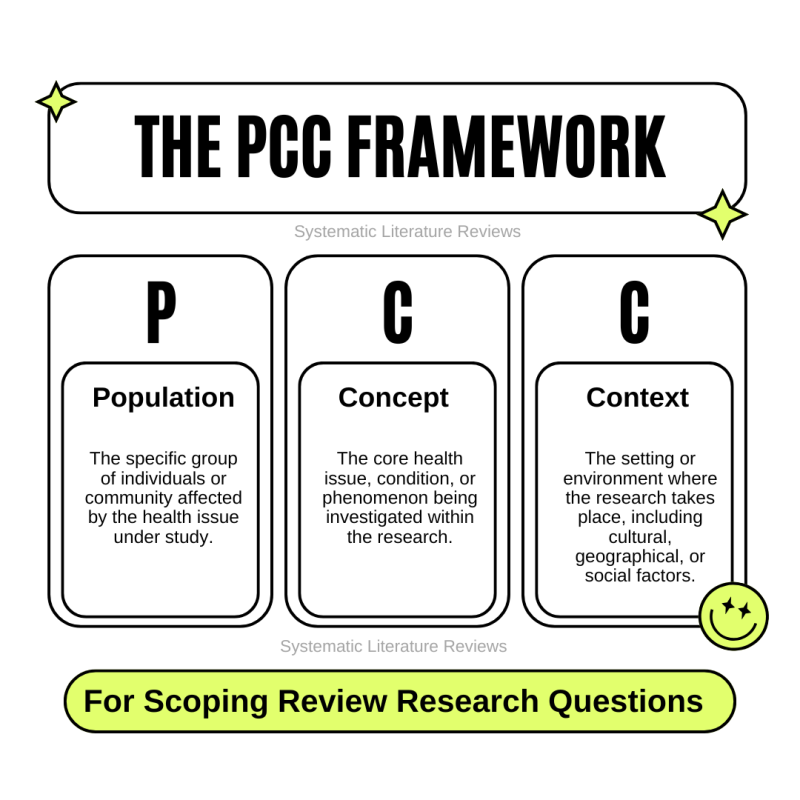
- PCC Framework stands for Population, Concept, and Context, an essential tool for structuring scoping reviews and systematic reviews in health research.
- The PCC framework is critical in qualitative research, particularly for health promotion and addressing social determinants of health.
- Unlike the traditional PICO framework, which focuses on Population, Intervention, Comparison, and Outcome, the PCC tool is specifically designed for questions in qualitative research and population health.
- The PCC framework enables researchers to define phenomena of interest, ensuring clarity when developing research questions.
- By using the PCC framework, health services can improve health system performance and aid in creating better health policy informed by evidence-based practice.
Get Expert Systematic Review Writing Help
Unlock comprehensive and high-quality systematic literature review services tailored to your research needs. Our expert team ensures thorough analysis, clear synthesis, and accurate references. Contact us today for professional writing assistance!
The Role of the PCC Framework in Formulating Research Questions
- The PCC framework helps structure research questions by clarifying the population or patient, the conceptual framework of the study, and the context in which the research is conducted.
- It focuses on health information related to specific determinants of health and ensures that the research team considers all the variables of health status and health promotion.
- In scoping reviews, the PCC framework is useful for identifying research gaps by addressing the key components like population health, health approach, and geographic location.
- It is particularly valuable for studies related to public health and provides a solid foundation for the synthesis of grey literature, enabling comprehensive inclusion criteria for systematic reviews.
- The PCC framework can guide search strategies by assisting in choosing relevant search terms that align with the review’s focus on social determinants of health and health services research.
Practical Tips for Applying the PCC Framework to Scoping Reviews
- Define the Population: Start by clearly identifying the population or patient group being studied. This is a crucial step in health research, ensuring the research is relevant to the target group.
- Clarify the Concept: Specify the concept or health issue under investigation, ensuring alignment with existing models and frameworks. Whether it’s a qualitative study or focusing on determinants of health, a well-defined concept strengthens the review’s focus.
- Set the Context: In the PCC framework, context includes the geographical location, health service settings, and socio-cultural factors. This helps refine review questions and supports the inclusion of diverse populations.
- Develop Inclusion Criteria: Use the PCC tool to develop inclusion and exclusion criteria, helping to ensure consistency across studies included in the scoping review. This will also streamline the process of assessing evidence-based practice.
- Consult Reporting Standards: Adhere to reporting items for systematic reviews such as the Preferred Reporting Items for Systematic Reviews and Meta-Analyses (PRISMA), ensuring transparency in the review process.
- Use Open Access Articles: Ensure that the studies included are published under Creative Commons or open access article licenses, promoting greater accessibility and transparency for the research community.
Comparison Between PIO, PEO, and PCC Frameworks
| Aspect | PIO Framework | PEO Framework | PCC Framework |
| Focus | Population, Intervention, Outcome | Population, Exposure, Outcome | Population, Concept, Context |
| Research Type | Quantitative (Intervention-focused) | Qualitative (Exposure-focused) | Qualitative (Scoping reviews and exploratory) |
| Primary Use | Studies measuring intervention effects | Studies exploring the relationship between exposures and outcomes | Studies mapping concepts, populations, and contexts in health |
| Application in Scoping Reviews | Less commonly used | Used in qualitative scoping reviews | Designed for scoping reviews and qualitative research |
| Key Variables | Intervention effectiveness, Outcome measures | Exposures (social, environmental, etc.), Outcome | Concept (health issue), Population, Context |
| Best Suited For | Intervention impact studies, Randomized controlled trials (RCTs) | Qualitative studies, Observational studies | Exploratory studies, Health policy research |
By incorporating the PCC framework, you can effectively guide the scoping review process, ensuring that all necessary aspects of the review are considered and that findings contribute meaningfully to health research and policy development.
Get Quick Access to Other Key Research Question Frameworks Below
- Learn how to craft effective and achievable goals by reading the article on how to Write SMART Objectives | Best 5 Tips in Writing SMART Goals.
- Explore key tips on how to craft strong and focused research questions for successful outcomes in your studies by reading the article about Sample Research Questions | Tips for Good Research Questions.
- Learn how the SPIDER framework can guide you in formulating well-defined qualitative research questions by reading the article about SPIDER Framework | Formulate Qualitative Research Question.
- Understand how to use the PIO framework to create focused clinical research questions for your practice by reading the article about PIO Framework for Formulating Clinical Research Questions.
- Dive into the PEO framework to effectively formulate qualitative research questions that drive meaningful insights by reading the article about PEO Framework for Formulating Qualitative Research Questions.
- Find out how the PICO framework can enhance your ability to create evidence-based research questions for clinical research by reading the article about PICO Framework for Evidence-Based Research Question.
- Uncover the power of the SPICE framework in crafting systematic review research questions that yield comprehensive findings by reading the article about SPICE Framework for Systematic Review Research Questions.
- Explore a 5-step guide to formulating PICOT questions for nursing research, optimizing clinical evidence-based practice by reading the article about PICOT Framework | 5 Steps Guide in Nursing PICOT Questions.
Applying the PCC Framework to Population Health Research
Using the PCC Framework to Define Population Health Research Questions
- The PCC framework is essential for defining population health research questions, as it helps clarify key components of the study: Population, Concept, and Context.
- Population: Identify the target group or population affected by the health issue, which can include age, ethnicity, or geographic location.
- Concept: The health risk or health status being studied. This can be a disease, health outcome, or intervention.
- Context: Defines the health and human services settings or environmental factors that influence health outcomes, such as cultural factors or geographic location.
- The PCC framework helps in formulating a research question for a scoping review, ensuring that all aspects of population health are addressed within the review’s scope.
- By applying the PCC framework, researchers can focus on evidence-based practice, aligning their questions with existing health sciences and the World Health Organization guidelines.
Impact of the PCC Framework on Public Health Studies
- The PCC framework significantly enhances the quality of public health research by ensuring that research questions are comprehensive and targeted.
- It provides a structured approach to designing studies that consider the impact of public health on populations, which is essential for improving health system delivery.
- Using the PCC framework, researchers can better assess health services research, including primary health care and care approaches that influence health risk factors in different populations.
- The PCC framework helps in developing inclusive protocols for a scoping review, making the review process more transparent and comprehensive.
- This framework allows for the inclusion of studies under open access articles distributed under Creative Commons, increasing accessibility to relevant public health research.
Case Studies: How the PCC Framework Shapes Research Approaches in Population Health
- Case Study 1: A Study on Health Promotion in Rural Areas
- Using the PCC framework, researchers focused on population health in rural communities. The concept involved health promotion strategies to improve health risk among underserved populations.
- The context included cultural factors and health and human services available in rural areas.
- This approach, guided by the PCC tool, helped researchers create a focused systematic review that identified effective strategies for improving health in rural settings.
- Case Study 2: Examining the Effect of Socioeconomic Status on Health Disparities
- Researchers applied the PCC framework to study the impact of public health policies on individuals with varying socioeconomic backgrounds.
- The concept involved analysing social determinants of health, and the context included geographic location, focusing on urban versus rural health disparities.
- This study demonstrated how the PCC tool helps define research questions that are critical for understanding and addressing health inequalities.
- Case Study 3: Evaluating Health Systems in Low-Income Countries
- The PCC framework was used to study the health system performance in countries with limited healthcare resources. The population involved individuals in low-income countries, while the concept focused on delivery of health services.
- Researchers used the PCC framework to examine medical research on health infrastructure and service delivery, helping improve healthcare access in underdeveloped regions.
By applying the PCC framework, these case studies highlight how the framework shapes research approaches, making it easier to design studies that are aligned with the World Health Organization goals and evidence-based practice.
Here are important examples of research questions formulated using the PCC framework.
| Question Type | Patient or Problem | Concept | Context |
| Therapy | Elderly patients with dementia | Cognitive behavioural therapy (CBT) | Nursing homes in urban settings |
| PCC Question: In elderly patients with dementia, does cognitive behavioural therapy improve memory and cognitive function in nursing homes compared to standard care? | |||
| Diagnosis | Adolescents with chronic migraines | Diagnostic imaging (e.g., MRI) | General hospitals in rural areas |
| PCC Question: In adolescents with chronic migraines, does diagnostic imaging (MRI) provide more accurate diagnosis compared to standard clinical evaluation in rural settings? | |||
| Prognosis | Stroke survivors with aphasia | Speech therapy interventions | Rehabilitation centres |
| PCC Question: In stroke survivors with aphasia, does speech therapy improve recovery in communication abilities compared to routine rehabilitation in rehabilitation centres? | |||
| Etiology or Harm | Heavy drinkers | Liver function tests (e.g., ALT, AST) | Urban outpatient clinics |
| PCC Question: In heavy drinkers, do liver function tests predict liver damage compared to non-drinkers in outpatient clinics? | |||
| Prevention | Children with obesity | Exercise and diet interventions | Schools and community centres |
| PCC Question: In children with obesity, does a combined exercise and diet intervention reduce BMI and improve fitness levels in schools compared to no intervention in community centres? | |||
Best Practices for Integrating the PCC Framework into Your Research Design
Developing Effective Question Frameworks Using the PCC Framework
- The PCC framework helps structure research questions by focusing on three key components: Population, Concept, and Context.
- Population: Define the population or target group, ensuring clarity about the group’s characteristics, such as age, ethnicity, or socioeconomic status.
- Concept: Identify the core concept examined within the study, which could include a health issue, behaviour, or intervention.
- Context: Consider the context, such as health systems, geographic location, and health service settings, which are integral to the research question.
- The PCC tool provides a systematic approach for developing clear, comprehensive research question frameworks, ensuring that all relevant factors are addressed.
Combining the PCC Framework with Other Conceptual Frameworks
- The PCC framework can be combined with other conceptual frameworks like PICO, JBI, and others to create a more nuanced research design.
- The PCC framework is especially useful when dealing with qualitative research or studies in population health, where PICO may be too rigid.
- For instance, PICO focuses on interventions and comparisons, while the PCC framework allows for a more flexible approach that considers the social determinants of health and the broader health system performance.
- Frameworks available, such as theoretical or conceptual frameworks, can help refine the research question framework when combined with the PCC framework for a more comprehensive analysis.
Evaluating and Refining Your Research Question Framework with the PCC Model
- After developing the research question framework using the PCC framework, it is important to evaluate and refine the framework to ensure it is focused and aligned with the study’s objectives.
- Regularly assess whether the core concept examined in the PCC tool is relevant to the research aims and that the context of the study is appropriately captured.
- Consider the evidence-based practice guidelines and reference lists to ensure the framework includes the most relevant health research and literature.
- During critical review, it is helpful to assess whether the PCC framework captures all necessary terms of the creative commons, inclusion criteria, and aligns with existing frameworks.
- Make use of resources like JBI and BMC Health to refine and ensure that your research question framework is comprehensive and accurate.
By integrating the PCC framework effectively, researchers can ensure their studies are well-defined, inclusive of all key components, and aligned with global health policy and practice.

