
Meta-Analysis Topics and Ideas for Your Research

Good meta-analysis topics share one feature: many studies have measured the same outcome in similar ways, so their results can be combined into one estimate. Pick a topic where this is not true and your analysis will stall before it begins.
This guide gives a six-step method for choosing a feasible topic, more than fifty ideas organised by field, the effect-size formulas you will need, and a list of mistakes to avoid.
- The method: six steps for choosing a topic with enough comparable studies.
- The ideas: more than fifty topics across healthcare, psychology, education and business.
- The statistics: effect-size formulas with worked numbers, and common mistakes.
On this page
- What makes a good meta-analysis topic?
- Step-by-step guide to choosing meta-analysis topics
- Fifty meta-analysis topics and ideas by field
- Planning and registering your meta-analysis
- The effect size behind each of your meta-analysis topics
- Common mistakes when choosing meta-analysis topics
- Frequently asked questions about meta-analysis topics
Key takeaways
- A good topic has enough studies that measure the same outcome in similar ways.
- Run a scoping search and check PROSPERO before you commit.
- Choose a topic whose studies report the same kind of effect size.
- A small, finished meta-analysis beats a large, abandoned one.
What makes a good meta-analysis topic?
A meta-analysis combines results from several studies into one estimate. A topic is good when it meets five conditions.
- Enough studies: at least three to five comparable studies, and ideally ten or more.
- Comparable studies: similar populations, interventions and outcomes. Example: all randomised trials of cognitive behavioural therapy for adult insomnia.
- Usable data: means, standard deviations, event counts or correlations are reported.
- A gap: no recent review answers the same question.
- Interest and skill: you can finish it with the time, software and supervision you have.
Step-by-step guide to choosing meta-analysis topics
Work through the steps in order. Each has an explanation and an example.
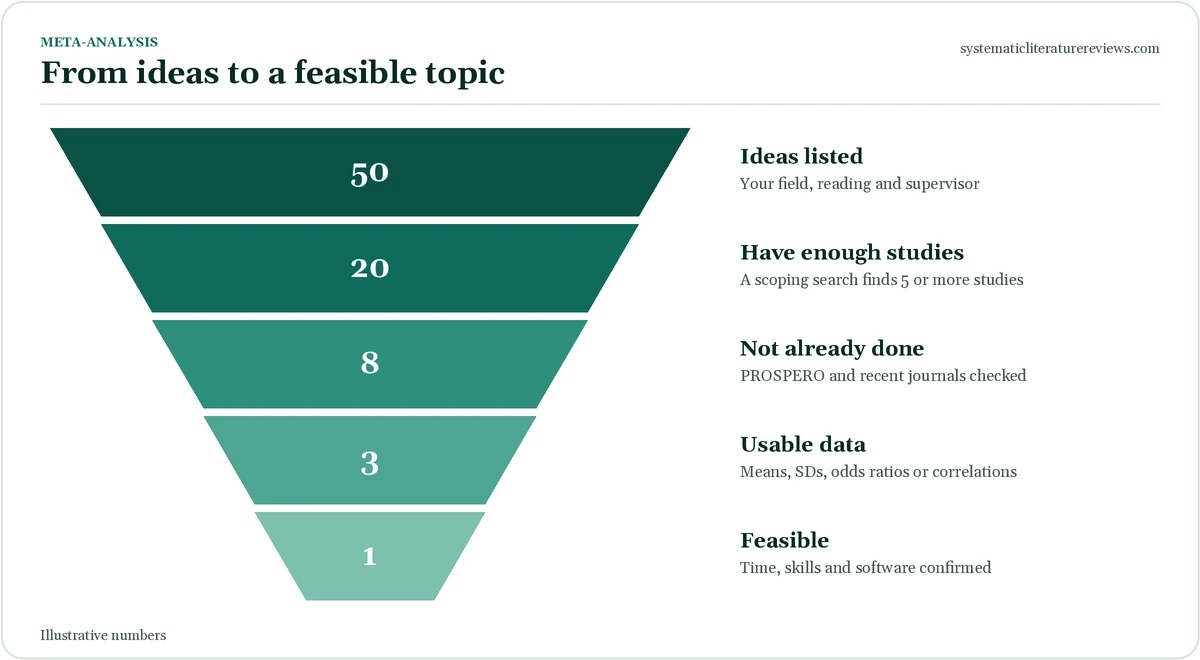
- List ten ideas. Write down topics from your reading, your supervisor and recent reviews. Aim for variety; you will cut most of them. Example: exercise for depression; mindfulness for burnout; sleep hygiene for students.
- Run a scoping search. Search one database for each idea and count the records that look relevant. Fewer than five means the topic is probably too narrow. Example: mindfulness for burnout returns 60 relevant trials.
- Check for existing reviews. Search PROSPERO, the Cochrane Library and journals from the last three years. If a recent review exists, look for a new angle or an update. Example: a 2022 review exists, but not for nurses.
- Check the data. Read ten abstracts and note which statistics are reported. If most give means and standard deviations, you can compute a standardised mean difference. Example: 8 of 10 report means and SDs.
- Define your question. Write it with a framework such as PICO so the criteria are clear. Example: In nurses, what is the effect of mindfulness training compared with no training on burnout?
- Plan the project. Estimate your time, choose software and register the protocol. Example: Three months, R with the metafor package, registered on PROSPERO.
Fifty meta-analysis topics and ideas by field
Each idea names a population, an intervention or exposure and an outcome. Narrow any idea further to suit your resources.
Healthcare and nursing
- Exercise and depression: effect of aerobic exercise on depressive symptoms in adults.
- Mindfulness for burnout: effect of mindfulness training on burnout in nurses.
- Pressure ulcer prevention: effect of repositioning schedules on pressure ulcer incidence.
- Telehealth in chronic disease: effect of telehealth on HbA1c in type 2 diabetes.
- Hand hygiene: effect of education programmes on compliance.
- Pain management: effect of music on postoperative pain.
- Falls prevention: effect of exercise programmes on falls in older adults.
- Smoking cessation: effect of text-message support on quit rates.
- Sleep interventions: effect of cognitive behavioural therapy for insomnia on sleep quality.
- Nurse staffing: association between staffing levels and patient mortality.
Psychology and mental health
- Social media: association between use and adolescent anxiety.
- Psychotherapy: effect of cognitive behavioural therapy on social anxiety.
- Resilience: effect of resilience training on stress.
- Loneliness: effect of befriending on loneliness in older adults.
- Gratitude: effect of gratitude exercises on wellbeing.
- Trauma: effect of EMDR on post-traumatic stress symptoms.
- Parenting: effect of parent-training programmes on child behaviour.
- Sleep and mood: association between sleep duration and depression.
- Therapy delivery: effect of online therapy compared with face to face.
- Stigma: effect of contact-based interventions on mental-health stigma.
Education
- Feedback: effect of formative feedback on attainment.
- Tutoring: effect of tutoring on reading outcomes.
- Flipped classrooms: effect on student performance.
- Technology: effect of tablets on learning in primary schools.
- Teacher training: effect of professional development on teaching quality.
- Homework: effect on achievement by year group.
- Class size: effect on attainment.
- Gamification: effect on motivation.
- Early years: effect of preschool programmes on later outcomes.
- Assessment: effect of self-assessment on learning.
Business and management
- Remote work: effect on productivity.
- Leadership: association between transformational leadership and job satisfaction.
- Diversity: association between board diversity and financial performance.
- Employee training: effect on retention.
- Wellbeing programmes: effect on absence.
- Customer loyalty: effect of loyalty schemes on repeat purchases.
- Social media marketing: effect on brand awareness.
- Ethical climate: association with misconduct.
- Pay transparency: effect on pay gaps.
- Team size: association with performance.
Public health and social care
- Vaccination: effect of reminders on uptake.
- Nutrition: effect of school meal programmes on attendance.
- Physical activity: effect of workplace programmes on sickness absence.
- Housing: effect of housing support on health.
- Cash transfers: effect on child health.
- Alcohol: effect of brief interventions on consumption.
- Screen time: association with child development.
- Carers: effect of respite care on carer burden.
- Handwashing: effect of promotion on diarrhoea in children.
- Air pollution: association with respiratory admissions.
Planning and registering your meta-analysis
Once you have a topic, plan the project before you search.
- Write a protocol: include the question, eligibility criteria, search, data extraction and analysis plan.
- Register it: PROSPERO accepts health-related reviews and the Open Science Framework accepts others.
- Choose software: R with the metafor package, RevMan, Stata or Comprehensive Meta-Analysis.
- Report with PRISMA: follow the PRISMA 2020 checklist and draw a flow diagram.
- Plan the statistics: state your effect size, model (fixed or random), heterogeneity checks and sensitivity analyses.
If you are new to the method, read what meta-analysis is first, and pair it with a clear systematic literature review search. Expert help with search, extraction and analysis is available when you place an order.
The effect size behind each of your meta-analysis topics
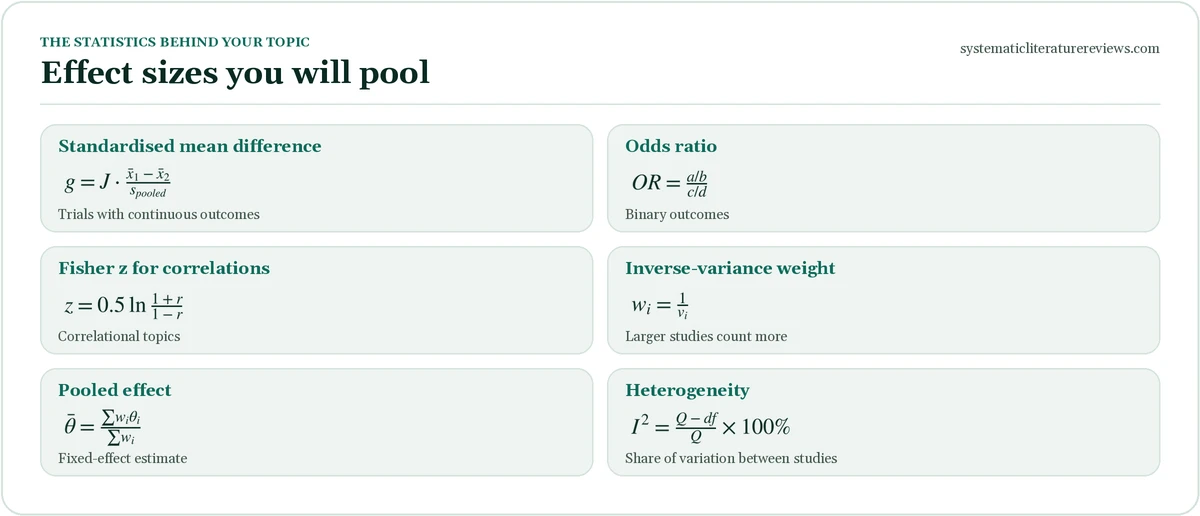
Every meta-analysis pools one effect size. Choose the topic first, then confirm the studies report the numbers you need. The formulas below are the ones you will meet most often.
Before you commit, check that most candidate studies report the inputs for one of these formulas. The Cochrane Handbook explains each calculation, and our guide to the inclusion and exclusion criteria shows how to define comparable studies.
Common mistakes when choosing meta-analysis topics
Avoid the traps below.
- Topic too broad: all interventions for depression yields studies that cannot be pooled. Example: one intervention, one population and one outcome.
- Topic too narrow: fewer than three comparable studies cannot be pooled. Example: relax the population or the setting.
- Duplicating a recent review: your work adds nothing. Example: search PROSPERO and journals for the last three years.
- Ignoring data availability: many papers omit standard deviations or event counts. Example: check ten abstracts for reported statistics.
- Mixing outcomes: combining anxiety scales with sleep scores is not meaningful. Example: one outcome construct per analysis.
Fixed-effect and random-effects models for your meta-analysis topic
Choose the model before you analyse, and explain why.
- Fixed-effect model: assumes one true effect shared by all studies. Example: suitable when studies are near identical.
- Random-effects model: assumes the true effect varies between studies, and estimates that variation as τ². Example: suitable for most real topics, because populations and methods differ.
- Prediction interval: shows the range in which the effect of a new study may fall, which helps readers see heterogeneity.
- Subgroups and meta-regression: explore why results differ, for example by age group or dose.
- Publication bias: inspect a funnel plot and use Egger’s test when you have ten or more studies.
Checking quality and bias in meta-analysis topics
A pooled estimate is only as good as the studies behind it.
- Risk of bias: use a tool such as Cochrane RoB 2 for randomised trials or ROBINS-I for non-randomised studies.
- Sensitivity analysis: repeat the analysis without low-quality studies or outliers and see whether the result changes.
- Selective reporting: compare protocols with published outcomes when possible.
- Certainty of evidence: summarise with the GRADE approach.
- Report: present the results in a forest plot with the pooled estimate and confidence interval.
A worked example: pooling three studies by hand
Seeing the arithmetic once makes software output much easier to understand. The numbers are invented for illustration.
| Study | Effect size g | Variance v | Weight w = 1/v |
|---|---|---|---|
| Study 1 | 0.50 | 0.04 | 25.0 |
| Study 2 | 0.30 | 0.02 | 50.0 |
| Study 3 | 0.70 | 0.08 | 12.5 |
| Total | 87.5 |
- Pooled effect: (25 × 0.50 + 50 × 0.30 + 12.5 × 0.70) / 87.5 = 36.25 / 87.5 = 0.41.
- Standard error: 1 / √87.5 = 0.107.
- 95% confidence interval: 0.41 ± 1.96 × 0.107, which gives 0.20 to 0.62.
- Cochran’s Q: 25 × (0.50 − 0.41)² + 50 × (0.30 − 0.41)² + 12.5 × (0.70 − 0.41)² = 1.86 with 2 degrees of freedom.
- I²: Q is smaller than df, so I² = 0%: little heterogeneity.
- Reading: a small to medium positive effect, estimated precisely enough to exclude zero.
Study 2 has the smallest variance, so it carries the largest weight. This is why a very large study can dominate a pooled result, and why sensitivity analysis matters.
Frequently asked questions about meta-analysis topics
How many studies do I need for a meta-analysis?
Technically two studies can be combined, but most researchers want at least three to five, and ideally ten or more, before the pooled estimate and the heterogeneity statistics become informative. With very few studies, random-effects estimates are imprecise and tests of publication bias have little power. If your scoping search finds fewer than five comparable studies, broaden the population or the outcome slightly, or consider a systematic review with a narrative synthesis instead. Always state the number of studies and the reasons for your choice in the methods section.
Can I do a meta-analysis as a student project?
Yes, many students complete one for a dissertation, provided the topic is small and well defined. Choose an intervention and outcome with a clear literature, extract data in a spreadsheet, and use free software such as R or JASP. A supervisor who knows the statistics is important. Start with a protocol, register it, and keep a log of every decision. If time is short, a systematic review with a narrative synthesis is a respectable alternative, and you can still state that a pooled analysis was not possible because of heterogeneity.
What is the difference between a systematic review and a meta-analysis?
A systematic review is a structured, reproducible search and appraisal of all studies on a question. A meta-analysis is a statistical method that combines numerical results from the studies in a review. Every meta-analysis should sit inside a systematic review, but not every systematic review includes a meta-analysis. When studies are too different in design, population or outcome to combine, authors summarise them in words, tables and themes instead. Your topic should state which you intend to do and why, before the search starts.
Which software is best for meta-analysis?
R with the metafor or meta packages is the most flexible and is free, although it requires some coding. RevMan, from Cochrane, is free and simple for standard intervention reviews. Stata and Comprehensive Meta-Analysis are paid options with menu-driven interfaces. JASP and jamovi offer free point-and-click modules suitable for students. Whatever you choose, keep your data file, code and settings together so that another person could repeat your analysis, and report the software and version in your methods. Many universities also offer free training workshops and licences, so ask your library before you buy anything.
Need expert help? Our experienced writers can handle the search, screening and write-up for you. Place your order in two minutes, or read how a systematic literature review works first.
Systematic Literature Reviews
Need a meta-analysis done right?
Effect sizes, heterogeneity and forest plots, reported to journal standards.