
Research Paper Topics

Choosing from many research paper topics is harder than it looks. A good topic interests you, has enough sources, is narrow enough for the word limit and leaves room for an argument.
This guide lists 40 research paper topics in eight subject areas, gives six steps for choosing and narrowing a topic with an example at every step, shows how to test it and turn it into a thesis statement and lists the mistakes that waste time.
- The ideas: 40 topics across eight subject areas.
- The method: six steps to choose, narrow and test a topic.
- The next step: from topic to thesis statement and common mistakes.
Key takeaways
- Choose a topic that interests you, has enough sources and fits the length of the paper.
- Narrow a broad subject by population, place, time and aspect.
- Test the topic with a quick search and a one-sentence thesis.
- Ask your instructor to approve the topic before you start.
What makes a good research paper topic?
Check each point before you commit.
- Interest: you will work on it for weeks.
- Sources: a quick search finds many scholarly articles.
- Scope: it fits the word limit and the time.
- Argument: it allows more than one position or a question that needs analysis.
- Relevance: it fits the course and the assignment.
- Feasibility: you can access the data or texts you need.
40 research paper topics by subject
Use these research paper topics as starting points and narrow them with the steps below.
Health and nursing
- 1: the effect of nurse staffing levels on patient safety.
- 2: telehealth for managing long-term conditions.
- 3: burnout and retention among nurses.
- 4: mental health support for university students.
- 5: vaccination hesitancy and public trust.
Education
- 6: retrieval practice and exam performance.
- 7: the impact of homework on attainment.
- 8: inclusive education for pupils with special needs.
- 9: artificial intelligence in the classroom.
- 10: online learning and student engagement.
Business and economics
- 11: remote work and productivity.
- 12: corporate social responsibility and brand value.
- 13: the gig economy and worker rights.
- 14: financial technology and inclusion.
- 15: leadership styles and employee engagement.
Psychology and social science
- 16: social media use and adolescent wellbeing.
- 17: sleep and cognitive performance.
- 18: loneliness in older adults.
- 19: bias in hiring decisions.
- 20: the psychology of procrastination.
Technology and computing
- 21: ethics of artificial intelligence.
- 22: cybersecurity awareness training.
- 23: blockchain beyond finance.
- 24: privacy and data protection.
- 25: accessible design for digital services.
Environment and sustainability
- 26: renewable energy adoption in developing countries.
- 27: plastic pollution policy.
- 28: urban green spaces and wellbeing.
- 29: food waste reduction strategies.
- 30: climate adaptation in coastal cities.
Law, politics and history
- 31: freedom of expression online.
- 32: voting rights and turnout.
- 33: the role of international organisations in conflict.
- 34: the industrial revolution and urbanisation.
- 35: women’s suffrage movements.
Literature and media
- 36: representation in children’s literature.
- 37: misinformation and news media.
- 38: the influence of streaming on film.
- 39: translation and cultural meaning.
- 40: the rise of podcasts.
Step-by-step guide to choosing a research paper topic
Follow these six steps. Each has an explanation and an example.
- Read the assignment closely. Note the length, the type of paper, the sources required and any limits on the subject. Example: A 2,500-word argumentative paper on a health topic.
- List your interests. Write a short list of areas you know or want to learn about, and use course readings for ideas. Example: Mental health, technology, young people.
- Do a quick search. Search a database or Google Scholar for each idea and see how many sources exist and what they discuss. Example: Social media and mental health returns many recent studies.
- Narrow by population, place, time and aspect. Add limits until the topic fits the word count. Example: Social media use and sleep in UK university students.
- Turn the topic into a question. Write a question that needs analysis and not only description. Example: Is daily social media use linked to shorter sleep in university students?
- Test and get approval. Check for sources, write a draft thesis and ask your instructor to approve the topic. Example: Thesis: heavy evening use shortens sleep.
How to narrow a broad topic
Broad research paper topics need limits.
| Limit | Broad topic | Narrower topic |
|---|---|---|
| Population | Social media and mental health | Social media and anxiety in adolescent girls |
| Place | Plastic pollution | Plastic pollution policy in the European Union |
| Time | Women’s suffrage | Women’s suffrage in Britain, 1900 to 1918 |
| Aspect | Artificial intelligence in education | Artificial intelligence feedback tools in university writing |
| Method | Remote work | A comparison of productivity studies of remote work |
Test your research paper topic
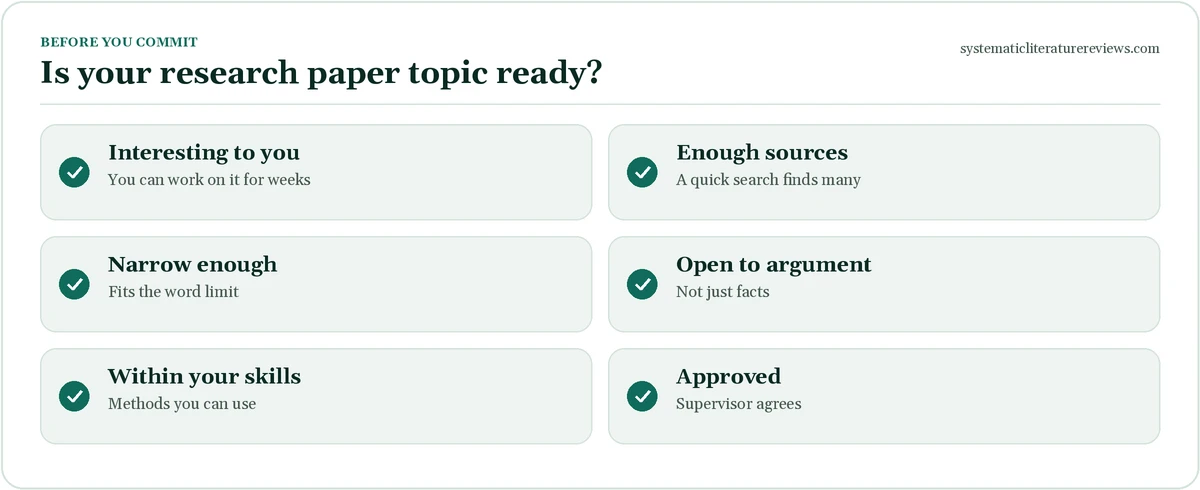
The figure gives a checklist. Use these questions.
- Can I find at least ten good sources: in two or three databases?
- Can I state a thesis in one sentence: that someone could dispute?
- Is it narrow enough: for the word limit?
- Do I have access: to the data, texts or participants?
- Does it meet the assignment: and has my instructor approved it?
From topic to thesis statement
A thesis statement states your position or answer.
| Topic | Weak thesis | Strong thesis |
|---|---|---|
| Sleep and social media | Social media affects sleep. | Heavy evening social media use shortens sleep in university students, so universities should teach digital sleep hygiene. |
| Remote work | Remote work is good. | Remote work raises productivity for tasks that need focus but weakens collaboration unless teams hold regular in-person days. |
| Plastic policy | Plastic is a problem. | Bans on single-use bags reduce litter more than voluntary charges, according to policy evaluations. |
For question models, see sample research questions.
Choosing topics by type of paper
The kind of paper shapes the topic.
| Paper type | Topic should | Example |
|---|---|---|
| Argumentative | Allow a debatable position | Should universities ban laptops in class? |
| Analytical | Break a subject into parts | Causes of nurse turnover |
| Expository | Explain a process or idea | How vaccines are developed |
| Literature review | Have enough studies to synthesise | Mindfulness for student stress |
| Empirical | Allow data collection | A survey of study habits |
For review papers, read how to write a literature review.
Where to find ideas and sources
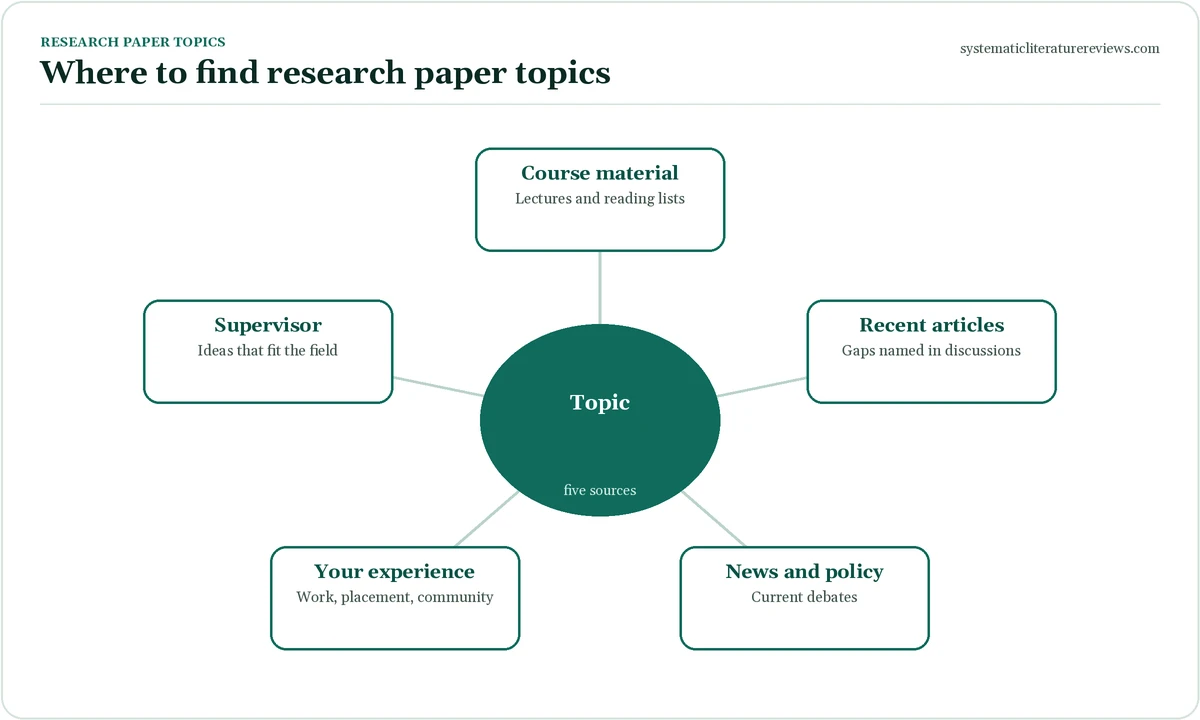
These places give ideas and evidence.
- Course materials: lecture slides and reading lists name key debates.
- Recent journal articles: the discussion section often suggests future research.
- News and policy reports: show current issues.
- Library databases: subject databases list current topics.
- Your own experience: work, placement and community.
- Your instructor: can suggest topics that fit the course.
Current trends that suggest topics
Fast-moving fields give fresh topics.
- Artificial intelligence: uses, risks and regulation.
- Mental health: prevention and access.
- Climate and energy: adaptation and policy.
- Work: remote and flexible patterns.
- Misinformation: media literacy and platforms.
- Health systems: workforce and technology.
Check that enough peer-reviewed sources exist, because new topics may have few.
Common mistakes when choosing research paper topics
Avoid these problems.
- Too broad: you cannot cover it. Example: narrow by population, place or time.
- Too narrow: few sources. Example: widen the scope.
- Only description: no argument. Example: ask a question that needs analysis.
- Choosing too late: you rush the research. Example: pick early.
- Not asking for approval: the topic does not fit. Example: check with your instructor.
If you want support, see our order page. Next, read how to write a research paper.
A worked example: from a broad subject to a thesis
This example follows one subject through the steps.
| Stage | Entry |
|---|---|
| Subject | Mental health |
| Narrowed | Mental health of university students |
| Aspect | The effect of sleep on anxiety in first-year students |
| Question | Is shorter sleep associated with higher anxiety in first-year university students? |
| Thesis | Shorter sleep is associated with higher anxiety in first-year students, so universities should promote sleep education. |
- Sources found: eleven peer-reviewed articles in two databases.
- Approval: instructor approved the topic with advice to focus on UK samples.
Topics that work well for different paper lengths
Match the topic to the length.
| Length | Topic scope | Example |
|---|---|---|
| 1,000 words | One narrow question | Does retrieval practice improve spelling in Year 4? |
| 2,500 words | One question with a few sources | Social media and sleep in students |
| 5,000 words | A broader question with sub-questions | Remote work, productivity and wellbeing |
| 10,000 words or more | A project with data or a review | A systematic review of telehealth for diabetes |
Debatable topics for argumentative papers
These topics have more than one defensible position.
- Education: should homework be banned in primary schools?
- Technology: should social media companies be liable for content?
- Health: should vaccination be mandatory for health workers?
- Work: should the four-day week become standard?
- Environment: should carbon taxes replace subsidies?
Always present the strongest opposing views fairly.
Topics that need data or fieldwork
Empirical papers require data.
- Surveys: topics where you can collect responses ethically.
- Secondary data: public datasets on health, education or economics.
- Interviews: topics with accessible participants.
- Case studies: one organisation or programme.
- Check ethics: approval may be needed before collecting data.
Examples of narrowing in different subjects
See how the same method works in other fields.
| Broad | Narrower | Question |
|---|---|---|
| Climate change | Coastal flooding in Bangladesh | How have households adapted to coastal flooding in Bangladesh since 2010? |
| Artificial intelligence | AI feedback in university writing | Does AI-generated feedback improve first-year essay quality? |
| Nursing | Nurse retention in intensive care | What factors predict intention to leave among intensive care nurses? |
| Business | Small business marketing | How do small cafés use social media to attract customers? |
From topic to a research plan
After you choose a topic, plan the next steps.
- Write the question and thesis: in one or two sentences.
- List key terms: for your search.
- Plan the search: see the literature search strategy guide.
- Draft an outline: and a word budget.
- Set deadlines: for research, drafting and editing.
Tips for sticking with your topic
These habits keep a project on track.
- Keep a research journal: record ideas and sources.
- Set small goals: a few sources per day.
- Talk to others: a friend or tutor can help refine your argument.
- Be flexible: small changes are normal as you read.
Finding more research paper topics
For more research paper topics, search Google Scholar for review articles on your subject and read their suggestions for future research. Your library’s subject guides also list research paper topics by course.
- Browse review articles: they summarise current debates.
- Check course reading lists: they hold many research paper topics.
- Ask a librarian: for subject guides.
Research paper topics: how to know when you have enough
Good research paper topics produce at least ten useful sources. If you cannot find that many, adjust the focus before you write.
- Too few sources: widen the scope.
- Too many sources: narrow the focus.
- Just right: a manageable set of high-quality sources.
Frequently asked questions about research paper topics
How do I choose a research paper topic?
Start by reading the assignment so that you know the length, type and limits. List subjects that interest you, do a quick search for each to see how many scholarly sources exist and narrow the best one by population, place, time or aspect. Turn it into a question that needs analysis, and write a one-sentence thesis to test it. Finally, check that you can find enough sources and ask your instructor to approve the topic. Choosing a topic early gives you more time for research and writing.
How narrow should a research paper topic be?
The topic should be narrow enough to cover in your word limit with some depth, but broad enough to find at least ten good sources. As a rough guide, a 2,000-word paper can handle one focused question, such as social media use and sleep in university students, while a topic like social media and mental health is too broad for that length. If you find too many sources, add limits for population, place or time. If you find too few, widen the scope or change the angle.
What makes a topic good for an argumentative paper?
A good argumentative topic allows a position that reasonable people could dispute, and has evidence on more than one side. A topic with only facts, such as the date of an event, does not need an argument, and a topic with only opinions is hard to support with scholarly evidence. Test it by writing a thesis statement that someone could disagree with, and check that you can find studies, data or texts that support your position and address the strongest opposing views.
Can I change my research paper topic after I start?
You can, but do it early and tell your instructor. Changing late costs time, because you must find new sources and rewrite the outline. Small changes, such as narrowing the focus or adjusting the question as you read, are normal and often improve a paper. If you cannot find enough good sources, or the evidence points in a different direction, it is better to refine the topic than to force the paper into the original plan. Keep notes on why you changed it, in case you need to explain it.
Need expert help? Our experienced writers can handle the search, screening and write-up for you. Place your order in two minutes, or read how a systematic literature review works first.
Systematic Literature Reviews
Need help with your systematic review?
Get PRISMA-aligned searching, screening, appraisal and synthesis from experienced review writers.