
Blog
How to Conduct Phenomenological Research Design.

What is Phenomenological Research Design in Qualitative Research Designs?
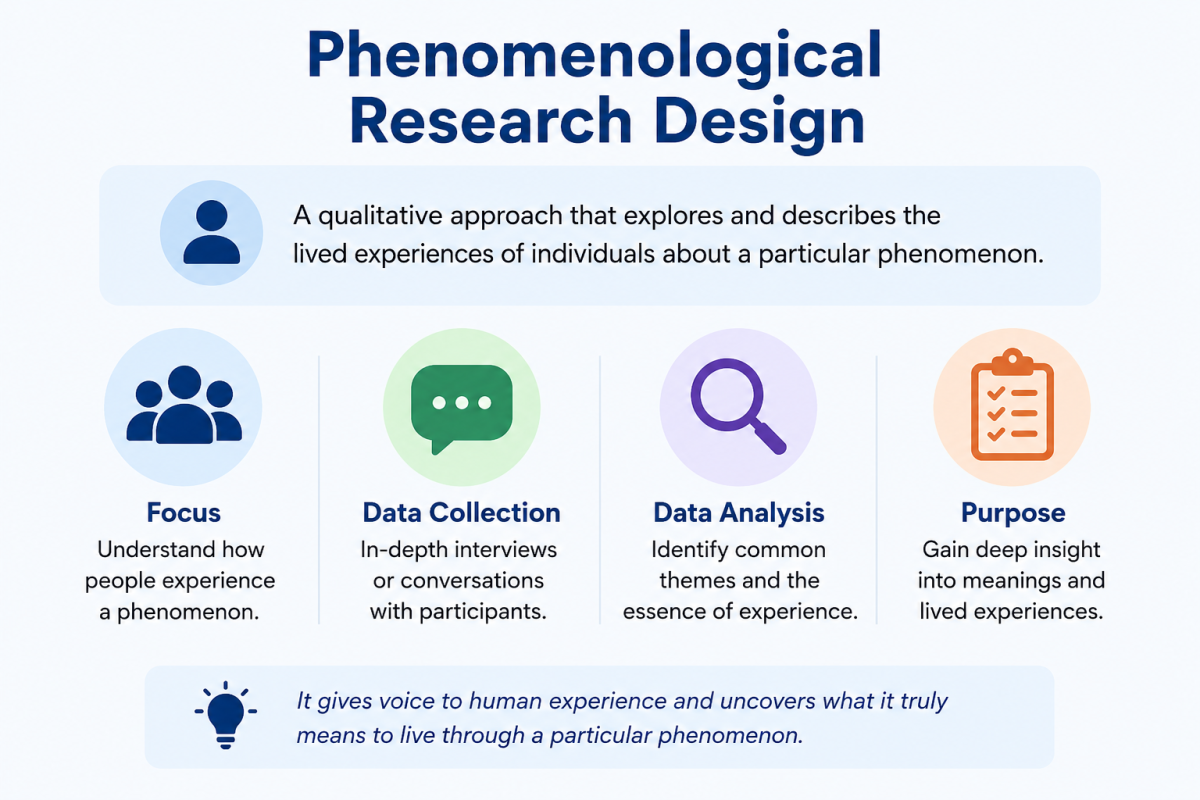
- Phenomenological research design is a qualitative research approach that seeks to understand and describe the lived experience of individuals who have gone through a particular phenomenon. Rather than measuring variables or testing hypotheses, this research method focuses on uncovering the essence of a phenomenon as it is consciously experienced by the people who lived it.
- At its core, phenomenology is a qualitative research approach that seeks to answer the question: “What is this experience like for the people who lived it?” It does not try to explain causes or predict outcomes; instead, it aims to capture the meaning and structure of human experience in as much depth as possible.
- Phenomenological research is a qualitative research method that sits alongside other qualitative research approaches such as case study research, narrative research, and grounded theory. However, what sets it apart is its exclusive focus on lived experience and consciousness, rather than processes, cultures, or timelines.
- In qualitative research designs, this approach is often chosen when a researcher wants to explore a topic that is deeply personal, subjective, or difficult to quantify — such as grief, chronic illness, trauma, career transitions, or spiritual experiences. Because these topics resist numerical measurement, a qualitative approach grounded in phenomenology allows richer, more nuanced insight.
- Phenomenological studies typically involve small, purposefully selected samples of participants who have direct experience with the phenomenon under investigation. The goal is not statistical generalizability but depth of understanding — a hallmark of most qualitative research methods.
- There are two broad traditions within phenomenological research design: descriptive phenomenology (associated with Husserl) and interpretive phenomenology, also called hermeneutic phenomenology (associated with Heidegger and later developed by scholars like van Manen). Descriptive phenomenology focuses on describing experiences as they are, while interpretive phenomenology acknowledges that the researcher inevitably interprets participants’ experiences through their own lens.
- A well-known method within this space is interpretative phenomenological analysis (IPA), which is widely used in psychology and health-related qualitative studies. IPA combines detailed description with interpretation, making it both descriptive and interpretive in nature.
- Ultimately, this research method is valuable because it gives voice to human experience in a way that surveys or experiments cannot. It allows the researcher to sit with complexity, ambiguity, and subjectivity — honoring the richness of what it truly means to experience something as a human being.
Philosophical Assumptions of The Phenomenological Research Design
- Every research design is built on philosophical assumptions, and phenomenological research is no exception. Understanding these assumptions helps a researcher choose the right research approaches and justify their research methodology to reviewers, supervisors, or ethics boards.
- Ontological assumption: Phenomenology assumes that reality is subjective and multiple — meaning there is no single objective truth about an experience. Instead, each participant’s account represents their own valid version of reality. This assumption is foundational to phenomenological research design, as it shapes how the researcher collects and interprets qualitative data.
- Epistemological assumption: Knowledge, in phenomenology, is co-constructed between the researcher and the participant. The role of the researcher is not to remain distant and neutral (as in positivist research) but to engage closely with participants to uncover deep, meaningful understanding of their experiences.
- Assumptions about the phenomenon: A phenomenological approach assumes that a phenomenon has an “essence” — a core structure of meaning that is common across different people’s experiences of it, even though each individual experience is unique. Identifying this essence of the phenomenon is often the central goal of the research study.
- Axiological assumption: Phenomenology assumes that the researcher’s values, background, and personal experiences inevitably influence the research process. In descriptive phenomenology, researchers attempt to set aside (or “bracket”) their assumptions through a process called phenomenological reduction. In interpretive phenomenology, researchers accept that complete objectivity is impossible and instead reflect openly on how their perspective shapes the findings of the study.
- Rhetorical assumption: Phenomenological research studies are typically written in a personal, narrative, first-person style rather than the detached, formal tone found in quantitative research. This rhetorical choice reflects the qualitative research approach that seeks to preserve the voice and emotional texture of participants’ lived experiences.
- Methodological assumption: Phenomenology assumes an inductive, flexible, and evolving research process. Unlike quantitative designs, questions and interpretations may shift as the researcher gains deeper insight during data collection and data analysis.
- Understanding the difference between hermeneutic phenomenology and phenomenology in its descriptive form is essential here. Descriptive phenomenology assumes that pure description of experience is possible if bias is bracketed; hermeneutic phenomenology assumes that all understanding is inherently interpretive, since researchers cannot fully separate themselves from their own historical and cultural context.
- These philosophical foundations matter because they directly influence the research strategy, the research question being asked, and the criteria used to judge the quality and rigor of the final research project.
How To Conduct a Phenomenological Research Design In 4 Easy Steps?
Conducting phenomenological research studies well requires a structured yet flexible process. Below are four essential steps for conducting phenomenological research:
Step 1: Identify the Phenomenon and Formulate the Research Question
- Begin by clearly identifying the phenomenon you want to study. This should be a specific, meaningful human experience — such as living with a chronic illness, transitioning into parenthood, or coping with job loss.
- Your research question should be open-ended and exploratory, typically starting with “What is the lived experience of…?” or “How do individuals experience…?”
- At this stage, decide whether you will use a descriptive phenomenological approach or an interpretive phenomenological approach, since this decision will shape every subsequent step of your research process.
- Conduct a literature review to understand existing phenomenological research studies on similar topics, which helps refine your focus and justify the significance of your research study.
Step 2: Select Participants and Plan Data Collection
- Choose participants using purposeful sampling — individuals must have direct, first-hand experience of the phenomenon being studied. Sample sizes in phenomenological studies are typically small, often between 5 and 15 participants, since the goal is depth rather than breadth.
- The most common data collection methods in phenomenological research are in-depth, semi-structured phenomenological interviews. These interviews use open-ended questions designed to encourage participants to describe their experiences in rich detail.
- Other collection methods in phenomenological research may include written reflections, journals, observations, or focus groups, though interviews remain the gold standard.
- Before collecting data, descriptive phenomenologists often engage in phenomenological reduction — consciously setting aside preconceptions to approach the interviews with openness. Interpretive researchers instead keep a reflexive journal to track how their own perspective might shape the conversation.
Step 3: Analyze the Data
- Qualitative data analysis in phenomenology involves several structured steps: transcribing interviews verbatim, reading and re-reading transcripts for familiarity, and identifying significant statements related to the phenomenon.
- These significant statements are then clustered into themes, which are further synthesized into a description of the essence of a phenomenon — capturing what is common across all participants’ experiences.
- If using interpretative phenomenological analysis, the researcher moves beyond description into interpretation, considering not just what participants say, but what it might mean in a broader psychological or social context.
- Methods in phenomenological data analysis, such as those developed by Colaizzi, Moustakas, or van Manen, provide step-by-step frameworks that increase the rigor and credibility of the research findings.
Step 4: Write Up and Validate the Findings
- The final step in phenomenological research and writing is presenting findings in a way that honors participants’ voices — often using direct quotations alongside thematic descriptions.
- Findings should clearly answer the research question and articulate the essence of the phenomenon, supported directly by phenomenological data gathered during interviews.
- Validation techniques such as member checking (returning findings to participants to confirm accuracy) and peer debriefing strengthen the trustworthiness of the research study.
- Finally, researchers should reflect on the limitations of phenomenological research design, including small sample sizes and researcher subjectivity, to provide a balanced, transparent account of the research project.
What are the Advantages and Disadvantages of Phenomenological Research Design in Qualitative Research Designs?
Advantages of Phenomenological Research Design
- Deep insight into human experience: This research method allows researchers to explore the essence of the phenomenon in ways that surveys and experiments cannot, offering rich, textured understanding of participants’ lived experiences.
- Gives voice to marginalized or under-researched experiences: Because phenomenological research design centers participants’ experiences directly, it is particularly powerful for exploring topics that are emotionally complex or historically overlooked, such as illness, trauma, or identity.
- Flexible and adaptable: Unlike rigid quantitative designs, this qualitative approach can evolve as new insights emerge during data collection, allowing researchers to follow unexpected but meaningful threads.
- Strong fit for exploratory research questions: When little is known about a topic, phenomenological research is particularly useful for generating foundational understanding that can inform future, larger-scale qualitative research methods or even quantitative studies.
- Widely applicable across disciplines: This phenomenological approach is used extensively in health professions education, nursing, psychological research, education, and social sciences, demonstrating its versatility as a research method.
- Encourages reflexivity and rigor: Especially within hermeneutic phenomenology, researchers are required to critically reflect on their own assumptions, which can lead to more thoughtful, self-aware qualitative research.
- Produces rich, detailed qualitative data: Because it relies on in-depth interviews and reflection, phenomenological research generates thick, descriptive data that captures nuance often lost in numerical research.
- Supports interdisciplinary dialogue: Findings from phenomenological research studies often resonate across disciplines, since human experiences like grief, resilience, or uncertainty are universally relevant.
Disadvantages of Phenomenological Research Design
- Small sample sizes limit generalizability: Because phenomenological studies rely on small, purposefully selected samples, findings cannot be statistically generalized to broader populations — a key limitation compared to quantitative research.
- Researcher subjectivity and bias: The role of the researcher is central to phenomenology, but this also introduces risk. Even with phenomenological reduction, complete objectivity is arguably impossible, especially within interpretive phenomenology.
- Time-intensive process: Conducting phenomenological interviews, transcribing data, and performing thorough qualitative data analysis is far more time-consuming than distributing a quantitative survey.
- Requires skilled interviewing technique: Poorly conducted interviews can fail to elicit the depth of reflection needed to uncover the essence of a phenomenon, making researcher training and experience essential.
- Difficulty achieving true “bracketing”: Descriptive phenomenology asks researchers to set aside prior knowledge and assumptions, but critics argue this is nearly impossible to achieve fully, raising ongoing debate about considerations in phenomenological research.
- Findings can be difficult to validate: Unlike quantitative research methods with statistical tests, phenomenological research findings depend on interpretive judgment, which can make replication and validation more challenging.
- Risk of over-interpretation: In interpretive phenomenological research, particularly using interpretative phenomenological analysis, there is a risk that researchers project meaning onto participants’ words rather than accurately representing their experience.
- Limited use for testing causal relationships: Because this qualitative methodology is descriptive and exploratory by nature, it is not appropriate for research questions that require testing cause-and-effect relationships or measuring outcomes — for that, other appropriate qualitative or quantitative designs are better suited.
- Despite these limitations, when applied thoughtfully with clear methodological approaches of phenomenology, this research design remains one of the most powerful tools available for understanding human experience in depth.
Examples of Phenomenological Research Design
- Living with chronic illness: A classic example of descriptive phenomenological research involves exploring how patients experience life with conditions such as diabetes, cancer, or chronic pain. Researchers in qualitative health research often use phenomenological interviews to understand how illness reshapes patients’ identity, daily routines, and sense of control.
- Nursing and health professions education: Phenomenology is widely used within health professions education to explore how nursing students experience clinical placements for the first time, or how healthcare workers experience burnout. These phenomenological research studies help institutions design better training and support systems.
- Grief and bereavement: Using hermeneutic phenomenology to investigate the experience of losing a loved one is common in psychology and social work research. This interpretive approach allows researchers to explore not just what grief feels like, but how it is shaped by culture, relationships, and personal history.
- Career transitions: Researchers studying qualitative research in psychology often apply phenomenology to understand experiences like retirement, career change, or job loss, capturing the emotional and identity-related dimensions that quantitative surveys tend to miss.
- Trauma and resilience: Interpretive phenomenological analysis is frequently used to study survivors of trauma, such as combat veterans or survivors of natural disasters, focusing on how individuals make meaning of adversity and rebuild a sense of self.
- Educational experiences: A phenomenological research design might explore how first-generation college students experience the transition into higher education, using in-depth interviews to surface challenges and support systems that shape their success.
- Parenthood and caregiving: Studies frequently use this phenomenological research approach to explore the lived experience of becoming a parent, or of caregiving for a family member with dementia, highlighting the emotional complexity behind these universal human roles.
- Workplace and organizational studies: Phenomenology can also be applied in organizational contexts, such as exploring employees’ lived experience of remote work, leadership transitions, or workplace discrimination — demonstrating that using phenomenological research extends well beyond healthcare and psychology.
- These examples illustrate why phenomenological research is particularly valuable: it addresses research questions that are deeply human, emotionally layered, and resistant to simple measurement. Whether guided by descriptive or interpretive traditions, or grounded in the influential work of hermeneutic phenomenology developed by scholars like van Manen, this research method continues to offer some of the richest insight available within qualitative research methodologies today.
