
Phenomenological Research Questions

Phenomenological research questions explore what an experience is like for the people who have lived it. They do not ask what caused something or how many people did it. Instead they ask for rich descriptions, so that the researcher can understand the meaning and the essence of a lived experience.
This guide explains how the approach shapes your wording, gives six steps with an example at every step, lists 25 example questions by field, and shows how to write sub-questions and avoid common mistakes.
- The approaches: how descriptive, hermeneutic and IPA traditions shape the question.
- The method: six steps for writing a central question and sub-questions.
- The examples: 25 questions by field, with weak and strong wording.
On this page
- What are phenomenological research questions?
- How the phenomenological approach shapes the question
- Step-by-step guide to writing phenomenological research questions
- 25 phenomenological research questions by field
- Weak and strong phenomenological research questions
- Checking your phenomenological research questions
- Frequently asked questions about phenomenological research questions
Key takeaways
- Phenomenological research questions ask what an experience is like, not what caused it.
- Name the participants and the phenomenon they have lived.
- Avoid why, effect of and yes or no wording.
- Match the wording to your approach and sampling.
What are phenomenological research questions?
They are open questions about a lived experience.
- Focus: the meaning of an experience as the participants describe it.
- Participants: people who have lived the phenomenon, usually 5 to 25.
- Data: in-depth interviews, often with open prompts.
- Outcome: a description of the essence or themes of the experience.
- Not asked: causes, effects, comparisons or numbers.
How the phenomenological approach shapes the question
Three traditions are common. Each phrases its central question differently. For background on the philosophy, see the Stanford Encyclopedia of Philosophy entry on phenomenology.
- Descriptive (Husserlian): describes the experience as lived, setting aside the researcher’s assumptions. Example: what is the lived experience of nurses caring for a dying patient?
- Hermeneutic (Heideggerian, van Manen): interprets the meaning of the experience in its context. Example: what is it like to return to work after a stroke?
- Interpretative phenomenological analysis (IPA): examines how individuals make sense of a significant life event. Example: how do first-time mothers make sense of postnatal depression?
Step-by-step guide to writing phenomenological research questions
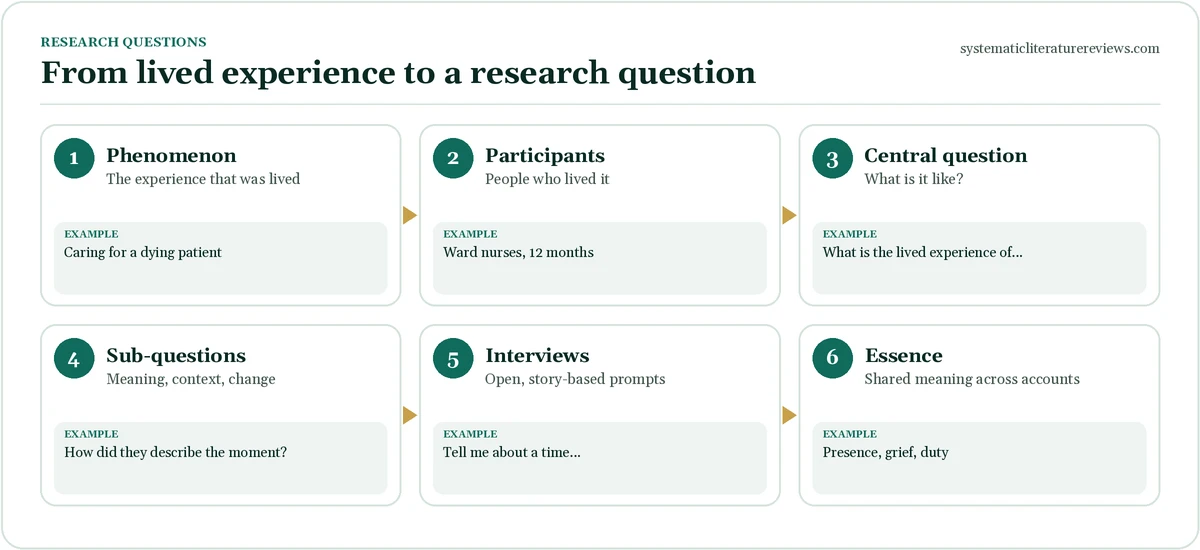
Follow these six steps. Each has an explanation and an example.
- Name the phenomenon. Choose the one experience you want to understand and write it as a noun phrase, not a cause or an outcome. Example: Caring for a dying patient.
- Identify the participants. State who has lived it, because the experience belongs to them and shapes the sample. Example: Ward nurses with at least one year of experience.
- Write the central question. Use what is the lived experience of or what is it like to, and keep it open. Example: What is the lived experience of ward nurses caring for a dying patient?
- Add two to four sub-questions. Break the central question into aspects such as meaning, context and change, each still open. Example: How did nurses describe the moment of death? What made the care easier or harder?
- Plan interview prompts. Prepare open, story-based prompts that invite description. Example: Tell me about a time you cared for a patient who was dying.
- Check with the approach and your supervisor. Confirm the wording fits the tradition you chose and does not hide cause, comparison or numbers. Example: Replace why nurses leave with how nurses experience leaving.
25 phenomenological research questions by field
Use these as models and adapt them to your own phenomenon.
Nursing and healthcare
- Q1: what is the lived experience of patients undergoing chemotherapy?
- Q2: what is it like for nurses to care for a patient who is dying?
- Q3: how do family carers experience a relative’s dementia diagnosis?
- Q4: what is the experience of living with chronic pain?
- Q5: how do new mothers experience breastfeeding in the first month?
Education
- Q6: how do students experience learning online?
- Q7: what is the lived experience of first-generation university students?
- Q8: how do teachers experience a change in curriculum?
- Q9: what is it like to return to study as a mature student?
- Q10: how do students with dyslexia experience assessment?
Mental health and social care
- Q11: what is the lived experience of recovery from addiction?
- Q12: how do young people experience being in foster care?
- Q13: what is it like to live with anxiety at work?
- Q14: how do refugees experience the first year of resettlement?
- Q15: what is the experience of isolation for family carers?
Business and management
- Q16: how do middle managers experience restructuring?
- Q17: what is the lived experience of remote workers?
- Q18: how do employees experience redundancy?
- Q19: what is it like to start a business after a career break?
- Q20: how do women leaders experience the glass ceiling?
Other fields
- Q21: what is the lived experience of athletes returning after serious injury?
- Q22: how do teachers experience teaching in a second language?
- Q23: what is it like to be a first-time homeowner?
- Q24: how do volunteers experience working in disaster relief?
- Q25: what is the experience of migrating for work?
Weak and strong phenomenological research questions
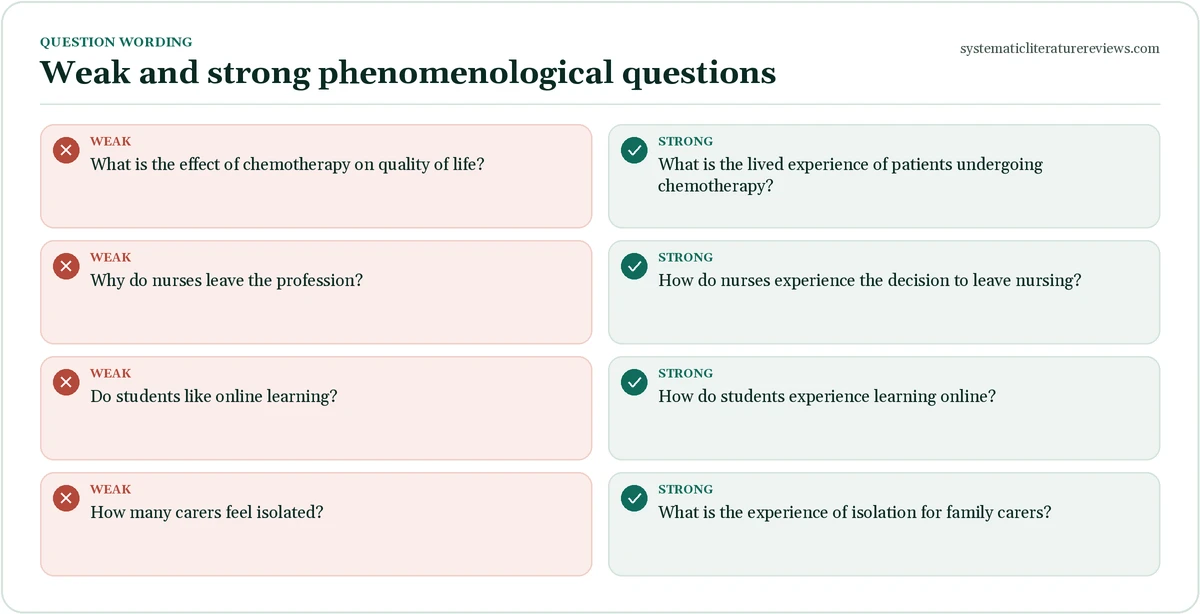
The figure above compares weak and strong wording. Use the rules below to convert yours.
- Avoid why: why questions ask for causes. Example: replace why nurses leave with how nurses experience the decision to leave.
- Avoid effect of: effect questions ask for cause and effect. Example: replace effect of chemotherapy on quality of life with the lived experience of chemotherapy.
- Avoid yes or no: closed questions end the story. Example: ask what it was like.
- Avoid how many: counts belong to quantitative research. Example: ask how participants describe it.
- Keep it open and short: one sentence, one phenomenon.
Checking your phenomenological research questions
Use these checks before you submit your proposal.
- Is it about an experience: not an opinion or a process.
- Are participants who lived it named: not just anyone.
- Does it fit your approach: descriptive, hermeneutic or IPA.
- Is it open: no yes or no answers.
- Is it ethical: sensitive topics need careful prompts and support.
Related guides: grounded theory research questions and ethnographic research questions.
Central questions and sub-questions side by side
The examples show how a central question breaks into open sub-questions.
| Phenomenon | Central question | Sub-questions |
|---|---|---|
| Dementia caregiving | What is the lived experience of family members caring for a relative with dementia? | How do carers describe daily life? What changes in relationships do they notice? |
| Online learning | How do university students experience learning online? | What helps or hinders them? How do they describe belonging? |
| Redundancy | What is the experience of employees who have been made redundant? | How did they describe the first week? What meaning did they give to work afterwards? |
Interview prompts that fit phenomenological research questions
The prompts invite stories and avoid leading words.
- Opening: tell me about a time when you experienced this.
- Description: what was it like for you in that moment?
- Feelings and body: what did you notice in yourself as it was happening?
- Meaning: what did that experience mean to you?
- Probe: can you say a little more about that, or give an example?
- Closing: is there anything else about the experience you would like to add?
From question to analysis: how the approach guides your method
Your question should lead naturally to a method of analysis.
- Descriptive: steps such as Colaizzi’s read transcripts, extract significant statements, formulate meanings, cluster themes and describe the essence.
- Hermeneutic: van Manen’s approach moves between parts and whole, reading for themes in the lived experience.
- IPA: analyses each case in detail before comparing across cases.
- Rigour: keep a reflexive journal, check findings with participants and report your decisions.
Match the choice to your question in your methodology chapter.
Ethics and sampling for phenomenological studies
Because participants share personal stories, plan carefully.
- Purposive sampling: recruit people who have lived the phenomenon.
- Informed consent: explain the topic, the time needed and the right to stop.
- Support: provide contacts for support where the topic is distressing.
- Confidentiality: use pseudonyms and store recordings securely.
- Ethics approval: submit your questions and prompts with your application.
Common mistakes with phenomenological research questions
Check your draft against this list.
- Starting with a hypothesis: phenomenology does not test predictions. Example: start with a phenomenon.
- Using the wrong participants: people who have not lived the experience cannot describe it. Example: define who counts as having lived it.
- Hiding a comparison: nurses and doctors need a comparative design. Example: study one group, or choose another approach.
- Closed prompts: yes or no questions end the story. Example: use open, story-based prompts.
- Ignoring your own assumptions: your views can shape the results. Example: keep a reflexive journal.
Turning a topic into a phenomenological research question: one full example
The sequence below shows a topic becoming a question.
- Topic: new graduates and workplace stress.
- Phenomenon: the experience of starting a first nursing job.
- Participants: nurses in their first year after qualifying.
- Weak version: what causes stress in new nurses?
- Strong version: what is the lived experience of newly qualified nurses starting their first job?
- Sub-questions: how do they describe the first week? What supports or challenges them? What does the role mean to them?
Reflexivity and bracketing in phenomenological research
Your own views can shape how you ask and interpret.
- Bracketing: set aside assumptions in descriptive phenomenology. Example: write down what you expect before interviews.
- Reflexivity: in hermeneutic work, acknowledge your role and perspective.
- Reflexive journal: record decisions and reactions after each interview.
- Report it: explain in your methods how you managed your influence.
Common questions about wording phenomenological research questions
These short answers help you finish your wording.
- Can I use the word experience: yes, it is the core of the approach.
- Can I name a condition: yes, the phenomenon may be a condition, role or event. Example: living with chronic pain.
- Can I add context: yes, add place or time lightly. Example: in the first year after diagnosis.
- Should I use the word essence: only if your approach is descriptive phenomenology.
A walk-through: from phenomenological research questions to the whole design
The questions you write drive every later decision. This example shows the chain for one study.
- Topic: nurses and end-of-life care.
- Central question: what is the lived experience of ward nurses caring for a dying patient?
- Sub-questions: how do nurses describe the moment of death? What makes the care easier or harder? What does the care mean to them?
- Approach: descriptive phenomenology, so the researcher sets aside assumptions and describes the experience as lived.
- Participants: 10 to 15 ward nurses with at least one year of experience who have cared for a dying patient.
- Data: one in-depth interview of 45 to 60 minutes each, audio-recorded and transcribed.
- Analysis: read transcripts, extract significant statements, formulate meanings, cluster themes and write the essence of the experience.
- Trustworthiness: credibility through member checking, dependability through an audit trail, confirmability through a reflexive journal, and transferability through rich description.
If a part of the design cannot be traced back to the question, either the question or the design needs to change.
Frequently asked questions about phenomenological research questions
How many phenomenological research questions do I need?
Most studies have one central question and two to four sub-questions. The central question captures the lived experience as a whole, for example what is the lived experience of ward nurses caring for a dying patient. Sub-questions explore aspects such as meaning, context and change. If you have more than five, you may be trying to answer too much, or some of your questions may be interview prompts rather than research questions. Keep the central question open and short, and move detailed prompts to your interview guide.
Can phenomenological research questions start with why?
It is best to avoid why. Why questions ask for causes and explanations, which move the study towards cause and effect and away from description of lived experience. They can also feel judgemental in an interview. Rewrite them as how or what questions: instead of why do nurses leave, ask how nurses experience the decision to leave nursing. The answer will still tell you about reasons, but in the participants’ own words and with their own meanings, which is the purpose of a phenomenological study.
How many participants do I need for a phenomenological study?
Phenomenological studies use small, purposive samples because the aim is depth, not generalisation. Many descriptive studies recruit 5 to 25 participants who have all lived the phenomenon, while IPA studies often use fewer, sometimes 3 to 10, because each case is analysed in great detail. The right number depends on how rich the interviews are and when new accounts stop adding new meaning. State your sampling logic in the methods section and discuss it with your supervisor and ethics committee before you recruit.
What is the difference between phenomenological and grounded theory questions?
Phenomenological questions ask what an experience is like and aim to describe its essence or meaning, for example what is it like to live with chronic pain. Grounded theory questions ask how a process happens and aim to build a theory, for example how do people manage chronic pain over time. Phenomenology stays close to individual accounts of an experience, while grounded theory moves from the data to a model of a process. Choose the approach that fits your aim, and match the wording of your question to it.
Need expert help? Our experienced writers can handle the search, screening and write-up for you. Place your order in two minutes, or read how a systematic literature review works first.
Systematic Literature Reviews
Need strong research questions?
Research questions that fit your method and can be answered with your data.