
Blog
How To Write Grounded Theory Research Questions

What Are Grounded Theory Research Questions? Definition, Purpose, and Role in Grounded Theory Research
Definition of Grounded Theory Research Questions
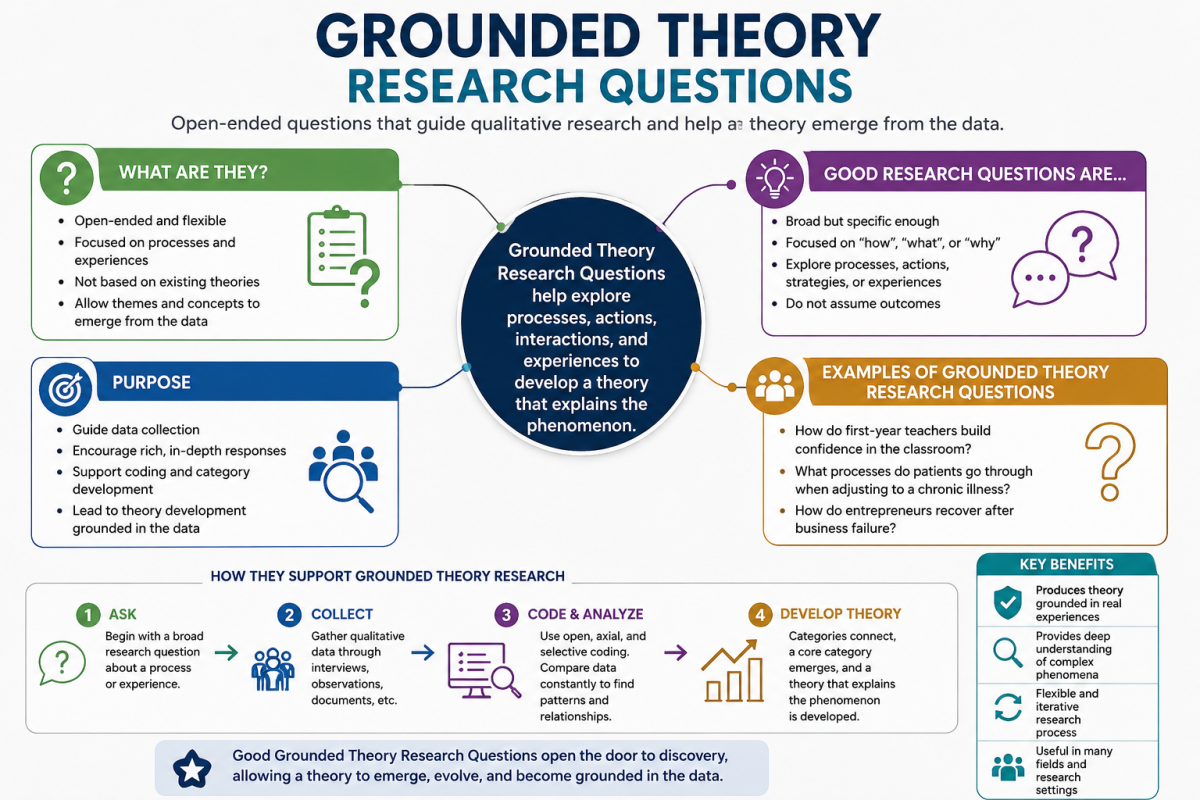
- Grounded Theory Research Questions are open-ended questions designed to explore social processes, behaviors, actions, interactions, or experiences without beginning with a predetermined theory.
- They are a central component of grounded theory research, a qualitative research methodology focused on generating a theory from data rather than testing existing theories.
- Unlike traditional research that often starts with a hypothesis, grounded theory studies begin with broad areas of interest and allow explanations to emerge from the data.
- The purpose is to collect rich qualitative data that helps the researcher identify patterns, relationships, and processes that lead to theory development.
- A grounded theorist seeks to understand how people interpret their experiences and how those experiences influence behavior in real-world settings.
- Through systematic data collection and analysis, researchers gradually develop a theory that explains what is happening in a particular context.
Overview of Grounded Theory
- Grounded theory was introduced through the discovery of grounded theory by Barney Glaser and Anselm Strauss in 1967.
- The methodology emerged as an alternative to research approaches that relied heavily on pre-existing theoretical assumptions.
- The goal of grounded theory is to generate theory that is firmly grounded in the data collected from participants.
- Rather than forcing findings into existing theories, grounded theory researchers allow concepts, categories, and relationships to emerge naturally.
- The theory evolves throughout the research process as new information becomes available.
- The final grounded theory becomes an explanatory theory that accounts for observed behaviors and experiences.
Purpose of Grounded Theory Research Questions
Grounded Theory Research Questions serve several important purposes:
1. Guide Data Collection
- They help focus interviews, observations, documents, and other qualitative methods.
- They direct the researcher toward meaningful experiences without restricting discovery.
- They provide enough structure to guide data collection and analysis while remaining flexible.
2. Support Theory Development
- The primary objective is developing a theory that explains a social phenomenon.
- Researchers use grounded theory to discover processes and relationships that may not have been previously identified.
- The resulting theory from data reflects participants’ realities rather than assumptions imposed by researchers.
3. Encourage Discovery
- Grounded theory questions support exploration rather than confirmation.
- They allow new theories and unexpected findings to emerge from the data.
- This flexibility is one reason many researchers use grounded theory in emerging fields.
4. Facilitate Qualitative Analysis
- The questions generate detailed qualitative data suitable for qualitative data analysis.
- Rich responses help researchers identify codes and categories.
- These categories eventually contribute to theory building and developing grounded theory.
Characteristics of Strong Grounded Theory Research Questions
A strong research question should:
- Be broad enough to allow discovery.
- Focus on processes, actions, and interactions.
- Avoid assumptions about outcomes.
- Encourage participants to share experiences.
- Support theory building rather than hypothesis testing.
- Allow a theory that explains the data to emerge.
- Align with grounded theory methods and grounded theory procedures.
Role of Grounded Theory Research Questions in the Research Process
- They act as the foundation of the entire research design.
- They guide data collection and analysis activities.
- They shape interview questions and observation strategies.
- They help identify core categories during analysis.
- They support the constant comparative method used throughout the study.
- They assist in constructing grounded theory from raw data.
- They contribute directly to developing a theory that explains the phenomenon under investigation.
How To Write Grounded Theory Research Questions: A 4-Step Process for Qualitative Research, Data Analysis, Coding, and Theory Development
Step 1: Identify the Phenomenon or Process You Want to Explore
What This Step Involves
- Begin by identifying a broad topic or issue.
- Focus on a process rather than a simple description.
- Think about actions, interactions, decision-making, adaptation, or behavior.
Questions to Ask Yourself
- What social process interests me?
- What behavior needs explanation?
- What phenomenon lacks a clear explanatory theory?
- Where might theory emerge from participant experiences?
Examples
- How do first-year university students adapt to online learning?
- How do remote employees manage workplace isolation?
- How do entrepreneurs recover after business failure?
Why This Step Matters
- Grounded theory research questions must begin broadly.
- Starting too narrowly can limit discovery.
- Broad questions allow theory from the data to develop naturally.
Step 2: Frame an Open-Ended Research Question
Key Principles
- Avoid yes-or-no questions.
- Avoid testing existing theories.
- Focus on understanding processes and experiences.
Effective Question Starters
- How do individuals experience…?
- What processes influence…?
- How do participants respond to…?
- What strategies do people use when…?
Examples
- How do healthcare workers cope with workplace burnout?
- What processes influence employee retention in remote organizations?
- How do small business owners adapt to economic uncertainty?
Why This Step Matters
- Open-ended questions encourage rich qualitative analysis.
- Participants provide detailed narratives instead of limited answers.
- Rich responses support theory development.
Step 3: Collect Data and Begin Initial Coding
Data Collection Sources
- Interviews
- Focus groups
- Observations
- Diaries
- Organizational documents
Initial Coding Process
- Examine raw data line by line.
- Assign a code to meaningful statements.
- Capture actions and processes whenever possible.
Example
Participant statement:
“I constantly checked online forums before making decisions.”
Possible code:
- Seeking peer guidance
Another statement:
“I watched experienced colleagues before acting.”
Possible code:
- Learning through observation
Importance of Iterative Coding
- Iterative coding means coding occurs continuously throughout the study.
- Data collection and analysis happen simultaneously.
- New insights shape future data collection efforts.
Step 4: Refine Categories and Develop Theory
Comparative Analysis
- Researchers compare incidents across participants.
- Similar codes are grouped together.
- Patterns become visible.
Developing Categories
Examples:
Codes:
- Seeking advice
- Asking questions
- Consulting experts
Category:
- Information-seeking behavior
Codes:
- Managing stress
- Emotional regulation
- Self-motivation
Category:
- Coping mechanisms
Selective Coding
- Selective coding focuses on identifying relationships between major categories.
- Researchers determine which categories best explain the phenomenon.
- One category often emerges as the central or core category.
Building the Final Theory
- Categories become integrated into an evolving theory.
- Relationships between categories become clear.
- Researchers develop a theory that explains participant behavior.
Outcome
- The final theory is grounded in the data.
- It reflects actual experiences.
- It offers an explanatory theory capable of informing future research projects.
Grounded Theory Research Questions Examples: Sample Research Question Ideas, Grounded Theory Analysis Applications, and Examples of Grounded Theory in Practice
Education Examples
Example 1
Research Question:
- How do first-generation university students navigate academic challenges during their first year?
Potential Theory:
- A theory explaining academic adaptation and resilience.
Example 2
Research Question:
- What processes influence student engagement in online learning environments?
Potential Theory:
- A model explaining digital engagement behaviors.
Healthcare Examples
Example 3
Research Question:
- How do nurses manage emotional stress in high-intensity hospital environments?
Potential Theory:
- A theory describing coping and adaptation mechanisms.
Example 4
Research Question:
- How do patients adapt after receiving chronic illness diagnoses?
Potential Theory:
- A framework explaining adjustment and acceptance processes.
Business Examples
Example 5
Research Question:
- How do entrepreneurs recover after business failure?
Potential Theory:
- A theory explaining entrepreneurial resilience.
Example 6
Research Question:
- What strategies do employees use to maintain productivity while working remotely?
Potential Theory:
- A model explaining remote work effectiveness.
Technology Examples
Example 7
Research Question:
- How do older adults learn to use new digital technologies?
Potential Theory:
- A theory describing technology adoption among older populations.
Example 8
Research Question:
- How do social media influencers establish credibility with audiences?
Potential Theory:
- A framework explaining digital trust-building.
Community and Social Issues Examples
Example 9
Research Question:
- How do immigrants build social support networks in new communities?
Potential Theory:
- A theory explaining community integration.
Example 10
Research Question:
- What processes influence youth participation in community development initiatives?
Potential Theory:
- A model explaining civic engagement.
Grounded Theory in Practice
When using a grounded theory approach:
- Researchers continuously compare new and existing data.
- Theory emerges through constant examination.
- Categories evolve throughout the study.
- Researchers refine concepts repeatedly.
- The final theory remains closely connected to participant experiences.
Grounded Theory Research Questions: Advantages, Strengths, Disadvantages, Limitations, and the Difference Between Grounded Theory and Other Qualitative Methods
Advantages and Strengths of Grounded Theory Research Questions
1. Generates New Theories
- One of the greatest strengths is the ability to generate theory.
- Researchers are not limited by existing theories.
- New insights emerge naturally from participant experiences.
2. Grounded in Real Experiences
- Findings remain grounded in the data.
- The resulting theory directly reflects participant perspectives.
- This increases practical relevance.
3. Flexible Research Design
- Grounded theory methods allow adaptation throughout the study.
- Researchers can modify interview questions as new themes emerge.
- This flexibility supports deeper exploration.
4. Strong Explanatory Power
- Grounded theory creates a theory that explains observed behaviors.
- It moves beyond simple description.
- It identifies underlying processes and relationships.
5. Encourages Deep Understanding
- Researchers gain detailed insights into complex phenomena.
- The methodology uncovers hidden patterns and social processes.
6. Supports Continuous Learning
- The iterative process encourages ongoing refinement.
- Theory evolves as new data becomes available.
- Research findings become increasingly sophisticated.
Disadvantages and Limitations of Grounded Theory Research Questions
1. Time-Intensive Process
- Conducting qualitative research using grounded theory requires substantial time.
- Data collection and analysis occur simultaneously.
- Iterative coding can be lengthy.
2. Large Volumes of Data
- Researchers often collect extensive qualitative data.
- Managing and organizing information can become challenging.
- Many researchers use qualitative data analysis software to assist.
3. Requires Significant Research Expertise
- Coding and category development require skill.
- Novice researchers may struggle to identify meaningful patterns.
- Maintaining objectivity can be difficult.
4. Potential Researcher Bias
- Researchers interpret data throughout the study.
- Personal assumptions may influence coding decisions.
- Reflexivity is essential.
5. Limited Generalizability
- Findings are often context-specific.
- The goal is theory development rather than statistical generalization.
- Results may not apply universally.
Difference Between Grounded Theory and Other Qualitative Methods
Grounded Theory vs Phenomenology
Grounded Theory:
- Focuses on developing a theory.
- Explains processes and actions.
- Produces an explanatory theory.
Phenomenology:
- Focuses on lived experiences.
- Explores meaning and perception.
- Does not aim to develop theory.
Grounded Theory vs Case Study
Grounded Theory:
- Seeks theory building.
- Examines patterns across participants.
Case Study:
- Investigates a specific case.
- Provides detailed contextual understanding.
Grounded Theory vs Ethnography
Grounded Theory:
- Focuses on theory from the data.
- Emphasizes coding and category development.
Ethnography:
- Focuses on culture and social groups.
- Relies heavily on long-term observation.
Grounded Theory vs Narrative Research
Grounded Theory:
- Examines patterns across many participants.
- Produces theory-based explanations.
Narrative Research:
- Focuses on individual stories.
- Explores personal experiences over time.
Final Thoughts
- Grounded Theory Research Questions are essential tools for generating theory from qualitative data.
- They help researchers investigate processes, actions, and interactions without relying on predetermined assumptions.
- Through coding, comparative analysis, selective coding, and theory development, researchers can build a final grounded theory that explains complex social phenomena.
- Whether using the Glaser approach, Strauss and Corbin framework, or constructivist grounded theory perspective, the ultimate goal of grounded theory remains the same: developing a theory that explains the data and provides meaningful insights into human behavior and social processes.
Research Questions
Types of Research Questions
Explore different categories of research questions used in academic studies.
Descriptive Research Question
What is happening?
→
Exploratory Research Question
Explore unknowns
→
Explanatory Research Question
Why it happens
→
Comparative Research Question
Compare variables
→
Relationship-Based Research Question
Connections
→
Causal Research Question
Cause-effect
→
Predictive Research Question
Future outcomes
→
Evaluative Research Question
Assess value
→
Interpretive Research Question
Meaning focus
→
Action Research Question
Practical change
→
Phenomenological Research Question
Lived experience
→
Grounded Theory Research Question
Theory building
→
Historical Research Question
Past events
→
Ethnographic Research Question
Culture study
→
Systematic Review Research Question
Evidence synthesis
→
PICO Research Question
Clinical format
→
PEO Research Question
Qualitative health
→
FINER Research Question
Quality criteria
→
Hypothesis-Based Research Question
Testable design
→
Mixed Methods Research Question
Combined approach
→
