
Blog
How To Write Systematic Review Research Questions

What Is Systematic Review Research? Definition, Research Question Frameworks, Types of Research Questions, and the Importance of a Well-Formulated Research Question
A systematic review is one of the most rigorous forms of research used to identify, evaluate, and synthesize existing literature on a specific topic. Unlike a traditional literature review, a systematic review follows a structured and transparent methodology to minimize bias and provide reliable findings.
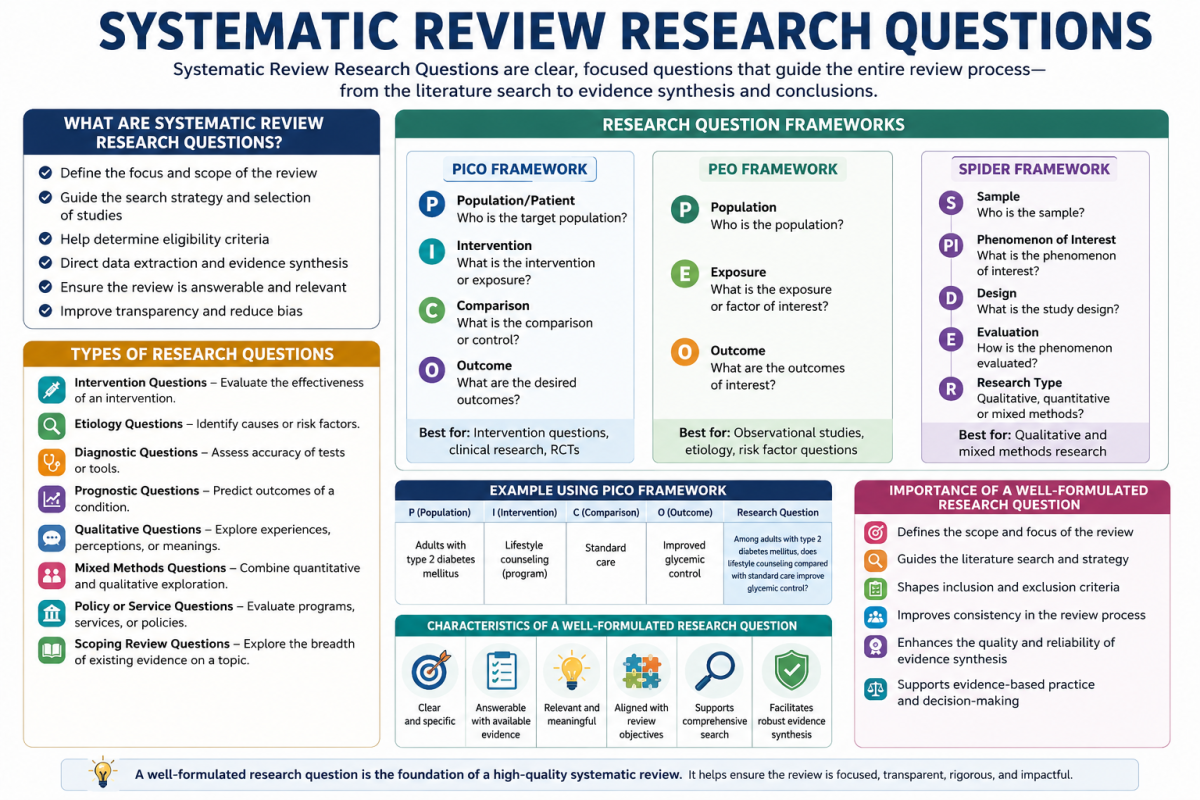
Understanding how to create effective Systematic Review Research Questions is essential because the research question serves as the foundation of the entire review process. Every stage of the systematic review process, from the literature search to evidence synthesis and final conclusions, depends on the quality of the review question.
Definition of Systematic Review Research
- A systematic review is a research method that collects and analyzes evidence from multiple studies related to a specific research topic.
- It uses predefined methods to identify, select, evaluate, and synthesize evidence.
- The purpose is to provide a comprehensive summary of existing literature on a particular issue.
- Systematic reviews are widely used in health sciences, education, social sciences, business, and policy development.
- They are considered essential for evidence-based practice because they summarize findings from multiple studies rather than relying on a single source.
Key Characteristics of a Systematic Review
- Uses a clearly defined research question.
- Employs a transparent and reproducible search strategy.
- Applies predefined eligibility criteria.
- Evaluates study quality using methodological standards.
- Conducts evidence synthesis of selected studies.
- Documents every step of the review process.
- Minimizes researcher bias.
What Are Systematic Review Research Questions?
- Systematic Review Research Questions are focused questions designed to guide a systematic review.
- They define what evidence will be searched for, evaluated, and included.
- They help researchers clearly define the scope of the review.
- They establish boundaries for study selection.
- They guide the development of inclusion and exclusion criteria.
- They determine the type of evidence synthesis that will be conducted.
Why Systematic Review Research Questions Matter
A strong research question:
- Helps ensure a focused review.
- Prevents unnecessary collection of irrelevant studies.
- Makes the literature search more efficient.
- Improves consistency during study selection.
- Supports reliable evidence-based conclusions.
- Increases transparency throughout the systematic review process.
Without a focused question, researchers may struggle to identify relevant evidence and may end up with an overly broad or poorly organized review.
Research Question Frameworks Used in Systematic Reviews
Research question frameworks help researchers formulate answerable and well-defined research questions.
These frameworks provide a structured approach to developing a review question and selecting appropriate search terms.
Why Use Frameworks?
Research question frameworks:
- Help clearly define important concepts.
- Improve search strategy development.
- Ensure consistency during the review process.
- Help identify relevant factors.
- Support effective evidence synthesis.
- Improve transparency and reproducibility.
Many research guides at university libraries and LibGuides recommend using research question frameworks before beginning a systematic review.
Common Research Question Frameworks
1. PICO Framework
The PICO framework is one of the most commonly used frameworks in clinical research.
PICO stands for:
- P – Population or Patient
- I – Intervention
- C – Comparison
- O – Outcome
Using PICO helps researchers formulate focused clinical research questions.
Example:
- Population: Adults with diabetes mellitus
- Intervention: Lifestyle counseling
- Comparison: Standard care
- Outcome: Improved blood glucose control
Research Question:
- Among adults with diabetes mellitus, does lifestyle counseling compared with standard care improve blood glucose control?
The PICO framework is particularly useful for quantitative studies, randomized controlled trials, and controlled trials.
2. PEO Framework
PEO stands for:
- Population
- Exposure
- Outcome
PEO is commonly used for observational studies and etiology questions.
Example:
- Population: Pregnant women
- Exposure: Antenatal education
- Outcome: Reduced postnatal depressive symptoms
PEO is often used when researchers are exploring associations rather than interventions.
3. SPIDER Framework
SPIDER stands for:
- Sample
- Phenomenon of Interest
- Design
- Evaluation
- Research Type
SPIDER is especially useful for qualitative research and mixed methods research.
Researchers often use SPIDER when exploring experiences, perceptions, attitudes, or behaviors.
Example:
- Sample: New mothers
- Phenomenon of Interest: Postnatal support services
- Design: Interviews
- Evaluation: Experiences and perceptions
- Research Type: Qualitative
SPIDER is useful for qualitative evidence synthesis because it captures aspects that traditional frameworks like PICO may overlook.
4. Frameworks Beyond PICO
Researchers should understand that there are frameworks beyond PICO.
Depending on the research type, alternatives may be more suitable.
Examples include:
- SPIDER for qualitative research.
- PEO for observational studies.
- PICo (Population, Interest, Context) for qualitative studies.
- ECLIPSE for policy or service evaluations.
- PCC for scoping review questions.
Selecting a framework should depend on the review objective, study design, and evidence being examined.
Types of Research Questions Used in Systematic Reviews
There are several types of research questions commonly used in systematic reviews.
Intervention Questions
These questions evaluate the effectiveness of an intervention.
Example:
- Does antenatal education improve maternal health outcomes?
These often use the PICO framework.
Etiology Questions
These examine causes or risk factors.
Example:
- What factors contribute to depressive symptoms among adolescents?
PEO is commonly used for these questions.
Diagnostic Questions
These assess diagnostic tools or tests.
Example:
- How accurate is a screening tool for diabetes mellitus?
Prognostic Questions
These explore future outcomes associated with a condition.
Example:
- What factors predict recovery following stroke?
Qualitative Research Questions
These investigate experiences and perceptions.
Example:
- How do patients experience telehealth services?
SPIDER is often useful for qualitative research questions.
Mixed Methods Questions
Mixed methods research combines quantitative and qualitative evidence.
Example:
- What is the effectiveness of community health programs, and how do participants perceive them?
Policy or Service Questions
These evaluate programs, services, or organizational practices.
Example:
- How effective are school-based mental health services?
Scoping Review Questions
A scoping review typically explores broader topics.
Example:
- What evidence exists regarding digital learning tools in higher education?
Scoping review questions are generally broader than systematic review questions.
Importance of a Well-Formulated Research Question
A well-formulated research question is the foundation of every successful systematic review.
It Defines the Scope
A defined research question:
- Identifies what will be studied.
- Identifies what will not be studied.
- Prevents scope creep.
- Maintains focus throughout the research process.
It Guides the Literature Search
The research question determines:
- Search terms.
- Keywords.
- Databases.
- Search strategy development.
A focused research question improves efficiency and helps locate the most relevant evidence.
It Shapes Eligibility Criteria
Eligibility criteria are developed directly from the review question.
These criteria determine:
- Studies to include.
- Studies to exclude.
- Population characteristics.
- Study design requirements.
- Publication criteria.
It Supports Evidence Synthesis
A focused question ensures:
- Consistent data extraction.
- Meaningful comparisons.
- Stronger conclusions.
- Reliable evidence-based recommendations.
It Improves Research Quality
A well-defined research question:
- Enhances transparency.
- Reduces bias.
- Improves reproducibility.
- Strengthens methodological rigor.
Characteristics of a Good Systematic Review Research Question
Effective Systematic Review Research Questions should:
- Be clear and specific.
- Be answerable using available evidence.
- Address a meaningful issue.
- Match the review objective.
- Align with the selected framework.
- Support a comprehensive literature search.
- Facilitate evidence synthesis.
- Be structured using recognized research question frameworks.
- Clearly define populations, interventions, exposures, or phenomena of interest.
- Remain manageable within the available resources and timeline.
Researchers who invest time in developing strong Systematic Review Research Questions are far more likely to produce high-quality reviews that contribute valuable knowledge to their field. Whether conducting research in health sciences, education, social sciences, or policy development, a focused question serves as the roadmap that guides every stage of the systematic review process.
Research Questions
Types of Research Questions
Explore different categories of research questions used in academic studies.
Descriptive Research Question
What is happening?
→
Exploratory Research Question
Explore unknowns
→
Explanatory Research Question
Why it happens
→
Comparative Research Question
Compare variables
→
Relationship-Based Research Question
Connections
→
Causal Research Question
Cause-effect
→
Predictive Research Question
Future outcomes
→
Evaluative Research Question
Assess value
→
Interpretive Research Question
Meaning focus
→
Action Research Question
Practical change
→
Phenomenological Research Question
Lived experience
→
Grounded Theory Research Question
Theory building
→
Historical Research Question
Past events
→
Ethnographic Research Question
Culture study
→
Systematic Review Research Question
Evidence synthesis
→
PICO Research Question
Clinical format
→
PEO Research Question
Qualitative health
→
FINER Research Question
Quality criteria
→
Hypothesis-Based Research Question
Testable design
→
Mixed Methods Research Question
Combined approach
→
