
Blog
How To Write Evaluative Research Questions With Examples

Introduction to Evaluative Research Questions: Definition, Purpose, Types of Evaluation, and Key Evaluation Questions
What Are Evaluative Research Questions?
- Evaluative Research Questions are specific questions designed to assess the effectiveness, quality, value, impact, or success of a program, intervention, service, policy, product, or process.
- Unlike descriptive research questions that simply describe a situation, Evaluative Research Questions aim to determine whether something works and how well it works.
- They are commonly used in evaluation research, program evaluation, user research, UX research, healthcare studies, education, business, public policy, and product development.
- The primary goal is to evaluate performance against a predefined criterion or standard.
- These questions help researchers collect evidence that can support decision-making and future improvements.
Definition of Evaluative Research Questions
- Evaluative Research Questions are research questions that assess outcomes, effectiveness, efficiency, relevance, usability, quality, or impact.
- They focus on measuring whether objectives have been achieved.
- A researcher uses these questions to analyze results and determine whether a project, program, or initiative meets expectations.
- They often include measurable indicators that allow evaluators to assess success objectively.
Purpose of Evaluative Research Questions
Evaluative Research Questions serve several important purposes:
- Assess the impact of a program or intervention.
- Determine whether resources are being used effectively.
- Identify strengths and weaknesses.
- Provide evidence-based recommendations.
- Validate assumptions and design decisions.
- Help stakeholders make informed decisions.
- Improve future implementation strategies.
- Uncover areas requiring refinement.
Types of Evaluation Used in Evaluative Research
Formative Evaluation
- Conducted during development or implementation.
- Focuses on improving processes before completion.
- Helps identify issues early.
- Often used in user research, prototype testing, and educational program development.
Example:
- How effectively do users navigate the prototype during usability testing?
- What improvements can enhance the user experience before launch?
Summative Evaluation
- Conducted after implementation.
- Measures final effectiveness and outcomes.
- Determines overall success.
Example:
- Did the training program improve employee productivity?
- To what extent did the intervention achieve its intended outcome?
Process Evaluation
- Examines how activities were implemented.
- Focuses on operational effectiveness.
Example:
- Were project activities delivered according to the research plan?
Outcome Evaluation
- Measures short-term and long-term results.
- Assesses whether goals were achieved.
Example:
- Did the health awareness campaign increase vaccination rates?
Impact Evaluation
- Measures broader changes resulting from an intervention.
- Focuses on long-term effects.
Example:
- How has the scholarship program affected graduation rates over five years?
Key Evaluation Questions
Some of the most common key evaluation questions include:
- Was the program effective?
- Did participants benefit from the intervention?
- Were objectives achieved?
- What factors influenced success or failure?
- Was implementation efficient?
- How satisfied were users?
- What improvements are necessary?
- Was the outcome measurable and meaningful?
Characteristics of Good Evaluation Questions
Good evaluation questions should be:
- Clear and easy to understand.
- Specific rather than vague.
- Relevant to the evaluation purpose.
- Measurable using appropriate indicators.
- Feasible within available resources.
- Actionable for decision-making.
- Aligned with stakeholder needs.
- Focused on obtaining meaningful insight.
How To Write Evaluative Research Questions With Examples: A 4-Step Process for Developing a Good Research Question and Feasible Evaluation Criteria
Creating strong Evaluative Research Questions requires a structured approach.
Step 1: Define the Program, Product, Service, or Scenario Being Evaluated
Before writing the research question:
- Clearly identify what will be evaluated.
- Understand objectives and expected outcomes.
- Determine the target audience.
- Review existing evidence and stakeholder expectations.
Questions to ask:
- What is being evaluated?
- Why is evaluation necessary?
- Who benefits from the findings?
Example:
Instead of:
- Is the website good?
Write:
- How effectively does the website help users complete a task?
Step 2: Identify Evaluation Criteria and Indicators
Evaluation criteria are standards used to judge success.
Common criteria include:
- Effectiveness
- Efficiency
- Relevance
- Satisfaction
- Accessibility
- Usability
- Impact
- Quality
Indicators help measure these criteria.
Examples of indicators:
- Completion rates
- User satisfaction scores
- Survey ratings
- Error frequency
- Time on task
- Retention rates
Example:
Criterion:
- Usability
Indicator:
- Percentage of users who successfully complete a task.
Step 3: Develop Specific Questions and Sub-Questions
The main research question should focus on the overall evaluation objective.
Then create sub-questions that explore different dimensions.
Main Question:
- How effective is the employee onboarding program?
Sub-Questions:
- How satisfied are participants with the training materials?
- What skills have employees gained?
- Which components contribute most to learning outcomes?
- What challenges do participants encounter?
This structure improves the research process and helps collect data systematically.
Step 4: Test Feasibility and Refine the Questions
Before conducting research:
- Ensure the questions are realistic.
- Verify data availability.
- Confirm that indicators are measurable.
- Check time and budget constraints.
- Determine whether research participants can provide the required information.
Checklist for Refinement:
✓ Is the question clear?
✓ Is it measurable?
✓ Is it aligned with objectives?
✓ Can data be collected?
✓ Will the answer support decision-making?
Example of Refining an Evaluation Question
Weak Question:
- Is the mobile app successful?
Improved Question:
- To what extent does the mobile app improve user engagement and task completion rates among first-time users?
The refined version provides a measurable and feasible evaluation framework.
How To Write Evaluative Research Questions With Examples for Formative Evaluation, Summative Evaluation, Outcome Assessment, and Other Evaluation Research Scenarios
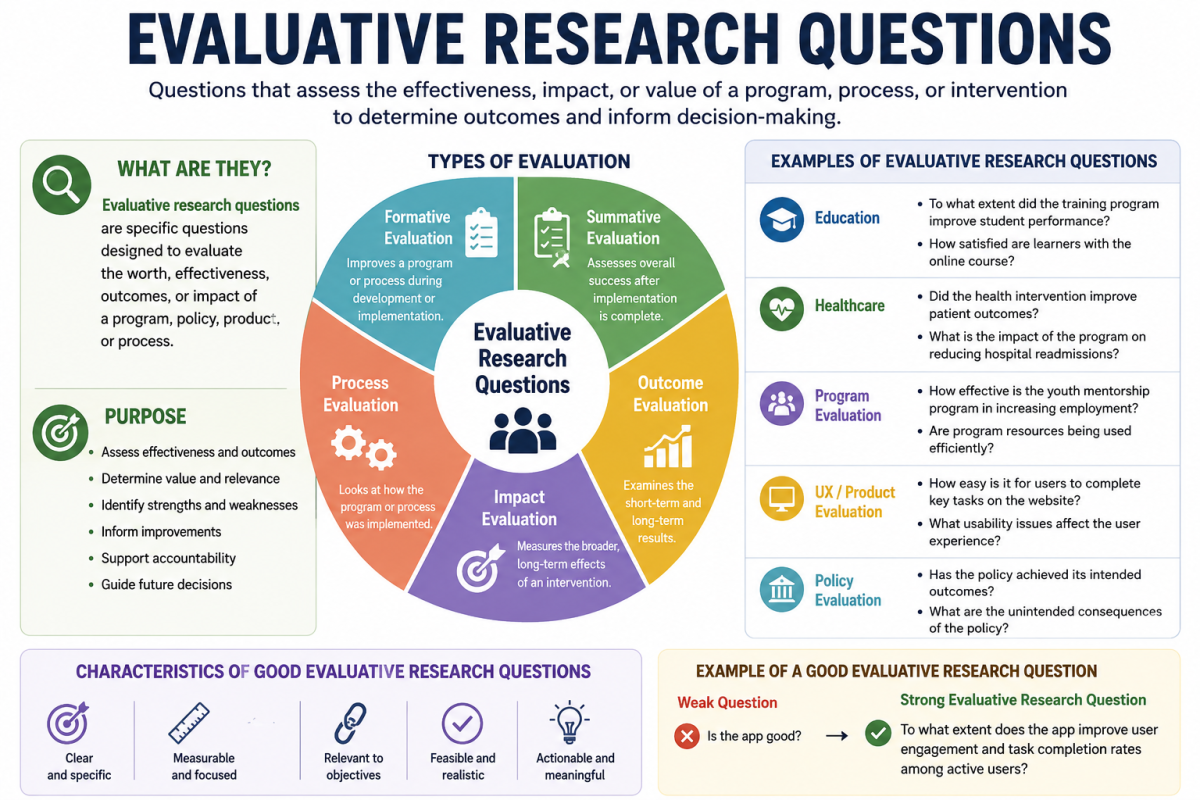
Different scenarios require different evaluative questions.
Formative Evaluation Question Examples
Formative evaluation focuses on improvement during development.
Examples:
- How effectively do users navigate the prototype?
- What obstacles prevent users from completing tasks?
- Which interface elements create confusion?
- How can the information architecture be improved?
- What user feedback suggests design changes?
Methods often include:
- User interviews
- Usability testing
- Tree testing
- Card sorting
- First click testing
- Diary studies
UX Research Example:
Main Question:
- How effectively does the prototype support task completion?
Sub-Questions:
- Which features are difficult to locate?
- How easily can users navigate key sections?
- What usability issues emerge during testing?
Summative Evaluation Question Examples
Summative evaluation assesses final performance.
Examples:
- Did the training program improve employee performance?
- To what extent were project goals achieved?
- How satisfied are participants with the completed program?
- Did the intervention meet stakeholder expectations?
Education Example:
Main Question:
- How effective was the online learning program?
Sub-Questions:
- Did student performance improve?
- Were learners satisfied with course content?
- What completion rates were achieved?
Outcome Assessment Examples
Outcome assessment focuses on results.
Examples:
- Did the healthcare initiative improve patient outcomes?
- Has customer satisfaction increased after implementation?
- Did the awareness campaign influence behavior change?
- How much improvement occurred compared to baseline measurements?
Healthcare Scenario:
Main Question:
- To what extent did the health intervention improve patient adherence?
Sub-Questions:
- Did adherence rates increase?
- Which factors influenced adherence?
- What barriers remain?
Program Evaluation Examples
Program evaluation is common in nonprofit and public-sector settings.
Examples:
- How effective is the youth mentorship program?
- What impact has the initiative had on employment outcomes?
- Are resources being allocated efficiently?
- Which program components generate the greatest benefit?
User Research and UX Evaluation Examples
Evaluative research is widely used in digital product development.
Examples:
- Can users successfully complete a purchase?
- How easy is it to locate information?
- Which design decisions improve usability?
- Does the platform meet user expectations?
Methods may include:
- Usability testing
- User interviews
- Surveys
- First click testing
- Card sorting
- Tree testing
Example:
Main Question:
- How effectively can users complete a checkout process?
Sub-Questions:
- Where do users encounter difficulties?
- Which pages generate abandonment?
- How satisfied are respondents with the experience?
AI Evaluation Examples
As AI systems become increasingly common, evaluation questions are used to assess effectiveness.
Examples:
- How accurately does the AI system answer customer inquiries?
- Does the AI improve operational efficiency?
- How satisfied are users with AI-generated responses?
- What limitations affect performance?
How To Write Evaluative Research Questions With Examples: Advantages, Strengths, Disadvantages, Limitations, and When to Use This Type of Research Method for Evaluation and Evaluative Research
Advantages and Strengths of Evaluative Research Questions
Provide Evidence-Based Decision Making
- Help stakeholders make informed decisions.
- Reduce reliance on assumptions.
- Generate empirical research findings.
Measure Real Outcomes
- Focus on measurable outcomes.
- Assess the impact of programs and interventions.
- Identify success indicators.
Support Continuous Improvement
- Reveal strengths and weaknesses.
- Encourage ongoing refinement.
- Improve future performance.
Enhance Accountability
- Demonstrate whether objectives were achieved.
- Provide transparency for funding and management decisions.
Applicable Across Multiple Fields
Evaluative Research Questions can be used in:
- Education
- Healthcare
- Business
- Government
- Technology
- UX research
- User research
- Marketing
- Nonprofit organizations
Support Qualitative and Quantitative Analysis
Researchers can collect data through:
Qualitative Methods
- User interviews
- Focus groups
- Observation
- Diaries
- Open-ended survey responses
Quantitative Methods
- Rating scale measurements
- Surveys
- Performance metrics
- Statistical analysis
- Benchmark comparisons
Combining qualitative and quantitative approaches often provides richer insight.
Disadvantages and Limitations of Evaluative Research Questions
Can Be Resource Intensive
- May require significant time and funding.
- Data collection can be complex.
- Large studies may require extensive recruitment efforts.
Risk of Bias
- Respondent bias may affect survey results.
- Evaluator bias may influence interpretation.
- Stakeholder expectations may affect conclusions.
Difficult to Isolate Causes
- External variables can influence outcomes.
- Multiple factors may contribute to results.
- Establishing causation can be challenging.
Measurement Challenges
- Some outcomes are difficult to measure.
- Indicators may not fully capture effectiveness.
- Intangible benefits can be overlooked.
Data Quality Concerns
- Poor data can weaken conclusions.
- Low response rates may reduce reliability.
- Inaccurate reporting may affect findings.
When to Use Evaluative Research Questions
Evaluative Research Questions are most useful when:
- Assessing the effectiveness of a program.
- Evaluating a new product or service.
- Measuring user satisfaction.
- Conducting usability testing.
- Assessing organizational performance.
- Evaluating educational interventions.
- Measuring healthcare outcomes.
- Validating design decisions.
- Determining whether objectives were achieved.
- Assessing the usability of a website, application, or prototype.
Final Thoughts
- Evaluative Research Questions are an essential component of effective research and evaluation.
- They help researchers assess performance, measure outcomes, and generate actionable insight.
- Whether conducting formative evaluation, summative evaluation, program evaluation, user research, UX research, or outcome assessment, carefully crafted Evaluative Research Questions provide the evidence needed to evaluate success and guide future improvements.
- By focusing on measurable indicators, relevant criteria, and feasible research methods, researchers can create good evaluation questions that deliver meaningful answers and support informed decision-making.
Research Questions
Types of Research Questions
Explore different categories of research questions used in academic studies.
Descriptive Research Question
What is happening?
→
Exploratory Research Question
Explore unknowns
→
Explanatory Research Question
Why it happens
→
Comparative Research Question
Compare variables
→
Relationship-Based Research Question
Connections
→
Causal Research Question
Cause-effect
→
Predictive Research Question
Future outcomes
→
Evaluative Research Question
Assess value
→
Interpretive Research Question
Meaning focus
→
Action Research Question
Practical change
→
Phenomenological Research Question
Lived experience
→
Grounded Theory Research Question
Theory building
→
Historical Research Question
Past events
→
Ethnographic Research Question
Culture study
→
Systematic Review Research Question
Evidence synthesis
→
PICO Research Question
Clinical format
→
PEO Research Question
Qualitative health
→
FINER Research Question
Quality criteria
→
Hypothesis-Based Research Question
Testable design
→
Mixed Methods Research Question
Combined approach
→
