
Blog
How To Write Interpretive Research Questions With Examples

Understanding Interpretive Research Questions: Definition, Purpose, and Role in Qualitative Research
What Are Interpretive Research Questions?
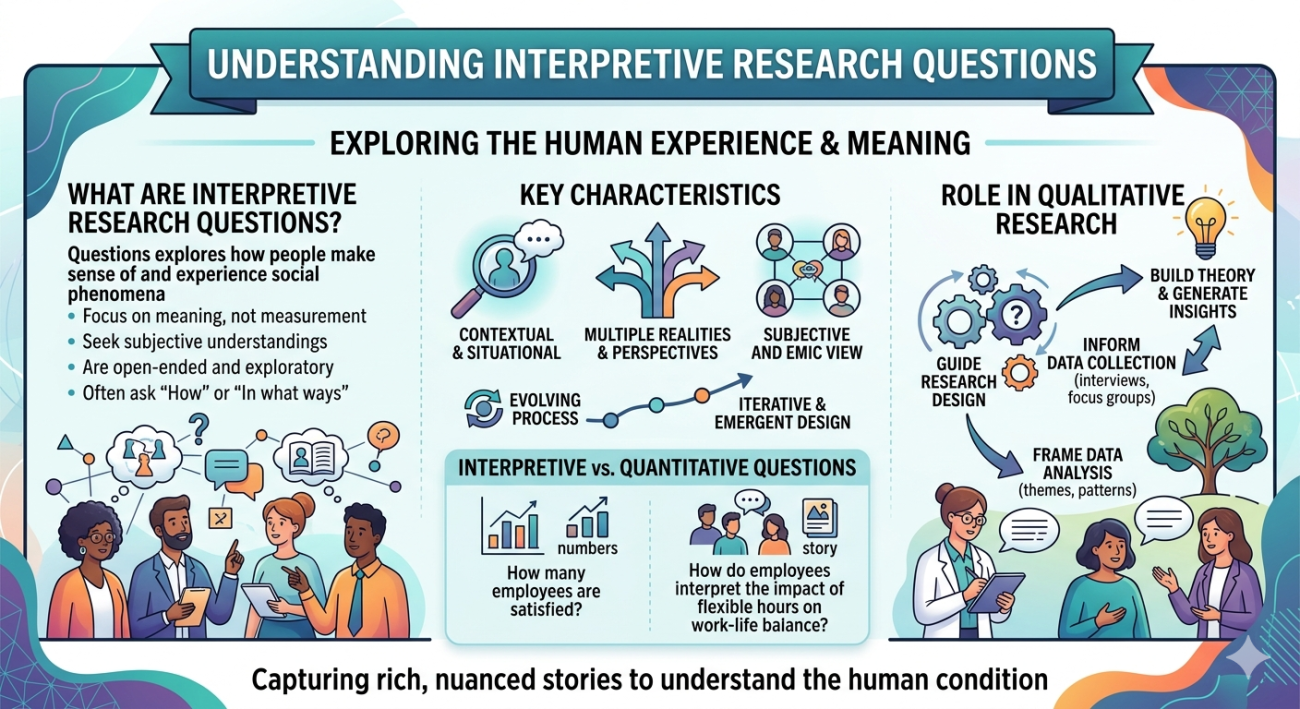
- Interpretive Research Questions are questions designed to explore how people understand, experience, and assign meaning to events, behaviors, situations, and social phenomena.
- Unlike questions in quantitative research that seek numerical measurements, Interpretive Research Questions focus on understanding human experiences, perceptions, beliefs, values, and social interactions.
- They are grounded in the interpretive or interpretivist research tradition, which assumes that reality is socially constructed and can be understood through people’s experiences.
- An interpretive researcher seeks to understand the meanings individuals attach to their actions rather than simply measuring observable outcomes.
- These questions are commonly used in qualitative research because they allow researchers to investigate complex social contexts and context-specific experiences.
- The primary goal is not prediction or generalization but understanding.
Definition of Interpretive Research Questions
- Interpretive Research Questions are open-ended questions that seek to understand how individuals or groups make sense of a particular phenomenon under investigation.
- They focus on subjective meanings rather than objective facts.
- They encourage detailed exploration of experiences and perspectives.
- They are designed to uncover multiple ways of understanding a phenomenon being studied.
- They align with interpretive inquiry, which emphasizes human interpretation as a source of knowledge.
Example
Instead of asking:
- “How many employees are satisfied with remote work?”
An interpretive research question would ask:
- “How do employees experience and interpret remote work in relation to their professional and personal lives?”
The second question seeks to understand meaning rather than measure frequency.
Key Characteristics of Interpretive Research Questions
They Focus on Meaning
- The goal is to understand how people interpret their experiences.
- Researchers seek to understand participants’ viewpoints rather than impose external explanations.
- Meaning becomes the central unit of analysis.
They Are Open-Ended
- They do not require a yes-or-no answer.
- They encourage detailed responses.
- They allow research participants to explain experiences in their own words.
They Explore Social Contexts
- Human experiences are shaped by cultural, organizational, and social settings.
- Interpretive questions examine how these social contexts influence behavior and understanding.
They Are Contextual
- Findings are often context-specific rather than generalizable across all populations.
- Understanding the social setting is often more important than producing universal laws.
They Support Flexible Inquiry
- Questions may evolve during the research process.
- An iterative approach allows researchers to refine the research question as new insights emerge.
Purpose of Interpretive Research Questions
To Understand Human Experience
- One of the primary purposes is to understand how individuals experience particular situations.
- This focus makes them valuable in health research, education, sociology, anthropology, and organizational studies.
To Explore Social Phenomena
- Many social phenomena cannot be adequately explained through numbers alone.
- Interpretive approaches help researchers uncover hidden meanings and motivations.
To Generate Rich Qualitative Data
- These questions encourage detailed narratives and reflections.
- The resulting qualitative data often provides deeper insights than numerical statistics.
To Build Theory
- Many interpretive studies contribute to grounded theory development.
- Researchers develop explanations directly from participant experiences.
To Expand Knowledge in the Field
- Interpretive work helps generate new perspectives and understanding.
- It contributes valuable knowledge in the field where existing theories may be insufficient.
The Role of Interpretive Research Questions in Qualitative Research
Guiding the Entire Research Process
- A well-formulated research question serves as the foundation of the entire research project.
- It influences study design, sampling decisions, data collection techniques, and data analysis procedures.
Shaping Research Design
- The research design is selected based on the nature of the research question.
- Different interpretive methods may be used depending on the phenomenon under investigation.
Examples include:
- Ethnography
- Ethnographic research
- Grounded theory
- Phenomenology
- Participatory action research
- Narrative inquiry
- Case studies
Influencing Data Collection
Interpretive Research Questions determine:
- The type of interview questions used.
- The observation methods employed.
- The documents examined.
- The participants selected.
Common data collection methods include:
- In-depth interviews
- Focus groups
- Participant observation
- Field notes
- Diaries
- Document reviews
Supporting Qualitative Data Analysis
- The nature of the question shapes qualitative data analysis procedures.
- Researchers search for themes, meanings, and patterns rather than statistical relationships.
- Data collection and analysis often occur simultaneously.
Encouraging Reflexivity
- The role of the researcher is particularly important.
- Researchers acknowledge their influence on interpretation.
- Reflexivity improves the quality of interpretive research.
How To Write Interpretive Research Questions With Examples: A 4-Step Process for Formulating a Good Research Question in Interpretive Research Design
Step 1: Identify the Phenomenon You Want to Understand
- Begin by selecting a meaningful research topic.
- Focus on a phenomenon that involves human experiences, beliefs, or social interactions.
- Ask yourself what aspect of humanity interests you most.
- Consider gaps identified during research on the topic.
Questions to ask:
- What social issue am I exploring?
- What experiences need deeper understanding?
- What social setting is relevant?
Examples:
- Social media use among university students.
- Patient experiences in healthcare facilities.
- Workplace culture in remote organizations.
Step 2: Determine the Interpretive Perspective
- Decide which interpretive lens will guide your research approach.
- Consider the epistemological and methodological assumptions underlying your study.
- Reflect on the set of ontological and epistemological beliefs shaping your inquiry.
Key considerations:
- What meanings do participants assign to experiences?
- How are these meanings constructed?
- What social factors influence interpretation?
At this stage, an interpretive researcher focuses on understanding rather than measuring.
Step 3: Identify the Participants and Context
- Define who will provide the information needed.
- Select participants capable of offering rich insights.
Consider:
- Age groups
- Professional groups
- Communities
- Organizations
- Cultural groups
Also identify:
- The social context
- The social setting
- Environmental influences
Sampling should prioritize depth rather than representativeness.
Common sampling approaches include:
- Purposive sampling
- Snowball sampling
- Theoretical sampling
The goal is to achieve saturation, where additional data provides minimal new insights.
Step 4: Formulate an Open-Ended Research Question
- Construct a question that seeks to understand experiences and meanings.
- Avoid questions that require numerical answers.
- Use wording that encourages exploration.
Useful question starters include:
- How do participants experience…?
- How do individuals interpret…?
- What meanings do people attach to…?
- How do participants understand…?
- In what ways do people make sense of…?
Example Transformation
Weak question:
- How many workers prefer flexible schedules?
Strong interpretive question:
- How do employees interpret the impact of flexible work schedules on their work-life balance?
Checklist for a Good Research Question
A good research question should be:
- Clear.
- Focused.
- Open-ended.
- Contextual.
- Researchable.
- Relevant.
- Aligned with qualitative methods.
- Consistent with interpretivist research principles.
How To Write Interpretive Research Questions With Examples: Sample Interpretive Research Questions for Qualitative Research and Data Collection
Education
- How do first-year university students interpret their transition from high school to higher education?
- How do students experience online learning environments?
- What meanings do students attach to academic success?
Sociology
- How do urban youth interpret community identity?
- How do individuals experience social inclusion and exclusion?
- How do families construct meanings around changing gender roles?
Anthropology
- How do indigenous communities interpret cultural preservation efforts?
- What meanings do community members assign to traditional ceremonies?
- How do local populations experience cultural change?
Health Research
- How do patients interpret their experiences with chronic illness management?
- How do nurses experience emotional challenges in clinical research settings?
- How do caregivers understand their caregiving responsibilities?
Workplace Research
- How do employees interpret organizational culture?
- How do remote workers experience workplace belonging?
- How do managers understand leadership in virtual environments?
Ethnographic Research Examples
Ethnographic research often seeks detailed cultural understanding.
Examples include:
- How do street vendors interpret their economic and social roles within local communities?
- How do migrant workers experience adaptation to a new cultural environment?
- How do hospital staff interpret workplace routines and rituals?
Grounded Theory Examples
Grounded theory studies often focus on developing explanations.
Examples:
- How do entrepreneurs navigate uncertainty during business startup phases?
- How do teachers develop resilience in challenging educational environments?
- How do healthcare professionals adapt to organizational change?
Participatory Action Research Examples
Examples include:
- How do community members interpret efforts to improve local healthcare services?
- How do residents experience participation in community development programs?
- What meanings do participants assign to collaborative decision-making processes?
Examples of Poor vs Strong Interpretive Research Questions
Poor Example
- Does social media affect students?
Problems:
- Too broad.
- Not interpretive.
- Lacks context.
Strong Example
- How do university students interpret the influence of social media on their academic and social identities?
Poor Example
- Are nurses satisfied with workplace conditions?
Strong Example
- How do nurses experience and interpret workplace conditions in public hospitals?
These stronger Interpretive Research Questions encourage deeper exploration and richer qualitative data.
How To Write Interpretive Research Questions With Examples: Advantages and Strengths vs Disadvantages and Limitations in Interpretive Research Compared to Positivist Research
Advantages and Strengths of Interpretive Research Questions
1. Provide Deep Understanding
- Interpretive Research Questions seek to understand human experiences in depth.
- They reveal motivations, perceptions, emotions, and meanings that numbers cannot capture.
2. Capture Context
- Human behavior is influenced by context.
- Interpretive approaches acknowledge the importance of social contexts and environmental factors.
3. Produce Rich Qualitative Data
- Participants provide detailed descriptions.
- Researchers gain nuanced insights into complex experiences.
4. Support Flexible Research Practice
- The research process remains adaptable.
- Researchers can modify interview questions and directions as understanding develops.
5. Useful for Emerging Topics
- When little research exists, interpretive inquiry helps generate foundational knowledge.
- It is valuable for exploratory social science research.
6. Helps Develop Theory
- Interpretive studies frequently contribute to grounded theory development.
- New conceptual frameworks often emerge directly from participant experiences.
7. Reflects Real Human Experiences
- The approach values individual perspectives.
- It acknowledges multiple realities and ways of understanding social life.
Disadvantages and Limitations of Interpretive Research Questions
1. Limited Generalizability
- Findings are often context-specific.
- Results may not apply to broader populations.
- Unlike quantitative research, conclusions are rarely generalizable.
2. Time-Intensive Data Collection
- Gathering detailed qualitative data requires substantial time.
- Interviews and observations can be lengthy.
3. Complex Data Analysis
- Qualitative data analysis often involves large volumes of information.
- Identifying themes and meanings requires considerable effort.
4. Potential Researcher Bias
- The role of the researcher is significant.
- Personal assumptions may influence interpretation.
5. Difficulties with Reliability and Validity
- Traditional concepts of reliability and validity can be challenging to achieve.
- Researchers often use alternative quality criteria suited to interpretive methods.
6. Smaller Sample Sizes
- Sampling typically involves fewer participants.
- This can limit broader applicability.
Interpretive Research vs Positivist Research
Interpretive Research
- Focuses on meanings and experiences.
- Uses qualitative methods.
- Explores context-specific realities.
- Accepts multiple perspectives.
- Seeks understanding.
- Often uses ethnography, interviews, and observations.
Positivist Research
- Focuses on objective measurement.
- Uses quantitative techniques.
- Emphasizes prediction and explanation.
- Seeks universal laws.
- Prioritizes statistical testing.
- Often uses surveys and experiments.
Final Thoughts
- Interpretive Research Questions play a critical role in qualitative research by helping researchers explore meanings, experiences, and social phenomena.
- They guide every stage of a research project, from research design and data collection to data analysis and answering the research question.
- By focusing on human interpretation, these questions provide valuable insights that complement findings from quantitative research.
- Whether used in sociology, anthropology, health research, social research, or other research traditions, Interpretive Research Questions remain an essential tool for producing good research and advancing knowledge in the field.
Research Questions
Types of Research Questions
Explore different categories of research questions used in academic studies.
Descriptive Research Question
What is happening?
→
Exploratory Research Question
Explore unknowns
→
Explanatory Research Question
Why it happens
→
Comparative Research Question
Compare variables
→
Relationship-Based Research Question
Connections
→
Causal Research Question
Cause-effect
→
Predictive Research Question
Future outcomes
→
Evaluative Research Question
Assess value
→
Interpretive Research Question
Meaning focus
→
Action Research Question
Practical change
→
Phenomenological Research Question
Lived experience
→
Grounded Theory Research Question
Theory building
→
Historical Research Question
Past events
→
Ethnographic Research Question
Culture study
→
Systematic Review Research Question
Evidence synthesis
→
PICO Research Question
Clinical format
→
PEO Research Question
Qualitative health
→
FINER Research Question
Quality criteria
→
Hypothesis-Based Research Question
Testable design
→
Mixed Methods Research Question
Combined approach
→
