
Blog
How To Write Causal Research Questions With Examples

How To Write Causal Research Questions With Examples: Introduction, Definition, and Understanding Causal Relationships in Research
Introduction to Causal Research Questions
- Causal Research Questions are a specific type of research question designed to determine whether one factor causes or affects another factor.
- Unlike descriptive research questions that simply describe a phenomenon, Causal Research Questions seek to explain why something happens and identify a cause-and-effect relationship.
- In academic research, business studies, healthcare investigations, education, psychology, and public policy, researchers frequently use causal research to understand whether one or more variables influence an outcome.
- People often ask:
- Why do students who study longer achieve higher grades?
- Does an advertising campaign increase product sales?
- Does employee training improve workplace productivity?
- These questions move beyond description and attempt to identify causation.
- A researcher uses a causal approach when they want to know whether one variable directly affects another variable.
- Understanding how to formulate strong Causal Research Questions is essential because the quality of a study often depends on the quality of its research question.
- A well-written causal question guides:
- Research design
- Data collection
- Sampling strategy
- Analysis methods
- Interpretation of findings
- Whether you are writing a thesis, dissertation, journal article, or business report, learning how to use causal questions effectively can significantly improve your research outcomes.
Definition of Causal Research Questions
- Causal Research Questions are questions designed to determine whether one or more variables cause changes in one or more outcome variables.
- They focus on establishing a causal relationship between an independent variable and a dependent variable.
- In simple terms:
- The independent variable is the factor believed to cause change.
- The dependent variable is the outcome affected by that change.
- A causal question investigates whether one variable causes or affects one or more outcome variables.
- General structure: Does X cause Y? or To what extent does X affect Y?
- Examples:
- Does online learning affect student performance?
- Does exercise reduce stress levels?
- Does flexible work scheduling improve employee satisfaction?
- Does social media usage affect academic achievement?
- These questions are designed to determine whether one factor produces a direct effect on another factor.
What Is Causal Research?
- Causal research is a type of research that examines cause and effect relationships.
- The primary goal is to identify whether one variable influences another variable.
- Unlike descriptive research, which focuses on describing characteristics or trends, causal research seeks to explain why outcomes occur.
- Researchers use causal research when they need evidence regarding causation rather than simple association.
- This research method is common in:
- Education
- Marketing
- Medicine
- Psychology
- Sociology
- Economics
- Public policy
Example
- Research Topic: Employee Productivity
- Descriptive Question:
- What percentage of employees work remotely?
- Relational Question:
- Is there a relationship between remote work and productivity?
- Causal Question:
- Does remote work increase employee productivity?
- Notice how the causal question attempts to determine whether one factor causes a change in another.
Understanding Cause and Effect Relationships
- A cause-and-effect relationship exists when one factor directly influences another.
- Establishing causation requires more than simply observing two variables moving together.
- Researchers must determine:
- Whether the cause occurs before the effect.
- Whether the relationship is plausible.
- Whether another variable could explain the outcome.
- For example:
- Ice cream sales increase during summer.
- Drowning incidents also increase during summer.
- A simple correlation exists between the two variables.
- However, ice cream sales do not cause drowning incidents.
- Another variable, temperature, influences both.
- This example demonstrates why researchers must carefully interpret relationships between two variables.
Difference Between Causal and Descriptive Research Questions
Descriptive Research Questions
- Descriptive research questions focus on describing a characteristic, trend, behavior, or condition.
- They answer:
- “What?”
- “Who?”
- “Where?”
- “When?”
- Examples:
- What percentage of students use online learning platforms?
- What is the average income of households in the region?
- What are the common causes of employee turnover?
Causal Research Questions
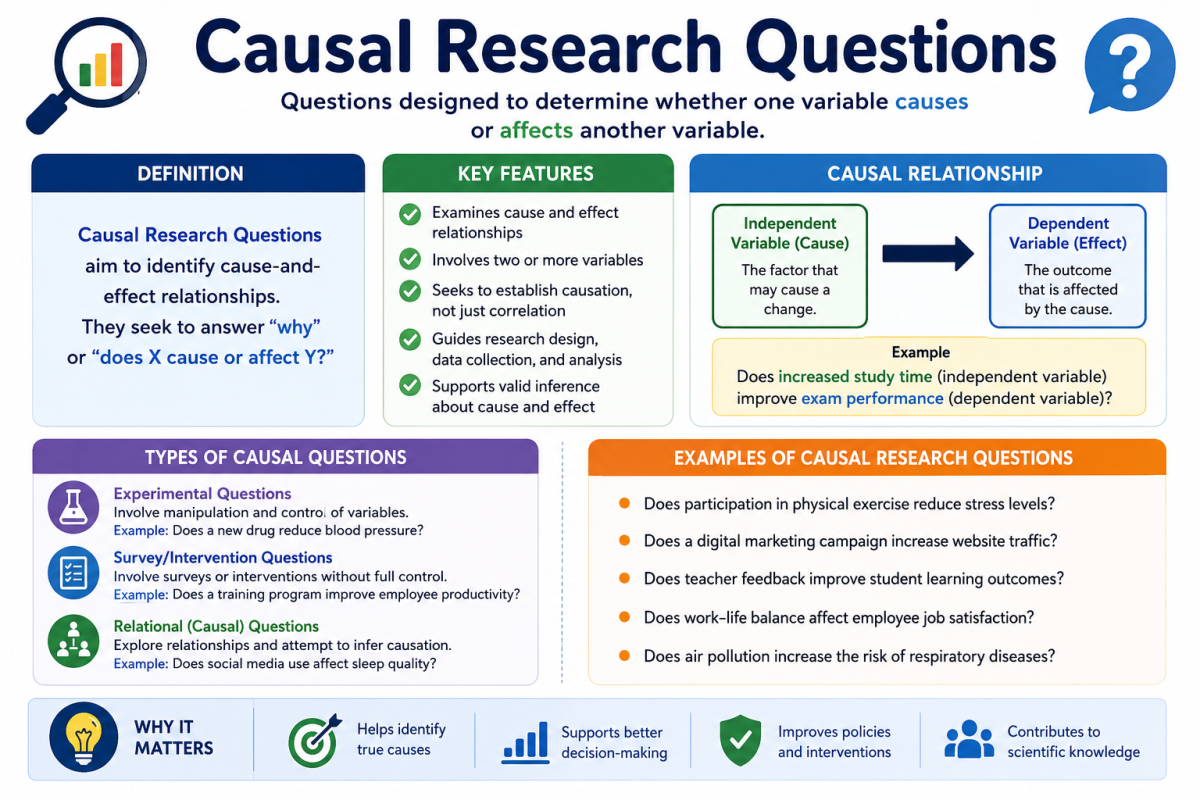
- Causal Research Questions focus on:
- Why something happens.
- Whether one variable affects another.
- How cause-and-effect relationships operate.
- Examples:
- Does online learning improve academic performance?
- Does income level affect health outcomes?
- Does employee recognition reduce turnover?
- The key distinction is that descriptive research describes, while causal research explains.
Difference Between Causal and Relational Research Questions
- Many researchers confuse causal questions with relational questions.
- Although both examine relationships between two variables, they serve different purposes.
Relational Questions
- Explore whether two or more variables are associated.
- Do not imply causation.
- Examples:
- Is there a relationship between exercise and stress?
- Is there a relationship between education level and income?
Causal Questions
- Seek evidence that one variable causes another.
- Examples:
- Does exercise reduce stress?
- Does education level increase income?
- Correlation alone cannot prove causation.
- This distinction is one of the most important concepts in research methodology.
Key Characteristics of Strong Causal Research Questions
A strong causal question should possess several important characteristics.
1. Focus on Cause and Effect
- The question should clearly investigate a cause-and-effect relationship.
- The cause and outcome should be obvious.
2. Include Clearly Defined Variables
- The independent variable and dependent variable should be specific.
- Ambiguous variables make interpretation difficult.
3. Be Researchable
- Researchers should be able to collect data to answer the question.
- The study should be feasible within available resources.
4. Be Measurable
- Variables should be measurable using reliable methods.
- Researchers must be able to observe variation and outcomes.
5. Support Valid Inference
- The question should allow meaningful inference about causation.
- Appropriate research design strengthens conclusions.
Components of a Causal Research Question
Most Causal Research Questions contain three essential elements.
Component 1: Independent Variable
- The factor believed to cause change.
- Examples:
- Training programs
- Advertising campaigns
- Exercise routines
- Teaching methods
Component 2: Dependent Variable
- The outcome being measured.
- Examples:
- Productivity
- Sales revenue
- Academic performance
- Stress levels
Component 3: Target Population
- The participant group being studied.
- Examples:
- University students
- Employees
- Consumers
- Patients
Example
- Does a digital advertising campaign increase product sales among online consumers?
Independent Variable:
- Advertising campaign
Dependent Variable:
- Product sales
Population:
- Online consumers
Why Causal Research Questions Matter
- Causal Research Questions help researchers move beyond observation.
- They provide deeper insight into why events occur.
- They support evidence-based decision-making.
- They help organizations create effective policies.
- They improve strategic planning.
- They allow researchers to test different interventions.
- They contribute to scientific knowledge.
- They support practical problem-solving.
Whether conducting academic research, developing organizational policy, evaluating educational programs, or designing healthcare interventions, Causal Research Questions provide a structured approach for understanding whether one factor causes or affects one or more outcome variables.
Research Questions
Types of Research Questions
Explore different categories of research questions used in academic studies.
Descriptive Research Question
What is happening?
→
Exploratory Research Question
Explore unknowns
→
Explanatory Research Question
Why it happens
→
Comparative Research Question
Compare variables
→
Relationship-Based Research Question
Connections
→
Causal Research Question
Cause-effect
→
Predictive Research Question
Future outcomes
→
Evaluative Research Question
Assess value
→
Interpretive Research Question
Meaning focus
→
Action Research Question
Practical change
→
Phenomenological Research Question
Lived experience
→
Grounded Theory Research Question
Theory building
→
Historical Research Question
Past events
→
Ethnographic Research Question
Culture study
→
Systematic Review Research Question
Evidence synthesis
→
PICO Research Question
Clinical format
→
PEO Research Question
Qualitative health
→
FINER Research Question
Quality criteria
→
Hypothesis-Based Research Question
Testable design
→
Mixed Methods Research Question
Combined approach
→
