
Blog
How To Write Action Research Questions With Examples

Understanding Action Research Questions: Definition, Purpose, and Their Role in Action Research Practice
What Are Action Research Questions?
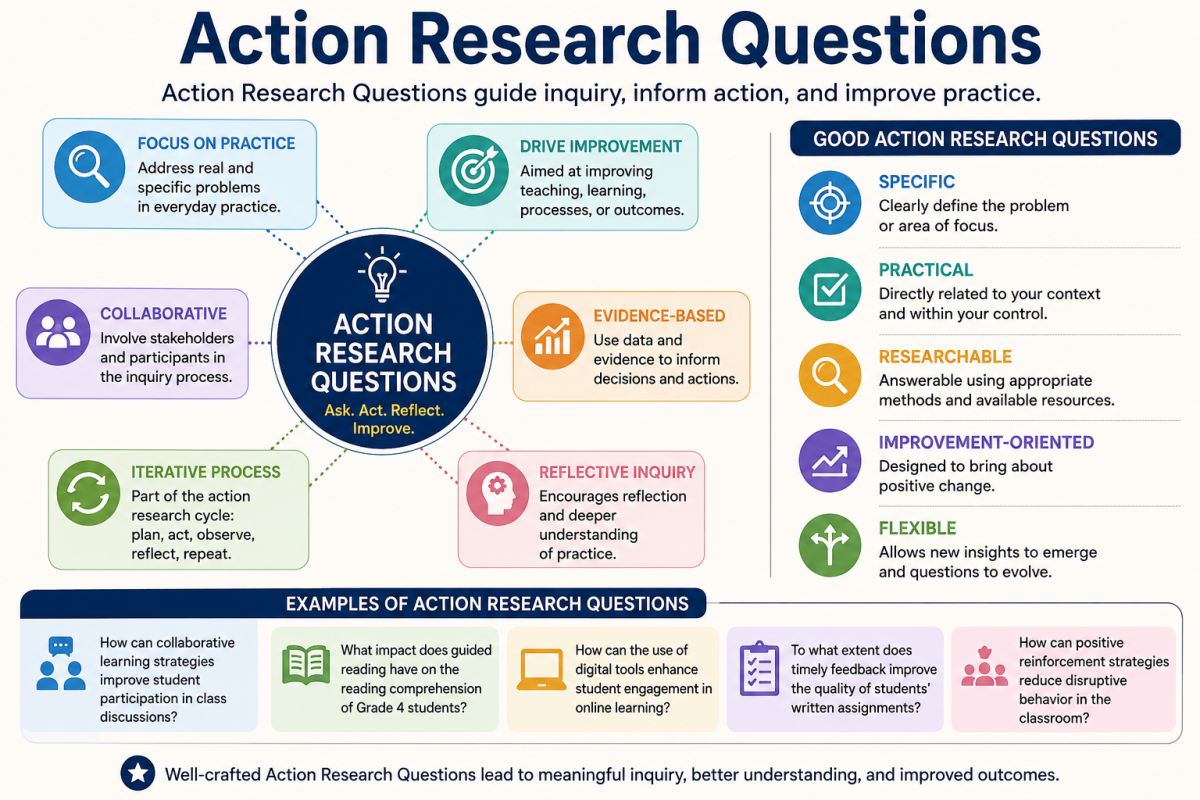
- Action Research Questions are specific questions developed to investigate a practical issue, challenge, or opportunity for improvement within a real-world setting.
- They are commonly used in action research, a systematic inquiry process that combines investigation with taking action to improve practice.
- Unlike questions used in traditional research, Action Research Questions focus on solving immediate and local problems rather than producing universally applicable theories.
- These questions guide the entire action research process by helping the researcher define the problem, collect relevant evidence, implement interventions, and evaluate outcomes.
- In many educational contexts, Action Research Questions help teachers examine classroom challenges and improve teaching practice.
- A practitioner may formulate Action Research Questions to understand why a learning strategy is ineffective, how student engagement can be increased, or what intervention can improve academic performance.
- The primary aim is not merely to generate knowledge but to improve daily practice through systematic reflection and inquiry.
Definition of Action Research
- Action research is a research method that combines investigation, reflection, and action.
- It involves identifying a problematic situation, implementing a strategy, evaluating results, and modifying practice based on findings.
- The action research cycle typically includes:
- Identifying a problem.
- Planning an intervention.
- Taking action.
- Collecting data.
- Conducting data analysis.
- Reflecting on outcomes.
- Beginning another cycle if necessary.
- The process is collaborative and often involves stakeholders such as teachers, students, administrators, or community members.
Purpose of Action Research Questions
Action Research Questions serve several important purposes:
They Provide Direction
- They establish a clear research focus.
- They help researchers remain focused on the most relevant issue.
- They define the boundaries of the research project.
They Help Identify Solutions
- They enable practitioners to explore practical solutions.
- They encourage evidence-based decision-making.
- They support continuous improvement.
They Guide Data Collection
- They determine what observations should be made.
- They influence interview questions.
- They help identify relevant variables.
- They guide the selection of qualitative or quantitative research methods.
They Support Reflection
- Reflection is a core component of action research.
- Well-written Action Research Questions encourage researchers to reflect on their assumptions and practices.
- They promote professional development and continuous learning.
Characteristics of Good Action Research Questions
Good Action Research Questions should be:
Specific
- Focus on a clearly defined issue.
- Avoid broad or vague wording.
- Address one central concern.
Practical
- Related directly to daily practice.
- Connected to realistic classroom or workplace challenges.
- Capable of producing actionable findings.
Researchable
- Possible to investigate using available resources.
- Supported by suitable research methods.
- Appropriate for the intended participant group.
Improvement-Oriented
- Designed to improve a process, strategy, or outcome.
- Focused on positive change.
Flexible
- Allow understanding to emerge throughout the research cycle.
- Can be refined as new evidence becomes available.
The Role of Action Research Questions in Educational Research
- Action Research Questions are especially important in educational research.
- They help educators evaluate teaching strategies.
- They support evidence-based instruction.
- They allow teachers to assess classroom interventions.
- They contribute to improved student outcomes.
- They help bridge the gap between theory and practice.
- They encourage collaborative problem-solving among educational stakeholders.
How To Write Action Research Questions With Examples: A 4-Step Process to Formulate Effective Research Questions
Creating effective Action Research Questions requires careful planning and reflection. The following four-step process provides guidance for developing meaningful questions.
Step 1: Identify a Problem or Area for Improvement
Start With Observation
- Observe your environment carefully.
- Look for recurring challenges.
- Identify patterns that affect performance or outcomes.
Ask Reflective Questions
Examples include:
- What classroom issue occurs repeatedly?
- Which instructional strategy seems ineffective?
- What aspect of teaching practice needs improvement?
- What challenge affects participant engagement?
Example
Problem identified:
- Students rarely participate during classroom discussions.
Potential research focus:
- Improving student participation.
Step 2: Define the Purpose and Objective
Clarify What You Want to Achieve
Determine:
- What outcome you hope to improve.
- What intervention you want to test.
- What understanding you want to gain.
Consider Stakeholder Needs
Stakeholders may include:
- Students.
- Teachers.
- School administrators.
- Parents.
- Community members.
Example Objective
- To improve student participation through collaborative learning activities.
Step 3: Formulate the Research Question
Use Clear and Practical Language
Your research question should:
- Focus on action and improvement.
- Be realistic and manageable.
- Address a specific issue.
Helpful Question Starters
- How can…
- To what extent…
- What impact does…
- In what ways…
- How does…
Example
Weak question:
- Why do students struggle?
Improved Action Research Question:
- How can collaborative learning strategies improve student participation during classroom discussions?
Step 4: Evaluate and Refine the Question
Assess Quality
Ask:
- Is the question specific?
- Is it researchable?
- Is it relevant to practice?
- Is it realistic?
- Does it support meaningful evaluation?
Revise if Necessary
Initial question:
- How can technology help students?
Refined question:
- How can interactive learning applications improve reading comprehension among Grade 5 students?
Final Check
A strong question should:
- Address a real problem.
- Enable systematic inquiry.
- Support data collection.
- Produce actionable findings.
- Contribute to professional development.
Action Research Questions With Examples: How Researchers Identify Problems and Develop Research Questions for Better Practice
Example 1: Student Participation
Problem
- Students rarely engage in classroom discussions.
Research Question
- How can cooperative learning activities improve student participation in classroom discussions?
Possible Data Sources
- Observation records.
- Student interviews.
- Participation logs.
- Reflection journals.
Example 2: Reading Performance
Problem
- Reading scores remain below expectations.
Research Question
- What impact does guided reading instruction have on reading comprehension outcomes among elementary students?
Data Collection Methods
- Assessment results.
- Classroom observation.
- Student feedback.
Example 3: Homework Completion
Problem
- Many students fail to complete assignments.
Research Question
- How can digital reminders improve homework completion rates among middle school students?
Variables
- Independent variable: Digital reminders.
- Dependent variable: Homework completion rates.
Example 4: Teacher Feedback
Problem
- Students struggle to apply feedback effectively.
Research Question
- How does timely teacher feedback influence student revision quality?
Expected Outcome
- Improved assignment quality.
- Better student understanding.
Example 5: Classroom Behavior
Problem
- Frequent classroom disruptions.
Research Question
- To what extent can positive reinforcement strategies reduce disruptive classroom behavior?
Possible Intervention
- Reward systems.
- Recognition programs.
- Positive behavior supports.
Example 6: Online Learning Engagement
Problem
- Low participation during virtual lessons.
Research Question
- How can interactive online activities improve student engagement during virtual instruction?
Research Methods
- Qualitative interviews.
- Quantitative participation tracking.
- Surveys.
Example 7: Professional Development
Problem
- Teachers need improved technology integration skills.
Research Question
- How does participation in technology-focused professional development improve instructional effectiveness?
Stakeholders
- Teachers.
- Administrators.
- Students.
Example 8: Attendance Improvement
Problem
- Chronic absenteeism affects achievement.
Research Question
- What effect does parent communication have on student attendance rates?
Potential Findings
- Increased attendance.
- Improved academic outcomes.
- Better stakeholder engagement.
Example 9: Science Learning
Problem
- Students struggle with science concepts.
Research Question
- How can experimental learning activities improve student understanding of science concepts?
Research Focus
- Active learning.
- Hands-on instruction.
- Concept mastery.
Example 10: Collaborative Learning
Problem
- Students work independently and avoid teamwork.
Research Question
- How does collaborative project-based learning influence teamwork skills and academic performance?
How To Write Action Research Questions With Examples: Strengths, Advantages, Limitations, and Challenges in Action Research Research Practice
Strengths and Advantages of Action Research Questions
Direct Connection to Practice
- Action Research Questions focus on real-world challenges.
- They support meaningful improvement efforts.
- They address issues practitioners encounter daily.
Immediate Application of Findings
- Findings can be implemented quickly.
- Solutions can be tested and modified simultaneously.
- Improvements often occur during the research process itself.
Encourages Reflection
- Researchers continuously reflect on practice.
- Reflection supports deeper understanding.
- Reflection promotes professional growth.
Supports Collaboration
- Action research projects frequently involve multiple stakeholders.
- Collaborative inquiry improves decision-making.
- Different perspectives strengthen findings.
Flexible Methodology
- Questions can evolve as new insights emerge.
- Researchers can modify procedures when necessary.
- The methodology adapts to changing circumstances.
Promotes Professional Development
- Practitioners become active researchers.
- Research skills improve over time.
- Confidence in evidence-based decision-making increases.
Enhances Problem Solving
- Action Research Questions help identify root causes.
- They encourage systematic evaluation.
- They support effective intervention design.
Limitations of Action Research Questions
Limited Generalizability
- Findings often apply only to specific contexts.
- Results may not transfer to other settings.
Small Participant Groups
- Action research often involves limited participants.
- Small samples may reduce broader applicability.
Potential Researcher Bias
- Researchers are frequently directly involved.
- Personal expectations may influence interpretation.
Time Demands
- The action research process requires substantial commitment.
- Data collection and reflection can be time-consuming.
Resource Constraints
- Limited funding may affect implementation.
- Access to tools and technology may be restricted.
Challenges Researchers Commonly Face
Defining the Problem Clearly
- Some issues appear broader than they actually are.
- Researchers may struggle to identify a manageable focus.
Maintaining Objectivity
- Practitioners may find it difficult to judge outcomes objectively.
- Continuous reflection helps reduce bias.
Collecting Reliable Data
- Inconsistent observation procedures can affect quality.
- Strong methodology improves reliability.
Selecting Appropriate Research Methods
Researchers must decide whether to use:
- Qualitative methods.
- Quantitative research approaches.
- Mixed-method strategies.
Managing Multiple Responsibilities
- Teachers often conduct research while teaching.
- Balancing research and professional duties can be challenging.
Best Practices for Overcoming Challenges
Establish Clear Objectives
- Define the purpose early.
- Clarify expected outcomes.
Use Multiple Data Sources
Examples include:
- Interviews.
- Surveys.
- Assessments.
- Observation notes.
- Reflection journals.
Seek Stakeholder Input
- Collaboratively develop solutions.
- Gather diverse perspectives.
Maintain Detailed Records
- Document procedures carefully.
- Record interventions systematically.
- Track changes throughout each cycle.
Focus on Continuous Improvement
- View findings as part of an ongoing research cycle.
- Use each cycle to improve future practice.
Final Thoughts
- Action Research Questions are powerful tools for investigating and improving real-world practice.
- They help researchers identify meaningful problems, formulate focused inquiries, conduct systematic investigations, and evaluate outcomes.
- Whether used in educational research, education research, organizational settings, or other professional environments, Action Research Questions enable practitioners to connect inquiry with action.
- By following a structured process, selecting appropriate research methods, and maintaining a commitment to reflection, researchers can generate valuable findings that improve practice and contribute to long-term professional development.
- Most importantly, Action Research Questions transform research from a purely academic exercise into a practical process for understanding challenges, implementing solutions, and creating measurable improvements.
Research Questions
Types of Research Questions
Explore different categories of research questions used in academic studies.
Descriptive Research Question
What is happening?
→
Exploratory Research Question
Explore unknowns
→
Explanatory Research Question
Why it happens
→
Comparative Research Question
Compare variables
→
Relationship-Based Research Question
Connections
→
Causal Research Question
Cause-effect
→
Predictive Research Question
Future outcomes
→
Evaluative Research Question
Assess value
→
Interpretive Research Question
Meaning focus
→
Action Research Question
Practical change
→
Phenomenological Research Question
Lived experience
→
Grounded Theory Research Question
Theory building
→
Historical Research Question
Past events
→
Ethnographic Research Question
Culture study
→
Systematic Review Research Question
Evidence synthesis
→
PICO Research Question
Clinical format
→
PEO Research Question
Qualitative health
→
FINER Research Question
Quality criteria
→
Hypothesis-Based Research Question
Testable design
→
Mixed Methods Research Question
Combined approach
→
