
Blog
How To Write PICO Research Questions With Examples

What Are PICO Research Questions? Definition, Purpose, and the PICO Framework in Evidence-Based Clinical Research
Definition of PICO Research Questions
- PICO Research Questions are structured research questions used primarily in healthcare, nursing, medicine, public health, and other clinical disciplines.
- The term PICO is an acronym and mnemonic that helps researchers formulate a clear and searchable research question.
- The PICO framework was developed to support evidence-based practice by helping healthcare providers identify, evaluate, and apply the best evidence available.
- Rather than creating a broad or vague question, researchers use the PICO framework to develop a focused clinical question that can be answered through scientific literature and clinical research.
- PICO serves as a practical framework for organizing the key elements of a study and creating an effective search strategy.
What Does PICO Stand For?
The acronym PICO represents four essential components:
P – Patient, Population, or Problem
- Refers to the patient group, disease, health condition, or population being studied.
- Helps identify who the research is focused on.
- May include:
- Age group
- Gender
- Disease condition
- Risk factors
- Clinical setting
Example:
- Adults with diabetes
- Adolescent smokers
- Patients with high blood pressure
I – Intervention
- Refers to the treatment, procedure, therapy, diagnostic test, prevention method, or healthcare strategy being investigated.
- The intervention is the action that researchers want to assess.
Examples:
- Smoking cessation programs
- Medication therapy
- Lifestyle modification
- Diagnostic tests
- Educational interventions
C – Comparison
- Represents an alternative intervention or standard treatment.
- Allows researchers to compare outcomes between two approaches.
- In some studies, a comparison may not be necessary.
Examples:
- Standard care
- Placebo treatment
- No treatment
- Alternative therapy
O – Outcome
- Refers to the desired result or effect being measured.
- Outcomes help determine the effectiveness of the intervention.
Examples:
- Reduced blood sugar levels
- Lower infection rates
- Improved diagnosis accuracy
- Better prognosis
- Reduced risk of developing disease
Purpose of PICO Research Questions
PICO Research Questions serve several important purposes in evidence-based clinical research.
They Help Create Focused Clinical Questions
- Many researchers begin with broad topics that are difficult to investigate.
- Using PICO transforms a broad topic into a focused clinical question.
- A focused clinical question is easier to study, answer, and evaluate.
Broad Topic:
- Diabetes management
Focused Clinical Question:
- In adults with diabetes, does daily exercise compared with standard care improve blood sugar control?
They Support Evidence-Based Practice
- Evidence-based practice requires healthcare providers to combine:
- Clinical expertise
- Patients’ preferences
- Research evidence
- PICO helps researchers locate the best evidence available.
- It improves decision-making in healthcare settings.
They Improve Literature Searches
- PICO Research Questions help researchers identify important keywords.
- These keywords become the basis of a systematic search strategy.
- Researchers can search databases more accurately and efficiently.
They Improve Critical Appraisal
- Once evidence is located, researchers must conduct appraisal of the findings.
- PICO provides a structure for evaluating whether studies address the clinical question effectively.
- This leads to stronger evidence-based conclusions.
Origin and Importance of the PICO Framework
- The origin of the PICO framework can be traced to the growth of evidence-based medicine.
- Researchers needed a simple formula for converting clinical problems into searchable research questions.
- Over time, the framework became widely used in:
- Nursing
- Medicine
- Public health
- Allied health professions
- Clinical research
Today, the PICO framework is one of the most commonly recommended research guides for evidence based practice.
How To Write PICO Research Questions: A 4-Step Guide to Formulating a Focused Clinical Question Using the PICO Framework
Step 1: Identify the Patient, Population, or Clinical Problem
- The first step is identifying the specific patient group or healthcare issue.
- Consider who is affected by the condition.
- Define characteristics clearly.
Questions to ask include:
- Who is the patient?
- What disease is being studied?
- What risk factors are involved?
- What clinical setting is relevant?
Example:
- Adult patients with diabetes
- Adolescents exposed to smoking
- Patients suffering from infection
The more specific the patient group, the more focused the research question becomes.
Step 2: Determine the Intervention
- Next, identify the intervention you want to investigate.
- The intervention should represent the action, treatment, exposure, or strategy being assessed.
Possible interventions include:
- Medication
- Therapy
- Prevention programs
- Diagnostic tests
- Health education
- Lifestyle changes
Example:
- Exercise therapy
- Insulin treatment
- Smoking cessation counseling
Clearly defining the intervention improves the quality of the pico question.
Step 3: Select an Appropriate Comparison
- Determine whether another treatment or approach should be compared with the intervention.
- Comparisons help researchers assess effectiveness.
Possible comparison options:
- Standard care
- No intervention
- Alternative treatment
- Placebo
Example:
- Exercise versus no exercise
- New medication versus standard medication
The comparison should reflect realistic clinical practice whenever possible.
Step 4: Define the Desired Outcome
- Identify what result you want to measure.
- Outcomes should be specific and measurable.
Common outcomes include:
- Improved diagnosis
- Reduced blood sugar
- Reduced infection rates
- Better prognosis
- Increased treatment acceptability
- Lower risk of developing complications
Example:
- Improved blood sugar control among patients with diabetes
Combining the Components into a PICO Question
Once all elements have been identified, combine them into a complete research question.
Formula
Patient + Intervention + Comparison + Outcome
Example
- P: Adults with diabetes
- I: Daily exercise
- C: Standard care
- O: Blood sugar control
PICO Question:
- In adults with diabetes, does daily exercise compared with standard care improve blood sugar control?
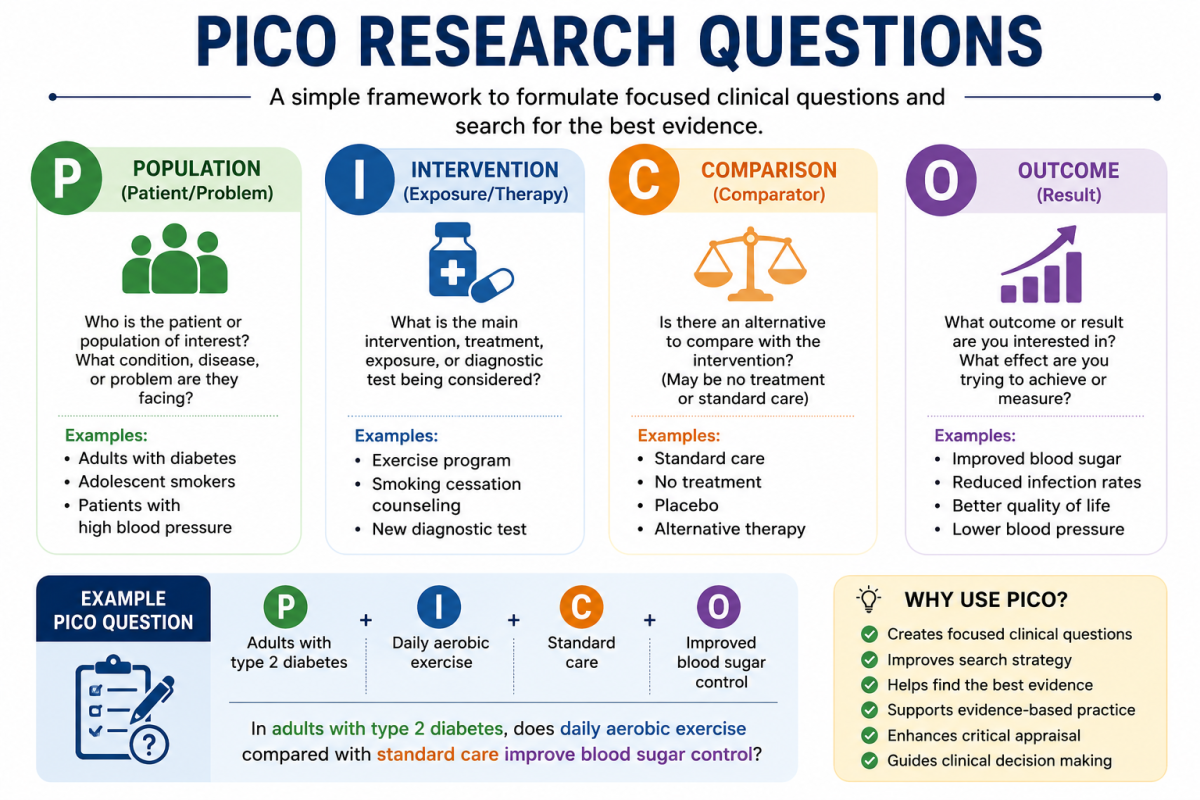
This process demonstrates how using PICO helps formulate a focused clinical question that is clear and searchable.
PICO Research Questions Examples: Practical Clinical Question Samples for Evidence-Based Research and Critical Appraisal
Example 1: Diabetes Management
P: Adults with diabetes
I: Daily exercise
C: Standard care
O: Improved blood sugar control
Research Question:
- In adults with diabetes, does daily exercise compared with standard care improve blood sugar control?
Example 2: Smoking Cessation
P: Adolescent smokers
I: Counseling programs
C: No counseling
O: Smoking cessation rates
Research Question:
- Among adolescent smokers, does counseling increase smoking cessation rates compared with no counseling?
Example 3: High Blood Pressure
P: Adults with high blood pressure
I: Low-sodium diet
C: Regular diet
O: Lower blood pressure
Research Question:
- In adults with high blood pressure, does a low-sodium diet reduce blood pressure more effectively than a regular diet?
Example 4: Infection Prevention
P: Hospital patients
I: Enhanced hand hygiene programs
C: Standard hygiene procedures
O: Reduced infection rates
Research Question:
- Among hospital patients, do enhanced hand hygiene programs reduce infection rates compared with standard procedures?
Example 5: Diagnostic Testing
P: Patients with suspected heart disease
I: New diagnostic test
C: Traditional diagnostic test
O: Accurate diagnosis
Research Question:
- In patients with suspected heart disease, does the new diagnostic test diagnose disease more accurately than traditional diagnostic tests?
Example 6: Mental Health Treatment
P: Adults with depression
I: Cognitive behavioral therapy
C: Medication alone
O: Symptom improvement
Research Question:
- In adults with depression, is cognitive behavioral therapy more effective than medication alone in reducing symptoms?
Example 7: Disease Prevention
P: Adults at risk of diabetes
I: Lifestyle intervention
C: Standard education
O: Reduced risk of developing diabetes
Research Question:
- Among adults at risk of diabetes, does lifestyle intervention reduce the risk of developing diabetes compared with standard education?
Example 8: Prognosis Research
P: Patients recovering from stroke
I: Early rehabilitation
C: Delayed rehabilitation
O: Recovery outcomes
Research Question:
- In stroke patients, does early rehabilitation improve prognosis compared with delayed rehabilitation?
These examples demonstrate how PICO Research Questions can represent different types of clinical and healthcare inquiries.
PICO Research Questions: Advantages, Strengths, Disadvantages, and Limitations of the PICO Framework for Focused Clinical Research and Appraisal
Advantages and Strengths of PICO Research Questions
Provides Clear Structure
- The PICO framework gives researchers a logical structure for question development.
- It prevents vague and confusing research questions.
Supports Evidence-Based Practice
- PICO Research Questions are central to evidence-based practice.
- They help healthcare providers make informed decisions using research evidence.
Improves Search for Evidence
- Researchers can identify keywords more easily.
- Database searches become more efficient and systematic.
- The search strategy becomes more focused.
Enhances Critical Appraisal
- PICO makes it easier to assess the relevance and quality of research findings.
- Researchers can compare studies against the original clinical question.
Improves Research Efficiency
- Time spent reviewing irrelevant literature is reduced.
- Researchers locate the best evidence faster.
Encourages Clinical Relevance
- Questions remain closely linked to patient care.
- Findings are more useful in clinical settings.
Helps Diagnose and Evaluate Treatments
- PICO can be used for:
- Diagnosis
- Therapy
- Prevention
- Etiology
- Prognosis
- Exposure assessment
Disadvantages and Limitations of the PICO Framework
Not Ideal for Every Research Design
- PICO works best for quantitative clinical research.
- It may be less suitable for qualitative studies exploring experiences or perceptions.
Can Oversimplify Complex Problems
- Some healthcare issues involve multiple interventions and outcomes.
- The framework may not fully capture these complexities.
Comparison May Not Always Exist
- Certain research topics lack a clear comparison group.
- This can make question development challenging.
May Restrict Broader Exploration
- Highly focused questions sometimes limit exploration of wider issues.
- Researchers may overlook unexpected findings.
Requires Careful Component Selection
- Poorly selected patient populations or outcomes can weaken the question.
- Researchers must accurately identify each component.
Not Always Suitable for Emerging Topics
- New clinical issues may lack sufficient research evidence.
- Finding studies that answer the question can be difficult.
Final Thoughts
- PICO Research Questions are among the most effective tools for developing a focused clinical question.
- The pico framework helps researchers formulate clear, answerable, and evidence-based questions.
- By identifying the patient, intervention, comparison, and outcome, researchers can create a strong foundation for clinical research.
- Whether investigating diagnosis, treatment, prognosis, prevention, or exposure, PICO Research Questions provide a practical guide for searching, evaluating, and applying the best evidence.
- For students, healthcare providers, and researchers alike, mastering the PICO framework is an essential skill for conducting high-quality evidence-based research and appraisal.
Research Questions
Types of Research Questions
Explore different categories of research questions used in academic studies.
Descriptive Research Question
What is happening?
→
Exploratory Research Question
Explore unknowns
→
Explanatory Research Question
Why it happens
→
Comparative Research Question
Compare variables
→
Relationship-Based Research Question
Connections
→
Causal Research Question
Cause-effect
→
Predictive Research Question
Future outcomes
→
Evaluative Research Question
Assess value
→
Interpretive Research Question
Meaning focus
→
Action Research Question
Practical change
→
Phenomenological Research Question
Lived experience
→
Grounded Theory Research Question
Theory building
→
Historical Research Question
Past events
→
Ethnographic Research Question
Culture study
→
Systematic Review Research Question
Evidence synthesis
→
PICO Research Question
Clinical format
→
PEO Research Question
Qualitative health
→
FINER Research Question
Quality criteria
→
Hypothesis-Based Research Question
Testable design
→
Mixed Methods Research Question
Combined approach
→
