
Blog
How To Write Hypothesis-Based Research Questions

Understanding Hypothesis-Based Research Questions: Definition, Purpose, and Relationship Between Research Question and Hypothesis
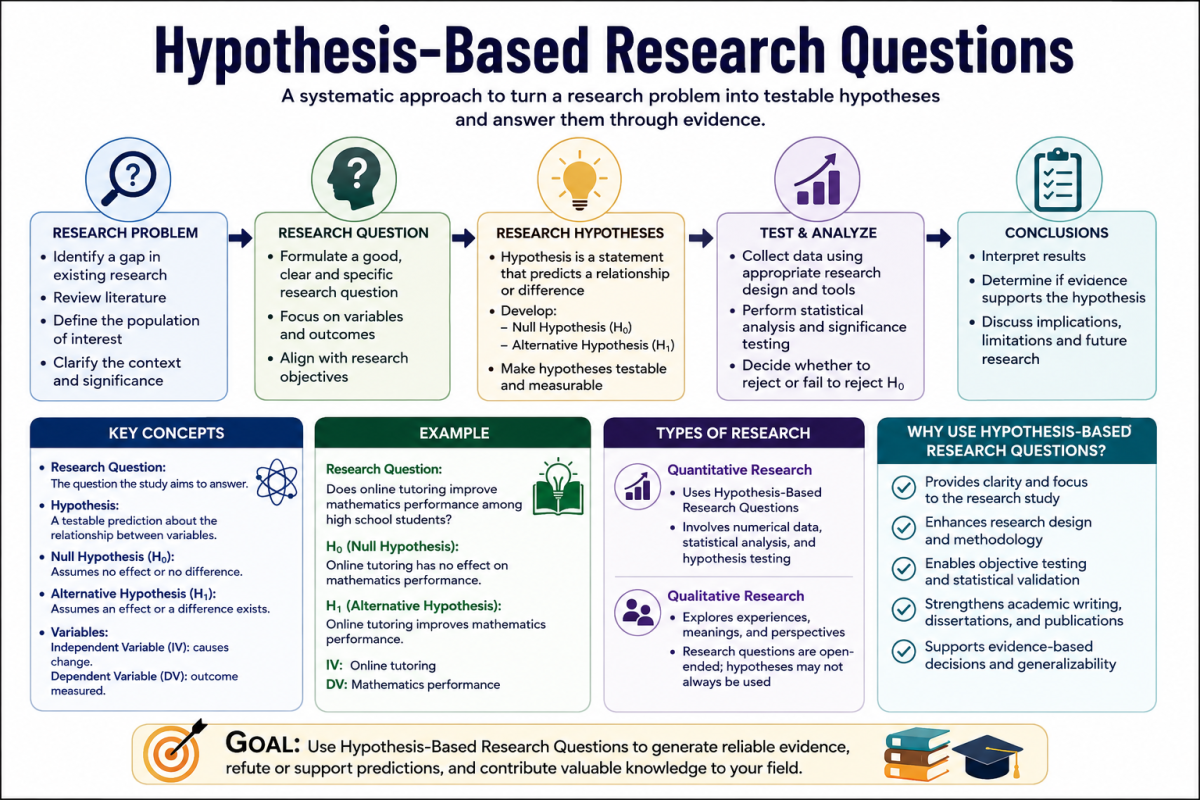
Hypothesis-Based Research Questions are research questions that are directly connected to a hypothesis and are designed to test a predicted relationship, difference, or effect between variables within a research study.
What Are Hypothesis-Based Research Questions?
- Hypothesis-Based Research Questions are structured questions that guide researchers toward testing a prediction.
- They are commonly used in quantitative studies where statistical testing is required.
- These questions help researchers investigate the relationship between two or more variables.
- They provide a framework for collecting measurable data and conducting statistical analysis.
- Unlike exploratory questions used in qualitative research, these questions focus on verification and testing.
- The primary goal is to determine whether evidence supports or helps refute a proposed explanation.
What Is a Hypothesis?
- A hypothesis is a statement that predicts an expected outcome in a research study.
- It is developed after examining a research problem and reviewing existing research.
- A hypothesis should be:
- Clear
- Specific
- Logical
- Measurable
- Testable
- Researchers use hypotheses to predict relationships, effects, or differences before collecting data.
- Well-developed hypothesis statements help maintain focus throughout the research process.
Types of Research Hypotheses
Null Hypothesis (H₀)
- The null hypothesis assumes that no relationship or difference exists.
- It serves as the default position in statistical hypothesis testing.
- Researchers attempt to gather evidence that will reject or fail to reject the null hypothesis.
Example:
- H₀: There is no difference in outcomes between students who attend online tutoring and those who do not.
Alternative Hypothesis (H₁)
- The alternative hypothesis or alternate hypothesis suggests that a relationship, effect, or difference does exist.
- It is the prediction researchers hope to support through data collection.
Example:
- H₁: Students who attend online tutoring achieve higher academic performance than those who do not.
Null and Alternative Hypotheses
- Most Hypothesis-Based Research Questions involve both null and alternative hypotheses.
- The null hypothesis acts as a benchmark.
- The alternative hypothesis presents the expected finding.
- Results from significance testing determine whether evidence supports the alternative hypothesis.
Relationship Between Research Question and Hypothesis
The connection between a research question and hypothesis is one of the most important concepts in research.
Research Question
- Identifies what the researcher wants to investigate.
- Provides direction for the entire research project.
- Establishes the scope of the study.
Example:
- Does remote work improve employee productivity?
Hypothesis
- Predicts the answer to the research question.
Example:
- Employees who work remotely demonstrate higher productivity than employees working exclusively in offices.
Research Question and Hypothesis Compared
| Research Question | Hypothesis |
|---|---|
| Asks a question | Provides a prediction |
| Guides investigation | Tests expectations |
| Broad and exploratory | Specific and predictive |
| Can be qualitative or quantitative | Usually associated with quantitative research |
Why Researchers Use Hypothesis-Based Research Questions
- They provide a clear path for data collection.
- They strengthen the overall research design.
- They facilitate objective testing.
- They improve alignment between research objectives and methodology.
- They help researchers develop reliable outcome measurement tools.
- They support accurate sample size calculations.
- They enhance the generalizability of the research findings.
- They improve the quality of academic writing, dissertations, and journal publications.
How To Write Hypothesis-Based Research Questions: A 4-Step Process for Developing a Good Research Question and Research Hypotheses
Creating effective Hypothesis-Based Research Questions requires a systematic approach. The following four-step process can help researchers formulate meaningful and testable questions.
Step 1: Identify the Research Problem
Every study begins with a clear research problem.
How to Identify a Research Problem
- Examine gaps in existing research.
- Review recent journal articles.
- Conduct a preliminary literature review.
- Identify unresolved issues within your discipline.
- Consider practical or theoretical challenges.
Questions to Ask
- What issue requires investigation?
- What remains unanswered?
- Why is this problem important?
- Does it have practical or theoretical significance?
Example
Research Problem:
- Rising employee burnout in remote workplaces.
Step 2: Formulate a Research Question
The next step involves developing the research question.
Characteristics of a Good Research Question
A good research question should be:
- Clear
- Specific
- Focused
- Relevant
- Feasible
- Researchable
How to Formulate a Research Question
- Define the population of interest.
- Identify the key variables.
- Specify the context.
- Ensure the question aligns with your research objectives.
Example
Specific Research Question:
- Does remote work reduce employee burnout among software developers?
Tips to Refine Your Research Question
- Remove unnecessary wording.
- Narrow broad topics.
- Ensure measurable outcomes.
- Verify alignment with available resources.
The ability to refine your research question often determines the success of a study.
Step 3: Identify Variables and Develop Research Hypotheses
After formulating a research question, identify variables.
Independent Variable
The factor being manipulated or examined.
Example:
- Remote work arrangements.
Dependent Variable
The outcome being measured.
Example:
- Employee burnout levels.
Develop the Hypothesis
The hypothesis states the expected relationship between variables.
Null Hypothesis
- Remote work has no effect on employee burnout.
Alternative Hypothesis
- Remote work reduces employee burnout.
Developing Several Hypotheses
Complex studies may require several hypotheses.
Example:
- Hypothesis 1: Remote work reduces burnout.
- Hypothesis 2: Remote work improves job satisfaction.
- Hypothesis 3: Remote work increases productivity.
Step 4: Evaluate Feasibility and Testability
The final step ensures the hypothesis can be tested effectively.
Assess Feasibility
Consider:
- Time available
- Budget
- Access to participants
- Ethical requirements
- Available resources
Assess Testability
Ask:
- Can the variables be measured?
- Is statistical testing possible?
- Can data be collected reliably?
Consider Research Methodology
The chosen research methodology should align with the hypothesis.
Important considerations include:
- Research instruments
- Data collection procedures
- Outcome measurement tool selection
- Inclusion and exclusion criteria
- Sample size calculations
Verify Clinical Relevance
In health-related studies and designing clinical research, researchers should determine whether findings have practical importance.
Final Checklist
Before proceeding, ensure:
- The question is specific.
- The hypothesis is measurable.
- Variables are clearly defined.
- Statistical analysis is possible.
- Research objectives are addressed.
Hypothesis-Based Research Questions Examples: Research Question and Hypothesis Formulation Across Different Types of Research
Different disciplines use Hypothesis-Based Research Questions in unique ways. Below are practical examples.
Example 1: Education Research
Research Question
- Does online tutoring improve mathematics performance among high school students?
Null Hypothesis
- Online tutoring has no effect on mathematics performance.
Alternative Hypothesis
- Online tutoring improves mathematics performance.
Variables
- Independent Variable: Online tutoring
- Dependent Variable: Mathematics performance
Example 2: Healthcare Research
Research Question
- Does a low-sodium diet reduce blood pressure among adults with hypertension?
Research or Clinical Hypothesis
- Adults following a low-sodium diet experience lower blood pressure.
Clinical Relevance
- Findings can influence treatment recommendations.
Example 3: Business Research
Research Question
- Does employee recognition increase job satisfaction?
Hypothesis
- Employees receiving recognition report higher job satisfaction.
Example 4: Marketing Research
Comparative Research Question
- Is there a difference in outcomes between personalized advertisements and generic advertisements?
Comparative Hypothesis
- Personalized advertisements generate higher conversion rates.
Example 5: Psychology Research
Research Question
- Does social media use affect self-esteem among university students?
Hypothesis
- Increased social media use decreases self-esteem.
Example 6: Environmental Research
Research Question
- Does urban tree coverage reduce local temperatures?
Hypothesis
- Areas with greater tree coverage experience lower temperatures.
Example 7: Clinical Research
Primary Research Question
- Does Drug A reduce migraine frequency compared to Drug B?
Null Hypothesis
- No difference exists between Drug A and Drug B.
Alternative Hypothesis
- Drug A reduces migraine frequency more effectively.
Inclusion and Exclusion Criteria
Researchers may specify:
- Adults aged 18–65.
- Diagnosed migraine sufferers.
- Exclusion of participants with unrelated neurological disorders.
Example 8: One-Sided Hypothesis Example
Research Question
- Does a new teaching strategy improve examination scores?
1-Sided Hypothesis
- Students exposed to the new strategy will score higher.
A 1-sided hypothesis predicts a specific direction of effect.
Hypothesis-Based Research Questions: Advantages, Strengths, Disadvantages, and Limitations in Academic Writing and Research Objectives Development
Understanding the strengths and weaknesses of Hypothesis-Based Research Questions helps researchers select the most appropriate approach.
Advantages and Strengths
1. Provides Clear Direction
- Establishes focus from the beginning.
- Helps guide the entire research process.
- Aligns with research goals.
2. Supports Quantitative Research
- Particularly valuable for quantitative studies.
- Facilitates data collection and measurement.
- Enables rigorous testing.
3. Improves Research Design
- Creates stronger research design structures.
- Enhances methodological consistency.
- Clarifies variable relationships.
4. Facilitates Statistical Analysis
- Supports advanced analytical techniques.
- Enables statistical hypothesis testing.
- Improves evidence-based conclusions.
5. Aligns Hypotheses and Objectives
- Creates strong connections between hypotheses and objectives.
- Ensures studies remain focused on intended outcomes.
6. Useful for Dissertations
- Widely used in dissertation research.
- Preferred in many scientific disciplines.
- Strengthens methodological rigor.
7. Encourages Precision
- Requires researchers to define variables clearly.
- Promotes stronger measurement procedures.
8. Supports Generalizability
- Well-designed studies improve the generalizability of the research findings.
- Enables broader application of results.
Disadvantages and Limitations
1. Limited Flexibility
- Researchers may become overly focused on testing predictions.
- Unexpected findings may receive less attention.
2. Not Always Suitable for Qualitative Research
- Many qualitative research studies prioritize exploration rather than prediction.
- Researchers may use open-ended questions instead.
3. Risk of Oversimplification
- Complex social phenomena may not fit simple hypothesis structures.
- Human behavior often involves multiple influences.
4. Dependence on Existing Knowledge
- Effective hypotheses require substantial understanding of existing research.
- Weak literature reviews often lead to weak hypotheses.
5. Potential for Bias
- Researchers may unconsciously seek evidence supporting their expectations.
- Strong methodology is necessary to maintain objectivity.
6. Requires Measurable Variables
- Some concepts are difficult to quantify.
- Abstract ideas may be challenging to operationalize.
7. May Overlook Exploratory Insights
- Some researchers prefer hypotheses rather than research questions, while others argue that exploratory questions reveal unexpected discoveries.
- Balance is often necessary depending on the type of research.
When Should You Use Hypothesis-Based Research Questions?
Use Hypothesis-Based Research Questions when:
- Conducting quantitative studies.
- Testing relationships between two or more variables.
- Investigating a difference in outcomes.
- Performing statistical analysis.
- Completing a dissertation or thesis.
- Conducting clinical or experimental studies.
- Evaluating interventions or treatments.
- Testing theoretical predictions.
When properly developed, Hypothesis-Based Research Questions provide a powerful framework for transforming research problems into measurable investigations. They help researchers formulate a research question, develop meaningful research hypotheses, conduct rigorous significance testing, and generate evidence that contributes to both theory and practice.
Research Questions
Types of Research Questions
Explore different categories of research questions used in academic studies.
Descriptive Research Question
What is happening?
→
Exploratory Research Question
Explore unknowns
→
Explanatory Research Question
Why it happens
→
Comparative Research Question
Compare variables
→
Relationship-Based Research Question
Connections
→
Causal Research Question
Cause-effect
→
Predictive Research Question
Future outcomes
→
Evaluative Research Question
Assess value
→
Interpretive Research Question
Meaning focus
→
Action Research Question
Practical change
→
Phenomenological Research Question
Lived experience
→
Grounded Theory Research Question
Theory building
→
Historical Research Question
Past events
→
Ethnographic Research Question
Culture study
→
Systematic Review Research Question
Evidence synthesis
→
PICO Research Question
Clinical format
→
PEO Research Question
Qualitative health
→
FINER Research Question
Quality criteria
→
Hypothesis-Based Research Question
Testable design
→
Mixed Methods Research Question
Combined approach
→
