
Blog
How To Write Complex Hypothesis With Example

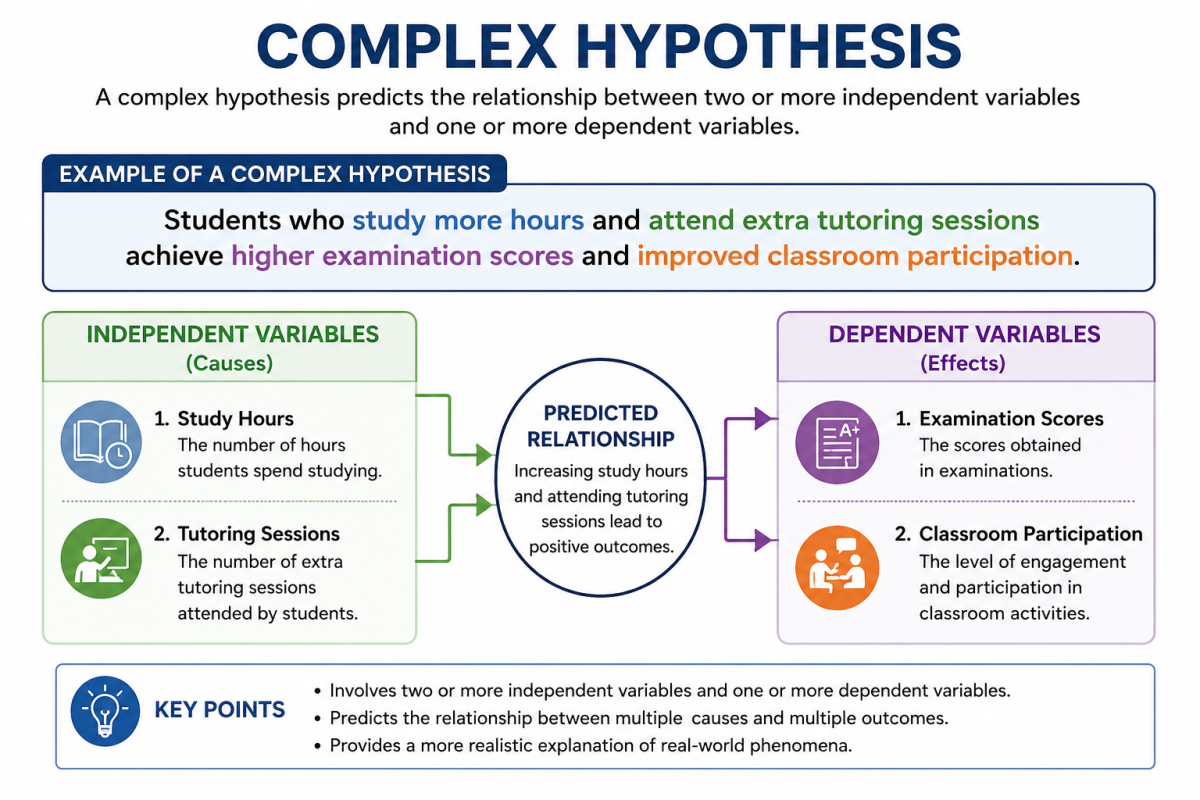
What Is a Complex Hypothesis? Definition, Meaning, and Importance in Research
- A Complex Hypothesis is a type of hypothesis that predicts a relationship among two or more variables rather than focusing on a single independent variable and a single dependent variable.
- Unlike a simple hypothesis, which examines the connection between one independent and one dependent variable, a complex hypothesis explores how multiple factors interact within a research study.
- In research, a hypothesis is an assumption or an educated statement that can be tested through observation, experimentation, and data collection.
- A complex hypothesis typically includes:
- Two or more independent variables
- One or more dependent variables
- A predicted relationship between variables
- A clear and measurable outcome
- Example of a simple hypothesis:
- Students who study more hours achieve higher examination scores.
- Here, there is one independent variable (study hours) and one dependent variable (exam scores).
- Example of a Complex Hypothesis:
- Students who study more hours and attend extra tutoring sessions achieve higher examination scores and improved classroom participation.
- This statement includes:
- Two independent variables (study hours and tutoring sessions)
- Two dependent variables (exam scores and classroom participation)
Definition of Complex Hypothesis
- A Complex Hypothesis is a testable hypothesis that predicts the relationship between multiple independent and dependent variables within a research study.
- It goes beyond examining the relationship between two variables and investigates the interdependency between variables in more realistic situations.
- Because many real-world phenomena are influenced by several factors at the same time, researchers often use a complex hypothesis in advanced studies.
Meaning of a Complex Hypothesis
- The meaning of a complex hypothesis lies in its ability to explain complicated situations where outcomes are affected by several causes.
- It allows a researcher to:
- Examine multiple influences simultaneously.
- Understand how variables interact.
- Develop more accurate predictions.
- Improve the quality of findings.
- In many forms of quantitative research, a complex hypothesis helps researchers identify patterns that may not be visible when studying only one variable.
Importance of Complex Hypothesis in Research
- A Complex Hypothesis plays a critical role in effective research because it:
Provides a More Realistic View
- Most real-world situations involve more than one factor.
- Human behavior, business performance, health outcomes, and educational achievement are rarely influenced by only one variable.
- A complex hypothesis reflects these realities more accurately.
Supports Better Prediction
- Since multiple variables are considered, the hypothesis predicts outcomes with greater depth.
- Researchers can develop stronger explanations and more reliable conclusions.
Strengthens Research Design
- A well-developed complex hypothesis helps guide the entire research design.
- It determines:
- What data should be collected.
- Which variables should be measured and manipulated.
- What statistical techniques should be used.
Encourages Deeper Analysis
- Instead of focusing on a single relationship, researchers can examine:
- Multiple causes.
- Multiple effects.
- Complex interactions.
Improves Scientific Understanding
- The scientific method depends on creating and testing explanations.
- A complex hypothesis allows scientists to explore broader questions and generate more meaningful knowledge.
How To Write Complex Hypothesis with Example: A 7-Step Process for Formulating Research Hypotheses
Writing a Complex Hypothesis requires careful planning and logical thinking. The following step-by-step process can help you create a good research hypothesis that is clear, testable, and relevant.
Step 1: Identify Your Research Topic
- Begin with a specific research topic.
- The topic should be focused enough to allow investigation.
Examples:
- Impact of social media on student performance.
- Employee motivation and productivity.
- Exercise and mental health.
Why this step matters:
- A clear topic provides direction for the entire research process.
- It helps prevent vague or untestable ideas.
Step 2: Conduct Background Research
- Perform thorough background research before proposing a hypothesis.
- Review:
- Books
- Academic journals
- Government reports
- Industry publications
- Study previous research and prior research related to your topic.
Benefits:
- Helps identify existing knowledge.
- Reveals research gaps.
- Supports the development of a logical hypothesis.
Step 3: Define the Variables
- Identify all variables involved in your study.
Common variable categories include:
Independent Variable
- The factor that influences another variable.
- It is often controlled or manipulated by the researcher.
Examples:
- Study hours
- Exercise frequency
- Advertising spending
Dependent Variable
- The outcome being measured.
- It changes in response to the independent variable.
Examples:
- Academic performance
- Weight loss
- Sales revenue
In a Complex Hypothesis, there may be:
- Two or more independent variables.
- One or more dependent variables.
Step 4: Formulate a Research Question
- Convert your topic into a clear research question.
Examples:
- How do study hours and tutoring sessions affect academic performance and class participation?
- How do exercise and diet influence physical fitness and mental well-being?
A good research question should be:
- Specific
- Focused
- Researchable
- Measurable
Step 5: Develop a Prediction
- A hypothesis is essentially a prediction about expected outcomes.
Ask yourself:
- What relationship do I expect?
- Will there be a positive or negative relationship?
- Will a change in one variable affect another variable?
Your prediction should be based on:
- Theory
- Logic
- Previous findings
- Prior research
Step 6: Write the Complex Hypothesis
- Combine the variables and prediction into one statement.
Example:
- Increased study hours and participation in tutoring programs will improve examination performance and classroom participation among university students.
Why this works:
- Includes multiple variables.
- States expected outcomes.
- Can be measured objectively.
- Represents a testable prediction.
This is an excellent hypothesis example because it clearly predicts a relationship involving several variables.
Step 7: Evaluate and Refine the Hypothesis
Before finalizing, determine whether your statement is:
- Clear
- Specific
- Logical
- Measurable
- Testable
A good hypothesis should allow researchers to prove or disprove the prediction using evidence.
Questions to ask:
- Can the variables be measured?
- Is the statement supported by previous knowledge?
- Can data be collected to test it?
- Does it fit the research design?
If the answer is yes, you likely have a great hypothesis suitable for your research.
How To Write Complex Hypothesis with Example: Understanding Variables, Prediction, and the Scientific Method
Understanding variables is essential when learning How To Write Complex Hypothesis With Example because variables form the foundation of every hypothesis.
What Are Variables?
- Variables are characteristics or factors that can change.
Examples:
- Age
- Income
- Education
- Stress level
- Exercise frequency
Researchers use variables to investigate relationships and outcomes.
Independent Variables
- An independent variable is the presumed cause of change.
Examples:
- Study time
- Marketing budget
- Physical exercise
The independent variable influences other variables.
Dependent Variables
- A dependent variable is the outcome affected by another variable.
Examples:
- Academic achievement
- Customer satisfaction
- Blood pressure
Researchers measure these outcomes during the study.
Independent and Dependent Variable Relationship
- Every hypothesis examines the connection between an independent and dependent variable.
Example:
- Increased exercise leads to improved cardiovascular health.
Here:
- Independent variable = exercise
- Dependent variable = cardiovascular health
Complex Hypothesis and Multiple Variables
- A Complex Hypothesis often contains:
- Multiple independent variables.
- Multiple dependent variables.
Example:
- Regular exercise and balanced nutrition improve physical fitness and reduce stress levels.
This statement investigates multiple relationships simultaneously.
Relationship Between Variables
Researchers use hypotheses to examine the relationship between variables.
Possible relationships include:
Positive Relationship
- Both variables move in the same direction.
Example:
- Increased study time leads to higher grades.
Negative Relationship
- One variable increases while the other decreases.
Example:
- Increased stress reduces job satisfaction.
No Relationship
- Variables do not influence one another.
This outcome often supports null hypotheses.
Role of Prediction in Research
- Every hypothesis contains a prediction.
- The prediction explains what the researcher expects to find.
A strong prediction should:
- Be realistic.
- Be supported by theory.
- Be based on evidence.
- Be testable.
The Scientific Method and Hypothesis Development
The scientific method follows a systematic process:
- Observe a problem.
- Identify a research topic.
- Conduct background research.
- Develop a hypothesis.
- Collect data.
- Analyze results.
- Draw conclusions.
The hypothesis serves as the foundation for testing ideas scientifically.
Characteristics of a Good Hypothesis
A good research hypothesis should be:
- Clear and understandable.
- Specific and focused.
- Logical and evidence-based.
- Testable through observation or experimentation.
- Relevant to the research question.
- Capable of being supported or rejected.
These qualities help create a logical hypothesis that contributes to effective research.
Types of Complex Hypothesis and Other Types of Research Hypotheses
Researchers use different types of research hypotheses depending on the purpose of the study.
Complex Hypothesis
- A Complex Hypothesis predicts relationships involving:
- Two or more independent variables.
- One or more dependent variables.
Example:
- Employee training and workplace motivation increase productivity and job satisfaction.
Simple Hypothesis
- A simple hypothesis predicts a relationship between one independent variable and one dependent variable.
Example:
- Exercise improves cardiovascular health.
Null Hypothesis (H0)
- A null hypothesis is a statement indicating that no relationship or effect exists.
Example:
- There is no significant relationship between exercise frequency and cardiovascular health.
Key points:
- Expressed as H0.
- Often written as a negative statement.
- Used for statistical testing.
Alternative Hypothesis (H1 or Ha)
- The alternative hypothesis states that a relationship or effect exists.
Example:
- Exercise frequency significantly improves cardiovascular health.
Key points:
- Written as H1 or Ha.
- Opposes the null hypothesis.
- Represents the expected outcome.
Together, these form the null and alternative hypotheses used in statistical testing.
Directional Hypothesis
- A directional hypothesis predicts the direction of the relationship.
Example:
- Increased study hours lead to higher examination scores.
The researcher expects a positive effect.
Non-Directional Hypothesis
- A non-directional hypothesis predicts a relationship but does not specify the direction.
Example:
- There is a relationship between study hours and examination scores.
This approach is useful when prior evidence is limited.
Associative Hypothesis
- An associative hypothesis predicts that variables are related but does not claim one causes the other.
Example:
- Academic achievement is associated with classroom attendance.
Causal Hypothesis
- A causal hypothesis predicts a cause-and-effect relationship.
Example:
- Increased training causes higher employee productivity.
A causal relationship suggests that one factor directly influences another.
Relational Hypothesis
- A relational hypothesis predicts a relationship between variables without necessarily establishing causation.
Example:
- Job satisfaction is related to employee engagement.
Statistical Hypothesis
- A statistical hypothesis is tested using numerical data and statistical analysis.
It may involve:
- Means
- Percentages
- Correlations
- Significant difference tests
Example:
- There is a significant difference between the academic performance of students who attend tutoring sessions and those who do not.
Empirical Hypothesis
- An empirical hypothesis can be tested using observation and measurable evidence.
Example:
- Daily exercise reduces stress levels among university students.
Original Hypothesis
- An original hypothesis presents a new idea that has not been thoroughly investigated before.
Researchers often develop this type after identifying gaps in previous studies.
Characteristics of a Good Hypothesis: What Makes a Complex Hypothesis Testable and Effective
A Complex Hypothesis is only valuable when it can be tested, measured, and evaluated through a systematic research process. Whether a researcher is conducting quantitative research or another type of research, understanding the characteristics of a good hypothesis is essential for producing reliable results.
A Good Hypothesis Must Be Clear and Specific
- One of the most important characteristics of a good hypothesis is clarity.
- Readers should immediately understand:
- The variables being studied.
- The expected outcome.
- The relationship between variables.
- A vague statement creates confusion and weakens the research design.
Poor example:
- Social media affects students.
Good hypothesis example:
- Increased social media usage reduces academic performance among university students.
- The second statement clearly identifies:
- The independent variable (social media usage).
- The dependent variable (academic performance).
- The expected relationship.
A Complex Hypothesis Must Be Testable
- A testable hypothesis can be examined using data and evidence.
- Researchers must be able to collect information that can either support or reject the prediction.
- A hypothesis should allow researchers to prove or disprove the proposed relationship.
For example:
- Employee training and workplace motivation increase productivity and job satisfaction.
This Complex Hypothesis can be tested by measuring:
- Training participation.
- Motivation levels.
- Productivity outcomes.
- Job satisfaction scores.
A Good Research Hypothesis Must Include Measurable Variables
- Variables should be clearly defined and capable of being measured and manipulated where appropriate.
- In many research studies, variables are expressed as:
- Hours.
- Percentages.
- Scores.
- Frequencies.
- Ratings.
Examples:
- Study hours.
- Income level.
- Customer satisfaction score.
- Employee productivity rate.
A hypothesis that cannot be measured scientifically cannot contribute to effective research.
A Complex Hypothesis Should Be Based on Logic
- A logical hypothesis is supported by existing theories and evidence.
- The prediction should not be based on personal opinions or assumptions alone.
- Researchers should review:
- Previous research.
- Prior research.
- Academic literature.
- Background research.
This helps ensure the hypothesis has a reasonable foundation.
A Good Hypothesis Should Predict a Relationship
- Every hypothesis contains a prediction.
- The hypothesis predicts how one or more variables are expected to behave.
Examples:
- Increased exercise improves physical fitness.
- Employee training increases productivity.
- Better sleep quality improves academic performance.
In a Complex Hypothesis, the prediction often involves two or more variables and may include several outcomes.
A Complex Hypothesis Should Align With the Research Question
- The research question and hypothesis must work together.
- The hypothesis should directly answer the question being investigated.
Research Question:
- How do study hours and classroom attendance affect examination performance?
Hypothesis:
- Increased study hours and higher classroom attendance improve examination performance.
This alignment strengthens the overall research process.
A Good Hypothesis Should Be Consistent With the Scientific Method
- The scientific method relies on observation, testing, and analysis.
- A hypothesis must fit within this process.
- Researchers should be able to:
- Observe a problem.
- Develop a prediction.
- Test the prediction.
- Analyze findings.
- Draw conclusions.
A Great Hypothesis Is Falsifiable
- A great hypothesis can potentially be shown to be false.
- If a statement cannot be challenged or tested, it is not scientific.
For example:
- Students who attend tutoring sessions achieve higher grades.
Researchers can test this statement using actual performance data.
A Complex Hypothesis Should Support Effective Research
- The best Complex Hypothesis contributes to effective research by:
- Guiding data collection.
- Supporting statistical analysis.
- Improving research design.
- Producing meaningful conclusions.
When all these characteristics are present, researchers are more likely to develop a good research hypothesis capable of generating valuable findings.
How To Write Complex Hypothesis with Example for Different Types of Research
Different types of research require different approaches to hypothesis development. Understanding how to adapt a Complex Hypothesis to various research situations helps researchers create stronger and more relevant studies.
Complex Hypothesis in Quantitative Research
- Quantitative research focuses on numerical measurement and statistical analysis.
- Variables are measured using data and tested for significance.
Example:
- Employee training programs and performance incentives increase productivity and reduce employee turnover.
Why this works:
- Multiple independent variables are included.
- Multiple dependent variables are included.
- Results can be analyzed statistically.
This is a strong Complex Hypothesis for quantitative research.
Complex Hypothesis in Educational Research
Educational researchers often study learning outcomes influenced by multiple factors.
Example:
- Study hours and classroom attendance improve examination performance and student engagement.
Variables:
- Independent variables:
- Study hours.
- Classroom attendance.
- Dependent variables:
- Examination performance.
- Student engagement.
This hypothesis investigates the interdependency between variables affecting educational success.
Complex Hypothesis in Healthcare Research
Healthcare studies frequently involve multiple causes and outcomes.
Example:
- Regular exercise and balanced nutrition reduce blood pressure and improve cardiovascular health.
This Complex Hypothesis allows researchers to analyze several health-related factors simultaneously.
Complex Hypothesis in Business Research
Businesses often examine multiple influences on organizational performance.
Example:
- Employee training and workplace motivation increase productivity and customer satisfaction.
This type of hypothesis supports strategic decision-making and organizational improvement.
Complex Hypothesis in Social Science Research
Social science studies often investigate human behavior and social relationships.
Example:
- Social media usage and peer influence affect self-esteem and academic performance among adolescents.
This example demonstrates how a Complex Hypothesis can address complex social issues.
Complex Hypothesis in Marketing Research
Marketing researchers often evaluate several factors affecting consumer behavior.
Example:
- Product quality and online advertising increase customer loyalty and purchase intention.
This hypothesis helps organizations understand multiple influences on consumer decisions.
Tips for Writing a Complex Hypothesis for Any Research Study
When writing a hypothesis, remember to:
- Conduct background research first.
- Review previous research.
- Define all variables clearly.
- Create a testable prediction.
- Ensure variables can be measured.
- Align the hypothesis with the research question.
- Keep the statement specific and focused.
These steps help researchers create a Complex Hypothesis suitable for different research methods and research studies.
Complex Hypothesis Example: Real-World Examples for Effective Research Studies
Examining examples is one of the best ways to understand how a Complex Hypothesis works in practice.
Education Example
Hypothesis:
- Study hours and tutoring participation improve examination scores and classroom engagement among university students.
Independent variables:
- Study hours.
- Tutoring participation.
Dependent variables:
- Examination scores.
- Classroom engagement.
This hypothesis examines multiple educational influences and outcomes.
Healthcare Example
Hypothesis:
- Regular exercise and healthy dietary habits reduce obesity rates and improve cardiovascular fitness.
Independent variables:
- Exercise frequency.
- Dietary habits.
Dependent variables:
- Obesity rates.
- Cardiovascular fitness.
This is a strong healthcare-related Complex Hypothesis.
Business Example
Hypothesis:
- Employee training and performance-based rewards increase productivity and job satisfaction.
Independent variables:
- Training programs.
- Performance rewards.
Dependent variables:
- Productivity.
- Job satisfaction.
This hypothesis is useful in organizational research.
Marketing Example
Hypothesis:
- Product quality and social media advertising increase customer loyalty and purchase frequency.
Independent variables:
- Product quality.
- Social media advertising.
Dependent variables:
- Customer loyalty.
- Purchase frequency.
Environmental Research Example
Hypothesis:
- Renewable energy adoption and government incentives reduce carbon emissions and improve energy efficiency.
Independent variables:
- Renewable energy adoption.
- Government incentives.
Dependent variables:
- Carbon emissions.
- Energy efficiency.
Technology Research Example
Hypothesis:
- Technology training and software usability improve employee productivity and system adoption rates.
This example demonstrates how a Complex Hypothesis can be applied to workplace technology studies.
What Makes These Examples Effective?
These examples succeed because they:
- Include clearly defined variables.
- Present a testable prediction.
- Follow the scientific method.
- Support statistical analysis.
- Address realistic research problems.
- Contribute to effective research.
Common Mistakes in Writing a Hypothesis and How To Write Complex Hypothesis with Example Correctly
Many researchers make mistakes when developing a hypothesis. Understanding these common errors can help improve the quality of your research.
Mistake 1: Creating a Vague Hypothesis
Poor example:
- Technology affects learning.
Problem:
- Variables are not clearly defined.
- The relationship is unclear.
Better example:
- Educational technology usage improves academic performance and classroom engagement among high school students.
Mistake 2: Using Variables That Cannot Be Measured
Poor example:
- Happiness creates success.
Problem:
- Variables may not be clearly measurable.
A Complex Hypothesis should involve variables that can be measured and manipulated whenever possible.
Mistake 3: Ignoring Previous Research
- Some researchers create hypotheses without reviewing prior research.
- This often leads to weak or unsupported predictions.
Before proposing a hypothesis:
- Conduct background research.
- Examine previous research.
- Identify existing findings.
Mistake 4: Writing a Hypothesis That Is Too Broad
Poor example:
- Education affects society.
Problem:
- Too many possible interpretations.
- Difficult to test.
Better example:
- Teacher training and classroom technology improve student performance and classroom participation.
Mistake 5: Confusing Correlation With Causation
Researchers must distinguish between:
- Associative hypothesis.
- Relational hypothesis.
- Causal hypothesis.
A causal hypothesis suggests one factor directly influences another.
An associative hypothesis simply suggests a relationship between variables.
Mistake 6: Forgetting Null and Alternative Hypotheses
Researchers should often develop both:
Null Hypothesis (H0)
- A null hypothesis is a statement that no relationship exists.
- It is usually expressed as a negative statement.
Example:
- There is no significant difference in academic performance between students who receive tutoring and those who do not.
Alternative Hypothesis (H1 or Ha)
- The alternative hypothesis predicts that a relationship does exist.
Example:
- Students who receive tutoring achieve higher academic performance.
These null and alternative hypotheses are important for statistical testing.
Mistake 7: Failing to Identify Variables Correctly
Researchers should clearly distinguish:
- Independent variable.
- Dependent variable.
A simple hypothesis may include:
- One independent variable.
- One dependent variable.
A Complex Hypothesis often includes:
- Two or more independent variables.
- One or more dependent variables.
Mistake 8: Creating a Hypothesis Without a Prediction
A hypothesis must predict an outcome.
Poor example:
- Study habits and grades are related.
Better example:
- Increased study hours and classroom attendance improve examination performance and classroom participation.
How To Write Complex Hypothesis with Example Correctly
To create a strong Complex Hypothesis, follow these guidelines:
- Start with a clear research topic.
- Conduct thorough background research.
- Review prior research and previous research.
- Develop a focused research question.
- Identify all independent and dependent variables.
- Create a testable prediction.
- Ensure the hypothesis can be measured statistically.
- Confirm that it supports the research design.
- Make sure it can be proved or disproved through evidence.
- Final Thoughts
- A Complex Hypothesis is one of the most valuable tools in modern research because it allows researchers to investigate the relationship between two variables, multiple outcomes, and the broader interdependency between variables.
- Learning How To Write Complex Hypothesis With Example helps researchers create stronger studies, develop a testable hypothesis, and produce more reliable findings.
- Whether you are conducting quantitative research, designing a new research study, or creating a hypothesis for your research, understanding the principles behind a Complex Hypothesis will improve the quality and accuracy of your work.
Research Hypotheses
Types of Research Hypotheses
Explore key hypothesis categories used in academic research and studies.
Types of Hypotheses
Overview
→
Research Hypotheses
Basics
→
Alternative
H1
→
Null
H0
→
Directional
One-tailed
→
Non-Directional
Two-tailed
→
Simple
One variable
→
Complex
Multiple variables
→
Causal
Cause-effect
→
Associative
Relationship
→
Statistical
Testing
→
Working
Temporary
→
Declarative
Statement form
→
Question Form
Question-based
→
Empirical
Observed data
→
Logical
Reasoned
→
Value
Business focus
→
