
Blog
How To Write Working Hypothesis With Examples

What Is a Working Hypothesis? Definition, Purpose, and Introduction to Working Hypotheses
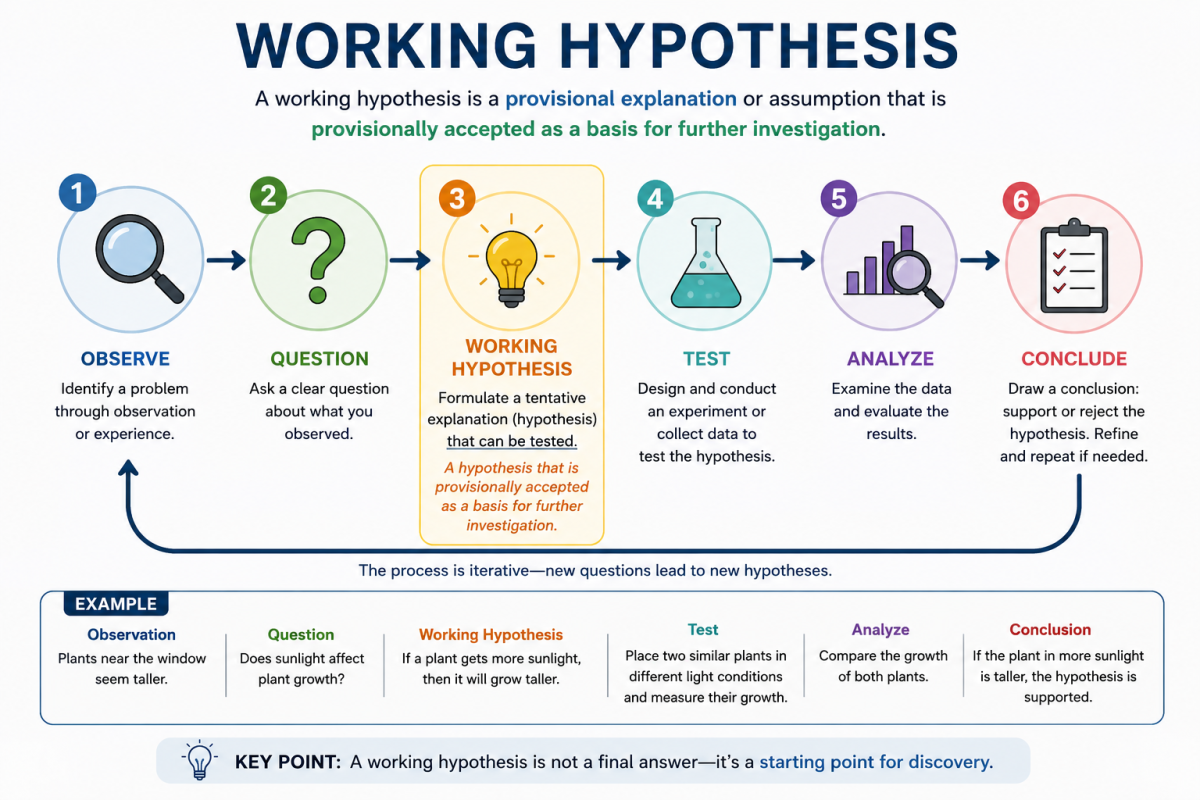
- A Working Hypothesis is a preliminary explanation or assumption that guides investigation, research, or problem-solving.
- Simply put, a working hypothesis is a hypothesis that is provisionally accepted until enough evidence becomes available to support, modify, or reject it.
- Researchers often describe it as a hypothesis that is provisionally accepted as a basis for further investigation.
- Unlike final conclusions, working hypotheses are flexible and can change as new information emerges.
- The idea of a working hypothesis originated from philosophical discussions about inquiry and scientific thinking.
- Scholars such as Charles Sanders Peirce (Peirce), John Dewey (Dewey), and George Herbert Mead (Mead) emphasized the importance of provisional explanations in human cognition and scientific inquiry.
- According to these thinkers, knowledge develops through observation, experimentation, and continuous evaluation.
Definition of a Working Hypothesis
- A Working Hypothesis can be defined as:
- A temporary proposition created to explain a phenomenon.
- A statement of expectation that directs research activities.
- A hypothetical explanation that remains open to revision.
- A starting assumption used as a point of departure for investigation.
- In many cases, the statement of a working hypothesis serves as the foundation for later theories and conclusions.
- Because it is not permanently established, it is considered provisional rather than absolute.
- It is often provisionally accepted as a basis for conducting studies and gathering evidence.
Purpose of Working Hypotheses
Working hypotheses serve several important purposes:
1. Provide Direction
- They help researchers formulate clear objectives.
- They prevent investigations from becoming random.
- They establish a logical framework for inquiry.
2. Act as a Basis for Further Investigation
- A Working Hypothesis gives researchers a clear starting point.
- It helps identify what information should be collected.
- It supports systematic analysis.
3. Encourage Critical Thinking
- Researchers constantly evaluate evidence against the proposed explanation.
- The process improves cognition and analytical skills.
- It encourages questioning and refinement of ideas.
4. Support the Scientific Method
- The scientific method relies heavily on assumptions that can be tested.
- A Working Hypothesis allows researchers to move from observation to experimentation.
- Through hypothesis testing, evidence either strengthens or weakens the explanation.
5. Promote Fruitful Research
- A fruitful hypothesis generates new questions.
- It stimulates discoveries and deeper understanding.
- Good working hypotheses often lead to broader theories.
Historical Background of Working Hypotheses
Peirce and Hypothetical Reasoning
- Peirce viewed hypotheses as tools for explaining observations.
- He believed that hypothetical reasoning was essential for discovery.
- His ideas influenced modern scientific investigation.
Dewey’s Contribution
- Dewey emphasized inquiry as an ongoing process.
- He argued that provisional explanations should be continuously evaluated.
- According to Dewey, knowledge develops through experience and verification.
Mead and Human Cognition
- Mead linked hypotheses with social interaction and cognition.
- He believed that people construct explanations to understand their environment.
- These explanations evolve with experience.
Working Hypotheses in the Scientific Method
- The scientific method follows a structured sequence:
- Observation.
- Problem identification.
- Development of a Working Hypothesis.
- Experimentation.
- Verification.
- Analysis.
- Conclusion.
- Because evidence may change, the Working Hypothesis remains tentative until adequate support is obtained.
How To Write Working Hypothesis With Examples: A 7-Step Process for Formulating a Hypothesis
Creating a strong Working Hypothesis requires a logical approach. The following 7-step process of statistical hypothesis development helps ensure clarity and accuracy.
Step 1: Identify the Problem
- Begin by defining the issue you want to investigate.
- Ask questions about what needs explanation.
- Clearly specify the research focus.
Example:
- Problem: Students’ grades have declined during online learning.
Step 2: Gather Background Information
- Review existing studies and observations.
- Collect facts relevant to the problem.
- Evaluate available evidence before making assumptions.
Example:
- Previous studies suggest that reduced interaction affects academic performance.
Step 3: Determine Variables
- Identify independent and dependent variables.
- Understand the relationship you wish to examine.
Example:
- Independent variable: Classroom interaction.
- Dependent variable: Academic performance.
Step 4: Formulate a Hypothesis
- Develop a clear proposition.
- Ensure that the statement is specific and measurable.
- The statement of a working hypothesis should explain an expected relationship.
Example:
- Increased classroom interaction improves students’ academic performance.
Step 5: Establish the Null and Alternative Hypothesis
During hypothesis testing, researchers normally formulate two statistical statements:
Null Hypothesis (Null)
- States that no relationship exists.
- Example:
- Classroom interaction has no effect on academic performance.
Alternative Hypothesis
- Suggests that a relationship exists.
- Example:
- Increased classroom interaction improves academic performance.
These two statements form the basis of the process of statistical hypothesis testing.
Step 6: Test and Evaluate
- Collect evidence through experiments or observations.
- Analyze findings objectively.
- Evaluate whether the explanation remains tenable.
This stage reflects the Popperian principle of falsification:
- A theory should be capable of being disproved.
- Evidence determines whether the explanation survives testing.
Step 7: Revise When Necessary
- A Working Hypothesis should remain flexible.
- If evidence contradicts expectations, modify the proposition.
- Researchers should avoid becoming emotionally attached to assumptions.
Example of the Complete Process
Problem:
- Employees show low productivity.
Working Hypothesis:
- Flexible work schedules increase employee productivity.
Null Hypothesis:
- Flexible work schedules have no effect on productivity.
Alternative Hypothesis:
- Flexible work schedules improve productivity.
After verification and analysis, the researcher decides whether the explanation remains acceptable or requires revision.
How To Write Working Hypothesis With Examples for Research, Projects, and Everyday Problems
A Working Hypothesis is useful far beyond scientific laboratories. It can be applied to research, business projects, and everyday decision-making.
Working Hypothesis in Research
Example:
Research Topic:
- Effects of social media usage on academic performance.
Working Hypothesis:
- Excessive social media use reduces students’ academic performance.
Purpose:
- Guides data collection.
- Supports hypothesis testing.
- Helps researchers evaluate relationships.
Working Hypothesis in Business Projects
Example:
Problem:
- Declining customer satisfaction.
Working Hypothesis:
- Faster response times improve customer satisfaction.
Benefits:
- Provides measurable objectives.
- Helps managers evaluate strategies.
- Supports evidence-based decisions.
Working Hypothesis in Healthcare
Example:
Problem:
- High patient waiting times.
Working Hypothesis:
- Increasing staff numbers reduces waiting times.
Benefits:
- Helps identify possible solutions.
- Supports continuous improvement.
Working Hypothesis in Everyday Problems
Example:
Problem:
- Poor sleep quality.
Working Hypothesis:
- Avoiding caffeine at night improves sleep quality.
This example demonstrates that working hypotheses are practical tools for daily life.
Working Hypothesis in Education
Example:
Problem:
- Low student participation.
Working Hypothesis:
- Interactive teaching methods increase classroom participation.
Working Hypothesis in Technology
Example:
Problem:
- Low website traffic.
Working Hypothesis:
- Improved SEO increases website visitors.
Why Working Hypotheses Are Valuable
- They provide a clear point of departure.
- They encourage systematic thinking.
- They improve cognition and decision-making.
- They help individuals evaluate evidence objectively.
- They serve as a basis for further investigation.
Working Hypothesis vs Tentative Hypothesis: Key Differences Explained
Many people use these terms interchangeably, but they are not always identical.
What Is a Tentative Hypothesis?
- A tentative hypothesis is an initial assumption developed before sufficient evidence exists.
- It represents an early explanatory idea.
- It may be less structured than a Working Hypothesis.
Similarities Between the Two
Both:
- Are provisional.
- Require verification.
- Can be revised.
- Support scientific inquiry.
- Function as hypothetical explanations.
Differences Between a Working Hypothesis and a Tentative Hypothesis
Working Hypothesis
- Usually more refined.
- Created after some background investigation.
- Used as a basis for further investigation.
- Guides experiments and data collection.
- Frequently involved in hypothesis testing.
Tentative Hypothesis
- Represents an early assumption.
- May rely primarily on observation.
- Often lacks supporting evidence initially.
- Functions as a preliminary idea.
Relationship With Statistical Testing
In formal research:
- Researchers formulate a Working Hypothesis.
- They then develop the null and alternative hypothesis.
- These become part of the process of statistical hypothesis testing.
- Evidence determines whether the explanation survives verification.
Philosophical Perspectives
Popperian Principle of Falsification
- Karl Popper argued that scientific explanations must be testable.
- A tenable theory should allow the possibility of being disproved.
- This approach strengthens scientific reliability.
Oppenheim and Putnam
- Oppenheim and Putnam discussed the assumption that unitary science and the belief that unitary science can be attained.
- Their work contributed to debates about the unity of science and theory integration.
Theory of Reference and Explanatory Models
- Explanatory theories help researchers connect concepts with observations.
- The theory of reference explains how scientific concepts correspond to reality.
Working Hypotheses Beyond Science
- Working hypotheses also appear in mathematics.
- Many conjectures in mathematics remain formally unproven for years.
- Some are supported by conditional proofs before complete demonstration is achieved.
- These examples illustrate how a proposition may remain provisional until stronger evidence emerges.
Ultimately, a Working Hypothesis is a practical and explanatory tool that enables researchers, students, and professionals to formulate ideas, conduct investigations, and develop reliable conclusions through verification and continuous evaluation.
Examples of Working Hypotheses Across Different Fields and Subjects
A Working Hypothesis is not limited to scientific research. Working hypotheses can be applied in almost every field where people need to investigate problems, make decisions, and evaluate outcomes. Since a Working Hypothesis is a hypothesis that is provisionally accepted, it serves as a useful point of departure before final conclusions are reached.
Examples of Working Hypotheses in Scientific Research
- Scientific studies frequently begin with the idea of a working hypothesis.
- Researchers use a hypothetical explanation before collecting evidence.
- The Working Hypothesis becomes a basis for further investigation.
Example
Research Question:
- Does sleep affect student performance?
Statement of a Working Hypothesis:
- Students who sleep for at least eight hours perform better academically.
Additional Statistical Statements:
- Null hypothesis (null):
- Sleep duration has no effect on academic performance.
- Alternative hypothesis:
- Increased sleep duration improves academic performance.
After hypothesis testing and verification, researchers evaluate whether the explanation remains a tenable theory.
Examples in Healthcare and Medicine
Healthcare professionals frequently formulate working hypotheses to identify possible causes of medical conditions.
Example
Problem:
- Patients experience frequent headaches.
Working Hypothesis:
- Dehydration contributes to recurring headaches.
Purpose:
- Guides medical investigations.
- Helps doctors evaluate possible causes.
- Supports evidence-based treatment decisions.
Because a Working Hypothesis is provisional, additional tests may confirm or reject the assumption.
Examples in Education
Educational researchers often use working hypotheses to improve learning outcomes.
Example
Problem:
- Students participate less during lectures.
Working Hypothesis:
- Interactive classroom activities increase student engagement.
Benefits:
- Improves cognition and participation.
- Encourages active learning.
- Provides measurable objectives.
Examples in Business and Marketing
Organizations use working hypotheses when making strategic decisions.
Example
Problem:
- Online sales have decreased.
Working Hypothesis:
- Improving website speed increases customer purchases.
Through verification and data analysis, managers evaluate whether the assumption is supported.
Examples in Psychology
Psychologists rely on explanatory assumptions to understand behavior.
Example
Problem:
- Employees experience high stress levels.
Working Hypothesis:
- Excessive workload increases workplace stress.
The scientific method allows researchers to test this proposition objectively.
Examples in Environmental Science
Environmental studies often depend on working hypotheses.
Example
Problem:
- Fish populations are declining.
Working Hypothesis:
- Water pollution contributes to reduced fish populations.
Researchers then perform hypothesis testing to determine whether evidence supports the explanation.
Examples in Technology
Technology professionals also use working hypotheses.
Example
Problem:
- Website traffic is decreasing.
Working Hypothesis:
- Improving SEO increases website visitors.
The results obtained through verification help businesses refine their strategies.
Examples in Everyday Life
People unknowingly use working hypotheses every day.
Example
Problem:
- Difficulty sleeping at night.
Working Hypothesis:
- Avoiding caffeine after dinner improves sleep quality.
This demonstrates that working hypotheses are useful beyond academic settings.
Working Hypotheses in Mathematics
- Some conjectures in mathematics begin as hypothetical propositions.
- Many remain formally unproven for decades.
- Researchers may establish conditional proofs before complete proof is achieved.
- These situations illustrate how knowledge can remain provisional.
Common Mistakes to Avoid When Creating Working Hypotheses and Performing Verification
Although a Working Hypothesis is extremely useful, mistakes during formulation and verification can weaken research quality.
1. Creating Vague Statements
Poor Example:
- Exercise affects health.
Better Example:
- Daily exercise reduces blood pressure among adults.
Why This Matters:
- Specific statements are easier to evaluate.
- Clear wording improves hypothesis testing.
2. Failing to Identify Variables
A common mistake is neglecting to define relationships.
Problems:
- Unclear independent variables.
- Undefined dependent variables.
- Difficulty collecting evidence.
A strong Working Hypothesis should clearly specify what is being investigated.
3. Confusing Facts With Assumptions
- A Working Hypothesis is a hypothesis that is provisionally accepted.
- It should never be treated as a proven fact.
- Researchers must remain open to revision.
This principle reflects the Popperian principle of falsification.
4. Ignoring the Null and Alternative Hypothesis
Many beginners forget that the process of statistical hypothesis testing requires two statements:
Null Hypothesis
- Assumes no relationship exists.
Alternative Hypothesis
- Assumes a relationship exists.
Without these components, statistical analysis becomes difficult.
5. Collecting Insufficient Evidence
Verification requires adequate information.
Problems include:
- Small samples.
- Incomplete observations.
- Poor measurement methods.
Researchers should gather enough evidence before reaching conclusions.
6. Becoming Emotionally Attached to the Hypothesis
- Researchers should evaluate evidence objectively.
- Personal bias can influence findings.
- Working hypotheses should remain flexible.
The scientific method emphasizes impartial investigation.
7. Skipping Verification
Some individuals formulate assumptions but never test them.
Consequences:
- Weak conclusions.
- Reduced reliability.
- Lack of scientific validity.
Verification transforms assumptions into meaningful knowledge.
8. Using Overly Complex Statements
Complicated hypotheses often create confusion.
Good working hypotheses should be:
- Clear.
- Logical.
- Measurable.
- Simple.
9. Ignoring Existing Research
Before creating a Working Hypothesis:
- Review previous studies.
- Identify research gaps.
- Build on established knowledge.
This improves the quality of the statement of a working hypothesis.
10. Violating the 7-Step Process of Statistical Hypothesis Development
The 7-step process of statistical hypothesis creation provides structure.
Skipping stages often leads to:
- Weak propositions.
- Poor data collection.
- Invalid conclusions.
Why Verification Matters in Testing a Working Hypothesis
Verification is one of the most important stages in the scientific method. Without verification, a Working Hypothesis remains only a tentative assumption.
Verification Determines Accuracy
- Verification helps researchers evaluate whether evidence supports the explanation.
- It separates assumptions from facts.
- It strengthens confidence in conclusions.
Verification Supports Hypothesis Testing
Hypothesis testing depends on verification because researchers must:
- Formulate assumptions.
- Collect evidence.
- Compare findings.
- Accept or reject conclusions.
This process improves reliability.
Verification Supports the Scientific Method
The scientific method depends on:
- Observation.
- Hypothesis development.
- Experimentation.
- Verification.
- Conclusion.
Without verification, scientific inquiry would lose credibility.
Verification Reflects the Popperian Principle of Falsification
According to Karl Popper:
- A theory should be capable of being disproved.
- Researchers should actively test assumptions.
- A tenable theory survives repeated testing.
Therefore, verification strengthens scientific knowledge.
Verification Encourages Continuous Improvement
A Working Hypothesis may require modification after testing.
Benefits include:
- Better explanations.
- More accurate predictions.
- Improved decision-making.
Verification Promotes Fruitful Research
Fruitful investigations generate new ideas.
Verification:
- Identifies weaknesses.
- Creates opportunities for future studies.
- Provides a basis for further investigation.
Verification Improves Human Cognition
Verification encourages:
- Logical thinking.
- Critical analysis.
- Objective reasoning.
These qualities enhance cognition and problem-solving abilities.
How To Write Working Hypothesis With Examples: Best Practices for Developing Strong Working Hypotheses
Developing a strong Working Hypothesis requires more than simply making assumptions. Effective working hypotheses should be logical, explanatory, and evidence-based.
Start With a Clearly Defined Problem
Before you formulate a hypothesis:
- Identify the issue.
- Specify what requires explanation.
- Establish a clear point of departure.
A poorly defined problem produces weak results.
Follow the Scientific Method
The scientific method provides structure.
Typical stages include:
- Observation.
- Problem identification.
- Working hypothesis and the creation of assumptions.
- Data collection.
- Verification.
- Analysis.
- Conclusion.
Following these stages improves consistency.
Make the Statement Specific
Good statements of expectation should:
- Describe measurable relationships.
- Be easy to evaluate.
- Avoid ambiguity.
Example:
Weak:
- Technology affects learning.
Strong:
- Educational software improves student performance.
Ensure the Hypothesis Is Testable
A Working Hypothesis should allow verification.
Questions to ask include:
- Can evidence support or reject the proposition?
- Can results be measured?
- Can observations be repeated?
Use Deductive Reasoning
Deductive thinking moves from general principles to specific conclusions.
This approach:
- Improves accuracy.
- Strengthens explanatory power.
- Supports logical analysis.
Keep the Hypothesis Provisional
Remember:
- A Working Hypothesis is a hypothesis that is provisionally accepted.
- It remains tentative until evidence is obtained.
- Researchers should remain open to revision.
Build on Existing Knowledge
Scholars such as Peirce, Dewey, and Mead emphasized continuous inquiry.
Their contributions demonstrate that:
- Knowledge develops gradually.
- Ideas evolve through experience.
- Verification strengthens understanding.
Encourage Fruitful Investigation
A good Working Hypothesis should:
- Generate additional questions.
- Support future studies.
- Contribute to scientific progress.
Avoid Overcomplication
Strong working hypotheses are:
- Clear.
- Focused.
- Realistic.
- Measurable.
Simplicity improves interpretation and analysis.
Understand Broader Philosophical Perspectives
Oppenheim and Putnam
- Oppenheim and Putnam discussed the assumption that unitary science can be attained.
- Their work contributed to the concept of unity of science.
Theory of Reference
- The theory of reference explains how scientific concepts relate to reality.
- It improves explanatory understanding.
Final Best Practice
Always remember that a Working Hypothesis is not a final answer.
Instead, it is:
- A proposition.
- A hypothetical explanation.
- A hypothesis that is provisionally accepted.
- A basis for further investigation.
- A tool for verification and learning.
When properly developed, a Working Hypothesis becomes one of the most valuable tools for research, problem-solving, and scientific discovery.
Research Hypotheses
Types of Research Hypotheses
Explore key hypothesis categories used in academic research and studies.
Types of Hypotheses
Overview
→
Research Hypotheses
Basics
→
Alternative
H1
→
Null
H0
→
Directional
One-tailed
→
Non-Directional
Two-tailed
→
Simple
One variable
→
Complex
Multiple variables
→
Causal
Cause-effect
→
Associative
Relationship
→
Statistical
Testing
→
Working
Temporary
→
Declarative
Statement form
→
Question Form
Question-based
→
Empirical
Observed data
→
Logical
Reasoned
→
Value
Business focus
→
