
Blog
How To Write Associative Hypothesis With Examples

What Is an Associative Hypothesis? Definition, Meaning, and Role in Scientific Research
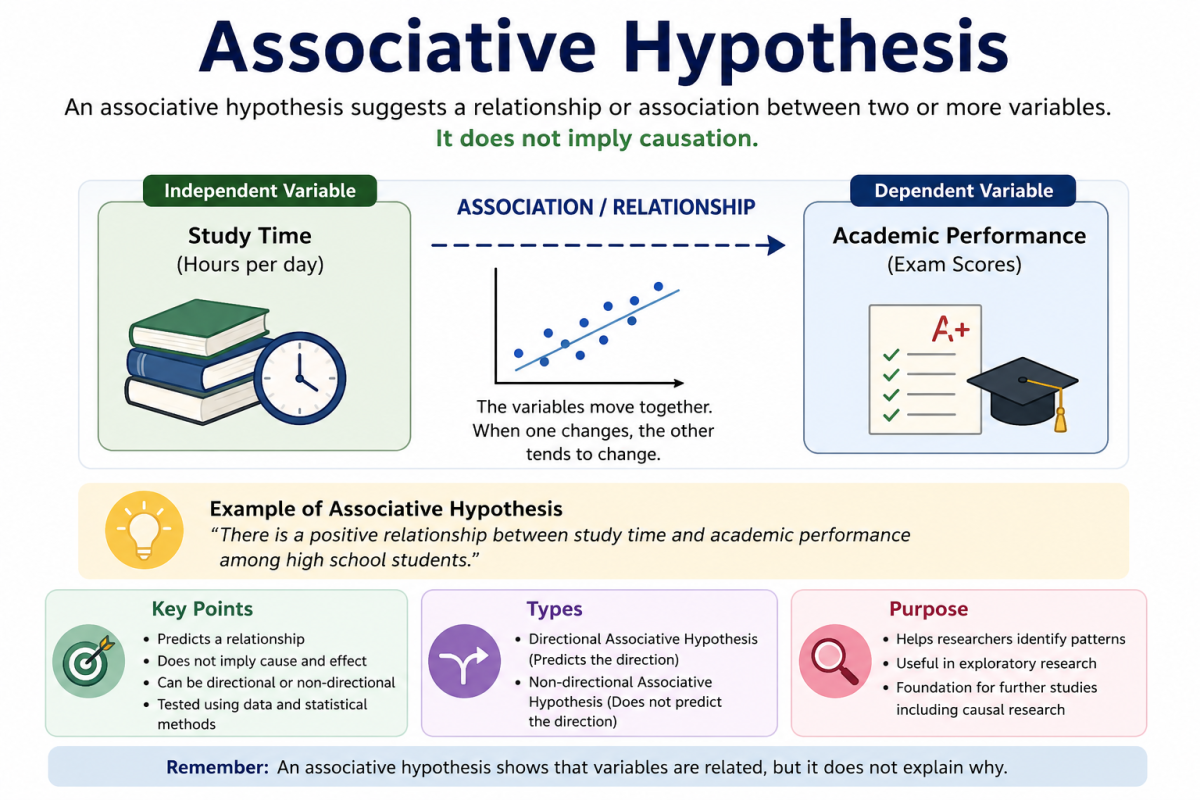
An Associative hypothesis is one of the most common forms of hypothesis in research. It focuses on identifying and examining the relationship between variables without claiming that one variable directly causes changes in another.
Definition of an Associative Hypothesis
- An Associative hypothesis is a statement that predicts a connection, correlation, or association between two variables or two or more variables.
- It proposes that variables are related in some way but does not suggest a direct cause-and-effect relationship.
- The hypothesis helps a researcher determine whether changes in one variable tend to occur alongside changes in another variable.
- Unlike a causal hypothesis, an Associative hypothesis does not attempt to explain why the relationship exists.
Meaning of an Associative Hypothesis
- An Associative hypothesis suggests that a relationship exists between factors being studied.
- It focuses on the nature of the relationship rather than causation.
- The hypothesis may indicate positive, negative, or neutral associations.
- It allows researchers to explore patterns that can later be examined through more advanced studies.
Key Characteristics of an Associative Hypothesis
- It examines the relationship between the two variables.
- It involves independent and dependent variables or related variables.
- It is a testable hypothesis that can be examined using data.
- It supports hypothesis testing through observation and analysis.
- It is commonly used in quantitative research and some forms of qualitative research.
- It may be either directional or non-directional.
Examples of Associative Hypotheses
- Students who spend more time studying tend to achieve higher academic performance.
- Higher levels of physical activity are associated with better mental health.
- Employee job satisfaction is related to workplace productivity.
- Social media usage is associated with levels of self-esteem among teenagers.
Role of Associative Hypotheses in Scientific Research
- They help researchers identify patterns before investigating causation.
- They provide a foundation for scientific research and theory development.
- They contribute to the scientific method by generating ideas that can be tested.
- They help define a research problem and clarify a research question.
- They guide data collection and analysis during the research process.
- They allow researchers to determine whether a relationship exists before attempting to explain it.
- They support hypothesis formulation and testing across different disciplines.
Importance in Different Types of Research
- Widely used in exploratory research when relationships are not fully understood.
- Frequently applied in quantitative research to measure correlations.
- Useful in different types of research, including education, psychology, healthcare, sociology, and business.
- Can serve as a starting point for developing more advanced research hypotheses.
How To Write Associative Hypothesis With Examples: A 7-Step Process for Creating an Effective Research Hypothesis
Writing an Associative hypothesis requires careful planning. The goal is to create a statement that clearly identifies variables and predicts the relationship between variables in a way that can be tested.
Step 1: Identify the Research Problem
- Every hypothesis begins with a clearly defined research problem.
- Determine what issue, trend, or phenomenon requires investigation.
- Review existing knowledge and identify gaps in understanding.
- Ensure the problem is relevant and researchable.
Example
Research Problem: Many universities want to understand factors affecting student performance.
Step 2: Develop a Clear Research Question
- Transform the research problem into a specific research question.
- The question should focus on variables that can be measured or observed.
- A good question helps guide constructing a hypothesis.
Example
Research Question: Is there a relationship between study time and academic performance?
Step 3: Review Previous Research and Theory
- Examine previous research related to the topic.
- Determine whether the hypothesis is derived from theory or existing evidence.
- Review findings from similar studies.
- Understand what relationships have already been identified.
This step helps ensure the hypothesis is derived from credible knowledge rather than assumptions.
Step 4: Identify the Variables
- Determine the variables involved.
- The independent variable is the factor being examined.
- The dependent variable is the outcome being measured.
- Some studies may involve a single independent variable and a single dependent variable.
- Others may involve two or more independent variables or two or more variables overall.
Example
- Independent Variable: Study time
- Dependent Variable: Academic performance
Step 5: Predict the Relationship
- Decide how the variables may be related.
- Consider whether you want to simply identify an association or predict the relationship.
- Determine the expected nature of the relationship.
Questions to ask:
- Will an increase in one variable correspond to an increase in another?
- Will a change in one variable be associated with a decrease in another?
- Is the relationship expected to be positive or negative?
Step 6: Choose Directional or Non-Directional Form
Directional Hypothesis
- A directional hypothesis specifies the expected direction of the relationship.
- It helps predict the exact direction of the association.
Example
Students who study more hours will achieve higher grades.
Non-Directional Hypothesis
- Non-directional hypotheses indicate a relationship exists but do not specify its direction.
Example
There is a relationship between study hours and academic performance.
Step 7: Write and Evaluate the Final Hypothesis
The final statement should meet the characteristics of a good hypothesis.
A good hypothesis must:
- Be clear and concise.
- Be based on theory or evidence.
- Be measurable.
- Be logically stated.
- Be relevant to the research objective.
- Be testable.
- Support statistical hypothesis testing.
Final Example
There is a positive relationship between study time and academic performance among university students.
This statement represents an effective research hypothesis because the hypothesis should be testable, measurable, and specific.
Associative Hypothesis Examples in Research and Scientific Studies
Understanding real-world hypothesis examples makes it easier to write your own Associative hypothesis.
Education
Research Question:
Is there a relationship between attendance and academic achievement?
Associative Hypothesis:
Higher attendance rates are associated with higher academic achievement.
Psychology
Research Question:
Is social media use related to self-esteem?
Associative Hypothesis:
The amount of social media use is associated with self-esteem levels among adolescents.
Healthcare
Research Question:
Is physical activity related to heart health?
Associative Hypothesis:
Individuals who engage in regular physical activity tend to have better cardiovascular health.
Business
Research Question:
Is employee engagement related to productivity?
Associative Hypothesis:
Higher employee engagement is associated with increased workplace productivity.
Marketing
Research Question:
Is customer satisfaction related to customer loyalty?
Associative Hypothesis:
Customer satisfaction is positively associated with customer loyalty.
Environmental Studies
Research Question:
Is air pollution related to respiratory illness?
Associative Hypothesis:
Higher levels of air pollution are associated with increased respiratory illness rates.
Examples of Directional and Non-Directional Associative Hypotheses
Directional
- Increased exercise is associated with improved mental health.
- Higher income is associated with greater life satisfaction.
Non-Directional
- Exercise is related to mental health.
- Income is related to life satisfaction.
These examples demonstrate how associative hypotheses can be applied across numerous fields of scientific research.
Associative Hypothesis vs Causal Hypothesis: Key Differences Researchers Should Know
One of the most important distinctions in research is understanding the difference between an Associative hypothesis and a causal hypothesis.
What Is a Causal Hypothesis?
- A causal hypothesis proposes that one variable directly causes changes in another.
- It focuses on cause-and-effect relationships.
- It attempts to explain why an outcome occurs.
Main Difference
Associative Hypothesis
- Examines the relationship between the variables.
- Indicates variables are connected.
- Does not prove causation.
- Focuses on correlation.
- Common in exploratory research.
Example:
Increased screen time is associated with reduced sleep quality.
Causal Hypothesis
- Suggests direct cause and effect.
- States that one variable produces changes in another.
- Requires stronger evidence.
- Often tested through experiments.
Example:
Increased screen time causes reduced sleep quality.
Comparison Table
| Feature | Associative Hypothesis | Causal Hypothesis |
|---|---|---|
| Focus | Relationship | Cause and effect |
| Goal | Identify associations | Explain causation |
| Evidence Required | Moderate | Strong |
| Research Design | Correlational studies | Experimental studies |
| Variable Connection | Related variables | Direct influence |
Relationship to Other Types of Hypotheses
Researchers should also understand other types of hypotheses commonly used in testing hypotheses.
Null Hypothesis
- The null hypothesis states that no relationship exists.
- Used during statistical hypothesis testing.
- Assumes observed differences occurred by chance.
Example:
There is no relationship between study time and academic performance.
Alternate Hypothesis
- The alternate hypothesis is the opposite of the null hypothesis.
- It states that a relationship does exist.
Example:
There is a relationship between study time and academic performance.
Statistical Hypothesis
- A statistical hypothesis is tested using statistical procedures.
- Determines whether the hypothesis is true or false based on evidence.
Why Understanding the Difference Matters
- Helps researchers select appropriate research designs.
- Improves creating an effective research hypothesis.
- Ensures proper testing a hypothesis.
- Supports valid conclusions during hypothesis testing.
- Helps distinguish between associative and causal relationships.
- Strengthens the quality of a good research hypothesis.
Types of Hypotheses in Research: Research Hypotheses, Null Hypothesis, Alternate Hypothesis, Simple Hypothesis, and Complex Hypothesis
Understanding the various types of hypotheses is essential for conducting high-quality scientific research. Different research objectives require different forms of hypotheses, and selecting the correct type can significantly improve the quality of your study.
Why Understanding Types of Hypotheses Matters
- A hypothesis serves as a foundation for the entire research process.
- It helps a researcher transform a broad research problem into a focused investigation.
- It guides data collection, analysis, and interpretation.
- It supports hypothesis formulation and testing by providing a statement that can be examined using evidence.
- Understanding the types of research hypotheses helps researchers choose the most appropriate approach for their study.
1. Research Hypothesis
A research hypothesis is a statement that predicts an expected outcome or relationship in a study.
Key Features
- It is the primary hypothesis in research.
- It provides a specific prediction about what the researcher expects to find.
- It is often based on theory, observation, or previous research.
- It helps answer the research question.
Example
- Students who spend more time studying achieve higher academic performance.
Importance
- Guides the direction of the study.
- Helps researchers predict the relationship between variables.
- Forms the basis for testing hypotheses.
2. Null Hypothesis (H₀)
The null hypothesis states that no significant relationship or difference exists.
Key Features
- Assumes no association between variables.
- Used extensively in statistical hypothesis testing.
- Acts as the default position until evidence suggests otherwise.
- Helps determine whether observed results occurred by chance.
Example
- There is no relationship between study time and academic performance.
Why It Is Important
- Provides a benchmark for analysis.
- Allows researchers to objectively test the hypothesis.
- Helps determine whether a hypothesis is true or false based on statistical evidence.
3. Alternate Hypothesis (H₁)
The alternate hypothesis is the opposite of the null hypothesis.
Key Features
- States that a relationship or difference exists.
- Represents the outcome the researcher expects to support.
- Often referred to as the alternative hypothesis.
Example
- There is a relationship between study time and academic performance.
Importance
- Provides the statement researchers attempt to support through evidence.
- Plays a central role in hypothesis testing.
4. Simple Hypothesis
A simple hypothesis involves one single independent variable and one single dependent variable.
Key Features
- Examines a straightforward relationship.
- Easy to test and interpret.
- Frequently used in beginner research projects.
Example
- Increased study time improves examination performance.
Variables
- Independent Variable: Study time
- Dependent Variable: Examination performance
5. Complex Hypothesis
A complex hypothesis involves two or more independent variables, two or more variables, or multiple dependent variables.
Key Features
- Examines more complicated relationships.
- Suitable for advanced studies.
- Provides a broader understanding of a phenomenon.
Example
- Study time and class attendance influence academic performance and student motivation.
Importance
- Helps researchers investigate real-world situations where multiple factors interact.
Other Common Types of Research Hypotheses
Directional Hypothesis
A directional hypothesis predicts the exact direction of a relationship.
Example
- Students who study more will achieve higher grades.
Benefits
- Helps researchers predict the exact direction of expected outcomes.
- Provides a more precise prediction.
Non-Directional Hypothesis
Non-directional hypotheses indicate a relationship exists but do not specify whether it will be positive or negative.
Example
- There is a relationship between study time and academic performance.
Benefits
- Useful when previous evidence is limited.
- Common in exploratory research.
Deductive and Inductive Hypotheses
Deductive Hypothesis
- A deductive hypothesis is developed from an existing theory.
- The hypothesis is derived from theory and established knowledge.
- Frequently used in theory-testing studies.
Inductive Hypothesis
- An inductive hypothesis emerges from observations.
- The hypothesis is derived from patterns identified in collected data.
- Common in qualitative research and exploratory investigations.
Associative and Causal Hypotheses
Researchers frequently compare associative and causal hypotheses.
Associative Hypothesis
- An Associative hypothesis focuses on the relationship between variables.
- An Associative hypothesis suggests that variables are related but does not claim direct causation.
- An Associative hypothesis defines how variables move together.
Example:
- Exercise levels are associated with mental well-being.
Causal Hypothesis
- A causal hypothesis proposes that one variable directly influences another.
- It explains why a change in one variable affects another variable.
Example:
- Exercise improves mental well-being.
Understanding these various types of hypotheses helps researchers select the best hypothesis for your research and strengthen the overall quality of scientific research.
Characteristics of a Good Associative Hypothesis and Effective Research Hypothesis
A well-written Associative hypothesis increases the likelihood of obtaining meaningful and reliable research findings. Whether conducting quantitative research, qualitative research, or mixed-method studies, certain qualities distinguish a strong hypothesis from a weak one.
1. It Must Be Clear and Specific
- A hypothesis must communicate exactly what is being studied.
- Readers should immediately understand the variables involved.
- Avoid vague language and broad statements.
Poor Example:
- Social media affects people.
Improved Example:
- Increased social media use is associated with lower self-esteem among adolescents.
2. It Must Be Testable
One of the most important characteristics of a good hypothesis is testability.
Why It Matters
- A hypothesis should be testable through observation or data collection.
- Researchers must be able to measure variables objectively.
- A testable hypothesis can be examined using statistical or analytical methods.
3. It Must Be Based on Evidence
- A strong scientific hypothesis should be supported by logic, theory, or previous research.
- Assumptions without evidence often lead to weak conclusions.
- An effective research hypothesis is rarely created in isolation.
4. It Must Address the Research Question
- The hypothesis should directly answer the research question.
- Every element of the hypothesis should contribute to solving the research problem.
5. It Must Identify Variables Clearly
A good hypothesis should clearly identify:
- The independent variable
- The dependent variable
- The relationship between the variables
This clarity improves the effectiveness of constructing a hypothesis.
6. It Should Be Logical
- The relationship proposed should make sense theoretically.
- The expected outcome should align with existing knowledge.
- The hypothesis must follow logical reasoning.
7. It Should State the Nature of the Relationship
A strong Associative hypothesis should explain the expected nature of the relationship.
Examples:
- Positive relationship
- Negative relationship
- General association
This helps researchers better predict the relationship.
8. It Should Be Relevant
- The hypothesis should address an important issue.
- It should contribute to knowledge within a field.
- It should support meaningful scientific research.
9. It Should Be Measurable
- Variables should be measurable using appropriate methods.
- Measurable variables allow effective testing a hypothesis.
10. It Should Be Consistent with the Scientific Method
A good Associative hypothesis supports the scientific method by:
- Generating a prediction.
- Guiding investigation.
- Supporting data collection.
- Facilitating analysis.
When these characteristics are present, the result is a good research hypothesis that strengthens the overall study.
How Associative Hypothesis Supports Hypothesis Testing and Statistical Hypothesis Testing
An Associative hypothesis plays a central role in hypothesis testing because it provides a statement that can be examined using empirical evidence.
Role in Hypothesis Testing
- The Associative hypothesis serves as a proposed explanation or prediction.
- It guides the collection of data.
- It helps determine whether a relationship exists.
Steps in Hypothesis Testing
Step 1: Formulate the Hypothesis
Example:
- There is a positive relationship between exercise and mental health.
Step 2: Develop a Null Hypothesis
Example:
- There is no relationship between exercise and mental health.
Step 3: Collect Data
- Gather information relevant to the variables.
- Ensure data quality and reliability.
Step 4: Analyze Results
- Use statistical methods to examine the relationship between the two variables.
- Determine whether observed patterns are significant.
Step 5: Draw Conclusions
Researchers determine whether:
- The null hypothesis should be rejected.
- The alternate hypothesis should be supported.
Importance in Statistical Hypothesis Testing
Statistical hypothesis testing helps researchers evaluate evidence objectively.
Benefits include:
- Reducing personal bias.
- Supporting evidence-based decisions.
- Determining whether a hypothesis is true or false.
- Establishing confidence in research findings.
Why Associative Hypotheses Are Valuable
- They help identify patterns before causation is investigated.
- They support both exploratory research and confirmatory research.
- They provide a foundation for future studies involving causal hypotheses.
Common Mistakes When Writing an Associative Hypothesis and How to Avoid Them
Even experienced researchers can make errors when writing an Associative hypothesis. Avoiding these mistakes improves the quality of the research design.
Mistake 1: Confusing Association with Causation
Problem
- Assuming that association automatically means causation.
Incorrect Example:
- Increased exercise causes better academic performance.
Correct Example:
- Increased exercise is associated with better academic performance.
Mistake 2: Using Vague Language
Problem
- Terms such as “better,” “more,” or “improved” may be unclear.
Solution
- Use measurable variables and precise wording.
Mistake 3: Failing to Identify Variables
Problem
- The reader cannot determine the independent and dependent variables.
Solution
- Clearly define all variables being studied.
Mistake 4: Writing an Untestable Statement
Problem
- The hypothesis is testable requirement is ignored.
Poor Example:
- Happiness is influenced by destiny.
Solution
- Focus on measurable concepts.
Mistake 5: Ignoring Previous Research
Problem
- Creating hypotheses without considering existing evidence.
Solution
- Review theory and previous research before writing the hypothesis.
Mistake 6: Making the Hypothesis Too Broad
Problem
- Including too many factors in a single statement.
Solution
- Focus on a specific relationship between variables.
Mistake 7: Not Aligning with the Research Question
Problem
- The hypothesis does not address the original research question.
Solution
- Ensure the hypothesis directly supports the purpose of the study.
Mistake 8: Choosing the Wrong Type of Hypothesis
Problem
- Using a causal statement when an Associative hypothesis is more appropriate.
Solution
- Determine whether the goal is to identify a relationship or explain causation.
Final Tips for Creating an Effective Research Hypothesis
- Start with a clear research problem.
- Define variables carefully.
- Ensure the hypothesis should be testable.
- Base the statement on theory and evidence.
- Use precise language.
- Focus on the relationship between the variables.
- Follow the principles of the scientific method.
- Review and refine the statement before beginning data collection.
Research Hypotheses
Types of Research Hypotheses
Explore key hypothesis categories used in academic research and studies.
Types of Hypotheses
Overview
→
Research Hypotheses
Basics
→
Alternative
H1
→
Null
H0
→
Directional
One-tailed
→
Non-Directional
Two-tailed
→
Simple
One variable
→
Complex
Multiple variables
→
Causal
Cause-effect
→
Associative
Relationship
→
Statistical
Testing
→
Working
Temporary
→
Declarative
Statement form
→
Question Form
Question-based
→
Empirical
Observed data
→
Logical
Reasoned
→
Value
Business focus
→
