
Blog
How to Conduct Thematic Analysis Research Design.

What is Thematic Analysis Research Design in Qualitative Research Designs?
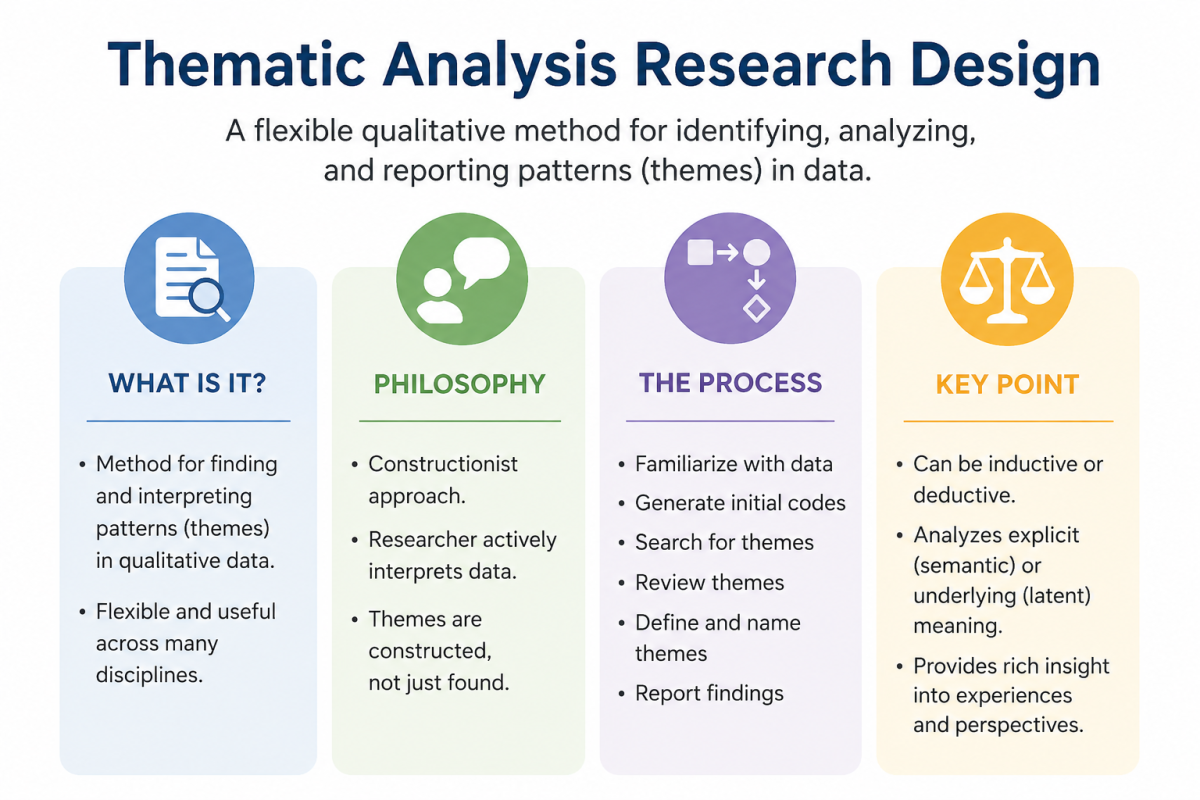
- Thematic analysis research design is one of the most widely used qualitative research methods for identifying, analyzing, and reporting patterns (or themes) within qualitative data. Unlike quantitative research, which relies on numbers and statistical testing, thematic analysis focuses on the meaning behind words, experiences, and behaviors shared by participants.
- At its core, thematic analysis is a method used to make sense of large volumes of unstructured qualitative data, such as interview transcripts, focus group discussions, open-ended survey responses, or even social media posts. It helps qualitative researchers move from raw data to a structured, meaningful interpretation of qualitative data.
- The thematic analysis process typically involves reading through qualitative data multiple times, generating initial codes, searching for patterns in your data, and eventually grouping these codes into broader themes that answer the research question.
- What makes thematic analysis research design distinct from other qualitative research methods, like narrative analysis, discourse analysis, or qualitative content analysis, is its flexibility. It isn’t tied to a single theoretical framework, which means it can be applied across diverse research contexts and disciplines, from psychology and healthcare to marketing and education.
- Within qualitative research methods, thematic analysis sits alongside grounded theory, phenomenology, and case study designs, but it is often considered more accessible for beginners because it doesn’t require deep theoretical commitment before starting the research process.
- A key distinction to understand early is the difference between reflexive thematic analysis (developed by Virginia Braun and Victoria Clarke) and more structured, code-book driven approaches. Reflexive thematic analysis emphasizes the active role of the researcher in interpreting the data, rather than treating coding as a purely mechanical or objective task.
- Thematic analysis in qualitative research is particularly valuable when a research project seeks to explore people’s perceptions, attitudes, experiences, or beliefs. It allows researchers to capture rich, detailed insight into forms of qualitative data that numbers alone cannot express.
- Thematic analysis research design can be applied deductively or inductively, depending on whether the researcher starts with pre-existing theories or lets themes in qualitative data emerge organically. This flexibility is one of the biggest reasons it appeals to such a wide range of research questions.
- In short, thematic analysis research design offers a systematic yet adaptable way of analyzing qualitative data, making it an essential tool in any qualitative researcher’s toolkit, whether the project is academic, clinical, or commercial in nature.
Philosophical Assumptions of the Thematic Analysis Research Design
- Every qualitative research design rests on philosophical assumptions about the nature of reality (ontology) and how we come to know it (epistemology), and thematic analysis research design is no exception.
- Ontological assumptions: Thematic analysis can be conducted from a realist, relativist, or somewhere-in-between stance. A realist approach assumes that participants’ words directly reflect their true experiences and reality. A relativist or constructionist approach assumes that reality is subjective and co-constructed through language, meaning the same event can be understood in multiple valid ways.
- Epistemological assumptions: These concern how knowledge is generated from qualitative data. An essentialist epistemology assumes that language transparently represents participants’ experiences, while a constructionist epistemology assumes that meaning is built through social and cultural context, and the researcher’s involvement in the analysis actively shapes what themes emerge.
- Reflexive thematic analysis, as developed by Virginia Braun and Victoria Clarke, leans heavily into a constructionist framework. It rejects the idea that themes simply “emerge” from data on their own; instead, it emphasizes that the researcher plays an active, interpretive role throughout the research process.
- This is a critical point for qualitative researchers to grasp: thematic analysis is not a passive or purely descriptive exercise. The researcher’s theoretical background, assumptions, and even personal experiences influence how codes are generated and how themes in qualitative data are ultimately constructed and named.
- Inductive vs. deductive thematic analysis also reflects different philosophical starting points. Inductive analysis assumes that themes should arise from the data itself, without forcing preconceived categories onto it. Deductive thematic analysis, by contrast, assumes that existing theory or prior research can meaningfully guide what to look for in the data, making the analysis more theory-driven from the outset.
- Semantic vs. latent analysis is another philosophical distinction within thematic analysis research design. Semantic analysis stays close to the explicit, surface-level content of what participants said. Latent analysis goes deeper, looking at the underlying ideas, assumptions, and ideologies that shape the explicit content.
- These philosophical assumptions matter practically because they shape decisions throughout the entire research process, including how the research question is framed, how qualitative data is collected, and how findings are eventually reported in the research report.
- Understanding these assumptions upfront helps ensure methodological consistency. A qualitative research project that mixes an essentialist data collection approach with a constructionist interpretation, for example, risks internal contradictions that can weaken the credibility of the thematic analysis findings.
- Ultimately, being explicit about these philosophical assumptions is what separates a rigorous, reflexive thematic analysis from a superficial coding exercise, and it’s a hallmark of high-quality qualitative research methods.
How to Conduct a Thematic Analysis Research Design in 4 Easy Steps?
Conducting thematic analysis doesn’t have to be overwhelming. Braun and Clarke’s widely cited guide to thematic analysis breaks the process down into manageable phases. Here are the thematic analysis steps simplified into four core stages:
- Step 1: Familiarize Yourself with the Data
- Before you can identify patterns in your data, you need to immerse yourself in it. This means reading and re-reading interview transcripts, field notes, or other qualitative data from interviews multiple times.
- Take notes on initial impressions, interesting phrases, or recurring ideas that stand out in relation to the research question.
- If you’re working with audio or video recordings, transcribe them carefully, since even small details (pauses, tone, phrasing) can carry meaning relevant to your qualitative analysis.
- This step lays the groundwork for the entire thematic analysis process, so it shouldn’t be rushed. Many qualitative researchers underestimate how much thorough familiarization improves the quality of the analysis later on.
- Step 2: Generate Initial Codes
- Once you’re familiar with the qualitative data, begin systematically coding it. Coding means labeling segments of text that relate to a specific idea, concept, or experience.
- Codes can be generated inductively (letting the data guide you) or deductively (using an existing framework or prior research to guide what you code for). Whether you choose inductive or deductive thematic analysis at this stage significantly shapes your final themes.
- Many researchers use qualitative data analysis software, such as NVivo, ATLAS.ti, or Dedoose, to manage and organize codes efficiently, especially for larger research projects with extensive qualitative data.
- Aim to code the entire dataset, not just the sections that seem obviously relevant. This ensures a comprehensive analysis and reduces researcher bias.
- Step 3: Search for and Review Themes
- After initial coding, start grouping related codes into broader themes. A theme should capture something meaningful and important in relation to the research question, not just a repeated word or phrase.
- Create a visual map or table of your candidate themes and sub-themes to see how they relate to one another and to the overall data set.
- Review these themes against the coded data extracts and the entire dataset to check they hold up. Some themes may need to be merged, split, or discarded entirely if they lack sufficient supporting data.
- This is where reflexive thematic analysis really comes into play: researchers must critically question whether the themes accurately represent the qualitative data, or whether personal assumptions are influencing the interpretation of qualitative data.
- Step 4: Define, Name, and Report Themes
- Once themes are finalized, clearly define what each theme represents and how it connects to your research question. Give each theme a concise, descriptive name.
- Write a detailed analysis for each theme, using direct quotes from participants to illustrate and support your interpretation. This adds credibility and richness to your research report.
- Consider how the themes relate to each other and to any relevant theory, ensuring your final write-up tells a coherent, well-supported story rather than a disconnected list of ideas.
- Finally, compile your findings into a formal report or publication, being transparent about your methodology, coding decisions, and any limitations encountered during the process of conducting thematic analysis.
Following these four thematic analysis steps consistently gives structure to what can otherwise feel like an unwieldy qualitative analysis process, and it helps ensure your findings are credible, transparent, and useful to your target audience, whether that’s academic peers, healthcare stakeholders, or market research clients.
What are the Advantages and Disadvantages of Thematic Analysis Research Design in Qualitative Research Designs?
Like any qualitative research method, thematic analysis research design comes with distinct strengths and limitations. Understanding both sides helps researchers decide whether it’s the right fit for their research needs.
Advantages:
- Flexibility: Thematic analysis is a flexible method that isn’t bound to any single theoretical or epistemological framework. This analysis is a flexible method that can be adapted to a wide range of research questions, disciplines, and data types, from psychology to marketing to public health.
- Accessibility for beginners: Compared to more theoretically demanding methods like grounded theory or phenomenology, thematic analysis offers a more approachable entry point for researchers new to qualitative research methods, without sacrificing analytical depth.
- Works with diverse data types: Thematic analysis handles a wide range of research questions and forms of qualitative data extremely well, including qualitative data from interviews, focus groups, open-ended survey responses, and documents, making it useful across diverse research contexts.
- Rich, detailed insights: Because thematic analysis focuses on interpretation of qualitative data rather than simple categorization, it can uncover nuanced, in-depth insights into participants’ experiences and perspectives that quantitative research often misses.
- Compatible with both inductive and deductive approaches: Researchers can choose deductive analysis when working from existing theory, or inductive analysis when exploring a new or under-researched area, giving thematic analysis approaches considerable adaptability within a single research project.
- Useful in mixed-methods designs: Thematic analysis integrates well within qualitative and mixed-methods research designs, allowing researchers to complement statistical findings with rich contextual understanding of participant experiences.
- Practical for real-world application: In fields like market research, thematic analysis helps businesses and organizations quickly identify recurring customer concerns, preferences, or pain points from qualitative feedback, informing practical decision-making.
- Time-efficient compared to some alternatives: While still labor-intensive, thematic analysis can often be conducted more quickly than approaches like grounded theory, which requires simultaneous data collection and analysis over extended periods.
Disadvantages:
- Risk of researcher subjectivity: Because reflexive thematic analysis emphasizes the researcher’s active involvement in the analysis, there’s an inherent risk that personal bias or assumptions could shape which themes are identified and how they’re interpreted.
- Lack of a single, agreed-upon procedure: Unlike some other qualitative research methods with more rigid, step-by-step protocols, thematic analysis’s flexibility can sometimes be seen as a weakness, since different qualitative researchers may apply the thematic analysis process quite differently, making replication harder.
- Time-consuming for large datasets: Analyzing qualitative data thoroughly, especially from a large research project with extensive interview transcripts, can be extremely time-consuming, particularly during the coding and theme development stages.
- Difficulty establishing reliability: Because thematic analysis often relies on subjective interpretation rather than fixed coding rules (unlike some forms of quantitative content analysis), establishing consistency between multiple coders can be challenging.
- Risk of superficial analysis: If not conducted rigorously, thematic analysis can result in a descriptive summary of the data rather than a deep, meaningful interpretation of qualitative data, undermining the value of the qualitative analysis.
- Steep learning curve for reflexivity: While thematic analysis is accessible on the surface, doing reflexive thematic analysis well requires a genuine understanding of the researcher’s role in constructing meaning, which can be a difficult skill for newer researchers to develop.
- Not ideal for testing hypotheses: Since thematic analysis research design is exploratory and interpretive by nature, it isn’t well-suited to testing specific hypotheses in the way quantitative research or structured quantitative content analysis might be.
- Dependence on data quality: The quality of thematic analysis findings depends heavily on the richness and depth of the underlying qualitative data. Thin, brief responses can limit the depth of themes that can realistically be developed.
Weighing these advantages and disadvantages against your specific research needs is essential before committing to thematic analysis research design as your chosen qualitative research method.
Examples of Thematic Analysis Research Design
Seeing thematic analysis research design in action across different research contexts can help clarify how flexible and widely applicable this method really is.
- Healthcare research example: A research project exploring patient experiences of chronic illness might use thematic analysis to examine qualitative data from interviews with patients. Researchers could identify themes such as “loss of independence,” “navigating healthcare systems,” or “emotional coping strategies,” offering healthcare providers valuable interpretation of qualitative data that can directly inform patient care improvements.
- Education research example: A study investigating teacher burnout might use inductive thematic analysis to analyze open-ended survey responses from educators. Emerging themes might include “administrative overload,” “lack of institutional support,” or “emotional exhaustion,” giving policymakers concrete, qualitative insight into systemic issues affecting the profession.
- Market research example: Businesses frequently apply thematic analysis to customer feedback, product reviews, or focus group transcripts. A company launching a new product might use thematic analysis to identify recurring themes around “ease of use,” “value for money,” or “customer service experience,” directly shaping product development and marketing strategy.
- Psychology research example: A qualitative research project examining the experiences of first-time parents might use reflexive thematic analysis to explore emotional and psychological adjustments. Common themes could include “identity shift,” “relationship strain,” or “unexpected joy,” providing rich insight beyond what quantitative research surveys alone could capture.
- Social media and digital research example: Researchers analyzing public sentiment around a social issue might apply thematic analysis to large volumes of social media posts or comments. This is often supported by qualitative data analysis software to manage the sheer volume of unstructured qualitative data, helping identify themes like “public trust,” “misinformation concerns,” or “calls for accountability.”
- Workplace research example: A study on employee engagement might use deductive thematic analysis, applying an existing theoretical framework (such as Herzberg’s motivation-hygiene theory) to interview data, allowing researchers to code responses against pre-established categories like “recognition,” “compensation,” or “career growth opportunities.”
- Comparative example with qualitative content analysis: While thematic analysis focuses on identifying patterns and meaning, qualitative content analysis often involves more systematic quantification of qualitative data (e.g., counting how often certain words or ideas appear). A researcher comparing news coverage of a policy issue might use qualitative content analysis instead of, or alongside, thematic analysis, depending on whether the research question calls for a more structured, frequency-based approach or a richer interpretive one.
- Comparative example with discourse analysis and narrative analysis: Unlike discourse analysis, which examines how language constructs power and meaning in social contexts, or narrative analysis, which focuses on the structure and sequence of participants’ stories, thematic analysis is more concerned with identifying recurring, meaningful patterns across an entire dataset, regardless of narrative structure.
These examples illustrate that thematic analysis allows researchers across diverse research contexts, from clinical settings to corporate boardrooms, to transform raw, unstructured qualitative data into clear, actionable insights. Whether the goal is understanding patient experiences, improving products, or informing public policy, thematic analysis provides a reliable, adaptable framework for making sense of complex human experiences, and this analysis provides value precisely because it keeps the focus on the meaning within the data, not just the data itself.
