
Blog
How To Conduct Participatory Action Research Design

What is Participatory Action Research Design in Qualitative Research Designs?
- Participatory action research design is a qualitative approach that blends research and action into a single, continuous process rather than treating them as separate phases. Unlike traditional research, where a research team studies a population from the outside, this design invites the people affected by an issue to become co-researchers who shape the research questions, the data collection methods, and the interpretation of findings.
- At its core, participatory action research rests on the idea that knowledge and action are inseparable. The research process is cyclical: people plan, act, observe, and reflect, then use what they learn to plan the next cycle of action and reflection. This is why many scholars describe it as learning and action happening together rather than research first, action later.
- Within qualitative research designs, this approach stands apart because it rejects the idea of the neutral, distant observer common in positivist research and mainstream research traditions. Instead, it insists that those who live the problem are best positioned to define the focus of the research and to test solutions in real time.
- Several related traditions fall under this umbrella, including youth participatory action research, community-based participatory research, participatory rural appraisal, educational action research, and critical participatory action research. Each applies the same underlying logic — participation and action — to different populations and settings, whether that’s classrooms, health clinics, or neighborhoods.
- The participatory approach is especially valuable in research for social change because it treats research participants as research partners, not subjects. This shift changes power dynamics: instead of researchers extracting data and leaving, the community research partners remain involved from the first research questions through to the final research findings and beyond.
- Foundational texts like the handbook of action research, the sage handbook of action research, and the handbook of qualitative research describe this method as sitting at the intersection of social science research and grassroots problem-solving. It draws on action science, action learning, and action inquiry as intellectual ancestors, all of which emphasize that understanding a system deeply often requires trying to change it.
- In practice, a participatory action research design might look like a group of teachers studying their own classroom practices, a group of patients working alongside clinicians on a health research question, or residents mapping local resources through participatory methods like participatory rural appraisal. What unites these examples is collaborative research built on shared decision-making, not a single expert directing the research project.
- Because it merges qualitative inquiry with social action, this design is often chosen when the goal isn’t just to describe a problem but to solve it — making it a natural fit for fields like public health, education, community development, and organizational change.
Philosophical Assumptions of The Participatory Action Research Design
- Participatory action research design is grounded in a distinct research paradigm that challenges several assumptions baked into conventional research and quantitative methods.
- Knowledge is co-created, not discovered by outsiders. Rather than assuming an expert researcher holds privileged access to truth, this approach assumes that the people experiencing a problem hold essential knowledge about it. This is a direct departure from traditional research, where the research team typically designs the study independently of the people being studied.
- Reality is socially constructed and context-dependent. This design draws on constructivist and critical theory traditions, assuming that what counts as a “problem” or a “solution” depends on the lived experience of the community-engaged research partners involved, not on a single objective standard imposed from outside.
- Action and knowledge are inseparable. One of the clearest philosophical commitments is that you cannot fully understand a social system without trying to change it. This is the action turn in social science — the belief that reflection and action must occur together in continuous cycles, rather than research concluding before any intervention begins.
- Power should be shared, not concentrated. A central assumption is that research relationships should be egalitarian. This means research decisions — from the initial research questions to the data collection methods used — are made collaboratively rather than unilaterally by academic researchers.
- Emancipation and social change are legitimate research goals. Many scholars root this design in emancipatory action research traditions and indigenous research frameworks, both of which argue that research should actively work to reduce inequality, not simply document it. This is especially visible in critical participatory action research, which explicitly aims to challenge oppressive structures.
- Local and experiential knowledge is valid knowledge. This design assumes that the insights of community members — even without formal academic training — are just as legitimate as theoretical or expert knowledge. This assumption underlies participatory rural appraisal and community-based participatory research for health, where local residents often lead the identification of priorities.
- Multiple truths can coexist. Because different participants bring different experiences, this participatory way of researching assumes there isn’t one single “correct” interpretation of a social phenomenon — a sharp contrast to the assumptions underpinning much of positivist research.
- Ethics extends beyond consent forms. Given the closeness of research relationships in this design, ethical practice is assumed to be ongoing and relational, not a one-time procedural checkbox — a theme explored at length in discussions of ethical challenges in community-based participatory work.
Together, these assumptions explain why participatory action research design feels so different in practice from conventional research: it is less about detached observation and more about shared inquiry and action aimed at real-world change.
How To Conduct a Participatory Action Research Design In 4 Easy Steps?
Conducting a participatory action research design follows a cyclical research process, but it can be broken down into four manageable stages. Each stage blends research and action, meaning the work doesn’t stop once data is collected — it continues into implementation and further reflection.
Step 1: Identify the Focus of the Research and Build the Research Team
- Start by bringing together the people who will be affected by the issue — this could be teachers, patients, residents, or students — and invite them to help define the focus of the research. This is a foundational moment in any participatory approach, since the direction of the entire research project depends on shared ownership from day one.
- Conduct a participatory needs assessment to surface the priorities of the group rather than assuming what matters most. This might involve informal conversations, community meetings, or simple surveys.
- Establish clear research relationships early. Decide together how decisions will be made, how often the group will meet, and how findings will be shared — this reduces later confusion and builds trust.
- Draft initial research questions collaboratively, ensuring they reflect the community’s real concerns rather than an outside researcher’s assumptions.
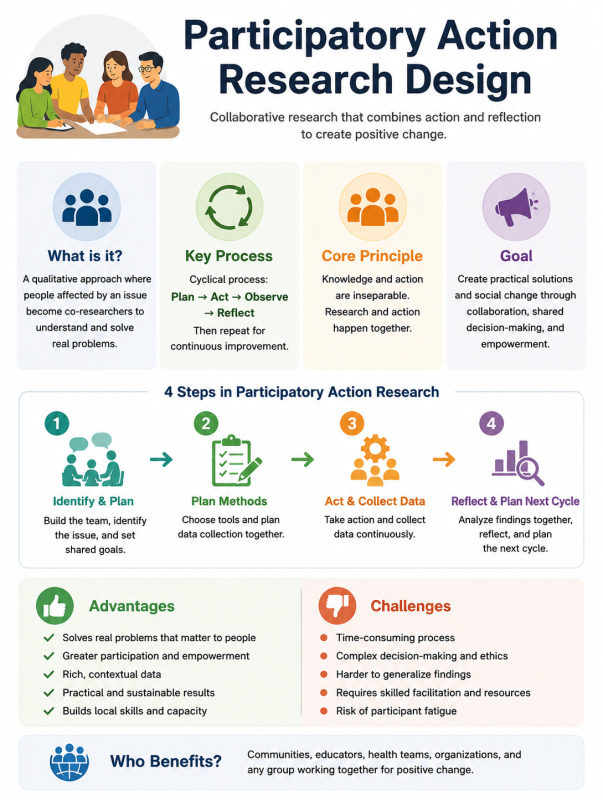
Step 2: Plan the Data Collection Methods and Research Methodologies
- Choose data collection methods that fit the context and the comfort level of participants. Common options include interviews, focus groups, journals, photovoice, or participatory rural appraisal tools like community mapping and seasonal calendars.
- Select research methodologies and methods and tools that allow for flexibility, since participatory action research often adapts mid-stream as new insights emerge.
- Train research partners in basic qualitative methods so that data collection isn’t limited to professional researchers. This step reflects the participatory nature of the design — capacity-building is part of the process, not a side effect.
- Set a realistic timeline for the first cycle of action and research, understanding that this is iterative and will likely repeat.
Step 3: Take Action and Collect Data Simultaneously
- Implement the planned research activities while simultaneously gathering data on what’s happening. This is the heart of taking action within the research design — the intervention and the observation happen together, not sequentially.
- Document experiences honestly, including setbacks, since critical participatory action research values transparency about what isn’t working as much as what is.
- Maintain regular check-ins with the research team to discuss emerging patterns, adjust the approach if needed, and ensure everyone’s voice remains part of the research process.
- Use participatory methods such as group reflection sessions to capture qualitative insights that formal data collection might miss.
Step 4: Reflect, Analyze, and Plan the Next Cycle
- Bring the group back together to analyze the research findings collectively. This shared analysis is a hallmark of collaborative research and distinguishes this design from traditional research, where analysis often happens behind closed doors.
- Ask what worked, what didn’t, and why — this reflection and action stage feeds directly into the next cycle of cycles of action, since participatory action research design is rarely a one-and-done process.
- Share results with the wider community in accessible formats, ensuring the research findings actually reach and benefit the people who contributed to them.
- Decide together whether another cycle is needed, adjusting research questions, methods, or focus based on what was learned — reinforcing that this is truly a continuous participatory action research process.
What are the Advantages and Disadvantages of Participatory Action Research Design in Qualitative Research Designs?
Advantages
- Stronger relevance to real-world problems. Because research participants help define the focus of the research, the questions being asked are more likely to matter to the people affected — a major advantage over conventional research, which can sometimes miss what communities actually need.
- Greater buy-in and sustainability. When people are part of the research and action process from the start, they’re more invested in implementing solutions afterward. This is a well-documented benefit within community-based participatory research and health research contexts, where sustained behavior change is often the ultimate goal.
- Richer, more contextual data. The close research relationships built through this participatory approach often produce deeper qualitative insight than traditional research methods that keep researchers at arm’s length.
- Empowerment of marginalized voices. Youth participatory action research and indigenous research projects, in particular, show how this design can shift power toward groups historically excluded from social science research, giving them a genuine role in shaping knowledge and action.
- Practical, applicable findings. Because taking action is built into the design, results tend to translate more directly into practice than findings from purely quantitative methods studies, which may sit in a report without ever informing community action.
- Flexibility of methods. Participatory methods and methods and tools can be adapted on the fly, making this design well-suited to complex, evolving problems in fields ranging from research in education to public health.
- Builds local research capacity. Community members gain new skills in qualitative research and data collection methods, which can benefit future community-based research long after a specific study ends.
Disadvantages
- Time-intensive process. Because it unfolds in cycles of action, a participatory action research design often takes considerably longer than a single-round research project using quantitative methods.
- Challenges of participatory decision-making. Reaching consensus among diverse research partners can slow progress, and disagreements about direction are common — one of the recurring challenges of participatory work noted across the literature.
- Complex ethical terrain. The close, ongoing nature of research relationships raises ethical challenges in community-based participatory research that don’t arise as often in conventional research, such as managing dual roles when participants are also researchers.
- Difficult to generalize findings. Because studies are context-specific and shaped by local priorities, results from community-engaged research are often harder to generalize than findings from standardized quantitative methods studies.
- Requires skilled facilitation. Without an experienced facilitator, group dynamics can stall the research process, and power imbalances (between academics and community members, for instance) can quietly resurface despite good intentions.
- Resource-intensive for research teams. Sustained community engagement demands funding, staffing, and institutional flexibility that many research teams and grant structures aren’t designed to support, a common challenge in community-based participatory research.
- Risk of research fatigue. Long, multi-cycle participatory action research process work can exhaust volunteer participants, especially in community research settings where the same residents are repeatedly asked to contribute time.
- Quality concerns from critics. Some scholars trained in positivist research question the research quality of participatory designs, arguing that close involvement between researcher and participant risks bias — though proponents counter that this closeness is precisely what produces valid, actionable research findings.
Examples of Participatory Action Research Design
- Community-based participatory research for health is one of the most well-documented applications. In numerous public health initiatives, researchers partner with residents to identify local health priorities — such as diabetes prevention or maternal health — and co-design interventions. This reflects using community-based participatory research to close gaps that traditional research alone often fails to address, since community members understand barriers to care that outside researchers might miss.
- Youth participatory action research projects frequently appear in schools, where students investigate issues like bullying, mental health resources, or curriculum gaps. Students act as co-researchers, conducting surveys and interviews with peers, then presenting research findings to school administrators to drive real policy change — a clear example of research for social impact led by those most affected.
- Educational action research is common among teachers who systematically study their own classrooms. A teacher might notice students disengaging during a particular unit, then use a cycle of action and reflection — trying a new teaching method, observing results, and adjusting — to improve outcomes. This is participatory action learning in its most everyday form.
- Participatory rural appraisal has been used extensively in international development. Community members map local resources, rank problems by severity, and identify solutions using visual, low-literacy-friendly tools. The practice of participatory rural appraisal has informed participatory needs assessment work across agriculture, water access, and infrastructure planning projects worldwide.
- Critical participatory action research has been applied in labor and social justice movements, where workers or activists study conditions of inequality while simultaneously organizing for change. This blends social action directly into the research approaches used, treating inquiry and action as a single unified effort.
- Indigenous research projects often use this design to ensure that studies of indigenous communities are led by, not merely conducted on, those communities. This has reshaped research methodologies in fields like anthropology and environmental science, aligning research and community priorities with academic inquiry.
- Participatory design in technology development is another growing example, where end-users co-create digital tools or services alongside designers. This ensures that products reflect real user needs, applying participatory principles from research for social good to commercial and nonprofit product development alike.
- Community action research initiatives in urban neighborhoods have brought together residents and city planners to co-design public spaces, using participatory methods like community walk-throughs and collaborative mapping to gather research findings that directly shape zoning and development decisions.
Across all these examples, the common thread is clear: a participatory action research design succeeds when research and social change are treated as two sides of the same coin, guided every step of the way by the very people the research is meant to serve.
