
Blog
How to Conduct Content Analysis Research Design.

What is Content Analysis Research Design in Qualitative Research Designs?
- Content analysis research design is a systematic research method used to examine and interpret textual data, images, audio, or video in order to identify patterns, themes, and meaning within a body of material. It sits within the broader family of qualitative research methods, though it can also be applied in a quantitative method when researchers want to quantify the frequency of certain words, phrases, or ideas.
- At its core, content analysis is a research technique that allows researchers to systematically categorize and interpret the content of communication — whether that’s interview transcripts, social media posts, news articles, or historical documents. This makes it an incredibly flexible research method for anyone working with textual data.
- Content analysis research design typically falls into one of two broad categories:
- Qualitative content analysis — focuses on interpreting the underlying meaning, context, and nuance within textual data. Researchers look beyond the surface to understand latent content, or the deeper implied meaning behind words and phrases.
- Quantitative content analysis — focuses on counting and measuring the occurrence of specific words, phrases, or concepts. This approach treats content more like numerical data, applying statistical analysis to draw conclusions about frequency and distribution.
- Many research projects actually blend both approaches, using qualitative and quantitative methods together. For instance, a researcher might first identify recurring themes qualitatively, then quantify how often those themes appear across a larger data set.
- Content analysis research design is especially popular in fields like communications, media studies, health research, psychology, education, and political science, largely because it allows researchers to work with existing textual data rather than having to collect brand new data through methods such as interviews or surveys.
- Unlike some other qualitative research designs, content analysis doesn’t require direct interaction with participants. Instead, it relies on materials that already exist, such as documents, transcripts, or media content, making it a practical and often cost-effective research method.
- Ultimately, content analysis research design gives qualitative researchers a structured framework for making sense of large volumes of textual data, transforming raw text into meaningful, organized insights that can inform a research question and contribute to a broader understanding of the data.
Philosophical Assumptions of The Content Analysis Research Design
- Every research method rests on underlying philosophical assumptions, and content analysis research design is no exception. Understanding these assumptions helps qualitative researchers select appropriate research methodologies and interpret their findings with greater confidence.
- Ontological assumptions — Content analysis research design assumes that meaning exists within textual data and can be systematically identified and interpreted. Researchers assume that both manifest content (the visible, surface-level content) and latent content (the underlying, implied meaning) are real and discoverable through careful analysis.
- Epistemological assumptions — This research method assumes that knowledge can be generated by systematically analyzing communication artifacts. Whether a researcher leans toward a more qualitative analysis or a more quantitative method, the underlying belief is that structured coding and interpretation can produce valid, trustworthy knowledge about social phenomena.
- Interpretivist roots — Qualitative content analysis is often grounded in interpretivism, which holds that reality is socially constructed and that meaning is context-dependent. This means that researchers using content analysis must remain attentive to context, culture, and the perspective of whoever produced the textual data being analyzed.
- Positivist influences — On the other hand, quantitative content analysis draws more from positivist traditions, assuming that content can be objectively measured, counted, and analyzed through statistical analysis. This branch treats textual data more like quantitative data, prioritizing reliability and replicability.
- Balancing objectivity and interpretation — One of the more nuanced philosophical tensions in content analysis is balancing objective coding rules with the need for interpretive, nuanced analysis. A rigid coding scheme increases consistency, but overly rigid rules can strip away the deeper meaning found in latent content.
- Constructivist perspective — Many qualitative researchers approach content analysis research design from a constructivist lens, assuming that meaning is not fixed but is instead constructed through the interaction between the text, the context, and the researcher’s own interpretive lens.
- Assumptions about coding as a knowledge-generating process — The process of coding itself is assumed to be a valid method for reducing complex qualitative data into manageable, analyzable units. This assumption underpins the entire content analysis method, whether conducted manually or with the help of qualitative data analysis software.
- Understanding these philosophical assumptions matters because it shapes decisions about coding rules, sample selection, and how a researcher will ultimately interpret the content and draw conclusions from their research project.
How To Conduct a Content Analysis Research Design In 4 Easy Steps?
Conducting content analysis research design might sound complicated, but breaking it down into clear steps makes the process manageable, even for beginner qualitative researchers. Here’s how to conduct content analysis in four easy steps:
- Step 1: Define the Research Question
- Every strong content analysis begins with a clear, specific research question. Before you even think about gathering textual data, you need to know exactly what you’re trying to find out.
- Ask yourself: What patterns, themes, or meanings am I hoping to uncover? Am I interested in manifest content (what’s explicitly stated) or latent content (the deeper, implied meaning)?
- A well-defined research question guides every other decision in your research project, from which materials to collect to how you’ll structure your coding scheme.
- This step also helps determine whether you’ll use a more qualitative content analysis approach, a quantitative content analysis approach, or a combination of both.
- Step 2: Select Your Data and Sampling Method
- Once your research question is defined, identify the textual data you’ll analyze. This could include interview transcripts, articles, social media posts, policy documents, or other forms of qualitative data.
- Decide on your sampling strategy — will you analyze an entire data set, or a representative sample? This decision often depends on the scope of your research project and the resources available.
- Consider whether you’re conducting a directed content analysis (guided by existing theory) or a more exploratory, inductive analysis. This distinction shapes how flexible or fixed your coding scheme will be from the start.
- Step 3: Develop a Coding Scheme and Begin the Coding Process
- This is the heart of the content analysis method. Developing a coding scheme means creating a clear set of categories, or codes, that represent the themes, ideas, or words you’re looking for in the data.
- Establish coding rules early on — these are the guidelines that ensure consistency when you or other researchers code the same qualitative data. Clear coding rules reduce bias and increase the reliability of your findings.
- During the actual process of coding, you’ll go through the textual data line by line (or segment by segment), assigning each unit of meaning to a code. This might involve identifying specific words, phrases, or broader ideas that fall under each category.
- Many qualitative researchers use qualitative data analysis software or dedicated content analysis software (like NVivo, MAXQDA, or Dedoose) to help organize and manage this coding process, especially for larger data sets. These tools make it easier to tag, sort, and retrieve coded segments efficiently.
- Depending on your approach, you might apply thematic analysis techniques alongside your coding scheme to help identify patterns across the data more holistically.
- Step 4: Analyze, Interpret, and Draw Conclusions
- With your data fully coded, it’s time to analyze the results. If you’re conducting quantitative content analysis, this might involve statistical analysis to determine the frequency, distribution, or correlation between coded categories.
- If your approach is more qualitative, this stage involves interpreting the content and meaning behind the codes — looking for relationships, contradictions, or deeper insights that answer your original research question.
- This is where you develop a genuine understanding of the data, connecting individual codes back to broader themes and drawing conclusions that contribute meaningfully to your field.
- Finally, document your findings clearly, being transparent about your coding rules, sampling method, and any limitations, so other researchers can evaluate or replicate your research project if needed.
By following these four steps — defining your research question, selecting your data, developing and applying a coding scheme, and analyzing your results — you’ll be well-equipped to conduct a content analysis that is both rigorous and meaningful.
What are the Advantages and Disadvantages of Content Analysis Research Design in Qualitative Research Designs?
Like any research method, content analysis research design comes with distinct strengths and limitations. Understanding both sides helps qualitative researchers decide whether this approach fits their research project.
Advantages of Content Analysis Research Design
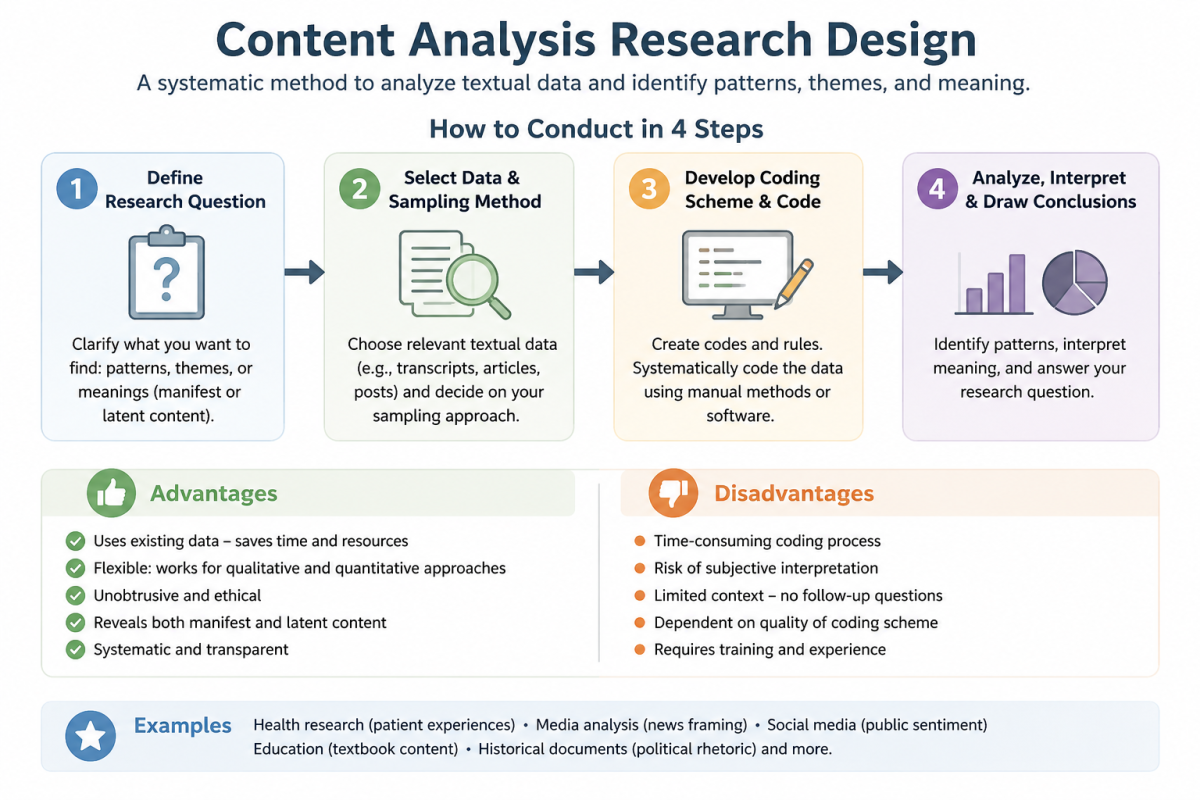
- Works with existing data — One of the biggest advantages is that content analysis allows researchers to use content that already exists, such as documents, media, or transcripts, without needing to conduct new data collection like interviews or surveys. This can save significant time and resources.
- Flexible and adaptable — Content analysis research design can be applied across an enormous range of textual data types and disciplines, from health research to political communication to marketing studies. It works equally well for qualitative and quantitative research questions.
- Combines qualitative and quantitative approaches — Researchers can choose to quantify patterns numerically or focus on rich, qualitative analysis of meaning, or blend both. This dual capability makes content analysis one of the more versatile research methodologies available to qualitative researchers.
- Unobtrusive research technique — Because content analysis doesn’t involve direct interaction with participants, it avoids many of the ethical and logistical challenges associated with other qualitative methods such as interviews or focus groups. There’s no risk of the researcher’s presence influencing participant behavior.
- Systematic and transparent — A well-designed coding scheme and clear coding rules make the analysis process transparent and, ideally, replicable. This adds credibility and rigor, especially valuable in fields like health research where consistency matters.
- Reveals both manifest and latent content — Content analysis is uniquely suited to uncovering not just what is explicitly stated (manifest content) but also deeper, implied meaning (latent content), giving researchers a nuanced analysis of the material.
- Supports multiple analytical approaches — Researchers can choose from conceptual and relational analysis, directed content analysis, or summative content analysis depending on their specific research question, offering flexibility in how the analysis unfolds.
- Cost-effective — Because it often uses existing textual data, content analysis tends to be less expensive than research designs requiring extensive fieldwork or participant recruitment.
Disadvantages of Content Analysis Research Design
- Time-consuming coding process — Despite its advantages, the actual process of coding qualitative data can be extremely labor-intensive, particularly with large data sets. Even with content analysis software, human judgment is still required to make sense of nuanced or ambiguous content.
- Risk of subjective interpretation — Especially in qualitative content analysis, there’s a risk that different researchers might interpret the same textual data differently, particularly when identifying latent content. This can affect the reliability of findings unless strict coding rules are established and followed.
- Limited context — Content analysis often relies on existing textual data, which means researchers can’t ask follow-up questions or clarify ambiguous meaning the way they could with interviews. This can sometimes limit the depth of understanding of the data.
- Reductionist tendencies — Quantitative content analysis, in particular, can risk oversimplifying complex qualitative data by reducing rich, nuanced content into simple counts or categories, potentially losing meaningful context in the process.
- Dependent on quality of coding scheme — The value of the entire analysis hinges on how well the coding scheme is designed. A poorly constructed set of categories can lead to inconsistent or invalid results, undermining the entire research project.
- Not ideal for all research questions — While content analysis is a strong research method for certain types of questions, it may not be the best fit for research questions requiring direct behavioral observation or real-time interaction data.
- Requires training — Effectively coding qualitative data, particularly latent content, requires training and experience. Novice researchers may struggle to apply coding rules consistently or to identify subtle patterns within the data.
Weighing these advantages and disadvantages carefully will help you determine whether content analysis research design is the right fit for your specific research question and research project.
Examples of Content Analysis Research Design
Seeing content analysis research design in action can make the concept much easier to grasp. Below are several real-world style examples illustrating how this research method is applied across different fields.
- Health Research Example — A team of qualitative researchers studying patient experiences with chronic illness might collect open-ended survey responses and apply qualitative content analysis to identify patterns around emotional coping strategies. Using a coding scheme built around themes like “fear,” “resilience,” and “support systems,” researchers can analyze the qualitative data to identify patterns and better understand the psychological impact of chronic disease. This is a common approach in qualitative health research, where understanding lived experience matters as much as statistical outcomes.
- Media and Communications Example — Researchers examining how news outlets cover a particular political event might use quantitative content analysis to count how often specific words, like “crisis” or “reform,” appear across multiple publications. This quantitative method allows them to quantify bias or framing patterns, offering measurable evidence of how different outlets shape public perception through language choices.
- Directed Content Analysis Example — A researcher studying workplace communication might use directed content analysis, applying an existing theoretical framework (such as a leadership communication model) to code transcripts of team meetings. Because the coding scheme is guided by prior theory, this approach helps confirm, extend, or challenge existing research methodologies in the field.
- Summative Content Analysis Example — A marketing researcher might conduct summative content analysis on customer reviews, first counting how frequently certain words or phrases (like “affordable” or “poor quality”) appear, then interpreting the underlying latent content to understand consumer sentiment more deeply. This blends quantitative counting with qualitative interpretation, showcasing how qualitative and quantitative techniques often work together.
- Educational Research Example — Content analysis is frequently used to analyze textbooks, curricula, or classroom transcripts. For instance, a researcher might use content analysis to identify patterns in how gender roles are represented across a set of elementary school reading materials, coding for specific words, character roles, and portrayed behaviors.
- Social Media Example — With the explosion of textual data available online, many researchers now use content analysis software to analyze large volumes of social media posts. A team might, for example, conduct a content analysis of tweets during a public health campaign to identify patterns in public sentiment, misinformation, or engagement, applying both manifest content coding (specific words used) and latent content interpretation (underlying attitudes or emotions).
- Historical Document Analysis Example — Historians and political scientists often use content analysis method techniques to analyze historical speeches, letters, or policy documents. By coding for recurring themes or ideological language, researchers can trace how political rhetoric has evolved over time, offering a research technique that bridges qualitative and quantitative historical inquiry.
- Thematic Analysis Crossover Example — Some researchers blend content analysis with thematic analysis when working with interview transcripts, using a coding scheme to first tag manifest content, then applying broader thematic analysis to connect codes into overarching narratives about participant experiences.
These examples demonstrate just how adaptable content analysis research design truly is. Whether applied to health research, media studies, education, or social media, this research method offers qualitative researchers a powerful, structured way to analyze textual data, uncover meaning, and generate insights that are both rigorous and rich in nuance. As a research guide, these examples also show that content analysis is a research approach flexible enough to serve almost any discipline that works with textual or communicative data — making it an indispensable tool for researchers navigating today’s data-rich research landscape.
