
Blog
How to Conduct Qualitative Descriptive Research Design

What is Qualitative Descriptive Research Design in Qualitative Research Designs?
- Qualitative descriptive research design is one of the most widely used qualitative research designs, especially within nursing research and other health-related fields, because it offers a straightforward, low-inference way to explore and describe a phenomenon as it naturally occurs.
- Unlike other qualitative research designs such as phenomenology, grounded theory, or case study, a qualitative descriptive design does not require the researcher to commit to a single, dense theoretical or philosophical framework. Instead, it borrows flexibly from multiple qualitative approaches, making it a practical choice when the research question calls for a rich, comprehensive summary of an experience or event rather than a deep theoretical interpretation.
- At its core, qualitative descriptive design aims to produce a straight, in-depth description of a phenomenon in the everyday language of the study participants, staying close to the data rather than transforming it into abstract theory.
- This design is often chosen when researchers want to answer the “who, what, and where” of an experience rather than the “why” that grounded theory or phenomenology typically pursues. It is exploratory in nature and works well when little is known about a topic.
- Qualitative descriptive research sits alongside quantitative approaches as a distinct paradigm: while quantitative research measures and quantifies variables, descriptive qualitative research seeks to capture meaning, context, and nuance through qualitative data such as interviews, focus group discussions, and open-ended survey responses.
- Researchers use this approach when the research objectives call for understanding a phenomenon from the perspective of those experiencing it, without imposing a rigid interpretive lens. This is one reason it’s a favorite in nursing practice, health services research, and broader social science inquiry.
- Sandelowski’s foundational work, “qualitative description revisited,” is often cited as the key reference that legitimized qualitative descriptive design as its own methodology rather than a lesser version of phenomenology or grounded theory research.
- In an introduction to qualitative methods, qualitative descriptive design is frequently presented as an accessible entry point for nursing students and new researchers because it requires less immersion in complex philosophical assumptions compared to other qualitative designs.
- Ultimately, this study design answers research questions that call for a comprehensive, accurate account of an experience, event, or process — making it invaluable for evidence for nursing practice and other applied research contexts where practical, actionable findings matter more than abstract theorizing.
Philosophical Assumptions of The Qualitative Descriptive Research Design
- Every qualitative research design carries philosophical assumptions, even when it aims to be flexible, and the qualitative descriptive design is no exception, even though it is less bound to a single school of thought than phenomenology or grounded theory research.
- Naturalistic inquiry is the foundational assumption. Researchers using descriptive qualitative research believe that reality is best understood by studying phenomena in their natural settings, without manipulation, and by staying close to participants’ own words and interpretations.
- Eclecticism is another defining feature. Rather than anchoring itself to a single philosophical tradition, qualitative descriptive design draws pragmatically from multiple qualitative approaches, including elements of phenomenology, ethnography, and even aspects of content analysis, without fully adopting any single one.
- The design assumes a low-inference stance, meaning the researcher aims to describe the data as accurately and closely to the participants’ actual accounts as possible, minimizing personal interpretation or theoretical abstraction. This contrasts with descriptive phenomenological and qualitative approaches that dive deeper into lived experience and meaning-making.
- There is an underlying assumption of subtle realism — the belief that a knowable reality exists, but our understanding of it is always filtered through language, culture, and individual perception. This positions qualitative descriptive research as a middle ground between the strict objectivity of quantitative research and the deeply interpretive nature of phenomenology.
- Because it does not require researchers to bracket their own assumptions in the same rigorous way phenomenology demands, the design assumes that the researcher’s role is to organize and present qualitative data clearly, rather than to filter it through a specific theoretical lens.
- Data collection and analysis are assumed to remain grounded in the exact words of study participants. Findings are presented descriptively rather than being pushed into higher-order theoretical constructs, which is a key philosophical distinction from grounded theory.
- This design also assumes an epistemological flexibility: knowledge is co-created through the interaction between researcher and participant, particularly during qualitative interviews or focus group sessions, yet the researcher’s job is to represent this knowledge with minimal distortion.
- Scholars writing in the International Journal of Qualitative Methods and the Journal of Advanced Nursing have noted that this blended philosophical stance is precisely what makes descriptive qualitative research so adaptable across nursing research, health nursing, and broader social science research.
- Understanding these philosophical assumptions matters because they shape everything from how the research question is framed to how thematic analysis or qualitative content analysis is eventually applied to the data.
How To Conduct an Qualitative Descriptive Research Design In 4 Easy Steps?
Step 1: Define the Research Question and Research Objectives
- Every strong qualitative descriptive research design begins with a clear, focused research question. Because this design is exploratory, the research question should aim to describe a phenomenon rather than test a hypothesis or establish causality.
- Researchers should clarify their research aims early — are they trying to understand patient experiences, explore a new nursing practice, or describe an unfamiliar social phenomenon? This clarity determines the entire research methodology going forward.
- At this stage, it helps to conduct a brief systematic review of existing literature to confirm that a descriptive qualitative research approach is genuinely the best fit, rather than phenomenology, grounded theory, or a case study design.
- The study aims should be specific enough to guide sampling and data collection, but broad enough to allow rich, unanticipated findings from a qualitative exploration to emerge naturally.
Step 2: Select the Sample and Choose Data Collection Methods
- Purposive sampling is the most common strategy in descriptive qualitative research, since researchers want participants who have direct, relevant experience with the phenomenon under study.
- Common data collection methods include qualitative interviews, focus group discussions, open-ended questionnaires, and sometimes direct observation. Each data collection method should align with the research question and the practical realities of the study population.
- In nursing research and other health nursing contexts, focus groups are often used to explore shared experiences among study participants, such as nursing students or patients managing a particular condition, while individual qualitative interviews are better suited for sensitive or personal topics.
- Sample size in qualitative studies is guided by data saturation rather than statistical power calculations, meaning researchers continue data collection until no significantly new qualitative data emerges from additional participants.
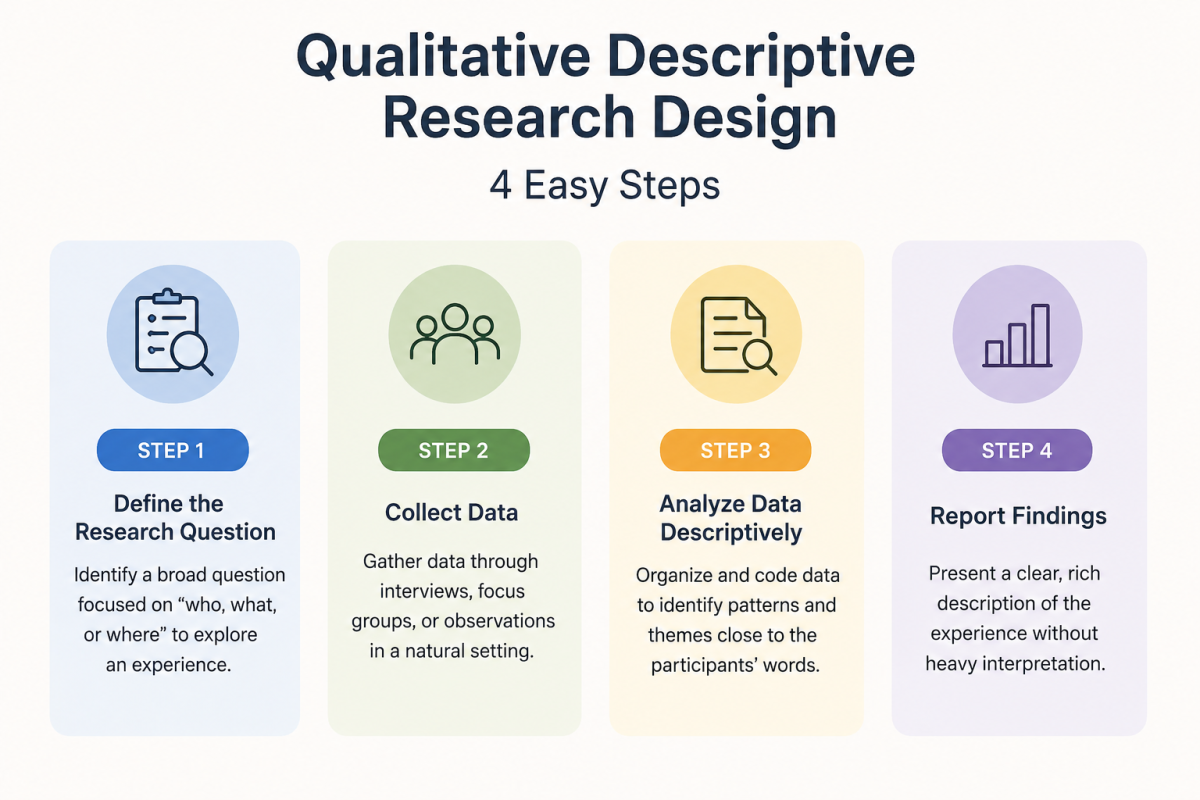
Step 3: Conduct Data Collection and Manage the Qualitative Data
- During data collection, researchers should use open-ended questions that encourage study participants to describe their experiences in detail, in their own words, rather than steering them toward predetermined categories.
- All qualitative interviews and focus group sessions should be audio-recorded and transcribed verbatim to preserve the accuracy of the qualitative data for later data collection and analysis.
- Field notes and reflexive journaling during this stage help researchers track their own assumptions, which is especially important given the low-inference philosophy underpinning the qualitative descriptive design.
- Researchers should also document contextual details about the setting, since descriptive designs place high value on providing a rich, in-depth description of the phenomenon within its natural context.
Step 4: Perform Data Analysis Using Thematic or Content Analysis
- The most common data analysis approaches for qualitative descriptive design are qualitative content analysis and thematic analysis, both of which stay close to the raw data rather than transforming it into abstract theoretical models.
- Thematic analysis involves coding the qualitative data, grouping codes into broader themes, and presenting these themes descriptively — always tied back to participants’ actual language and meaning.
- Qualitative content analysis, meanwhile, systematically categorizes qualitative data into meaningful units, often producing a structured yet descriptive account of the phenomenon studied.
- Once themes or categories are finalized, researchers write up findings using rich description and direct quotations from study participants, ensuring the final research reports remain faithful to the original voices of those studied.
- This four-step research approach — from crafting the research question to completing data analysis — reflects a systematic, evidence-based process that has made the qualitative descriptive design a trusted study design across nursing research, health services research, and broader qualitative research designs.
What are the Advantages and Disadvantages of Qualitative Descriptive Research Design in Qualitative Research Designs?
Advantages of Qualitative Descriptive Research Design
- Accessibility for new researchers: Because it does not demand deep immersion in a single philosophical tradition like phenomenology or grounded theory, the qualitative descriptive design is often recommended in an introduction to qualitative methods for nursing students and early-career researchers.
- Flexibility across disciplines: This design is used extensively in nursing research, health nursing, and social science research because it can be adapted to nearly any phenomenon researchers want to explore, without being locked into rigid theoretical assumptions.
- Practical, actionable findings: Since descriptive qualitative research stays close to participants’ own words, findings are often more directly applicable to real-world nursing practice and evidence for nursing practice than the more abstract outputs of grounded theory research.
- Efficient use of resources: Compared to some other qualitative research designs, descriptive studies often require less time for data collection and analysis, since the researcher is not building complex theoretical models, making it attractive for time-limited studies or dissertations.
- Strong fit for exploratory studies: When little is known about a phenomenon, a qualitative descriptive design provides a solid foundation for future qualitative studies, systematic reviews, or even mixed methods research that combines qualitative and quantitative elements.
- Rich, in-depth description: This descriptive design provides detailed, contextualized accounts of experiences that numbers alone cannot capture, offering nuance that quantitative research typically strips away in favor of measurable variables.
- Compatibility with multiple data collection methods: Whether using focus group discussions, individual qualitative interviews, or open-ended surveys, the design accommodates various data collection and analysis strategies without compromising its core purpose.
- Widely published and respected methodology: Journals such as the International Journal of Qualitative Studies, BMC Medical Research Methodology, and the Journal of Research in Nursing regularly publish studies that used a qualitative descriptive design, lending it strong academic credibility.
Disadvantages of Qualitative Descriptive Research Design
- Perceived lack of theoretical depth: Critics argue that because descriptive qualitative research avoids committing to a single philosophical framework, it can appear less rigorous or theoretically sophisticated compared to phenomenology or grounded theory research.
- Risk of superficial analysis: If not conducted carefully, data analysis in a qualitative descriptive design can end up merely summarizing data rather than offering meaningful insight, especially if thematic analysis or qualitative content analysis is applied too loosely.
- Ambiguity in methodology description: Because this design borrows from multiple qualitative approaches, some research reports struggle to clearly justify their methodology, leading reviewers in a systematic review to question the rigor of the study design.
- Limited generalizability: Like most qualitative research designs, findings from a qualitative descriptive study are not intended to be generalized to broader populations, which can be seen as a limitation for researchers seeking wider applicability, especially in comparison to quantitative research.
- Time-intensive data collection and analysis despite simplicity: While theoretically more straightforward than grounded theory or phenomenology, thorough data collection and analysis — including verbatim transcription and detailed coding — still requires considerable time and reflexivity from the researcher.
- Dependence on researcher skill: Since this design relies on the researcher’s ability to accurately and faithfully represent qualitative data without over-interpreting or under-analyzing it, novice researchers may struggle to strike the right balance.
- Difficulty distinguishing it from other designs: Some scholars have highlighted the features and similarities between descriptive, phenomenological, and qualitative case study approaches, which can create confusion for researchers trying to justify their specific choice of methodology.
- Less established audit trail conventions: Compared to grounded theory research, which has well-documented coding procedures, descriptive qualitative research sometimes lacks standardized guidance on how to design and report every analytical step, making replication more challenging.
Examples of Qualitative Descriptive Research Design
- Example 1: Nursing Students’ Experiences During Clinical Placements — A study conducted within a school of nursing may use a qualitative descriptive design to explore how nursing students experience their first clinical placement. Researchers might conduct focus group discussions with students, followed by thematic analysis to identify shared challenges, such as anxiety, skill development, and communication with patients.
- Example 2: Patient Experiences of Chronic Illness Management — In health nursing research, a study aims to describe how patients living with chronic conditions manage daily symptoms. Using qualitative interviews as the primary data collection method, researchers apply qualitative content analysis to categorize coping strategies, offering direct evidence for nursing practice.
- Example 3: Nurses’ Perspectives on a New Clinical Protocol — A hospital may commission descriptive qualitative research to understand how frontline nurses perceive a newly implemented care protocol. This qualitative descriptive study typically involves semi-structured qualitative interviews, later analyzed using thematic analysis to surface both supportive and critical perspectives among study participants.
- Example 4: Exploring Caregiver Burden in Family Settings — Health services research often uses a qualitative descriptive design to explore the lived reality of family caregivers. Open-ended questions allow caregivers to describe their emotional, physical, and financial burdens, with findings presented descriptively to inform policy and support services.
- Example 5: Understanding Barriers to Health Screening in Underserved Communities — A social science research team might use a qualitative descriptive design to explore why certain communities avoid preventive health screening. Focus group discussions and individual interviews generate qualitative data that, once analyzed, reveal cultural, logistical, and trust-related barriers.
- Example 6: Nurse Educators’ Approaches to Teaching Clinical Reasoning — Within nurse education, researchers may use a qualitative descriptive design to explore how educators teach clinical reasoning skills. This qualitative descriptive research often combines classroom observation with qualitative interviews, followed by content analysis to identify common teaching strategies.
- Example 7: Patient Satisfaction with Telehealth Services — As telehealth expands, researchers frequently apply descriptive qualitative research to explore patient satisfaction. Open-ended survey responses and qualitative interviews are analyzed to describe both positive experiences and ongoing frustrations with virtual care.
- Across all these examples, researchers use a consistent research approach: define a clear research question, collect qualitative data through interviews or focus groups, and apply thematic or content analysis to produce a faithful, in-depth description of the phenomenon — demonstrating why the qualitative descriptive design remains a cornerstone of nursing research, health nursing, and broader qualitative research designs.
