
Blog
How to Conduct Hermeneutic Research Design with Example

What is Hermeneutic Research Design in Qualitative Research Designs?
- Hermeneutic research design is a qualitative methods approach to investigate the meaning behind human experiences by focusing on interpretation rather than measurement. Instead of testing a hypothesis the way quantitative research does, this research method treats every account, text, or lived experience as something that must be interpreted within its own context before it can be understood.
- At its core, hermeneutic phenomenology blends two philosophical traditions. Hermeneutics is the study of interpretation, particularly of written texts, spoken narratives, and symbolic actions, while phenomenology is concerned with describing the meaning of the phenomenon as it is directly experienced by the person living it. When combined, hermeneutic phenomenology becomes an interpretive research approach that asks not just “what happened,” but “what did this experience mean to the person who lived it, and how did they come to understand it.”
- A hermeneutic research design assumes that understanding is not a passive act of recording facts. Instead, understanding is built through a continuous, circular process of interpretation, often called the hermeneutic circle. Researchers move back and forth between the parts of the data and the whole of the narrative, refining their interpretation each time they revisit the material with fresh context.
- This qualitative research approach is especially useful in fields such as nursing research, psychology, and educational research, where the researcher wants to understand lived experience in depth rather than reduce it to numbers or categories. For example, a nurse researcher exploring how patients cope with chronic illness would use hermeneutic phenomenology to uncover layers of meaning in patients’ stories that a survey could never capture.
- Unlike descriptive phenomenology, which tries to bracket or set aside the researcher’s own assumptions to describe a phenomenon purely as it appears, hermeneutic phenomenology accepts that the researcher’s own background, culture, and prior knowledge inevitably shape the interpretation. This is sometimes called the double hermeneutic: the participant is interpreting their own experience, and the researcher is then interpreting the participant’s interpretation.
- In short, hermeneutic research design is not simply a data collection technique. It is a full methodological approach that shapes the research question, the data collection strategy, the data analysis process, and the way conclusions are drawn, all guided by the hermeneutic principle that meaning emerges through dialogue between interpreter and text, researcher and participant, part and whole.
Philosophical Assumptions of The Hermeneutic Research Design
- Every hermeneutic phenomenological research project rests on a set of philosophical assumptions inherited from continental philosophy, most notably from Martin Heidegger and later expanded by Hans-Georg Gadamer. Understanding these assumptions is essential before applying the research method, because they explain why hermeneutic research design looks so different from positivist, quantitative research.
- Being-in-the-world (Heidegger’s contribution): Martin Heidegger argued that human beings cannot be separated from the world they inhabit. We are always already interpreting our surroundings through our history, language, and culture. This assumption means that a hermeneutic phenomenology study never treats a participant’s experience as a neutral, isolated event; it is always understood as embedded within a specific context.
- Fusion of horizons (Gadamer’s contribution): Hans-Georg Gadamer proposed that understanding happens when the researcher’s own “horizon” of assumptions meets the “horizon” of the text or the participant’s account. Neither horizon disappears; instead, they merge to produce new, shared understanding. This is a foundational idea behind modern hermeneutics and directly shapes how researchers approach data analysis.
- The hermeneutic circle: This is arguably the most practical philosophical assumption for researchers to grasp. The concept of the hermeneutic circle holds that understanding is not linear. To understand the whole of a text or narrative, one must understand its parts, but to understand the parts, one must already have some sense of the whole. Researchers using this qualitative research design move back and forth between excerpts of interview data and the overall narrative until a coherent, holistic understanding emerges.
- Reflexivity and researcher’s involvement: Rather than pretending to be a neutral observer, a hermeneutic phenomenological researcher acknowledges that the interpretation process is inevitably influenced by the researcher’s own experiences, beliefs, and disciplinary training. This is not treated as bias to be eliminated but as an interpretive resource to be made transparent throughout the entire research process.
- Language as the medium of understanding: Since hermeneutics is the study of interpretation, language itself is treated as central. Meaning of a text or a spoken account cannot exist outside of language, so careful attention to word choice, metaphor, and narrative structure becomes part of the interpretive process.
- Contextual and historical grounding: A phenomenon can never be fully understood outside the context in which the phenomenon occurs. Historical, cultural, and social context all shape both the participant’s original experience and the researcher’s later interpretation of it.
- Together, these assumptions position hermeneutic research design as fundamentally different from quantitative research. Where quantitative research seeks generalizable, replicable measurements, hermeneutic phenomenology embraces subjectivity, context, and dialogue as the very sources of deeper understanding.
How To Conduct a Hermeneutic Research Design In 4 Easy Steps?
Conducting a hermeneutic phenomenological research project involves a systematic yet flexible method of research. Below are four practical steps that researchers commonly follow.
- Step 1: Formulate a research question rooted in lived experience.
- Start by identifying a phenomenon that participants have directly lived through, such as recovering from surgery, transitioning into a new career, or experiencing grief.
- The research question should invite reflection rather than simple yes-or-no answers; phrases like “what is the experience of…” or “how do individuals make sense of…” work well.
- This stage also requires the researcher to reflect on their own assumptions and prior knowledge about the topic, since these will inevitably shape later interpretation.
- A well-formed research question anchors the entire study and determines who should be recruited as research participants.
- Step 2: Select participants and collect rich, first-person data.
- Data collection in hermeneutic phenomenology relies heavily on semi-structured interviews, personal journals, or written narratives that allow participants to describe their experience within the phenomenon in their own words.
- Sample sizes tend to be small, often between five and fifteen participants, because the goal is depth of interpretation, not statistical generalization.
- Open-ended questions are used to encourage participants to reflect on their experiences freely rather than steering them toward predetermined categories.
- Researchers often keep a reflexive journal during data collection, noting their own reactions and assumptions as they emerge, which becomes part of the interpretive process later.
- Step 3: Engage in hermeneutic analysis using the hermeneutic circle.
- This is the heart of the research method. The researcher reads through the entire transcript first to get a general sense of the whole account.
- Next, the researcher moves into smaller parts of the data, line by line or theme by theme, interpreting each segment in light of the whole, and then revisiting the whole in light of each new part.
- This constant movement between parts and the whole is the essence of the hermeneutic circle, and it is repeated multiple times until a stable, coherent interpretation emerges.
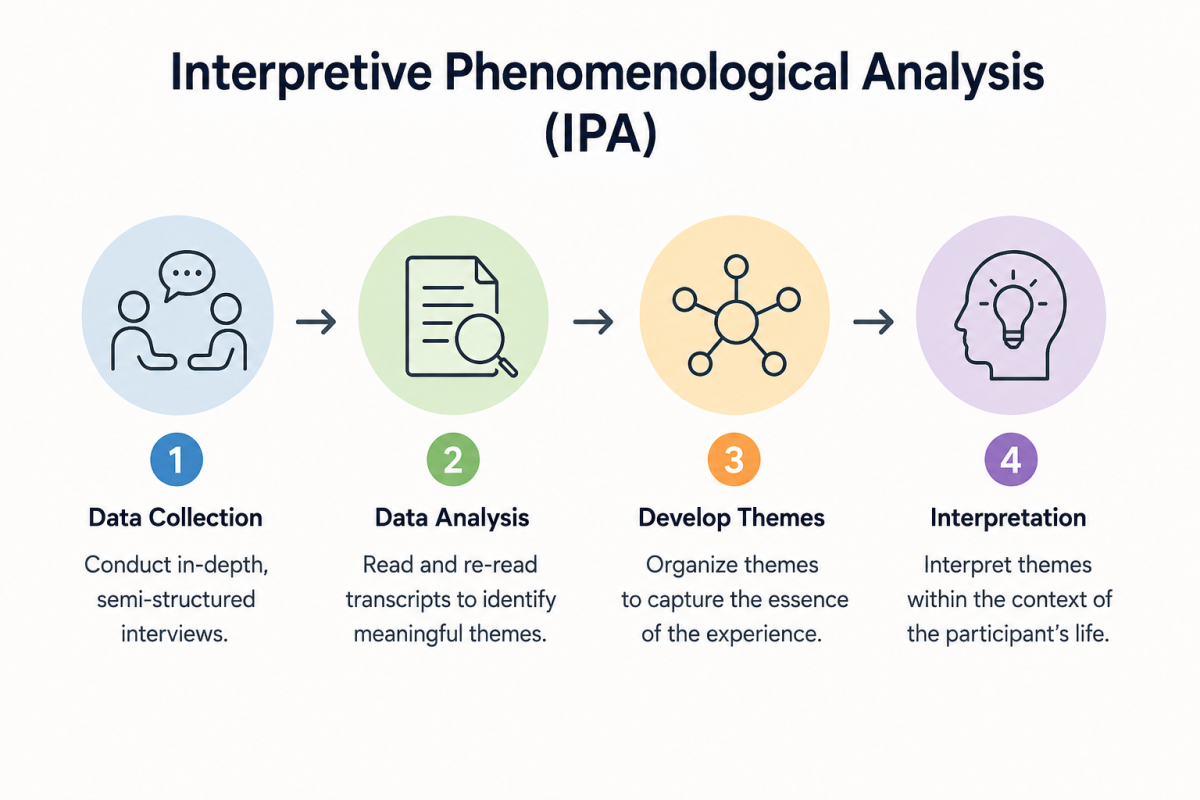
- Techniques such as interpretative phenomenological analysis are sometimes incorporated at this stage to structure the coding and theme development, while still preserving the interpretive, non-reductive spirit of hermeneutic phenomenology.
- Throughout data analysis, researchers document how their own perspective shifted, since transparency about the interpretation process strengthens the credibility of the findings.
- Step 4: Synthesize findings into a holistic understanding and write up interpretations.
- The final step involves weaving together the themes and interpretations into a rich, descriptive narrative that reflects the deeper understanding of the phenomenon as experienced by participants.
- Rather than presenting findings as isolated facts, the write-up should show the reader the layers of meaning uncovered through the interpretive process, often using direct excerpts alongside the researcher’s interpretive commentary.
- Researchers should explicitly discuss how the fusion of horizons between their own perspective and participants’ accounts shaped the final understanding.
- The conclusion should tie the study back to the broader field, showing how the research contributes to existing theoretical and philosophical psychology or professional literature, such as nursing research or educational research.
- Following these four steps ensures that a hermeneutic research design remains methodologically rigorous while staying true to its interpretive, philosophical roots.
What are the Advantages and Disadvantages of Hermeneutic Research Design in Qualitative Research Designs?
Like any qualitative methods approach, hermeneutic phenomenology carries distinct strengths and limitations that researchers should weigh carefully before choosing this research design.
Advantages:
- Deep, contextual understanding of lived experience: Because hermeneutic research design focuses on interpretation rather than measurement, it produces a far richer and more nuanced understanding of the phenomenon than quantitative research typically allows. Researchers gain insight into how participants themselves make sense of their experience within a specific context.
- Flexibility across disciplines: This research method has been successfully applied in nursing research, educational research, psychology, and even organizational studies, showing its versatility as an approach to understanding complex human phenomena across very different professional settings.
- Encourages reflexivity and transparency: Because the researcher’s involvement in the interpretation process is acknowledged rather than hidden, hermeneutic phenomenology tends to produce more honest, self-aware research. Readers can see how the researcher’s perspective shaped the findings, which strengthens rather than weakens the credibility of the study.
- Captures complexity and layers of meaning: The hermeneutic circle allows researchers to keep revisiting data with fresh eyes, uncovering layers of meaning that a single-pass analysis would miss. This iterative process allows for a deeper, more holistic understanding of participants’ experiences.
- Well suited to under-explored or emotionally complex topics: When a phenomenon is difficult to quantify, such as grief, resilience, or identity transformation, hermeneutic phenomenology offers a research approach to investigate these topics with the sensitivity they require.
Disadvantages:
- Time-consuming and labor-intensive: Because data analysis requires multiple passes through the material using the hermeneutic circle, this qualitative research design demands significantly more time than many quantitative research methods or even other qualitative approaches.
- Findings are not generalizable: The insights generated through hermeneutic phenomenology are deeply tied to the specific context of the study and its participants. Unlike quantitative research, findings cannot be statistically generalized to a wider population.
- Risk of researcher bias: While reflexivity is built into the methodological approach, the interpretation process is still influenced by the researcher’s own experiences, beliefs, and disciplinary training. Without careful, disciplined reflexivity, this can tilt the interpretation of the phenomenon in ways that are difficult to fully control.
- Requires advanced interpretive skill: Conducting rigorous hermeneutic analysis requires familiarity with the philosophical underpinnings established by Martin Heidegger and Hans-Georg Gadamer. Novice researchers may struggle to move beyond surface-level description into genuine interpretive depth.
- Difficult to standardize or replicate: Because interpretation is shaped by the specific researcher, the specific participants, and the specific context of their study, another researcher analyzing the same transcripts might arrive at a somewhat different, though equally valid, interpretation. This makes replication in the traditional scientific sense essentially impossible.
- Despite these disadvantages, hermeneutic research design remains a valuable qualitative inquiry method whenever the goal is deep, contextual, meaning-focused understanding rather than statistical generalization. Researchers weighing this research method should consider whether their research question truly calls for interpretive depth or whether a different qualitative or quantitative research method would better serve their study.
Examples of Hermeneutic Research Design
To make the research method more concrete, here are several real-world style examples showing how hermeneutic phenomenology is applied across different fields.
- Nursing research example: A doctoral researcher wants to understand the experience of nurses working in intensive care units during prolonged periods of high patient mortality. Using hermeneutic phenomenology, the researcher conducts semi-structured interviews with twelve nurses, then applies the hermeneutic circle to move between individual accounts and the collective narrative, ultimately uncovering themes such as moral distress, emotional numbing, and post-crisis meaning-making. This research contributes new insights that directly inform hospital support programs.
- Educational research example: A researcher studying first-generation college students wants to understand how these students interpret their sense of belonging on campus. Through in-depth interviews and reflective journals, the researcher applies interpretative phenomenological analysis alongside traditional hermeneutic interpretive techniques, revealing how students’ interpretations of belonging shift over time as they gain confidence, offering universities practical, contextual insight for designing better support systems.
- Psychology example: In theoretical and philosophical psychology, a researcher investigating the lived experience of individuals recovering from trauma uses a hermeneutic phenomenological research design to explore how survivors construct meaning from their experience within the specific context of their recovery journey. The double hermeneutic is especially visible here, as the researcher must interpret how each survivor already interprets their own recovery process.
- Organizational research example: A workplace researcher wants to understand how mid-level managers experience organizational change during a merger. Using hermeneutic phenomenology, the researcher interviews managers before and after the merger, applying the hermeneutic circle to trace how meaning of the phenomenon evolves as managers move through uncertainty, adaptation, and eventual acceptance.
- Cross-cultural research example: A hermeneutic research design is used to explore how immigrant families interpret the experience of raising children across two cultures. Because context in which the phenomenon occurs is central to hermeneutics, the researcher pays close attention to language, tradition, and generational differences, producing a richly contextual account rather than a generalized model of immigrant parenting.
- Across all of these examples, the same underlying method of research applies: rich data collection through interviews or narratives, followed by iterative data analysis guided by the principles of the hermeneutic circle, resulting in a holistic understanding that respects the complexity, context, and lived experience of the phenomenon being studied. Each example also illustrates how hermeneutic phenomenology, though demanding in its interpretive process, delivers a depth of insight that few other qualitative methods can match, making it a compelling research approach to investigate the messy, meaningful, and deeply human questions that quantitative research is often unable to answer.
