
Blog
How To Write Value Hypothesis With Examples

Introduction to Value Hypothesis: Definition, Importance, and Role in Startups
- Definition of Value Hypothesis
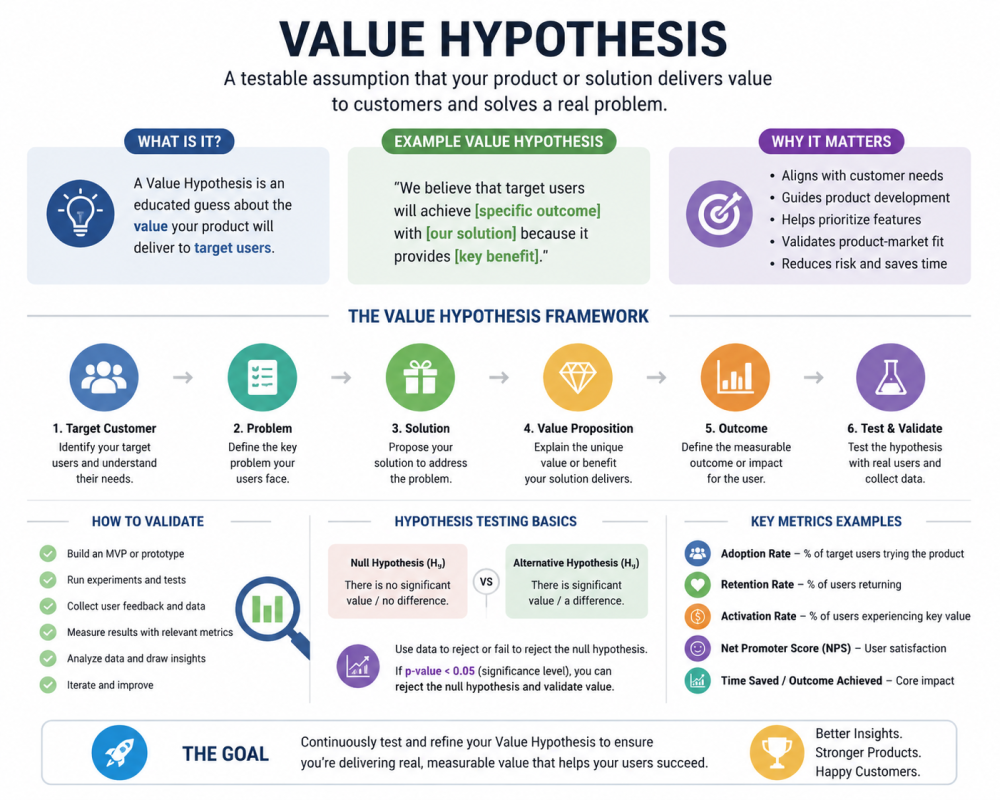
- A value hypothesis is an educated guess about how a product or service will create value for a specific set of target users.
- It is different from a general hypothesis; it specifically predicts customer benefits and expected outcomes that will drive adoption or engagement.
- In statistical terms, a value hypothesis can be treated as an alternative hypothesis, where the null hypothesis assumes the product does not provide value.
- Importance of a Value Hypothesis in Startups
- Helps identify which features or solutions will be truly valuable for the customer, reducing confirmation bias.
- Serves as a framework for hypothesis testing, guiding experiments with minimum viable products (MVPs) or trials to gather data.
- Enables startups to focus resources on features or products most likely to succeed, improving decision making and prioritization.
- Role in Product Development and Startup Strategy
- Supports product-market fit by providing measurable insights into whether a product solves customer needs.
- Allows evaluation of assumptions about the market, target users, and potential value proposition.
- Helps determine which metrics matter, e.g., customer feedback, engagement rates, or adoption probability.
- Reduces the risk of launching a product based on guesswork or untested assumptions, increasing the likelihood of a strong value hypothesis leading to success.
How To Write Value Hypothesis: A 7-Step Formulation Process
- Step 1: Identify the Target Users
- Clearly define who your customer is: age, profession, location, habits, and pain points.
- Use sample data or customer interviews to reduce bias in your educated guess.
- Align the value hypothesis with actual customer needs rather than assumptions.
- Step 2: Define the Problem or Opportunity
- Identify a problem the target users are experiencing or an opportunity they desire.
- Ensure the problem is significant and measurable to allow a statistical test of your hypothesis.
- Frame the assumption clearly so that it can later be validated or rejected.
- Step 3: Articulate the Value Proposition
- Clearly describe the value your product delivers and how it solves the user’s problem.
- Link the value hypothesis directly to measurable outcomes, such as increased efficiency, cost savings, or better engagement.
- Include metrics for evaluation, e.g., adoption rate, click-through, retention, or conversion.
- Step 4: Formulate the Hypothesis Statement
- Write a concise hypothesis: “We believe that [product feature] will create [value] for [target users].”
- Include the assumption you want to test, making it clear how you will observe and measure results.
- Example: “We believe adding in-app tutorials will increase new user retention by 15% over one month.”
- Step 5: Plan the Experiment or MVP Test
- Develop a minimum viable product or trial to validate value.
- Decide the sample size of users to test the hypothesis.
- Identify metrics to track: p-value, adoption, retention, engagement, or satisfaction.
- Ensure statistical significance is achievable, often using a 0.05 significance level to reject the null hypothesis.
- Step 6: Collect and Analyze Data
- Gather quantitative and qualitative data through surveys, usage analytics, and customer feedback.
- Calculate the probability that observed outcomes are not due to random chance using statistical tests.
- Examine results to confirm or reject your educated guess, checking for bias and validity.
- Step 7: Conclude and Iterate
- Based on findings, conclude whether the value hypothesis holds or if the assumption needs revision.
- If rejected, refine the value proposition and test a new hypothesis.
- Use insights to prioritize product development and improve product-market fit.
Key Elements of a Strong Value Hypothesis Every Startup Should Include
- Clear Customer Focus
- Identify target users and describe their needs in detail.
- Ensure the hypothesis addresses real pain points rather than hypothetical problems.
- Measurable Value Proposition
- Define the value your product delivers.
- Include clear metrics for evaluation: usage frequency, conversion rate, or engagement level.
- Testable Assumptions
- Every strong value hypothesis should have a testable assumption that can be validated or rejected.
- Avoid vague statements like “users will love the product” without measurable criteria.
- Statistical Framework
- Use hypothesis testing to determine significance of outcomes.
- Include a null hypothesis, define p-value, and select a significance level (e.g., 0.05) for robust evaluation.
- Minimization of Bias
- Guard against confirmation bias by objectively evaluating customer feedback and data.
- Ensure the sample is representative of your target users.
- Alignment with MVP and Product Strategy
- The hypothesis should guide the development of a minimum viable product, helping solve key customer problems quickly.
- Supports iterative product development and decision making.
- Insight-Driven Outcomes
- Should generate insights for future product features or prioritization.
- Helps startups focus on the most valuable solutions, improving probability of product-market fit.
How To Write Value Hypothesis That Can Be Tested and Validated Effectively
- Use Clear, Specific Language
- A good value hypothesis avoids ambiguous terms and makes the assumption explicit.
- Example: “Offering free shipping will increase checkout conversion by 20% among urban users within 30 days.”
- Design Experiments Around Customer Behavior
- Focus on observable actions such as signup rates, feature usage, or retention.
- Ensure the trial aligns with real-world customer experience to gather reliable evidence.
- Collect Sufficient and Relevant Data
- Use a sample size large enough for statistical significance, typically calculated based on 0.05 significance level.
- Collect customer feedback to complement quantitative data.
- Apply Statistical Testing
- Conduct value hypothesis tests using p-values and confidence intervals.
- Determine whether to reject the null hypothesis or accept the alternative.
- Examine Alternative Hypotheses
- Consider alternative hypotheses to ensure findings are robust.
- Helps prevent confirmation bias and overestimating value based on limited data.
- Iterate Based on Insights
- Use results to refine the hypothesis, adjust features, or improve the MVP.
- Insights guide prioritization of product features and resource allocation.
- Document and Align Outcomes
- Record findings and evidence to support decision making.
- Align results with business goals, ensuring that validated value hypotheses lead to product-market fit.
- Focus on Actionable Metrics
- Identify metrics that drive action: user engagement, adoption, churn, or revenue impact.
- Evaluation of these metrics informs whether the value hypothesis is strong and valuable for the target customer.
- Avoid Bias and Misinterpretation
- Be wary of confirmation bias when interpreting feedback or metrics.
- Validate assumptions with multiple sources of data, experiments, and trials.
- Iterative Learning for Startups
- A value hypothesis is rarely perfect on the first try.
- Use successive experiments and customer insights to gradually improve the hypothesis.
- This iterative approach increases the probability of developing a strong value hypothesis that ensures product success.
Metrics and Evaluation: Measuring the Significance of Your Value Hypothesis
- Understanding the Role of Metrics
- Metrics are critical for determining the value a product provides to target users.
- They allow a startup to validate value, examine outcomes, and make data-driven decisions.
- Metrics help in hypothesis testing, providing evidence to accept or reject the null hypothesis.
- Selecting Appropriate Metrics for Value Hypothesis Tests
- Focus on metrics that directly relate to the value proposition, such as adoption rate, user retention, engagement, conversion, or revenue.
- Consider qualitative data from customer feedback alongside quantitative metrics to reduce confirmation bias.
- Ensure metrics can demonstrate statistical significance, typically using a 0.05 significance level and calculating the p-value.
- Defining Evaluation Criteria
- Clearly define success thresholds before running experiments, e.g., “15% increase in engagement over 30 days”.
- Use these thresholds to estimate probabilities and determine whether to reject or accept the hypothesis.
- Set up a framework for decision making to prevent post-hoc guessing.
- Collecting and Analyzing Data
- Collect data from a representative sample of target users to ensure validity.
- Use a combination of MVP trials, surveys, and usage analytics to gather comprehensive evidence.
- Apply statistical tests such as t-tests, chi-square tests, or ANOVA to examine hypothesis significance.
- Understanding P-Values and Significance Levels
- The p-value represents the probability of observing results as extreme as your data if the null hypothesis were true.
- A p-value < 0.05 often indicates that the findings are statistically significant, allowing you to reject the null hypothesis.
- Be aware that a low p-value alone does not prove value; it must be combined with practical insights and customer relevance.
- Iterative Evaluation and Continuous Improvement
- Treat every experiment as a learning opportunity. Use hypothesis testing to refine assumptions and improve your value hypothesis.
- Compare multiple value hypothesis tests to prioritize product features with the highest potential value.
- Use insights to guide product development, adjust MVPs, and ensure alignment with customer needs.
- Integrating Insights into Decision Making
- Evaluate the outcome of experiments in relation to business goals.
- Determine if the value hypothesis provides actionable insight that can improve product-market fit.
- Document findings to conclude which assumptions are valid, which need refinement, and how to solve potential issues in future iterations.
Common Mistakes When Writing a Value Hypothesis and How to Avoid Them
- Mistake 1: Focusing on Features Instead of Value
- A hypothesis that emphasizes product features rather than customer value often fails to generate actionable insight.
- Solution: Start with target users and their needs, then frame the hypothesis around outcomes rather than technical specifications.
- Mistake 2: Ambiguous or Vague Assumptions
- Hypotheses like “Users will like this feature” are difficult to test and evaluate.
- Solution: Use specific, measurable outcomes, such as adoption rate, retention, or conversion.
- Mistake 3: Insufficient Sample Size
- Small or biased samples can produce misleading data and flawed decision making.
- Solution: Collect data from a representative sample of target users to ensure validity.
- Mistake 4: Ignoring Statistical Significance
- Assuming a hypothesis is true without statistical testing can lead to overconfidence and confirmation bias.
- Solution: Perform value hypothesis tests, calculate p-values, and examine results against a 0.05 significance level to determine reliability.
- Mistake 5: Overlooking Alternative Hypotheses
- Only testing one scenario may hide better opportunities.
- Solution: Consider alternative hypotheses to examine multiple possibilities and reduce bias.
- Mistake 6: Neglecting Customer Feedback
- Relying solely on analytics may miss qualitative insight about customer needs and satisfaction.
- Solution: Collect feedback through surveys, interviews, or focus groups to complement quantitative metrics.
- Mistake 7: Confusing Correlation with Causation
- Observing a positive outcome does not necessarily prove that the product caused it.
- Solution: Use controlled experiments or trial MVPs to establish causal relationships.
- Mistake 8: Ignoring Iterative Learning
- Treating the value hypothesis as static prevents continuous improvement.
- Solution: Refine hypotheses based on findings, adjust assumptions, and update MVPs to improve product-market fit.
Case Studies and Examples: Real-World Applications of Value Hypothesis in Startups
- Case Study 1: Dropbox’s Early MVP Test
- Hypothesis: “Providing a simple cloud storage solution will increase user adoption by 20% in 1 month.”
- Approach: Created a minimum viable product video demo, collected customer feedback, and measured signups.
- Metrics: User interest, email signups, and engagement.
- Outcome: Positive value hypothesis test, which validated assumption and led to full product development.
- Lesson: Early MVPs and data collection can prove the value hypothesis before investing heavily in development.
- Case Study 2: Airbnb’s Customer-Centric Experimentation
- Hypothesis: “Users will prefer listings with professional-quality photos, improving booking rates by 15%.”
- Approach: Conducted an experiment providing photography services to a subset of hosts.
- Evaluation: Compared booking metrics across sample groups, calculated p-values, and examined statistical significance.
- Finding: High-quality photos led to increased bookings; null hypothesis rejected, confirming a good value hypothesis.
- Insight: Focus on customer needs and measurable outcomes to validate value.
- Case Study 3: Slack’s Onboarding Flow Optimization
- Hypothesis: “Introducing interactive onboarding will improve daily active users by 10%.”
- Approach: Built an MVP of onboarding, ran A/B experiments, and collected customer feedback.
- Metrics: Retention rates, time to first meaningful action, engagement score.
- Outcome: Value hypothesis tests confirmed improved outcomes, leading to full-scale implementation.
- Lesson: Iterative experiments and data-driven decisions strengthen the value hypothesis and product-market fit.
- Key Takeaways from Case Studies
- Always collect evidence to support or refute assumptions.
- Use statistical testing to avoid bias and improve decision making.
- Iterative trials and MVPs provide insight and reduce risk for startups.
- A strong value hypothesis directly informs prioritization, product development, and overall success.
Advanced Tips: Strengthening Your Value Hypothesis for Better Product-Market Fit
- Integrate Multi-Channel Data
- Combine qualitative insights from user interviews with quantitative metrics to improve evaluation accuracy.
- Helps estimate probabilities, detect patterns, and reduce confirmation bias.
- Leverage Hypothesis Testing Frameworks
- Adopt a structured framework for writing and testing value hypotheses.
- Include alternative hypotheses to examine multiple potential outcomes.
- Use statistical tests, including calculation of p-values and setting a 0.05 significance level.
- Refine MVPs for Focused Experiments
- Build minimum viable products that target core customer needs.
- Ensure trials are efficient, minimizing resources while maximizing insight.
- Prioritize Hypotheses by Impact and Risk
- Evaluate each value hypothesis based on potential value, probability of success, and alignment with product strategy.
- Focus on high-impact, testable hypotheses first to accelerate product-market fit.
- Monitor Metrics Continuously
- Use metrics like engagement, retention, conversion, and feedback to refine hypotheses.
- Regularly re-examine outcomes to detect trends or issues.
- Guard Against Bias
- Actively validate assumptions, consider alternative explanations, and avoid over-interpreting data.
- Ensure sample selection is representative to maintain statistical validity.
- Iterate and Improve Hypotheses
- Treat each experiment as an opportunity to learn and improve your value hypothesis.
- Use insights to optimize product features, align with customer needs, and strengthen value propositions.
- Document Findings and Decisions
- Keep a detailed record of trials, results, and conclusions to support prioritization and strategic decision making.
- Helps avoid repeating mistakes and ensures knowledge is shared across the startup team.
- Connect Value Hypotheses to Product-Market Fit
- Strong value hypotheses are directly linked to customer satisfaction and adoption.
- Validated hypotheses allow startups to focus development on the features that truly create value, improving product-market fit and long-term success.
✅ Key Summary Points
- Always begin with a customer-focused problem.
- Ensure metrics and evaluation are clear and measurable.
- Use hypothesis testing and statistical analysis to validate assumptions.
- Minimize bias and confirm findings with data.
- Use MVPs or trials to quickly gather insights.
- Align results with business goals and product-market fit.
- Iteratively refine the value hypothesis until evidence supports decision making and startup success.
- Use metrics and evaluation to measure significance and validate value.
- Avoid common mistakes such as vague assumptions, small samples, or ignoring customer feedback.
- Learn from real-world case studies to apply value hypothesis testing effectively.
- Strengthen hypotheses with statistical rigor, iterative experiments, and focus on customer needs.
- A strong value hypothesis enables startups to make better decisions, improve product-market fit, and succeed in delivering meaningful value to users.
Research Hypotheses
Types of Research Hypotheses
Explore key hypothesis categories used in academic research and studies.
Types of Hypotheses
Overview
→
Research Hypotheses
Basics
→
Alternative
H1
→
Null
H0
→
Directional
One-tailed
→
Non-Directional
Two-tailed
→
Simple
One variable
→
Complex
Multiple variables
→
Causal
Cause-effect
→
Associative
Relationship
→
Statistical
Testing
→
Working
Temporary
→
Declarative
Statement form
→
Question Form
Question-based
→
Empirical
Observed data
→
Logical
Reasoned
→
Value
Business focus
→
