
Blog
How To Write Empirical Hypothesis With Examples

Introduction to Empirical Hypothesis: Definitions and Key Concepts in Empirical Research
- Definition of Empirical
- Empirical refers to knowledge or information that is based on observation, experience, or experimentation, rather than purely theoretical or speculative ideas.
- In the context of research, empirical data and evidence are critical for drawing accurate and reliable conclusions.
- Empirical research can include both quantitative research (numerical data, statistical analysis) and qualitative research (interviews, observational research, questionnaires).
- Understanding Empirical Hypothesis
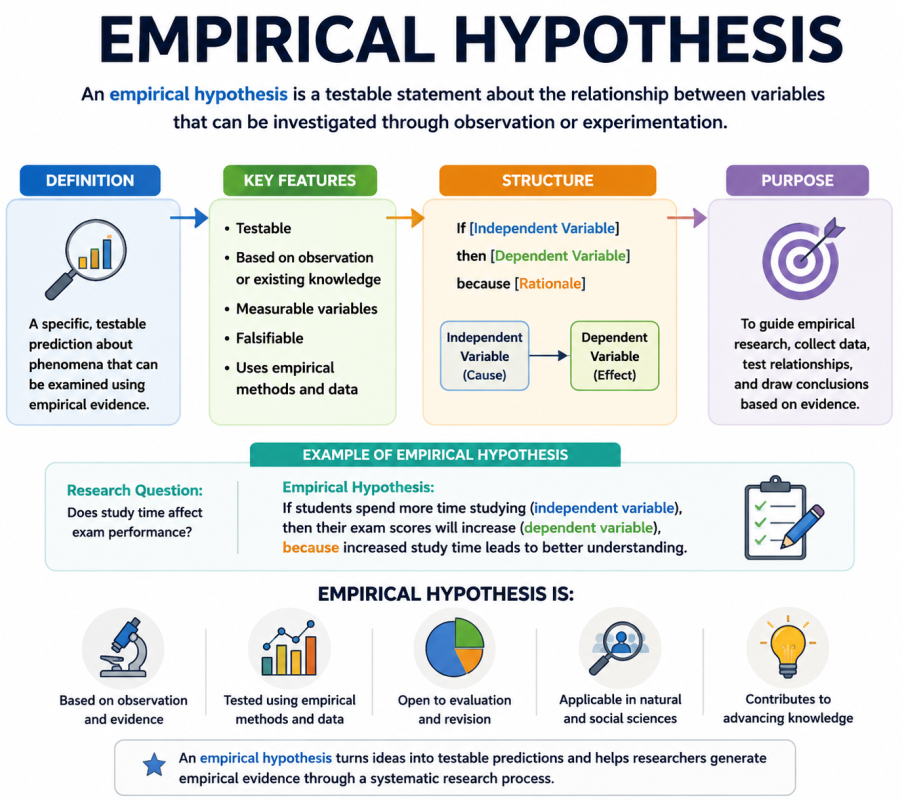
- An empirical hypothesis is a statement that predicts the relationship between variables and can be tested using empirical evidence.
- It is formulated based on existing knowledge, observations, and relevant literature to answer a research question.
- The hypothesis is not arbitrary; it must be structured in a way that allows hypothesis testing through direct observation, experimentation, or statistical analysis.
- Key Components of an Empirical Hypothesis
- Independent Variable: The factor that is manipulated or categorized to examine its effect.
- Dependent Variable: The outcome or phenomenon being measured.
- Observable Predictions: Statements that can be confirmed or refuted using empirical data.
- Testability: Must be capable of being supported or rejected by empirical research findings.
- Working Hypotheses and Alternative Hypotheses
- A working hypothesis is a preliminary statement that guides the research process.
- □□□ Alternative hypothesis: Represents a competing prediction or outcome against the main hypothesis, used to strengthen empirical hypothesis testing.
- Importance in Social Sciences and Natural Sciences
- Empirical hypotheses are widely used in social sciences, such as sociology, psychology, and political science, to understand complex social behavior.
- In natural sciences, they provide data-driven insights through laboratory experiments, field research, or observational research.
- Role of Observation and Experimentation
- Empirical research relies on direct observation and systematic experimentation to gather data.
- Observational studies help identify patterns and relationships, while experimental design allows researchers to test hypotheses under controlled conditions.
- The combination ensures accuracy and reliability of research results.
How To Write Empirical Hypothesis: A 7-Step Process for Conducting Empirical Research
- Identify a Research Question
- Start with a clear and focused research question.
- Example: “Does the use of social media impact academic performance in university students?”
- Ensure the question is suitable for empirical and non-empirical comparison, meaning it can be tested with real-world data.
- Conduct Literature Review
- Review relevant literature to understand what previous studies have found.
- Gather in-depth information to advance knowledge and avoid duplicating efforts.
- Determine gaps where empirical research can contribute valuable insights.
- Formulate the Empirical Hypothesis
- Convert the research question into a testable statement.
- Example of an empirical hypothesis: “Students who spend more than 3 hours daily on social media have lower GPA scores than those who spend less than 1 hour.”
- Identify independent and dependent variables and ensure the hypothesis is deductive and falsifiable.
- Determine the Research Design
- Decide on the form of research: observational research, field research, or laboratory experiments.
- Choose between quantitative research (numerical data, statistical tests) and qualitative research (interviews, questionnaires, observational notes).
- Ensure the design aligns with research objectives and allows empirical hypothesis testing.
- Collect Data
- Gather empirical data using appropriate methods: questionnaire, direct observation, experimentation, or existing datasets.
- Ensure the data collected is accurate, reliable, and representative of the study population.
- Combine observational data with numerical data for robust empirical research findings.
- Analyze Data and Test Hypotheses
- Use statistical tests or qualitative analysis to evaluate whether the empirical hypothesis is supported.
- Compare findings with the alternative hypothesis to assess validity.
- Apply empirical methods such as regression, correlation, or coding qualitative responses for data-driven insights.
- Draw Conclusions and Peer Review
- Interpret research findings to draw conclusions about the hypothesis.
- Discuss implications, limitations, and potential biases in the study.
- Submit work for peer review to ensure reliability, accuracy, and contribution to advancing knowledge.
Understanding Research Design to Support Your Empirical Hypothesis
- Definition and Importance of Research Design
- Research design is the blueprint of the study, outlining how to collect, analyze, and interpret empirical data.
- A strong design ensures accuracy and reliability while allowing replication by other researchers.
- It bridges the gap between working hypotheses and empirical research findings.
- Types of Research Design
- Experimental Design: Controlled manipulation of independent variables to study effects on dependent variables in a laboratory setting.
- Observational Research: Systematic observation without manipulation; valuable for naturalistic settings.
- Field Research: Data collected in real-world contexts to capture real-world data.
- Mixed Methods: Combines quantitative and qualitative research for comprehensive analysis.
- Selecting the Appropriate Design
- Consider research objectives, type of data needed, and available resources.
- Ensure compatibility with empirical hypothesis testing and ability to collect data from diverse sources.
- Ensuring Validity and Reliability
- Include control groups, random sampling, and replication where possible.
- Peer review of design increases accuracy and reliability of research results.
- Using Research Design to Advance Knowledge
- Research design helps draw conclusions that are grounded in empirical evidence rather than speculation.
- Supports hypothesis testing with data-driven insights, advancing both theory and practice in social sciences and natural sciences.
How To Write Empirical Hypothesis: Tips for Collecting Data Effectively
- Gathering Data from Diverse Sources
- Use multiple methods to enhance accuracy and reliability:
- Direct observation
- Questionnaires and surveys
- Existing databases
- Field research and laboratory experiments
- Use multiple methods to enhance accuracy and reliability:
- Maintaining Accuracy in Data Collection
- Ensure data collection methods are consistent and replicable.
- Record observation and experimentation procedures clearly.
- Minimize bias through randomization and control measures.
- Distinguishing Between Qualitative and Quantitative Data
- Quantitative data: Numerical, suitable for statistical tests, regression, correlation analysis.
- Qualitative data: Non-numerical, collected via interviews, field notes, or observational studies, offering valuable insights and understanding of complex behavior.
- Ensuring Ethical and Valid Data Collection
- Obtain consent for human subjects.
- Avoid manipulating results; data must reflect empirical research findings accurately.
- Tools and Techniques for Effective Data Collection
- Questionnaire: Standardized set of questions to gather structured data.
- Observation checklist: For observational research to capture relevant behavior systematically.
- Statistical software: For numerical analysis and empirical hypothesis testing.
- Leveraging Empirical Data to Test Hypotheses
- Ensure that collected data directly addresses the independent and dependent variables outlined in the hypothesis.
- Use empirical research methods to examine relationships and validate predictions.
- Documenting and Organizing Data
- Keep detailed logs of data collected, sources, and methods used.
- Organized records facilitate peer review, replication, and drawing conclusions based on empirical evidence.
- Ensuring Relevance and Utility of Data
- Align collected data with research objectives to produce valuable insights.
- Focus on data from diverse settings, including field research, laboratory settings, and observational studies to strengthen the robustness of the empirical hypothesis.
Analyzing Research Results to Refine Your Empirical Hypothesis
- Start with Data Organization
- Compile all data collected systematically from your quantitative research, qualitative research, or mixed methods.
- Ensure data includes numerical data, qualitative data, observational research, and field research results.
- Organize data to align with independent and dependent variables identified in the empirical hypothesis.
- Conduct Statistical Analysis
- Use appropriate statistical tests for quantitative data: t-tests, ANOVA, regression, correlation analysis, etc.
- Quantitative results allow you to test hypotheses and confirm or reject the working hypotheses.
- Statistical analysis ensures accuracy and reliability, and provides data-driven insights.
- Interpret Empirical Research Findings
- Analyze patterns and trends in empirical data to draw conclusions regarding the hypothesis.
- Compare findings to existing knowledge and relevant literature to see if they support or contradict the empirical hypothesis.
- Examine both empirical and non-empirical evidence for context; theoretical insights may guide interpretation.
- Refine Your Empirical Hypothesis
- Based on research results, adjust or exhaust empirical hypothesis to account for new observations.
- Consider alternative explanations and □□□ alternative hypothesis to ensure your conclusions are robust.
- Use observation and experimentation to validate refinements.
- Use Peer Review for Validation
- Share research findings with colleagues for peer review.
- Peer review enhances accuracy and reliability, identifies gaps, and ensures research is grounded in empirical evidence.
- Link Findings to the Scientific Method
- Analyzing results strengthens understanding of the scientific method by confirming that hypotheses are testable, falsifiable, and data-driven.
- Promotes advancing knowledge in both natural and social sciences.
- Document Lessons Learned
- Record how data supports or challenges the original empirical hypothesis.
- Note which empirical methods were most effective and which data collection techniques need improvement.
- This documentation informs future research projects and hypothesis testing strategies.
Common Mistakes to Avoid When Conducting Empirical Research
- Poorly Defined Research Question
- Starting with a vague or purely theoretical or speculative question hinders the creation of a valid empirical hypothesis.
- Ensure research questions are clear, specific, and deductive, allowing measurable outcomes.
- Ignoring Existing Knowledge and Literature
- Skipping a relevant literature review may lead to redundant work or flawed hypotheses.
- Review prior empirical research findings to inform your working hypotheses and research design.
- Inadequate Research Design
- A weak or inconsistent research design undermines data reliability.
- Avoid failing to specify your form of research: experimental, observational, or mixed methods.
- Ensure proper identification of independent and dependent variables.
- Poor Data Collection Methods
- Relying on incomplete or biased data collected can compromise results.
- Avoid using questionnaires or observation methods without clear procedures or documentation.
- Always gather empirical data from diverse sources for stronger validity.
- Neglecting Qualitative or Quantitative Balance
- Using only one type of data may miss crucial insights.
- Combine qualitative data (interviews, field notes) with numerical data for a comprehensive understanding.
- Failing to Test Hypotheses Properly
- Skipping empirical hypothesis testing or misapplying statistical tests leads to unreliable conclusions.
- Always test working hypotheses systematically with empirical evidence.
- Overlooking Observation and Experimentation Standards
- Not following observation and experimentation protocols can introduce errors.
- Ensure consistency in direct observation, laboratory settings, or field research.
- Ignoring Peer Review
- Lack of □□ peer review can result in unchecked bias or flawed reasoning.
- Peer feedback ensures accuracy and reliability and may reveal overlooked insights.
- Drawing Conclusions Too Early
- Avoid forming conclusions without analyzing all data collected thoroughly.
- Accurate conclusions should be based on empirical research findings rather than intuition.
How To Write Empirical Hypothesis: Examples from Real Empirical Studies
- Example 1: Social Media and Academic Performance
- Research Question: Does social media usage affect student grades?
- Empirical Hypothesis: Students spending more than 3 hours per day on social media have lower GPA scores than those spending less than 1 hour.
- Data Collection: Questionnaire, observation, school performance records.
- Empirical Methods Used: Statistical tests (correlation and regression) to analyze numerical data.
- Findings: Significant negative correlation found, supporting the empirical hypothesis.
- Example 2: Exercise and Mental Health
- Research Question: Does regular exercise improve mental well-being?
- Empirical Hypothesis: Individuals exercising at least 30 minutes daily report higher mental health scores than those who do not.
- Data Collection: Field research, questionnaire, direct observation.
- Analysis: Use of statistical analysis and empirical data for hypothesis testing.
- Research Results: Positive relationship confirmed; alternative hypothesis rejected.
- Example 3: Workplace Productivity and Remote Work
- Research Question: How does remote work influence productivity?
- Empirical Hypothesis: Employees working remotely 3+ days a week show higher task completion rates than those in-office full-time.
- Research Design: Observational research, time-tracking software, employee interviews.
- Data Analysis: Mixed methods combining qualitative research insights and numerical data.
- Results: Evidence supports empirical hypothesis, with data-driven insights highlighting workflow advantages.
- Example 4: Dietary Habits and Blood Sugar Levels
- Research Question: Does a low-sugar diet improve blood glucose control in adults?
- Empirical Hypothesis: Adults on a low-sugar diet for 3 months have lower average blood sugar than those on a normal diet.
- Data Collected: Clinical observations, lab testing, patient logs.
- Empirical Methods Used: Experimental design in laboratory setting, statistical analysis of numerical data.
- Research Results: Supports hypothesis; demonstrates the importance of direct observation and empirical evidence.
- Lessons from Real Studies
- Real-world examples show that empirical hypothesis must be testable, falsifiable, and grounded in observation.
- Effective research design and peer review ensure accuracy and reliability.
- Integrating both qualitative and quantitative research enhances understanding of complex phenomena.
Strengthening Your Empirical Research Skills: Best Practices and Next Steps
- Develop Strong Research Questions
- Base questions on existing knowledge and gaps in relevant literature.
- Ensure they allow for empirical and non-empirical evaluation.
- Master Research Design
- Learn to choose the most suitable form of research: observational, experimental, or mixed methods.
- Align research objectives with the type of empirical data to be collected.
- Refine Data Collection Techniques
- Use questionnaires, direct observation, laboratory experiments, or field research effectively.
- Record data collected systematically to facilitate empirical hypothesis testing.
- Enhance Data Analysis Skills
- Practice statistical analysis for numerical data and coding techniques for qualitative data.
- Learn to interpret results accurately to draw conclusions and advance knowledge.
- Understand Empirical and Non-Empirical Approaches
- Differentiate purely theoretical or speculative ideas from observation-based evidence.
- Apply the scientific method rigorously to ensure accuracy and reliability.
- Engage in Peer Review
- Submit findings for □□ peer review to improve credibility.
- Feedback identifies gaps, improves research process, and ensures data-driven insights.
- Document Research Process
- Maintain logs of observation and experimentation, data from diverse sources, and methodology details.
- Ensures transparency, reproducibility, and strengthens empirical research findings.
- Keep Learning and Advancing Knowledge
- Review studies in social sciences and natural sciences to see how empirical hypotheses are applied.
- Continuously refine your ability to exhaust empirical hypothesis and produce valuable insights.
- Integrate Both Qualitative and Quantitative Skills
- Combine real-world data with field research, laboratory settings, and observation.
- This allows for comprehensive empirical hypothesis testing, capturing the full complexity of studied phenomena.
Research Hypotheses
Types of Research Hypotheses
Explore key hypothesis categories used in academic research and studies.
Types of Hypotheses
Overview
→
Research Hypotheses
Basics
→
Alternative
H1
→
Null
H0
→
Directional
One-tailed
→
Non-Directional
Two-tailed
→
Simple
One variable
→
Complex
Multiple variables
→
Causal
Cause-effect
→
Associative
Relationship
→
Statistical
Testing
→
Working
Temporary
→
Declarative
Statement form
→
Question Form
Question-based
→
Empirical
Observed data
→
Logical
Reasoned
→
Value
Business focus
→
