
Blog
How To Write Simple Hypothesis With Examples

What Is a Simple Hypothesis? Definition, Characteristics, and Role in Research
A Simple Hypothesis is one of the most important concepts in scientific research because it helps researchers make clear and testable predictions about the relationship between variables. Before collecting data or conducting an experiment, a researcher typically develops a hypothesis to guide the investigation and establish what outcome is expected.
Definition of a Simple Hypothesis
- A hypothesis is a statement that proposes a possible explanation, prediction, or relationship that can be tested through observation and experimentation.
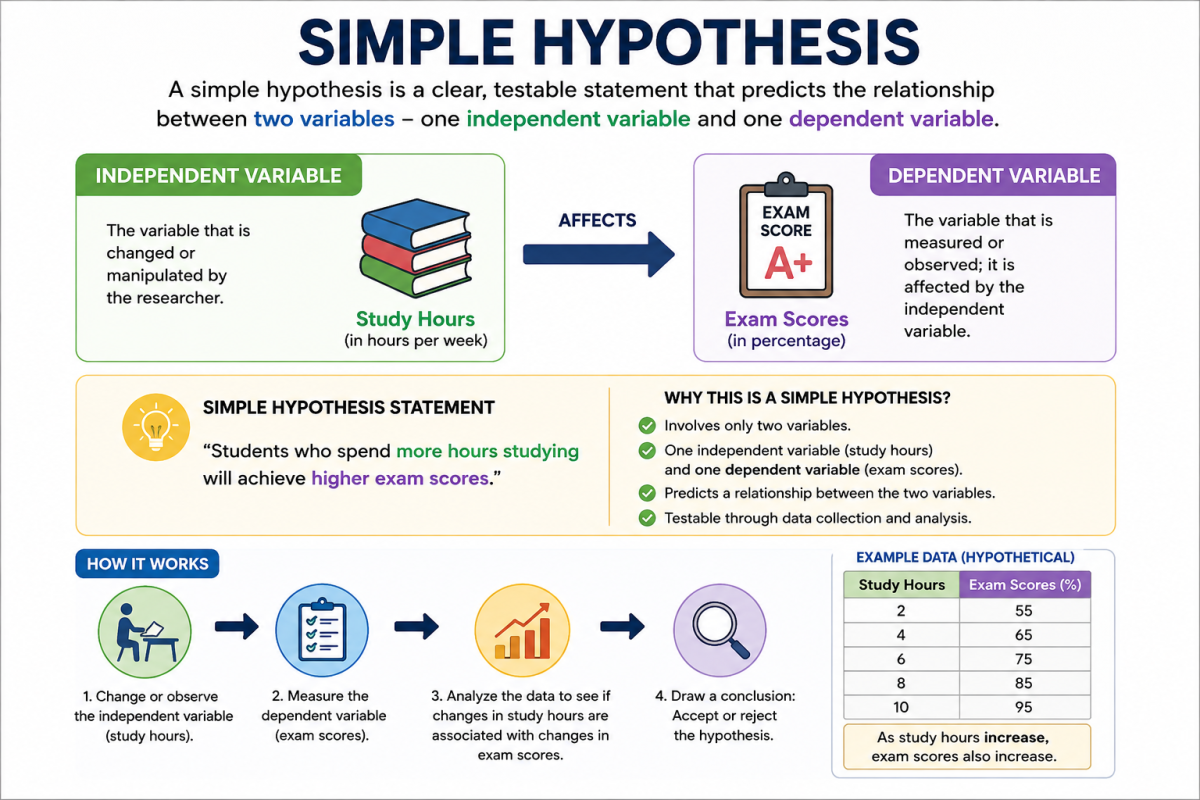
- A Simple Hypothesis specifically predicts a relationship between two variables:
- One independent variable
- One dependent variable
- In other words, a Simple Hypothesis examines how a change in one variable may influence another variable.
- The hypothesis must be clear, specific, measurable, and testable.
Example of a Simple Hypothesis
- Independent variable: Number of study hours
- Dependent variable: Examination score
- Simple Hypothesis:
- “Students who study more hours will achieve higher examination scores.”
This statement predicts a relationship between two variables and can be tested using empirical data.
Key Characteristics of a Simple Hypothesis
1. It Involves Two Variables
- A Simple Hypothesis focuses on a single independent variable and a single dependent variable.
- The independent variable is the factor that influences or affects another variable.
- The dependent variable is the outcome being measured.
- Because it examines only two variables, the relationship is easier to test and interpret.
2. It Is Testable
- A hypothesis must be capable of being tested using observation, surveys, experiments, or other research methods.
- Researchers must be able to collect evidence to determine whether the prediction is supported.
- If a statement cannot be tested experimentally or empirically, it is not considered a scientific hypothesis.
3. It Is Measurable
- Variables should be defined operationally.
- Operational definitions explain exactly how the variables will be observed and measured.
- For example:
- Study hours can be measured in hours per week.
- Academic performance can be measured using examination scores.
4. It Demonstrates Falsifiability
- Falsifiability is a key principle introduced by Karl Popper.
- According to Popper, a scientific hypothesis must be capable of being proven false.
- If no possible evidence could contradict a statement, it is not scientifically useful.
- A Simple Hypothesis should allow researchers to gather evidence that could either support or challenge the prediction.
5. It Provides Direction for Research
- The hypothesis guides data collection.
- It helps identify:
- The variable of interest
- Appropriate measurements
- Statistical tests
- Research procedures
- Without a hypothesis, scientific research may lack focus and purpose.
Role of a Simple Hypothesis in Research
Establishes Research Direction
- A Simple Hypothesis acts as a roadmap for the study.
- It tells researchers what relationship they are investigating.
- It helps narrow broad research questions into specific testable predictions.
Supports the Scientific Method
- The scientific method relies heavily on hypothesis development.
- Researchers:
- Observe a phenomenon
- Identify a problem
- Formulate a hypothesis
- Collect data
- Analyze findings
- Accept or reject conclusions
Facilitates Statistical Testing
- A Simple Hypothesis can be converted into a statistical hypothesis.
- Researchers often compare:
- The null hypothesis
- The alternative hypotheses
- Statistical procedures determine whether observed results are significant.
Encourages Objective Investigation
- A hypothesis reduces subjective interpretation.
- Researchers focus on measurable evidence rather than personal opinions.
- This improves reliability and validity.
Contributes to Theory Development
- Repeated testing of hypotheses contributes to scientific knowledge.
- Supported hypotheses can strengthen existing theories.
- Contradictory findings may encourage the development of new explanations.
How To Write Simple Hypothesis With Examples: A 7-Step Process
Creating a Simple Hypothesis involves more than making a guess. A strong research hypothesis follows a systematic process that ensures clarity, testability, and scientific value.
Step 1: Identify the Research Problem
- Begin with a specific question or problem.
- Determine what issue you want to investigate.
- Review previous research to identify gaps in knowledge.
Example:
- Research question:
- Does sleep duration affect student performance?
Step 2: Identify the Variables
- Determine the independent and dependent variables.
- The independent variable is the factor believed to influence outcomes.
- The dependent variable is the outcome being measured.
Example:
- Independent variable: Sleep duration
- Dependent variable: Academic performance
Step 3: Review Previous Research
- Examine scholarly articles and experimental data.
- Identify patterns and established findings.
- Use evidence to support your prediction.
Step 4: Predict the Relationship Between Variables
- Consider how the independent variable may influence the dependent variable.
- Determine whether the expected relationship is positive, negative, or neutral.
Example:
- More sleep may improve concentration and academic results.
Step 5: Write a Clear and Testable Statement
- Formulate the hypothesis in precise language.
- Avoid vague or subjective wording.
- Ensure the variables are measurable.
Example:
- “Students who sleep at least eight hours per night will achieve higher examination scores than students who sleep fewer than six hours.”
Step 6: Check for Falsifiability
- Ask whether evidence could prove the statement wrong.
- A valid hypothesis must be capable of being supported or contradicted by empirical evidence.
Step 7: Refine and Finalize the Hypothesis
- Review the wording.
- Confirm that:
- Variables are clearly identified.
- Measurements are possible.
- The prediction is specific.
- The statement aligns with the research objective.
Additional Examples of a Simple Hypothesis
Education
- Students who attend more classes will earn higher grades.
Health
- Individuals who exercise regularly will have lower blood pressure.
Business
- Increasing advertising expenditure will increase product sales.
Agriculture
- Plants receiving more sunlight will grow taller than plants receiving less sunlight.
Each example includes a single independent variable and a single dependent variable, making it a Simple Hypothesis.
How To Write Simple Hypothesis With Examples and Make Accurate Predictions
A Simple Hypothesis is most useful when it not only states a relationship between variables but also helps researchers make accurate predictions that can be tested through scientific research. Since a Simple Hypothesis focuses on a single independent variable and one dependent variable, it provides a clear framework for examining how a change in one variable may influence a particular outcome.
Understand What a Simple Hypothesis Predicts
- A Simple Hypothesis predicts a specific relationship between two variables.
- It identifies:
- One independent variable
- One dependent variable
- The hypothesis predicts what may happen when the independent variable changes.
- The prediction should be based on logic, theory, observation, or previous research rather than personal opinion.
- A strong research hypothesis should focus on measurable outcomes.
Example:
- Independent variable: Daily exercise
- Dependent variable: Body weight
- Hypothesis:
- “Individuals who exercise for at least 30 minutes daily will experience greater weight loss than those who do not.”
Steps to Make Accurate Predictions
Define the Variable of Interest
- Clearly identify the variable of interest before beginning research.
- The variables should be operationally defined.
- Researchers should know exactly how each variable will be measured.
Use Previous Research
- Previous research helps researchers formulate realistic predictions.
- Reviewing scientific literature prevents assumptions based solely on subjective beliefs.
- Existing evidence often reveals patterns that can support the original hypothesis.
Focus on Measurable Outcomes
- A Simple Hypothesis should include measurable variables.
- Measurement allows researchers to compare results objectively.
- Measurable variables improve reliability and validity.
Identify Possible Cause-and-Effect Relationships
- Many studies investigate cause and effect relationships.
- A causal hypothesis suggests that a change in one variable directly influences another.
- Example:
- Increasing study time causes improved examination performance.
Avoid Unsupported Assumptions
- Predictions should be supported by empirical evidence whenever possible.
- Unsupported assumptions may lead to contradictory findings.
Examples of Accurate Simple Hypotheses
Education Example
- “Students who complete weekly practice quizzes will score higher on final examinations.”
Health Example
- “Adults who consume more vegetables will have lower cholesterol levels.”
Marketing Example
- “Increasing online advertisements will increase website traffic.”
Agriculture Example
- “Plants receiving additional fertilizer will grow faster than plants receiving no fertilizer.”
Why Prediction Matters in Research
- Prediction is central to the scientific method.
- A well-written Simple Hypothesis helps researchers:
- Design experiments
- Collect relevant data
- Select appropriate measurements
- Analyze outcomes
- Compare expected and actual results
- Strong predictions make scientific research more focused and efficient.
The Importance of Falsifiability in a Simple Hypothesis
One of the most important characteristics of a Simple Hypothesis is falsifiability. Without falsifiability, a hypothesis cannot be considered scientific because there is no way to determine whether it is wrong.
What Is Falsifiability?
- Falsifiability refers to the possibility that evidence could prove a hypothesis incorrect.
- Philosopher Karl Popper argued that scientific claims must be capable of being disproven.
- According to Popper, a hypothesis must expose itself to testing and possible rejection.
Why Falsifiability Matters
Distinguishes Science from Opinion
- Scientific claims require evidence.
- Subjective opinions often cannot be tested.
- A Simple Hypothesis should be testable and supported by empirical observations.
Supports Objective Investigation
- Researchers collect evidence rather than relying on assumptions.
- The investigation becomes evidence-driven instead of belief-driven.
Encourages Better Research Design
- When a hypothesis can be disproven, researchers develop stronger methods for testing it.
- This improves the quality of scientific research.
Examples of Falsifiable and Non-Falsifiable Statements
Falsifiable Statement
- “Students who study for more than 10 hours per week will achieve higher examination scores.”
Why it is falsifiable:
- Study hours can be measured.
- Examination scores can be measured.
- Data may support or contradict the prediction.
Non-Falsifiable Statement
- “Success is determined by invisible forces that cannot be observed.”
Why it is not falsifiable:
- Invisible forces cannot be measured.
- No evidence can confirm or disprove the claim.
Falsifiability and Statistical Testing
- Statistical analysis helps determine whether researchers should accept or reject findings.
- Researchers often compare:
- The null hypothesis
- One of the alternative hypotheses
- The null hypothesis is usually written as a negative statement suggesting no relationship exists.
- Alternative hypotheses propose that a relationship does exist.
Role of Significance Testing
- Researchers conduct a statistical test to evaluate evidence.
- The level of significance is often set at 0.05.
- If the probability of getting the observed result by chance is less than the significance level, researchers may reject the hypothesis of no effect.
- If the probability is less than 0.05, evidence may support the alternative explanation.
Understanding Possible Errors
False Positive
- Occurs when researchers reject the null hypothesis even though it is actually true.
- This is known as a Type I error.
False Negative
- Occurs when researchers fail to detect a real effect.
- This is known as a Type II error.
Possible Error in Research
- Every study contains some possibility of error.
- Researchers attempt to reduce these errors through careful design and measurement.
Falsifiability and Scientific Progress
- Scientific knowledge grows when hypotheses are challenged.
- Contradictory evidence often leads to improved theories and better explanations.
- This process is a major reason why falsifiability remains a cornerstone of modern science.
Common Mistakes to Avoid When Writing a Simple Hypothesis
Many researchers struggle to formulate an effective Simple Hypothesis. Avoiding common mistakes improves the quality of research and increases the likelihood of meaningful findings.
Mistake 1: Including Too Many Variables
- A Simple Hypothesis should focus on two variables.
- Including two or more variables may transform it into a complex hypothesis.
- A complex hypothesis often examines two or more independent variables or multiple outcomes.
Incorrect Example
- “Study habits, exercise habits, sleep quality, and diet influence grades and mental health.”
Correct Example
- “Students who study more hours will achieve higher grades.”
Mistake 2: Using Vague Language
- Variables should be clearly defined.
- Terms such as “better,” “more successful,” or “improved” should be explained operationally.
Mistake 3: Creating a Non-Testable Statement
- A hypothesis must be testable.
- Researchers should be able to collect evidence experimentally or through observation.
Mistake 4: Ignoring Previous Research
- Previous research provides important guidance.
- Ignoring existing evidence may result in unrealistic predictions.
Mistake 5: Confusing Correlation with Causation
- Not every relationship represents a causal effect.
- Some studies investigate an associative hypothesis rather than a causal hypothesis.
- Researchers should be careful before claiming cause and effect.
Mistake 6: Writing a Subjective Hypothesis
- Scientific hypotheses should not be based solely on personal beliefs.
- Objective measurements should support every claim.
Mistake 7: Failing to Define Independent and Dependent Variables
- Researchers should clearly identify:
- Independent variable
- Dependent variable
- Failure to do so creates confusion during data analysis.
Mistake 8: Ignoring Statistical Requirements
- A strong statistical hypothesis should align with planned statistical analysis.
- Researchers should understand the theory of hypothesis testing before collecting data.
Mistake 9: Making Predictions That Cannot Be Measured
- Variables must be measurable.
- If measurement is impossible, meaningful testing cannot occur.
Mistake 10: Creating Contradictory Statements
- A hypothesis should communicate one clear prediction.
- Contradictory wording can confuse readers and weaken the study design.
How To Write Simple Hypothesis With Examples for Different Types of Research
Different types of research require different approaches to hypothesis development. Although the basic principles remain the same, the context of the study influences how researchers formulate hypotheses.
Experimental Research
- Experimental research investigates cause-and-effect relationships.
- Researchers manipulate the independent variable and observe changes in the dependent variable.
- Experimental data are often collected under controlled conditions.
Example
- “Students who receive tutoring sessions will achieve higher mathematics scores.”
Observational Research
- Researchers observe naturally occurring conditions.
- No direct manipulation occurs.
Example
- “Individuals who spend more time reading tend to have larger vocabularies.”
Quantitative Research
- Focuses on numerical measurement and statistical analysis.
- Frequently uses statistical hypotheses.
Example
- “Employees who receive professional training will demonstrate higher productivity scores.”
Educational Research
- Commonly examines learning outcomes.
Example
- “Students who participate in classroom discussions will earn higher course grades.”
Health Research
- Investigates factors affecting health outcomes.
Example
- “Individuals who walk 10,000 steps daily will have lower blood pressure.”
Business Research
- Studies organizational and consumer behavior.
Example
- “Increasing social media advertising will increase product sales.”
Agricultural Research
- Examines factors affecting crop production and livestock performance.
Example
- “Applying organic fertilizer will increase crop yield.”
Relationship Between Different Types of Hypotheses
Researchers may encounter various classifications of hypotheses, including:
Simple Hypothesis
- Examines a relationship between two variables.
- Includes one dependent variable and a single independent variable.
Complex Hypothesis
- Examines two or more variables simultaneously.
- May involve two or more independent variables.
Directional Hypothesis
- Predicts the direction of the effect.
Associative Hypothesis
- Predicts a relationship without specifying direct causation.
Causal Hypothesis
- Suggests that one variable directly causes a change in another.
Composite Hypothesis
- Includes multiple parameter values or conditions.
Final Thoughts
- A Simple Hypothesis remains one of the most valuable tools in scientific research.
- A well-developed Simple Hypothesis helps researchers make accurate predictions, design effective studies, and evaluate evidence objectively.
- By focusing on a single independent variable and one dependent variable, a Simple Hypothesis provides clarity and simplicity while maintaining scientific rigor.
- Whether conducting educational, business, health, or experimental studies, researchers who understand how to write a Simple Hypothesis can create stronger research hypotheses and produce more reliable findings.
Research Hypotheses
Types of Research Hypotheses
Explore key hypothesis categories used in academic research and studies.
Types of Hypotheses
Overview
→
Research Hypotheses
Basics
→
Alternative
H1
→
Null
H0
→
Directional
One-tailed
→
Non-Directional
Two-tailed
→
Simple
One variable
→
Complex
Multiple variables
→
Causal
Cause-effect
→
Associative
Relationship
→
Statistical
Testing
→
Working
Temporary
→
Declarative
Statement form
→
Question Form
Question-based
→
Empirical
Observed data
→
Logical
Reasoned
→
Value
Business focus
→
