
Blog
How To Write Descriptive Research Questions With Examples

What Are Descriptive Research Questions? Definition, Purpose, and Role in Descriptive Research
Descriptive Research Questions are questions used in a descriptive research study to provide factual information about a phenomenon being studied.
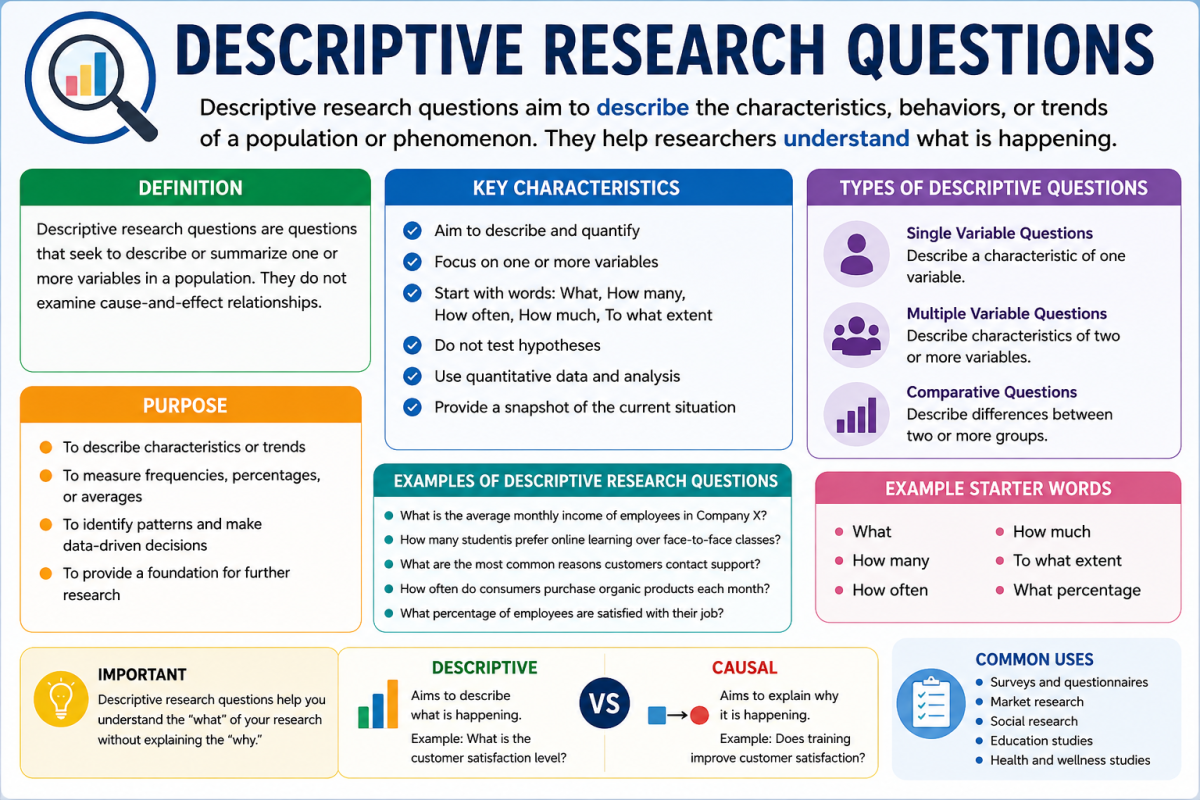
- A descriptive research question is a type of research question that aims to describe characteristics, behaviors, trends, frequencies, or conditions within a population.
- Unlike causal research or experimental research, descriptive research is used to describe situations without testing cause-and-effect relationships.
- Descriptive research questions focus on one variable or multiple variables but do not manipulate an independent variable.
- Their primary research purpose is to understand the nature of a specific topic through systematic data collection and data analysis.
- Researchers need these questions when they want data-driven insights rather than explanations about why something occurs.
Learn What Descriptive Research Means
- Descriptive research is a type of research that seeks to present an accurate picture of a population, event, or phenomenon.
- The study’s objective is to observe and report facts.
- It is usually observational rather than experimental.
- Research is used to describe patterns, satisfaction levels, behaviors, attitudes, and identifying trends.
- Descriptive research examples include:
- Measuring job satisfaction among employees.
- Examining consumer preferences for online shopping.
- Investigating stress levels among university students.
- Determining customer satisfaction levels after using a service.
Characteristics of Descriptive Research Questions
Descriptive Research Questions usually:
- Aim to describe rather than explain.
- Questions aim to quantify information.
- Start with words such as:
- What
- How many
- How often
- How much
- To what extent
- Focus on one variable or multiple variables.
- Avoid investigating causal relationships.
- Are actionable and measurable.
- Produce quantitative results that can be summarized using central tendency and standard deviation.
- Use categorical and numerical data.
Difference Between Descriptive, Qualitative, and Causal Questions
Descriptive Questions
- Aim to describe characteristics or trends.
- Questions often include frequencies and percentages.
- Example:
- What are the satisfaction levels of remote employees?
Qualitative Research Questions
- Explore meanings, opinions, and personal experiences.
- Qualitative research seeks contextual understanding.
- Data collection methods often involve interviews and observations.
- Example:
- How do employees describe their experiences working remotely?
Causal Questions
- Examine cause and effect.
- Investigate causal relationships between two or more variables.
- Usually involve an independent variable and a dependent variable.
- Example:
- Does remote work increase employee productivity?
Role of Descriptive Research Questions in a Research Project
Descriptive Research Questions play an important role in the research process because they:
- Define the research problem.
- Guide the study design.
- Align with research objectives.
- Determine appropriate research methods.
- Influence the amount of data required.
- Help researchers choose the right research design.
- Support collecting and analyzing data systematically.
- Provide information that can later support comparative research, correlation studies, or causal research.
How to Write Descriptive Research Questions: A 4-Step Process for Creating Effective Quantitative Research Questions
Creating effective Descriptive Research Questions requires careful planning. You’ll learn a simple four-step framework that improves the quality of any research project.
Step 1: Identify the Research Problem
Before writing a research question:
- Determine the specific topic you want to investigate.
- Review existing literature.
- Understand the phenomenon being studied.
- Clarify the study aims and research objectives.
- Ensure the research purpose is clear.
For example:
- Research problem: Employee burnout in technology companies.
Step 2: Determine the Variable to Be Measured
Descriptive questions typically focus on:
- A single variable.
- Multiple variables without establishing cause and effect.
Examples include:
- Job satisfaction.
- Consumer preferences.
- Stress levels.
- Customer loyalty.
- Employee engagement.
Because descriptive studies do not investigate cause-and-effect relationships, there is no manipulation of variables.
Step 3: Choose Quantifiable Language
Since a descriptive research question belongs to quantitative research, questions are designed to quantify information.
Questions usually start with:
- What percentage
- How many
- How frequently
- To what extent
Examples:
- What percentage of employees report high job satisfaction?
- How frequently do consumers purchase organic products?
These questions focus on measurable outcomes.
Step 4: Match the Question with the Research Design
Select the right research design and data collection methods.
Researchers need to consider:
- Study design.
- Research methods.
- Sample size.
- Data you collect.
- Methodological requirements.
Possible sampling techniques include:
- Random sampling.
- Stratified sampling.
- Cluster sampling.
The selected design should support effective data analysis and generate reliable findings.
Why This Process Matters
Following these four steps helps researchers:
- Develop actionable questions.
- Improve methodological quality.
- Create data-driven studies.
- Ensure alignment between research objectives and the full study.
- Produce accurate findings.
Descriptive Research Questions Examples: Real Examples of Descriptive Research Questions in Quantitative Research
Below are practical examples of descriptive research questions across different fields.
Education
Examples of Descriptive Research Questions:
- What are the average stress levels among first-year university students?
- How many students participate in online learning programs?
- What percentage of students prefer hybrid classes?
Business
Examples of descriptive research include:
- What are customer satisfaction levels among smartphone users?
- How frequently do consumers shop online each month?
- What are consumer preferences regarding payment methods?
Human Resources
- What is the level of job satisfaction among employees in manufacturing companies?
- How many employees work remotely at least three days per week?
- What percentage of employees participate in wellness programs?
Healthcare
- What are the most common health concerns among elderly patients?
- How often do patients visit healthcare facilities annually?
- What percentage of patients are satisfied with telemedicine services?
Marketing
Descriptive research examples in marketing include:
- What social media platform is most preferred by Generation Z consumers?
- How often do customers purchase products after seeing online advertisements?
- What are the satisfaction levels of subscribers?
Technology
- What percentage of smartphone users enable biometric security features?
- How many hours do teenagers spend on social media daily?
- What applications are most commonly used by remote workers?
Difference Between Descriptive and Comparative Questions
Comparative questions involve differences between two or more groups.
Example:
- Are there differences between two age groups regarding online shopping frequency?
Relationship-based questions examine correlation between two or more variables.
Example:
- Is there a correlation between stress levels and sleep duration?
By comparison, Descriptive Research Questions simply aim to describe characteristics without testing a hypothesis.
Descriptive Research Questions: Advantages and Strengths vs Disadvantages and Limitations in Descriptive Research Design
Advantages and Strengths
Descriptive Research Questions offer several benefits.
1. Simple and Easy to Develop
- Questions are straightforward.
- Suitable for beginners.
- Require less complexity than experimental research.
2. Support Quantitative Analysis
- Results can be analyzed statistically.
- Researchers can quantify findings.
- Measures such as central tendency and standard deviation summarize data efficiently.
3. Useful for Large Populations
- Large amounts of data can be collected.
- Surveys and questionnaires simplify data collection.
4. Provide Data-Driven Insights
- Findings help organizations make informed decisions.
- A company wants reliable information before launching products.
- Businesses can better understand consumer preferences.
5. Help Identify Trends
- Researchers can observe patterns over time.
- Useful for identifying trends in customer behavior and satisfaction levels.
6. Foundation for Further Research
- Findings often support exploratory studies.
- Results may lead to comparative research or correlation studies.
- They can help formulate a hypothesis for future studies.
Disadvantages and Limitations
1. Cannot Explain Cause and Effect
- Descriptive studies do not establish cause-and-effect relationships.
- They cannot determine why an outcome occurs.
2. Limited Depth
- Unlike qualitative research, they provide little contextual understanding.
- Personal experiences are not explored extensively.
3. Dependence on Accurate Data Collection
- Poor data collection methods can affect reliability.
- Errors in questionnaires may influence findings.
4. No Variable Manipulation
- There is no independent variable manipulation.
- Researchers cannot test causal relationships.
5. Results May Only Describe the Present Situation
- Findings may become outdated over time.
- Results often represent conditions only during the study period.
Final Thoughts
Descriptive Research Questions are among the most widely used types of research questions in quantitative research. They help researchers understand the nature of a problem, describe patterns, and generate valuable information without testing hypotheses. Whether you use descriptive research in education, healthcare, business, or marketing, selecting the appropriate research question is essential for achieving reliable
Research Questions
Types of Research Questions
Explore different categories of research questions used in academic studies.
Descriptive Research Question
What is happening?
→
Exploratory Research Question
Explore unknowns
→
Explanatory Research Question
Why it happens
→
Comparative Research Question
Compare variables
→
Relationship-Based Research Question
Connections
→
Causal Research Question
Cause-effect
→
Predictive Research Question
Future outcomes
→
Evaluative Research Question
Assess value
→
Interpretive Research Question
Meaning focus
→
Action Research Question
Practical change
→
Phenomenological Research Question
Lived experience
→
Grounded Theory Research Question
Theory building
→
Historical Research Question
Past events
→
Ethnographic Research Question
Culture study
→
Systematic Review Research Question
Evidence synthesis
→
PICO Research Question
Clinical format
→
PEO Research Question
Qualitative health
→
FINER Research Question
Quality criteria
→
Hypothesis-Based Research Question
Testable design
→
Mixed Methods Research Question
Combined approach
→
