
Blog
How To Write FINER-Based Research Questions With Examples

What Are FINER-Based Research Questions? Definition, FINER Criteria, Framework, and Why Every Researcher Should Use FINER in Writing Research Questions
- FINER-Based Research Questions are research questions developed using the FINER framework, a widely accepted framework used to assess whether a proposed study question is worth investigating.
- The term FINER is an acronym that stands for:
- F – Feasible
- I – Interesting
- N – Novel
- E – Ethical
- R – Relevant
- The FINER framework was popularized by Hulley and other research methodology experts as a practical tool for developing research questions.
- The primary purpose of the FINER approach is to help a researcher create a good research question that is:
- Clear
- Focused
- Researchable
- Practically achievable
- Valuable to the academic community
- Many students begin with a broad research topic but struggle to formulate a precise research question.
- For example:
- Broad topic: Social media and mental health
- Better research question: How does daily social media use affect anxiety levels among university students aged 18–25?
- The FINER criteria help researchers narrow the scope of a study and transform broad ideas into focused investigations.
Understanding the FINER Criteria
F – Feasible
- A feasible research question can realistically be answered using available resources.
- Researchers should consider:
- Time and resources available
- Access to participants
- Availability of data
- Required expertise
- Funding availability
- Questions that are too ambitious often become difficult to complete.
- Example of a question that is too broad:
- How does social media affect all people worldwide?
- More feasible version:
- How does Instagram usage influence academic performance among first-year university students?
- Feasibility ensures the research project can be completed with available resources.
I – Interesting
- A research question should be interesting to:
- The researcher
- Supervisors
- Stakeholders
- Readers of the research paper
- Interest helps maintain motivation during:
- Literature searches
- Data collection
- Data analysis
- Writing the final report
- A topic that genuinely interests the researcher often produces better-quality work.
N – Novel
- Novelty means the study contributes new knowledge to the existing body of knowledge.
- Novel does not always mean completely new.
- A study can be novel by:
- Investigating a different population
- Applying a new study design
- Examining a different geographical location
- Testing a new intervention
- Exploring a gap in existing knowledge
- Researchers should conduct a literature review and targeted literature searches to evaluate whether similar studies already exist.
- Reviewing existing literature helps identify:
- Unanswered questions
- Contradictory findings
- Emerging trends
- Areas needing further investigation
E – Ethical
- Every research project should comply with ethical guidelines.
- Ethical considerations include:
- Informed consent
- Participant confidentiality
- Privacy protection
- Risk minimization
- Institutional approval
- A research question may be scientifically interesting but unethical to investigate.
- Ethical research builds trust and protects participants.
R – Relevant
- Relevance ensures the research addresses a meaningful issue.
- A relevant study:
- Solves a real-world problem
- Improves practice
- Supports policy decisions
- Advances theory
- Improves future research
- Highly relevant studies often:
- Attract funding
- Gain publication opportunities
- Influence professional practice
- Generate meaningful contributions
Why Every Researcher Should Use FINER in Writing Research Questions
- Using FINER helps create a feasible research question before substantial work begins.
- The FINER framework provides a structured method for research planning.
- Benefits include:
- Improved clarity
- Better focus
- Stronger research design
- Easier funding applications
- More meaningful results
- Experienced researchers frequently apply FINER evaluation before approving a research proposal.
- FINER-Based Research Questions help ensure studies remain manageable and scientifically valuable.
- The framework used by FINER reduces the likelihood of pursuing impractical topics.
- FINER-Based Research Questions improve the quality of:
- Research protocols
- Grant proposals
- Academic dissertations
- Journal articles
- Thesis projects
- Ultimately, FINER-Based Research Questions increase the chances of producing research that contributes new knowledge and strengthens the state of knowledge within a field.
How To Write FINER-Based Research Questions: A 4-Step Process for Developing Research Questions Using the FINER Framework, Checklist, and Research Design Principles
Writing research questions is not a one-time activity. A research question is an iterative process that often requires refinement and revision. Developing research questions becomes easier when researchers follow a structured method.
Step 1: Identify and Narrow Your Research Topic
- Begin with a broad area of interest.
- Examples:
- Healthcare
- Education
- Technology
- Psychology
- Business
- Conduct preliminary literature searches.
- Examine:
- Published research
- Existing literature
- Current debates
- Research gaps
- Ask:
- What is already known?
- What remains unanswered?
- Where is the gap in existing knowledge?
- Narrow the scope by focusing on:
- A specific population
- A specific intervention
- A measurable outcome
- A particular setting
- Example:
- Broad topic: Employee wellbeing
- Narrow topic: Remote work and employee burnout among software developers
Step 2: Draft a Preliminary Research Question
- Create an initial version of your research question.
- Focus on clarity and specificity.
- Avoid:
- A vague question
- Multiple questions combined into one
- Questions that are too broad
- Weak example:
- Does technology affect education?
- Improved example:
- How does the use of AI-powered tutoring systems affect mathematics performance among secondary school students?
- The primary research question should clearly identify:
- Population
- Variable
- Outcome
Step 3: Apply the FINER Criteria Checklist
Use this checklist to evaluate your draft question.
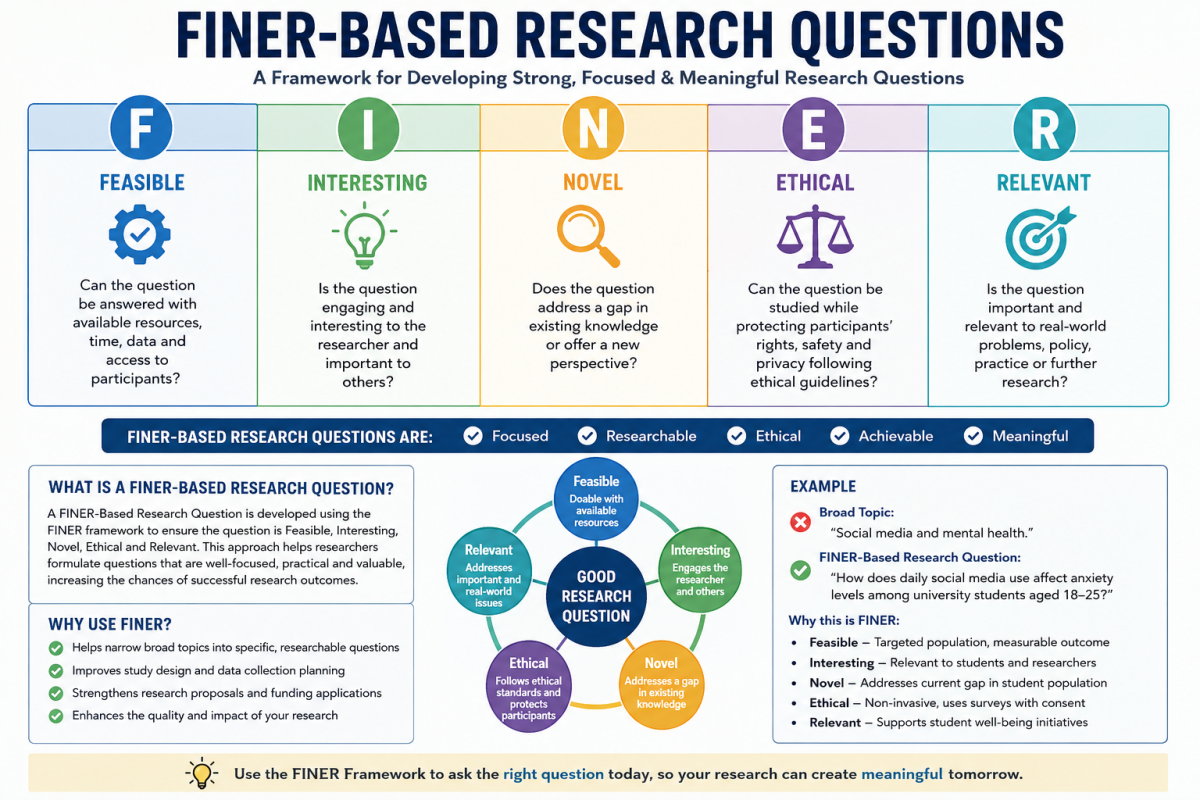
Feasible
- Can the study be completed with available resources?
- Do you have access to participants?
- Is sufficient data available?
- Is the timeline achievable?
Interesting
- Does the topic motivate you?
- Will readers find it valuable?
Novel
- Does it address a gap in existing knowledge?
- Does it contribute something meaningful?
Ethical
- Does it follow ethical guidelines?
- Can participants be protected?
Relevant
- Does it solve a real-world problem?
- Will it generate meaningful contributions?
- This stage is often called FINER evaluation.
- If the answer to any criterion is “no,” revise the question.
Step 4: Align the Question with Research Design and Data Collection
- Ensure the question matches the study design.
- Consider:
- Research design
- Data collection methods
- Inclusion criteria
- Sampling strategy
- Analysis techniques
- Ask:
- Can the research design answer the research question?
- Are the data collection methods appropriate?
- Quantitative studies require measurable variables.
- Qualitative studies require questions that explore experiences, perceptions, or behaviors.
- Once alignment is achieved, the question becomes ready for the research proposal and research protocol.
FINER-Based Research Questions Examples: Research Question Examples for Descriptive Research, PICO Studies, Data Collection, Research Protocols, and Research Papers
The following FINER-Based Research Questions demonstrate how researchers can formulate effective studies.
Example 1: Descriptive Research
Research Topic
- Social media usage among university students
Research Question
- What are the patterns of social media use among undergraduate students at public universities?
Why It Meets FINER
- Feasible
- Interesting
- Novel within the target population
- Ethical
- Relevant
Example 2: Healthcare Using the PICO Framework
The PICO framework works exceptionally well alongside the FINER approach.
PICO Elements
- Population: Adults with hypertension
- Intervention: Exercise program
- Comparison: No exercise program
- Outcome: Blood pressure reduction
Research Question
- Among adults with hypertension, does participation in a structured exercise program compared with no exercise program reduce blood pressure levels?
Why It Meets FINER
- Clearly measurable
- Clinically relevant
- Supported by existing knowledge
- Practical data collection process
Example 3: Education Research
Research Question
- How does online learning affect academic performance among first-year university students?
FINER Assessment
- Feasible research question
- Access to participants available
- Relevant educational issue
- Ethical to investigate
Example 4: Business Research
Research Question
- What is the relationship between employee engagement and productivity among remote workers?
FINER Assessment
- Manageable sample size
- Achievable within normal research timelines
- Valuable for organizational decision-making
Example 5: Public Health Research
Research Question
- What factors influence vaccine acceptance among parents of children under five years old?
FINER Assessment
- Addresses a real-world health challenge
- Generates meaningful results
- Contributes to public health policy
Example 6: Clinical Problem Research
Research Question
- Does telemedicine improve treatment adherence among diabetic patients in rural communities?
FINER Assessment
- Relevant clinical problem
- Practical implementation
- Strong potential to contribute new knowledge
FINER-Based Research Questions: Advantages and Strengths vs Disadvantages, Limitations, Common Mistakes, and How to Evaluate Research Questions Using the FINER Criteria Checklist
Advantages and Strengths of FINER-Based Research Questions
1. Provides a Clear Framework
- The FINER framework offers a systematic approach to writing research questions.
- Reduces confusion during research planning.
- Improves consistency.
2. Improves Feasibility
- Encourages realistic project planning.
- Helps researchers consider time and resources.
- Ensures projects remain practically achievable.
3. Supports Better Research Design
- Creates stronger alignment between:
- Research question
- Study design
- Data collection
- Analysis methods
4. Enhances Research Quality
- Produces more focused investigations.
- Improves reliability and validity.
5. Encourages Meaningful Contributions
- Helps identify research that contributes new knowledge.
- Strengthens the overall body of knowledge.
Disadvantages and Limitations of FINER-Based Research Questions
1. May Restrict Creativity
- Excessive focus on feasibility may discourage ambitious ideas.
2. Novelty Can Be Difficult to Judge
- Determining whether a topic is truly novel requires extensive literature review.
3. Relevance May Change Over Time
- Some highly relevant issues become less important as circumstances evolve.
4. Subjective Interpretation
- Researchers may disagree when evaluating:
- Interest
- Novelty
- Relevance
Common Mistakes When Using FINER
Mistake 1: Creating a Question That Is Too Broad
Example:
- How does education affect society?
Better version:
- How does online learning affect mathematics performance among high school students?
Mistake 2: Ignoring Existing Literature
- Failing to review published research may result in duplicated studies.
Mistake 3: Choosing an Unachievable Topic
- Lack of access to participants can make a study impossible.
Mistake 4: Overlooking Ethical Issues
- Ethical concerns can prevent project approval.
Mistake 5: Selecting a Non-Measurable Question
- Questions should contain outcomes that can be observed or assessed.
FINER Criteria Checklist for Evaluating Research Questions
Before finalizing your study, ask the following:
Feasible
- Can the study be completed with available resources?
- Is access to participants possible?
- Is the timeline realistic?
Interesting
- Does the topic motivate the researcher?
- Will others care about the findings?
Novel
- Does it address a gap in existing knowledge?
- Does it extend existing knowledge?
Ethical
- Does it comply with ethical guidelines?
- Can participant welfare be protected?
Relevant
- Does it solve a meaningful problem?
- Will the findings contribute to the field?
- If all answers are yes, you likely have a strong FINER-Based Research Question.
- Remember that developing research questions is a continuous refinement process.
- A question is an iterative process, and researchers often revise multiple versions before reaching the final form.
- By consistently using FINER, researchers can formulate stronger questions, create better research papers, improve research proposals, and generate meaningful contributions that advance both theory and practice.
Research Questions
Types of Research Questions
Explore different categories of research questions used in academic studies.
Descriptive Research Question
What is happening?
→
Exploratory Research Question
Explore unknowns
→
Explanatory Research Question
Why it happens
→
Comparative Research Question
Compare variables
→
Relationship-Based Research Question
Connections
→
Causal Research Question
Cause-effect
→
Predictive Research Question
Future outcomes
→
Evaluative Research Question
Assess value
→
Interpretive Research Question
Meaning focus
→
Action Research Question
Practical change
→
Phenomenological Research Question
Lived experience
→
Grounded Theory Research Question
Theory building
→
Historical Research Question
Past events
→
Ethnographic Research Question
Culture study
→
Systematic Review Research Question
Evidence synthesis
→
PICO Research Question
Clinical format
→
PEO Research Question
Qualitative health
→
FINER Research Question
Quality criteria
→
Hypothesis-Based Research Question
Testable design
→
Mixed Methods Research Question
Combined approach
→
