
Blog
How To Conduct Embedded Design in Mixed Method Research

What is Embedded Design in Mixed Method Research?
- Embedded Design is a mixed methods research design where one type of data is placed inside a larger research process that is mainly driven by another type of data.
- In simple terms, Embedded Design allows researchers to collect and analyze qualitative and quantitative data within a single study, but one method has a supporting role.
- This means that the main study may be quantitative, while qualitative data is embedded within the primary data to explain, support, or add greater detail to the numerical findings.
- It may also work the other way around. A study may be mainly qualitative, while quantitative data is embedded within the study to provide measurement, comparison, or background information.
- In Embedded Design, the researcher does not always place equal priority on both types of data. One data set is usually dominant, while the other data set is used to strengthen the main findings.
- For example, a researcher may conduct a quantitative experiment in medical education to determine whether a new teaching method improves student competency. Then, qualitative interview responses may be collected to understand how students experienced the intervention.
- This embedded approach is useful when one type of data alone is not enough to provide a full understanding of the research problem.
- Embedded Design is different from convergent mixed methods designs, where qualitative and quantitative data are often collected simultaneously and given equal priority on both types of findings.
- It is also different from explanatory and exploratory designs. In explanatory design, quantitative data is collected first and followed by qualitative data. In exploratory design, qualitative data is collected first and followed by quantitative data.
- However, Embedded Design can still be sequential or simultaneous. The supporting data may be collected before, during, or after the main data collection and analysis phase.
- Creswell and Plano Clark describe Embedded Design as a flexible framework because it allows researchers to integrate different types of data into one larger research design.
- The main purpose of Embedded Design is to gain a more comprehensive and nuanced understanding of a phenomenon without making both qualitative and quantitative methods equally central.
- This design is commonly used in social sciences, education, health research, nursing, psychology, and medical education.
- Embedded Design is helpful when researchers want to answer a main research question but also explore certain aspects of the research in greater detail.
- For example, a questionnaire may produce survey responses that show student satisfaction scores. Open-ended questions can then help identify why students gave those scores.
- In this way, Embedded Design provides valuable insights by combining numerical evidence with thematic explanations.
Philosophical Assumptions of The Embedded Design
- The philosophical foundation of Embedded Design is based on the belief that different types of data can work together to explain a research problem more fully.
- This means researchers accept that qualitative and quantitative methods do not have to compete. Instead, they can be integrated within a single study to produce stronger findings.
- A key assumption is that reality can be studied from different angles. Quantitative methods can measure patterns, relationships, and outcomes, while qualitative methods can explain meanings, experiences, and context.
- Embedded Design often follows a pragmatic worldview. Pragmatism focuses on choosing research methods that best answer the research question rather than following only one strict methodological tradition.
- From this view, researchers must select the type of data that fits the design aims of the study.
- For example, if the design aims to measure whether a training program improves competency, quantitative data may be the main data set. If the researcher also wants to understand how learners experienced the training, qualitative data collection can be embedded within the primary data.
- Another assumption is that one method can stand alone as the main method, while the other method can provide support.
- This is important because Embedded Design does not always place equal priority on both types of data.
- The researcher may use a quantitative or qualitative main framework and add the other method to answer a secondary question.
- For example, a randomized trial may use numerical results as the main evidence. However, qualitative interview data may inform the intervention, explain participant behaviour, or show why differences exist among groups.
- Embedded Design also assumes that research problems are often complex. One type of data may show what is happening, but another type of data may explain why it is happening.
- In mixed method research, this is important because different data sources can strengthen interpretation.
- The philosophical position also supports integration. Integration means the researcher does not treat qualitative and quantitative data as disconnected parts. Instead, the researcher connects both during data collection and analysis, interpretation, or discussion.
- In an Embedded Design study, integration may happen when qualitative themes are used to explain quantitative findings.
- It may also happen when quantitative and qualitative data are compared to see whether they support or challenge each other.
- This process can support triangulation, although Embedded Design is not always mainly about triangulation.
- The main purpose is often to add depth, context, and practical understanding to the primary method.
- Therefore, the philosophical assumptions of Embedded Design support flexibility, methodological openness, and the use of different types of data to gain a deeper understanding of the research problem.
How To Conduct an Embedded Design In 4 Easy Steps
1. Define the main research question and choose the primary method
- The first step in conducting Embedded Design is to clearly define the research question.
- The research question should show what the researcher wants to understand, measure, explain, or improve.
- After defining the research question, the researcher must decide whether the study will be mainly quantitative or mainly qualitative.
- If the goal is to measure outcomes, test an intervention, compare groups, or analyze numerical trends, the main method will likely be quantitative.
- If the goal is to explore a topic, understand experiences, describe meaning, or examine a phenomenon in depth, the main method may be qualitative.
- For example, in medical education, a researcher may ask: “Does simulation training improve nursing students’ clinical competency?”
- This question is mainly quantitative because it focuses on measuring improvement.
- However, the researcher may also want to know how students experienced the simulation training. That smaller question can be answered using qualitative interview data.
- This is where the embedded approach becomes useful.
2. Decide what type of data will be embedded
- The second step is to decide what data will be embedded within the primary data.
- If the main study is quantitative, the researcher may embed qualitative data to explain participant experiences, attitudes, challenges, or reasons behind the quantitative findings.
- For example, qualitative data is embedded within a survey to explain why some participants selected certain answers.
- If the main study is qualitative, the researcher may embed quantitative data to provide background information, describe patterns, or support the interpretation.
- For example, an ethnographic study may include short questionnaires to collect numerical demographic information from participants.
- Researchers must also decide whether the embedded data will be collected before, during, or after the main data collection.
- In some variants of the embedded design, data are collected simultaneously.
- In other variants, data first comes from the main method, followed by qualitative data or quantitative follow-up data.
- The decision depends on the research process and the role of the secondary data.
3. Collect and analyze both data sets carefully
- The third step is collecting and analyzing the qualitative and quantitative data.
- Researchers must make sure that both data types are collected using suitable research methods.
- Quantitative data may be collected through questionnaires, tests, structured observations, rating scales, experiments, or statistical records.
- Qualitative data may be collected through open-ended questions, interviews, focus groups, observations, field notes, or document analysis.
- If the embedded data is qualitative, the researcher may analyze it using thematic analysis.
- This means the researcher looks for repeated ideas, patterns, explanations, and meanings in the data.
- If the embedded data is quantitative, the researcher may analyze it using descriptive statistics, comparisons, or other numerical methods.
- The data collection and analysis process should be planned early so that the two types of data support the same study purpose.
- Researchers must also decide whether the embedded data will be small or detailed.
- Sometimes, the embedded data is short and limited, such as a few open-ended questions added to a questionnaire.
- In other cases, the embedded data may be more detailed, such as interviews conducted with selected participants after an intervention.
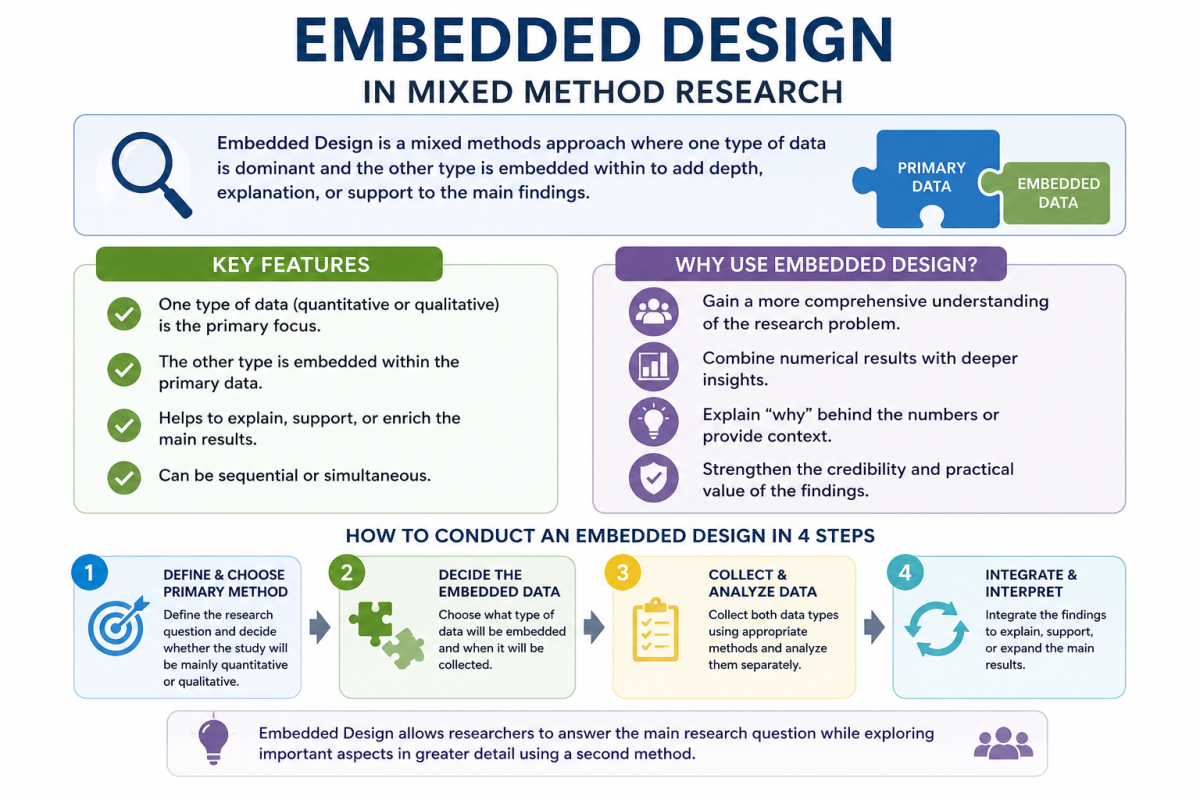
4. Integrate the findings and explain the final meaning
- The final step in Embedded Design is integration.
- Integration means bringing qualitative and quantitative data together to answer the research question more clearly.
- The researcher should not only present the two data sets separately.
- Instead, the researcher should explain how the embedded data supports, expands, challenges, or explains the main findings.
- For example, quantitative findings may show that students improved after training.
- Qualitative interview findings may explain that students improved because the training gave them confidence, repeated practice, and real-time feedback.
- This gives readers a deeper understanding of the research problem.
- If differences exist between the two data sources, the researcher should explain them honestly.
- For example, numerical results may show high satisfaction, but open-ended survey responses may reveal that some participants still had concerns about time, workload, or unclear instructions.
- This kind of finding is useful because Embedded Design enables researchers to see both general patterns and personal experiences.
- The final report should clearly show which method was primary, which method was embedded, and how both contributed to the final interpretation.
What are the Advantages and Disadvantages of Embedded Design in Mixed Method Research?
Advantages
- Embedded Design gives a fuller understanding of the research problem.
One type of data may provide the main answer, while another type of data adds detail, meaning, or explanation. This helps researchers gain a more comprehensive understanding of the phenomenon. - It allows researchers to use different types of data without making the study too large.
Unlike some mixed methods designs that place equal priority on both types of data, Embedded Design can keep one method central and use the second method in a smaller role. - It is flexible.
Embedded Design can be used in quantitative or qualitative studies. It can also be used in sequential, convergent, explanatory, or exploratory forms depending on the research design. - It is useful for intervention studies.
In healthcare, education, and medical education, researchers may use quantitative data to measure whether an intervention works. Qualitative data can then explain how participants experienced the intervention. - It strengthens interpretation.
Quantitative findings may show a pattern, but qualitative data can explain the reasons behind that pattern. This makes the final discussion more useful and practical. - It supports triangulation when needed.
Researchers can compare the results from different data sources to see whether they support each other. This can strengthen the credibility of the study. - It helps identify hidden issues.
A questionnaire may show general trends, but open-ended questions can reveal concerns, emotions, or contextual issues that numbers alone may miss. - It provides valuable insights for applied research.
In social sciences, education, nursing, and organizational research, Embedded Design helps researchers connect measurable outcomes with real human experiences. - It can be efficient.
Since the secondary method is embedded within the main method, the study may be easier to manage than a full mixed methods approach that gives equal priority to both methods. - It helps inform the intervention.
Qualitative data may be collected before an intervention to understand participant needs. Quantitative data may then measure the success of that intervention.
Disadvantages
- The embedded data may be too limited.
Because one data set has a secondary role, the embedded data may not be detailed enough to fully explain the research problem. - Integration can be challenging.
Researchers must know how to connect qualitative and quantitative data clearly. Poor integration can make the study feel like two separate projects. - The supporting method may be treated as less important.
If researchers focus too much on the primary method, they may not give enough attention to the embedded data. - It requires methodological skill.
Researchers must understand both qualitative and quantitative methods. They must also know how to plan data collection and analysis across both approaches. - Timing can be difficult.
The researcher must decide whether data are collected before, during, or after the main method. Poor timing can weaken the usefulness of the embedded data. - It may create extra workload.
Even though the secondary method is smaller, collecting both quantitative and qualitative data still requires more time than using one method only. - The design may confuse readers if not explained well.
Researchers must clearly state the design aims, primary data set, embedded data set, and integration process. - Data may not always agree.
Sometimes quantitative and qualitative data may produce different results. This is not always a weakness, but researchers must analyze and explain the differences carefully. - Sampling can be complicated.
The participants used for the embedded data may not always represent the full study group. For example, only a small number of participants may take part in interviews after a large survey. - Reporting can be difficult.
Embedded Design requires the researcher to present numerical findings, thematic findings, and integrated conclusions in a clear and balanced way.
Examples of Embedded Design
- Example 1: Embedded Design in medical education
- A researcher wants to determine whether a simulation-based teaching method improves nursing students’ clinical competency.
- The main method is quantitative because the researcher uses pre-test and post-test scores to measure improvement.
- Qualitative data is embedded within the primary data through short interviews with selected students.
- The quantitative data shows whether competency improved.
- The qualitative interview data explains how students experienced the simulation, what helped them learn, and what challenges they faced.
- This Embedded Design gives valuable insights because it measures learning outcomes and also explains the learning experience.
- Example 2: Embedded Design in social sciences
- A researcher wants to study whether a community mentoring program reduces youth unemployment.
- The main data set is quantitative because the researcher collects employment rates before and after the program.
- Qualitative data collection is embedded within the study through open-ended questions and focus group discussions.
- The numerical data shows whether employment outcomes changed.
- The thematic findings explain how participants experienced the mentoring, what barriers remained, and why some participants benefited more than others.
- This mixed methods research design helps provide a nuanced understanding of both outcomes and personal experiences.
- Example 3: Embedded Design in education
- A researcher wants to analyze whether online learning improves student engagement.
- The main method may be a questionnaire with numerical survey responses.
- Open-ended questions are embedded within the questionnaire to collect qualitative responses.
- The quantitative data may show that engagement increased for most students.
- The qualitative data may show that students liked flexible learning, recorded lessons, and interactive quizzes.
- However, some students may also report internet problems or lack of motivation.
- The embedded approach helps compare the results and explain why differences exist among learners.
- Example 4: Embedded Design in healthcare research
- A researcher wants to evaluate whether a patient education program improves medication adherence.
- Quantitative data is collected through adherence scores, pharmacy refill records, or patient self-report scales.
- Qualitative and quantitative data collection is combined by adding interviews with patients who had high and low adherence.
- The quantitative findings show determining whether the program worked.
- The qualitative findings explain why some patients followed the medication plan and why others struggled.
- This helps healthcare providers improve future patient education programs.
- Example 5: Embedded Design in ethnographic research
- A researcher may conduct an ethnographic study of workplace culture.
- The main method is qualitative because the researcher observes workers, conducts interviews, and studies daily workplace behaviour.
- Quantitative or qualitative data may be embedded within the study through a short employee satisfaction questionnaire.
- The qualitative data explains the culture in depth.
- The quantitative data adds numerical information about employee satisfaction, workload, or communication.
- This example shows how Embedded Design can work even when the main study is qualitative.
- Example 6: Embedded Design in business research
- A company may want to understand customer satisfaction after launching a new digital service.
- The main method may be quantitative because the company collects rating scores from many customers.
- Qualitative or quantitative data can be embedded through open-ended survey responses.
- The numbers show the general satisfaction level.
- The written responses explain what customers liked, what frustrated them, and what features need improvement.
- This allows researchers and business leaders to gain a deeper understanding of customer needs.
- Overall, Embedded Design is one of the most practical mixed methods designs because it allows researchers to collect different types of data within a single study.
- It is especially useful when one method answers the main research question, but another method is needed to explain, support, or expand the findings.
- By integrating qualitative and quantitative data, Embedded Design helps researchers produce stronger, richer, and more meaningful conclusions.
