
Blog
How to Conduct Ethnographic Research Design with Examples

What is Ethnographic Research Design in Qualitative Research Designs?
- Ethnographic research design is a qualitative research method rooted in anthropology, where a researcher immerses themselves in a community, culture, or social group to understand how its members think, behave, and interact in their natural setting. Rather than relying on surveys or lab experiments, an ethnographic approach asks the researcher to become part of the environment being studied, at least for a period of time, so that the resulting qualitative data reflects real, lived experience rather than a simulated one.
- Ethnography is a qualitative research method that prioritizes context. Where quantitative research measures variables and tests hypotheses with numbers, ethnographic research design is concerned with the “why” and “how” behind human behavior. This is why ethnographic research differs so sharply from conventional research approaches: it doesn’t isolate participants from their environment, it studies them within it.
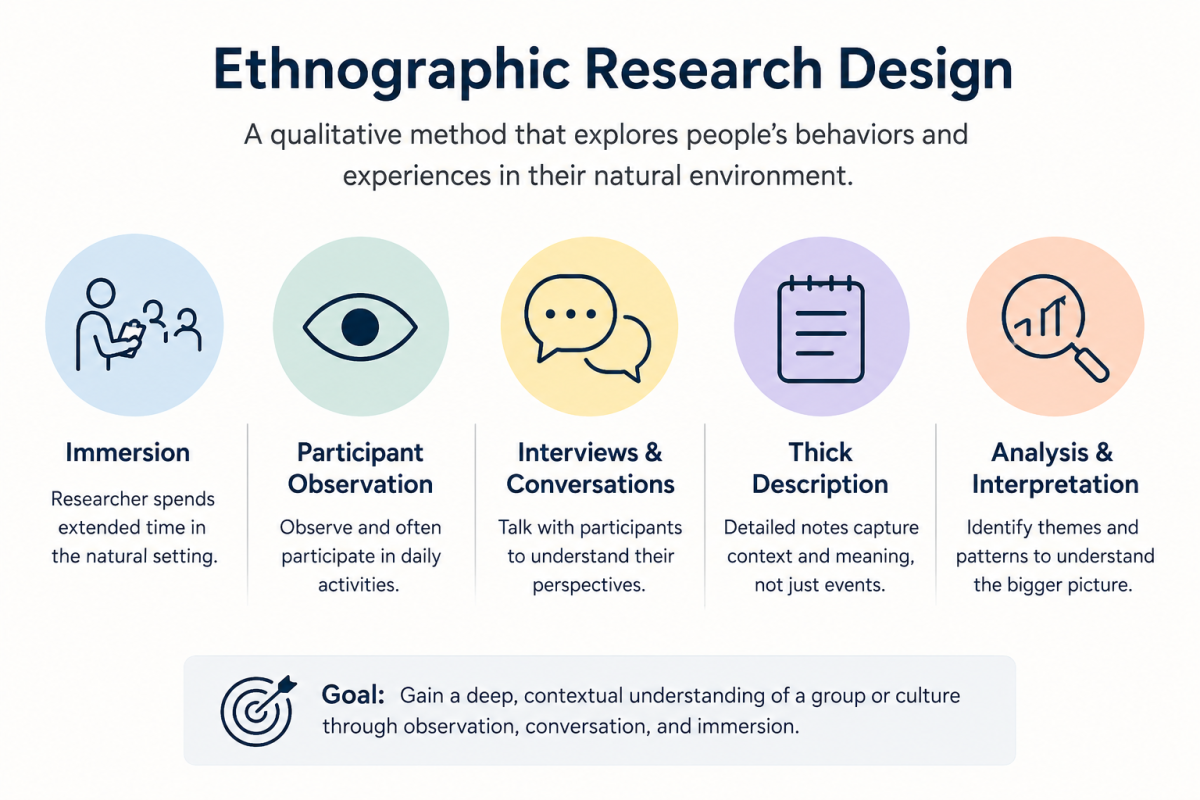
- Core elements of ethnographic research design include:
- Fieldwork — extended time spent in the ethnographic field, whether that’s a workplace, a neighborhood, an online community, or a hospital ward.
- Participant observation — the researcher watches, and often participates in, the daily activities of the group.
- Ethnographic interviews — informal or semi-structured conversations that surface beliefs, motivations, and meanings that observation alone can’t capture.
- Thick description — detailed, richly contextualized notes that capture not just what happened, but what it meant to the people involved.
- Ethnographic research is a qualitative research design used across many fields. It originated in anthropology and sociology, but today it’s widely used in UX research, communication research, medical education research, marketing, and organizational studies. In UX research specifically, ethnographic UX research helps design teams understand how people actually use products in their everyday lives, rather than how they say they use them in a research setting like a lab or focus group.
- A typical ethnographic research design is flexible by nature. Unlike a fixed survey instrument, the research question guiding an ethnographic study may evolve as the researcher spends more time in the field and begins to notice new patterns. This adaptability is one of the defining features that separates ethnography from other qualitative research designs like case studies or grounded theory, even though all three fall under the broader umbrella of qualitative research methods.
- In short, ethnographic research design is less a single technique and more a holistic research methodology — one that combines observation, conversation, and immersion to produce a deep, culturally grounded understanding of a group, rather than a shallow, generalized snapshot.
Philosophical Assumptions of The Ethnographic Research Design
Every research methodology rests on philosophical assumptions about what counts as knowledge and reality, and ethnographic research design is no exception. Understanding these assumptions helps explain why the ethnographic method looks and feels so different from quantitative research.
- Ontological assumption: reality is socially constructed. Ethnographic research design assumes that there isn’t one single objective truth waiting to be measured. Instead, reality is shaped by the shared meanings, symbols, and practices of the people being studied. This is why a researcher using an ethnographic approach doesn’t try to “control” variables — they try to understand multiple, sometimes conflicting, perspectives within the same research setting.
- Epistemological assumption: knowledge comes from immersion, not distance. Traditional research often assumes a researcher should remain neutral and separate from research subjects to avoid bias. Ethnography flips this. It assumes that genuine understanding can only be gained by getting close — by living alongside, talking with, and observing research participants over time. This proximity is treated as a strength of ethnographic fieldwork, not a weakness.
- Axiological assumption: values and bias are acknowledged, not eliminated. Ethnographic research is a qualitative research method that accepts the researcher’s own background, culture, and perspective will inevitably shape the research process. Rather than pretending to be a neutral observer, ethnographers are trained to reflect on their own positionality and document how it might influence their interpretation of qualitative data.
- Interpretivist foundation. Ethnographic research design sits within the interpretivist paradigm, which assumes human behavior can only be understood in context, through the meanings people themselves attach to their actions. This differs from the positivist assumptions behind quantitative and qualitative data collected through structured instruments, where behavior is often treated as measurable and generalizable.
- Naturalistic assumption. Ethnography assumes that behavior observed in a natural setting is more valid than behavior observed in an artificial one. This is central to conducting ethnography: researchers go to where people actually live, work, or interact, rather than bringing participants into a lab or research setting designed by the researcher.
- Holism. Ethnographic studies assume that individual behaviors can’t be fully understood in isolation — they need to be examined as part of a larger cultural, social, or organizational system. A single ethnographic interview or observation is rarely enough; the researcher needs to see how pieces of ethnographic data fit together across the whole research setting.
- Why this matters in practice. These philosophical assumptions explain several practical choices in ethnographic practice: why sample sizes are typically small, why data collection takes months rather than days, and why ethnographic insights are presented as narrative and interpretation rather than statistical proof. Anyone hoping to use ethnographic research effectively needs to accept these underlying assumptions first, or the research process will feel like a mismatch with the method.
How To Conduct an Ethnographic Research Design In 4 Easy Steps?
Conducting an ethnographic research design can feel intimidating at first, but breaking it down into a clear research process makes it manageable, even for first-time researchers. Here are four steps to conduct ethnographic research effectively.
Step 1: Define Your Research Question and Select a Research Setting
- Every strong ethnographic study starts with a clear but flexible research question. Because ethnography is exploratory by nature, the question should be broad enough to allow discovery, but focused enough to guide where you go and who you talk to.
- Identify the community, group, or setting that will help answer your research question. This could be a workplace, an online forum, a hospital, or a customer’s home — anywhere the target research subjects naturally live or work.
- Decide on the type of ethnographic research you’ll conduct: traditional ethnographic fieldwork involving months of immersion, or rapid ethnographic research, which compresses fieldwork into a shorter, more focused window — commonly used in ethnographic UX research and business settings where time constraints don’t allow for a traditional ethnographic timeline.
- Consider ethics in ethnographic research early. Apply for approval from a research ethics committee if required, especially for studies involving vulnerable populations, healthcare settings, or covert research where participants may not know they’re being observed.
Step 2: Gain Access and Build Rapport
- Before any meaningful ethnographic fieldwork can happen, the researcher needs to gain access to the community or organization being studied. This might mean securing permissions, finding a gatekeeper, or simply spending time introducing yourself.
- Building trust with research participants is essential. People behave differently when they feel observed or judged, so establishing rapport helps ensure the behavior you witness is authentic rather than performed.
- Be transparent about your role as a researcher wherever possible. While some ethnographic work involves a degree of covert observation, most modern ethnographic practice favors informed consent and openness with participants.
Step 3: Collect Data Through Observation and Interviews
- This is the heart of the ethnographic method. Data collection typically combines:
- Participant observation — immersing yourself in daily routines and documenting behaviors, interactions, and environments as they naturally unfold.
- Ethnographic interviews — both structured and informal conversations that let research participants explain their own perspectives in their own words.
- Artifact and document collection — gathering photos, objects, communications, or archival research materials that provide additional context.
- Keep detailed field notes throughout. Thick, descriptive notes are what separate rich ethnographic data from a surface-level account. Note not just what people do, but what they say about why they do it.
- Stay flexible. One hallmark of an ethnographic approach is that the research question and focus areas often shift as new patterns emerge — a good ethnographic researcher follows the data rather than forcing it into a predetermined narrative.
Step 4: Analyze the Data and Report Findings
- Once fieldwork concludes, the researcher moves into qualitative data analysis. This usually involves coding field notes and interview transcripts to identify recurring themes, patterns, and cultural meanings.
- Many researchers use qualitative data analysis software to organize and code large volumes of ethnographic data, though smaller studies can be analyzed manually.
- Findings are typically presented as narrative research reports, often supported by direct quotes, thick description, and case examples that illustrate broader cultural patterns.
- Reflect on your own positionality and any limitations of ethnographic research design in your specific study, such as small sample sizes or the risk of observer influence, before finalizing conclusions.
Following these four steps gives structure to what can otherwise feel like an open-ended research process, while still preserving the flexibility that makes the ethnographic method so effective for understanding real human behavior.
What are the Advantages and Disadvantages of Ethnographic Research Design in Qualitative Research Designs?
Like any research methodology, ethnographic research design comes with distinct strengths and real limitations. Weighing both helps researchers decide whether this qualitative research design is the right fit for their research goals.
Advantages of Ethnographic Research Design
- Rich, in-depth understanding. Ethnographic research offers a depth of insight that surveys and quantitative research simply can’t match. Because the researcher spends extended time in the ethnographic field, the qualitative data collected reflects real behavior, not just self-reported opinions.
- Captures context that other methods miss. A researcher conducting ethnography sees the full picture — the environment, relationships, and unspoken norms that shape behavior. This is especially valuable in user research and ethnographic UX research, where understanding the “why” behind user behavior often matters more than the “what.”
- Uncovers the unspoken. People don’t always articulate their own habits, assumptions, or motivations accurately in interviews or surveys. An ethnographic approach reveals discrepancies between what people say and what they actually do, which is often where the most valuable ethnographic insights come from.
- Flexible and adaptive research process. Because the research question can evolve during fieldwork, ethnographic studies are well-suited to exploratory research where the researcher doesn’t yet know exactly what questions to ask.
- Naturalistic validity. Since data is gathered in a real research setting rather than an artificial one, findings tend to reflect authentic behavior more accurately than lab-based or survey-based qualitative studies.
- Useful across many disciplines. From communication research to medical education research to product design, ethnographic research is a qualitative method that translates well across fields, making it a versatile addition to any research methodology toolkit.
Disadvantages of Ethnographic Research Design
- Time-intensive. Traditional ethnographic fieldwork can take weeks, months, or even years. This is one of the most cited limitations of ethnographic research design, especially in fast-paced industries where research needs are immediate. Rapid ethnographic research has emerged partly as a response to this challenge, though it trades some depth for speed.
- Small sample sizes limit generalizability. Because ethnographic research is so labor-intensive, researchers typically work with a small number of research subjects. This means findings, while deep, may not generalize to a broader population the way quantitative research can.
- Researcher bias and subjectivity. Since the researcher is both the observer and the instrument of data collection, personal bias can influence what gets noticed, recorded, and interpreted. This is a well-known disadvantage of ethnographic research that requires ongoing reflexivity to manage.
- Ethical complexity. Ethnographic research doesn’t always fit neatly into standard consent frameworks, particularly in covert research or studies involving vulnerable communities. Navigating a research ethics committee’s requirements can be more complicated than for conventional research designs, and ethics in ethnographic research remains an ongoing area of debate among scholars.
- Difficult to replicate. Because ethnographic data is so tied to a specific time, place, and set of relationships, it’s very difficult for another researcher to replicate the exact same study and expect identical results — a stark contrast to the replicability goals of quantitative and qualitative data collected through standardized instruments.
- Resource-heavy. Beyond time, ethnographic work often demands travel, sustained access to a research setting, and skilled researchers trained in observation and interviewing — all of which can be costly compared to distributing a survey or running a quantitative study.
- Risk of observer effect. Despite best efforts to build rapport, research participants may still alter their behavior simply because they know they’re being watched, which can subtly distort the qualitative data collected during fieldwork.
- Balancing the trade-offs. Ultimately, whether to use ethnographic research comes down to research goals. If a project needs statistical generalizability, quantitative research may be more appropriate. But if the goal is a nuanced, contextual understanding of behavior, few other qualitative research methods can match what ethnography offers.
Examples of Ethnographic Research Design
Seeing real examples of ethnographic research helps clarify how the method plays out across different research settings and disciplines.
- Example 1: Ethnographic UX Research for App Design. A UX research team wanted to understand why users abandoned a budgeting app after the first week. Instead of relying on analytics alone, researchers conducted ethnographic research by visiting users’ homes and observing how they actually managed money day to day. They discovered that most users tracked spending mentally or on paper first, only occasionally checking the app — an insight that reshaped the product’s onboarding flow. This is a classic example of an ethnographic approach uncovering behavior that a quantitative research method, like a usage-analytics dashboard, could never fully explain.
- Example 2: Workplace Communication Research. A communication research project examined how remote teams built trust without in-person contact. The researcher embedded themselves in company Slack channels and video meetings over three months, conducting ethnographic interviews with employees about how they interpreted tone, silence, and response times in digital communication. The resulting ethnographic data revealed unwritten norms around “acceptable” response delays that formal company policy never addressed.
- Example 3: Medical Education Research. Researchers studying how medical students develop clinical judgment used ethnographic fieldwork inside hospital wards, observing how students learned not just from textbooks but from watching senior doctors handle uncertainty. Interviews in ethnographic medical education research often reveal informal mentorship dynamics that formal curricula overlook entirely, offering ethnographic insights that directly inform teaching practices.
- Example 4: Consumer Behavior in Retail. A marketing team employed ethnographic research to understand why shoppers were bypassing a store’s self-checkout kiosks. By observing shoppers directly in the retail research setting rather than surveying them afterward, researchers noticed hesitation cues and confusion around specific screen prompts — details shoppers themselves hadn’t consciously registered or reported.
- Example 5: Online Community Ethnography. With more social interaction happening digitally, researchers increasingly apply ethnographic methods to online spaces. A researcher studying a niche gaming community conducted a digital ethnographic study by participating in forums and voice chats over several months, using participant observation and informal ethnographic interviews to understand identity and belonging within the group — demonstrating that ethnographic research is increasingly adapting to non-physical research settings.
- Example 6: Rapid Ethnographic Research in Product Testing. A tech company facing a tight launch deadline used rapid ethnographic research, compressing fieldwork into two intensive weeks of home visits and shadowing sessions. While shorter than a traditional ethnographic study, this approach still produced meaningfully richer qualitative data than a standard usability test alone, showing that even a condensed type of ethnographic research can deliver strong results under real-world constraints.
- What these examples reveal. Across UX research, communication research, medical education, retail, and digital spaces, these examples of ethnographic research design show a consistent pattern: whenever a research question hinges on understanding real behavior in its natural context, an ethnographic approach tends to surface insights that other qualitative research methods and quantitative research methods simply can’t reach on their own. Learn more about ethnographic research by exploring these applications in your own field, and consider how a well-designed ethnographic study might answer the questions your current research methodology can’t.
