
Blog
How To Write Causal Research Questions With Examples

How To Write Causal Research Questions With Examples: Introduction, Definition, and Understanding Causal Relationships in Research
Introduction to Causal Research Questions
- Causal Research Questions are a specific type of research question designed to determine whether one factor causes or affects another factor.
- Unlike descriptive research questions that simply describe a phenomenon, Causal Research Questions seek to explain why something happens and identify a cause-and-effect relationship.
- In academic research, business studies, healthcare investigations, education, psychology, and public policy, researchers frequently use causal research to understand whether one or more variables influence an outcome.
- People often ask:
- Why do students who study longer achieve higher grades?
- Does an advertising campaign increase product sales?
- Does employee training improve workplace productivity?
- These questions move beyond description and attempt to identify causation.
- A researcher uses a causal approach when they want to know whether one variable directly affects another variable.
- Understanding how to formulate strong Causal Research Questions is essential because the quality of a study often depends on the quality of its research question.
- A well-written causal question guides:
- Research design
- Data collection
- Sampling strategy
- Analysis methods
- Interpretation of findings
- Whether you are writing a thesis, dissertation, journal article, or business report, learning how to use causal questions effectively can significantly improve your research outcomes.
Definition of Causal Research Questions
- Causal Research Questions are questions designed to determine whether one or more variables cause changes in one or more outcome variables.
- They focus on establishing a causal relationship between an independent variable and a dependent variable.
- In simple terms:
- The independent variable is the factor believed to cause change.
- The dependent variable is the outcome affected by that change.
- A causal question investigates whether one variable causes or affects one or more outcome variables.
- General structure: Does X cause Y? or To what extent does X affect Y?
- Examples:
- Does online learning affect student performance?
- Does exercise reduce stress levels?
- Does flexible work scheduling improve employee satisfaction?
- Does social media usage affect academic achievement?
- These questions are designed to determine whether one factor produces a direct effect on another factor.
What Is Causal Research?
- Causal research is a type of research that examines cause and effect relationships.
- The primary goal is to identify whether one variable influences another variable.
- Unlike descriptive research, which focuses on describing characteristics or trends, causal research seeks to explain why outcomes occur.
- Researchers use causal research when they need evidence regarding causation rather than simple association.
- This research method is common in:
- Education
- Marketing
- Medicine
- Psychology
- Sociology
- Economics
- Public policy
Example
- Research Topic: Employee Productivity
- Descriptive Question:
- What percentage of employees work remotely?
- Relational Question:
- Is there a relationship between remote work and productivity?
- Causal Question:
- Does remote work increase employee productivity?
- Notice how the causal question attempts to determine whether one factor causes a change in another.
Understanding Cause and Effect Relationships
- A cause-and-effect relationship exists when one factor directly influences another.
- Establishing causation requires more than simply observing two variables moving together.
- Researchers must determine:
- Whether the cause occurs before the effect.
- Whether the relationship is plausible.
- Whether another variable could explain the outcome.
- For example:
- Ice cream sales increase during summer.
- Drowning incidents also increase during summer.
- A simple correlation exists between the two variables.
- However, ice cream sales do not cause drowning incidents.
- Another variable, temperature, influences both.
- This example demonstrates why researchers must carefully interpret relationships between two variables.
Difference Between Causal and Descriptive Research Questions
Descriptive Research Questions
- Descriptive research questions focus on describing a characteristic, trend, behavior, or condition.
- They answer:
- “What?”
- “Who?”
- “Where?”
- “When?”
- Examples:
- What percentage of students use online learning platforms?
- What is the average income of households in the region?
- What are the common causes of employee turnover?
Causal Research Questions
- Causal Research Questions focus on:
- Why something happens.
- Whether one variable affects another.
- How cause-and-effect relationships operate.
- Examples:
- Does online learning improve academic performance?
- Does income level affect health outcomes?
- Does employee recognition reduce turnover?
- The key distinction is that descriptive research describes, while causal research explains.
Difference Between Causal and Relational Research Questions
- Many researchers confuse causal questions with relational questions.
- Although both examine relationships between two variables, they serve different purposes.
Relational Questions
- Explore whether two or more variables are associated.
- Do not imply causation.
- Examples:
- Is there a relationship between exercise and stress?
- Is there a relationship between education level and income?
Causal Questions
- Seek evidence that one variable causes another.
- Examples:
- Does exercise reduce stress?
- Does education level increase income?
- Correlation alone cannot prove causation.
- This distinction is one of the most important concepts in research methodology.
Key Characteristics of Strong Causal Research Questions
A strong causal question should possess several important characteristics.
1. Focus on Cause and Effect
- The question should clearly investigate a cause-and-effect relationship.
- The cause and outcome should be obvious.
2. Include Clearly Defined Variables
- The independent variable and dependent variable should be specific.
- Ambiguous variables make interpretation difficult.
3. Be Researchable
- Researchers should be able to collect data to answer the question.
- The study should be feasible within available resources.
4. Be Measurable
- Variables should be measurable using reliable methods.
- Researchers must be able to observe variation and outcomes.
5. Support Valid Inference
- The question should allow meaningful inference about causation.
- Appropriate research design strengthens conclusions.
Components of a Causal Research Question
Most Causal Research Questions contain three essential elements.
Component 1: Independent Variable
- The factor believed to cause change.
- Examples:
- Training programs
- Advertising campaigns
- Exercise routines
- Teaching methods
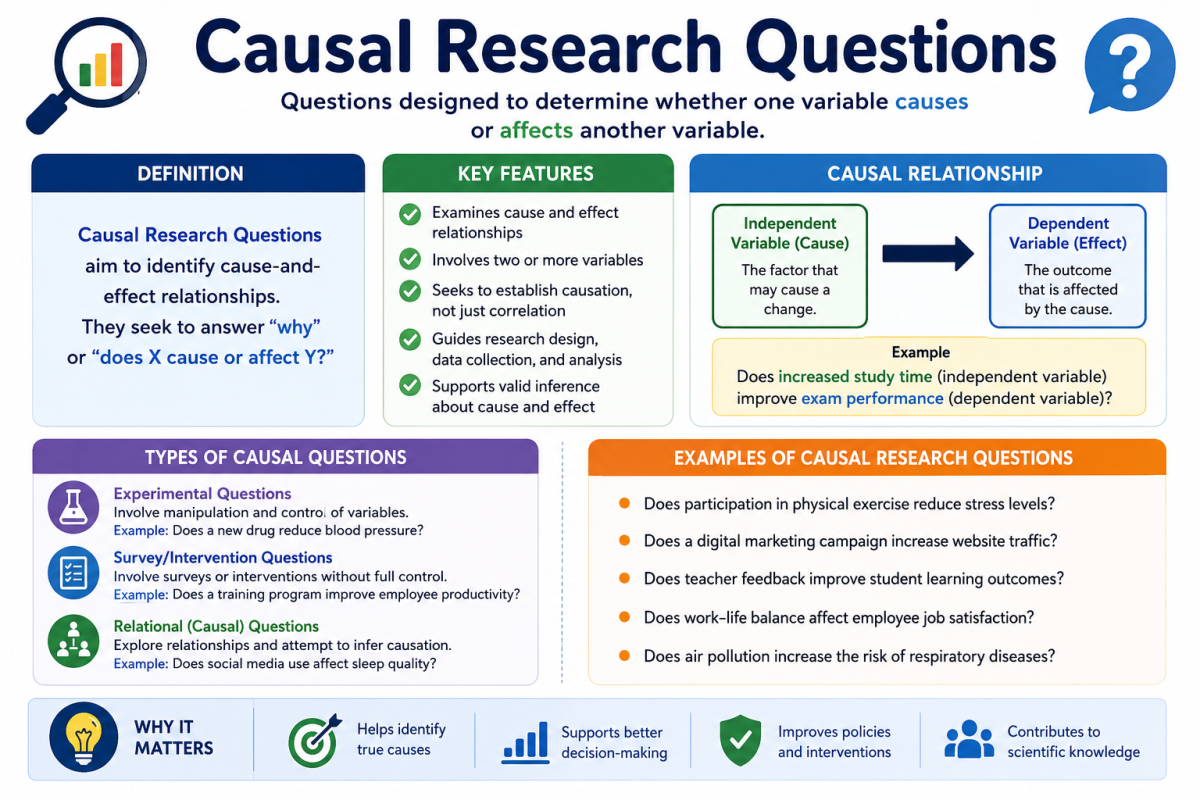
Component 2: Dependent Variable
- The outcome being measured.
- Examples:
- Productivity
- Sales revenue
- Academic performance
- Stress levels
Component 3: Target Population
- The participant group being studied.
- Examples:
- University students
- Employees
- Consumers
- Patients
Example
- Does a digital advertising campaign increase product sales among online consumers?
Independent Variable:
- Advertising campaign
Dependent Variable:
- Product sales
Population:
- Online consumers
Why Causal Research Questions Matter
- Causal Research Questions help researchers move beyond observation.
- They provide deeper insight into why events occur.
- They support evidence-based decision-making.
- They help organizations create effective policies.
- They improve strategic planning.
- They allow researchers to test different interventions.
- They contribute to scientific knowledge.
- They support practical problem-solving.
Whether conducting academic research, developing organizational policy, evaluating educational programs, or designing healthcare interventions, Causal Research Questions provide a structured approach for understanding whether one factor causes or affects one or more outcome variables.
