
Blog
How To Conduct Exploratory Sequential Design with Examples

What is Exploratory Sequential Design in Mixed Method Research?
- Exploratory Sequential Design is a mixed methods research design where the researcher begins with qualitative research and then follows it with quantitative research.
- In simple terms, the researcher first explores a topic through qualitative data, such as interviews, focus groups, observations, open-ended questionnaires, or document analysis.
- After the initial qualitative phase, the researcher uses the qualitative findings to design the second phase of the study, which is usually quantitative data collection and analysis.
- This means that the study begins by asking open-ended questions before moving into numerical measurement.
- Exploratory Sequential Design is useful when the researcher does not fully understand the problem at the beginning of the research process.
- It is also helpful when variables are unknown, when there is limited previous research, or when the researcher wants to develop a new instrument based on qualitative results.
- In mixed methods research, this design allows the researcher to move from discovery to measurement.
- The first phase answers questions such as:
- What is happening?
- How do participants describe the issue?
- What themes appear from the qualitative data?
- What concepts should be measured later?
- The second phase answers questions such as:
- How common are these findings in a larger group?
- Can the qualitative results be tested with numbers?
- Can the themes be converted into measurable variables?
- Can the results be generalized to a wider population?
- Exploratory Sequential Design is different from explanatory sequential design.
- In explanatory sequential design, the researcher starts with quantitative data and then uses qualitative data to explain the quantitative results.
- In Exploratory Sequential Design, the order is reversed because the researcher starts qualitatively and then follows with quantitative data.
- This makes Exploratory Sequential Design especially useful in social science, education, health research, business research, and behavioural studies.
- For example, a researcher may first conduct qualitative interviews with students to understand why they struggle with online learning.
- After identifying themes from the qualitative data, the researcher may create a questionnaire using a 5-point Likert scale to test those themes with a larger group of students.
- This type of research is powerful because it combines qualitative and quantitative methods in one research study.
- It helps the researcher understand people’s experiences deeply and then validate those experiences through quantitative analysis.
- In a mixed methods study, Exploratory Sequential Design gives the researcher a clear path from qualitative exploration to quantitative testing.
Philosophical Assumptions of The Exploratory Sequential Design
- Exploratory Sequential Design is commonly linked to a pragmatic worldview.
- Pragmatism means that the researcher focuses on what works best for answering the research question.
- Instead of choosing only qualitative methods or only quantitative methods, the researcher uses both because each method provides a different kind of evidence.
- This mixed methods approach accepts that complex research problems cannot always be understood through one type of research alone.
- Qualitative research helps the researcher understand meaning, experience, context, and participant perspectives.
- Quantitative research helps the researcher measure patterns, test a hypothesis, compare groups, evaluate relationships, and examine generalizability.
- The philosophical assumption behind Exploratory Sequential Design is that reality can be explored through people’s lived experiences and then tested through numerical data.
- This makes the design flexible and practical.
- It also allows the researcher to build the quantitative phase based on qualitative findings instead of forcing pre-existing variables onto the study.
- Creswell often explains mixed methods research designs as useful when researchers need to integrate qualitative and quantitative data to provide a fuller understanding of a problem.
- SAGE and SAGE publications also present mixed methods research as a practical way of connecting different forms of data in a single study.
- In Exploratory Sequential Design, the researcher believes that qualitative data are collected first because the topic needs exploration before measurement.
- This is important when the researcher is studying a new issue, a new population, a cultural experience, a sensitive topic, or a problem with limited existing theory.
- The researcher also assumes that the qualitative and quantitative phases are connected, not separate.
- The qualitative data collection and analysis directly informs the quantitative data collection and analysis.
- For example, qualitative results may help the researcher identify key variables, write survey questions, develop a new instrument, or create categories for quantitative measurement.
- The researcher then uses quantitative data collection to evaluate whether the qualitative findings apply to a broader sample.
- This supports validity and reliability because the instrument or questionnaire is based on real participant experiences.
- Another assumption is that qualitative and quantitative results should be integrated during interpretation.
- The researcher does not simply report the qualitative results and quantitative results separately.
- Instead, the researcher explains how the second phase confirms, expands, challenges, or validates the first phase.
- This is why Exploratory Sequential Design is valuable in mixed-methods research.
- It respects participant voices while also allowing numerical testing.
- It is especially helpful for developing and testing concepts, models, questionnaires, and practical interventions.
How To Conduct an Exploratory Sequential Design In 4 Easy Steps
- Step 1: Begin with a clear research problem and research question
- The first step in Exploratory Sequential Design is to identify a research problem that needs deeper exploration.
- This problem should be suitable for a mixed methods design.
- The researcher should ask whether qualitative data are needed first because the issue is not well understood.
- A strong research question may focus on experiences, perceptions, barriers, needs, behaviours, or meanings.
- For example, a research question may ask: “What challenges do first-year university students experience when using online learning platforms?”
- This question is exploratory because the researcher wants to understand the issue from the participants’ point of view.
- At this stage, the researcher should also consider ethical approval from an institutional review board if human participants are involved.
- This is important because qualitative interviews, surveys, and participant data must be collected responsibly.
- Step 2: Collect and analyse qualitative data
- The second step is the initial qualitative phase.
- In this phase, the researcher collects qualitative data using qualitative methods such as interviews, focus groups, open-ended questionnaires, observations, or document review.
- Qualitative data collection and analysis should be planned carefully.
- The sample is usually smaller because the goal is depth, not generalizability.
- For example, the researcher may interview 15 to 20 participants to understand their personal experiences.
- The researcher then analyses the qualitative data qualitatively by identifying themes, patterns, categories, and repeated ideas.
- This data analysis helps the researcher understand what matters most to participants.
- The qualitative findings become the foundation for the second phase.
- For example, if students mention poor internet access, lack of digital skills, weak feedback, and low motivation, these themes can later become survey sections.
- Step 3: Use the qualitative findings to build the quantitative phase
- The third step is where Exploratory Sequential Design becomes especially useful.
- The researcher uses qualitative data to develop a questionnaire, scale, checklist, model, intervention, or data collection tool.
- This is common when developing a new instrument.
- For example, the researcher may create survey items based on qualitative interviews.
- A theme such as “lack of feedback from instructors” may become a survey item like: “I receive timely feedback from my instructors.”
- Participants may respond using a 5-point Likert scale ranging from strongly disagree to strongly agree.
- This step connects qualitative and quantitative approaches.
- It also helps ensure that the quantitative data collection is based on qualitative findings instead of assumptions.
- The researcher may pilot-test the instrument before using it in a larger study.
- This supports validity and reliability because the questions are grounded in real participant responses.
- The researcher may also form a hypothesis based on qualitative results.
- For example, the researcher may hypothesize that students with low digital confidence are more likely to report poor online learning satisfaction.
- Step 4: Collect, analyse, and integrate quantitative data
- The fourth step is the subsequent quantitative phase.
- In this phase, the researcher collects quantitative data from a larger sample.
- This may involve a survey, structured questionnaire, experiment, or statistical dataset.
- Quantitative data collection and analysis allows the researcher to test whether the qualitative findings appear across a wider group.
- The researcher may use descriptive statistics to summarize responses.
- The researcher may also use comparative analysis to compare groups.
- For example, the researcher may compare online learning challenges between first-year and final-year students.
- The quantitative analysis may confirm, extend, or challenge the qualitative findings.
- After this, the researcher must integrate the qualitative and quantitative results.
- Integration means explaining how both sets of results work together.
- For example, qualitative interviews may show that students feel isolated, while quantitative results may show that 72% of students agree that isolation reduces motivation.
- This final interpretation helps the researcher produce a stronger conclusion.
- A good Exploratory Sequential Design does not treat the phases as separate studies.
- It connects both phases into one clear research process.
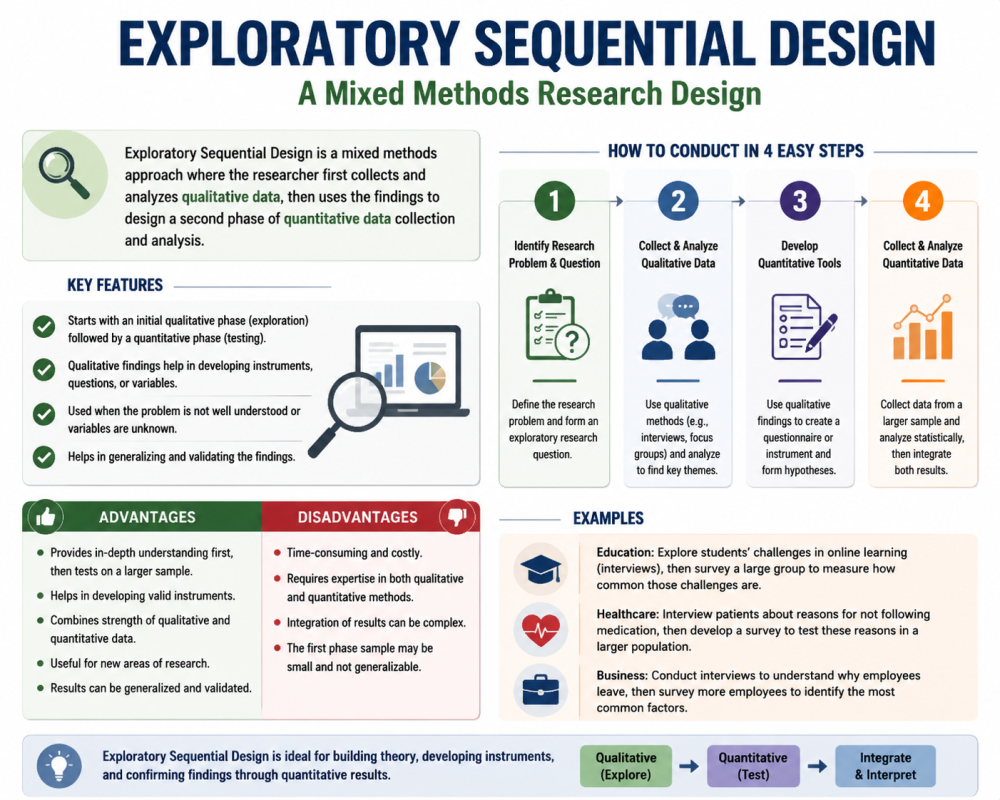
What are the Advantages and Disadvantages of Exploratory Sequential Design in Mixed Method Research?
- Advantage 1: It is useful when little is known about the topic
- Exploratory Sequential Design is ideal when the researcher is studying a new or under-researched problem.
- It allows the researcher to begin with qualitative research instead of guessing what should be measured.
- This is helpful when variables are unknown or when existing theories do not fully explain the issue.
- The researcher can first listen to participants and then build the quantitative phase based on qualitative findings.
- Advantage 2: It helps develop a new instrument
- This design is very useful for developing a new instrument, questionnaire, or measurement tool.
- The qualitative results help the researcher create items that reflect real experiences.
- This is stronger than creating a questionnaire without first understanding the participants’ views.
- For example, a researcher studying workplace stress may first interview employees and then create a survey based on the stress factors they describe.
- Advantage 3: It gives deeper and broader understanding
- Exploratory Sequential Design combines depth and breadth.
- The qualitative phase gives detailed insight into participant experiences.
- The quantitative phase shows how common those experiences are in a larger sample.
- This makes the mixed methods approach more complete than using only one method.
- Advantage 4: It supports validity and reliability
- Because the quantitative tool is based on qualitative data, the study can have stronger content validity.
- The survey questions or variables are grounded in participant experiences.
- The researcher can also test reliability during the quantitative phase.
- This is especially useful in quantitative and mixed methods research where measurement quality matters.
- Advantage 5: It allows researchers to build a hypothesis
- In some studies, the researcher may not have a clear hypothesis at the beginning.
- The qualitative findings can help the researcher identify possible relationships.
- These relationships can then be tested through quantitative analysis.
- This makes Exploratory Sequential Design useful for developing and testing ideas.
- Advantage 6: It is practical for applied research
- This design works well in education, healthcare, business, psychology, nursing, management, and social science.
- It can help researchers evaluate real-world problems.
- For example, the National Institutes of Health may support studies where researchers first explore patient experiences and then test interventions across larger groups.
- This makes the design useful for future research and practical decision-making.
- Disadvantage 1: It takes more time
- Exploratory Sequential Design usually takes longer than a single-method study.
- The researcher must complete qualitative data collection and analysis before starting the quantitative phase.
- This makes the research process longer and more demanding.
- It may not be suitable when the researcher has limited time.
- Disadvantage 2: It requires skill in both qualitative and quantitative methods
- The researcher must understand qualitative studies and quantitative studies.
- This includes interviewing, coding, thematic analysis, questionnaire design, statistical analysis, and interpretation.
- Some researchers may be strong in qualitative methods but weaker in quantitative analysis.
- Others may understand numbers well but struggle with qualitative data analysis.
- Disadvantage 3: Integration can be difficult
- One major challenge in mixed methods research involves integration.
- The researcher must connect qualitative and quantitative data clearly.
- It is not enough to simply place qualitative and quantitative results in separate sections.
- The researcher must explain how the findings relate to one another.
- Poor integration can weaken the whole mixed methods study.
- Disadvantage 4: The qualitative sample may not represent the wider population
- The first phase usually uses a smaller sample size.
- This is normal in qualitative research.
- However, if the first sample is too narrow, the questionnaire may miss important issues from other groups.
- The researcher must choose participants carefully during the qualitative phase.
- Disadvantage 5: Instrument development can be challenging
- Developing and testing a new instrument is not simple.
- The researcher must convert qualitative findings into clear measurable items.
- The items must be understandable, unbiased, and suitable for numerical analysis.
- The researcher may need expert review, pilot testing, and reliability checks before full data collection.
- Disadvantage 6: It may require more resources
- Exploratory Sequential Design may require more participants, more time, more software, and more research support.
- The researcher may need tools for qualitative coding and statistical analysis.
- This can make the design more expensive than basic qualitative or quantitative research.
- Disadvantage 7: The phases must be connected carefully
- The second phase must be clearly based on qualitative findings.
- If the quantitative phase does not follow from the first phase, the study may lose its logic.
- A strong Exploratory Sequential Design should show a clear link between qualitative data, questionnaire development, quantitative data collection, and final interpretation.
Examples of Exploratory Sequential Design
- Example 1: Education research
- A researcher wants to understand why students struggle with academic writing.
- Since the problem is broad, the researcher begins with qualitative interviews.
- Students explain that they struggle with grammar, referencing, confidence, feedback, and understanding assignment instructions.
- The researcher analyses the qualitative data and identifies major themes.
- Based on qualitative findings, the researcher develops a questionnaire.
- The questionnaire includes a 5-point Likert scale to measure how strongly students agree with statements about writing challenges.
- The researcher then collects quantitative data from 300 students.
- The quantitative results show which challenges are most common.
- This is an example of Exploratory Sequential Design because qualitative data are collected first, followed by quantitative data.
- Example 2: Healthcare research
- A researcher wants to explore why patients do not follow medication instructions.
- The first phase uses qualitative interviews with patients.
- The qualitative results show that patients forget doses, fear side effects, misunderstand instructions, and struggle with medication costs.
- The researcher then creates a survey based on qualitative results.
- In the quantitative phase, the survey is given to a larger patient group.
- The quantitative results show that cost and fear of side effects are the strongest predictors of poor medication adherence.
- The researcher can then integrate both findings to recommend better patient education and support.
- This type of exploratory sequential mixed methods study is useful because it begins with patient voices and then tests the findings numerically.
- Example 3: Business and workplace research
- A company wants to understand why employees are leaving.
- The researcher begins with qualitative interviews with former and current employees.
- The qualitative findings show concerns about poor communication, limited promotion opportunities, burnout, and weak leadership support.
- The researcher then develops a questionnaire based on qualitative themes.
- The subsequent quantitative phase measures how common these problems are across departments.
- The quantitative and qualitative results show that burnout and lack of career growth are the strongest issues.
- This helps management design better retention strategies.
- Example 4: Social science research
- A researcher wants to study how young adults define financial independence.
- Because the concept may mean different things to different people, the researcher first uses a qualitative approach.
- Participants describe financial independence as paying bills, living away from parents, saving money, avoiding debt, and making personal financial decisions.
- These qualitative findings are then used to design and testing a new survey tool.
- The researcher collects quantitative data from a larger sample.
- Descriptive statistics are used to show the most common meanings of financial independence.
- This example shows how Exploratory Sequential Design can turn personal meanings into measurable variables.
- Example 5: Comparing Exploratory Sequential Design with other mixed methods research designs
- Exploratory Sequential Design starts with qualitative data and then moves to quantitative data.
- Explanatory sequential design starts with quantitative data and then uses qualitative data to explain the numbers.
- Convergent parallel design collects quantitative and qualitative data at about the same time and then compares the results.
- Embedded design places one method inside a larger study, such as adding interviews inside an experiment.
- Convergent parallel is useful when the researcher wants to compare both types of data equally.
- Exploratory Sequential Design is better when the researcher first needs to explore ideas before measuring them.
- Example 6: Instrument development research
- A researcher wants to create a new questionnaire for measuring digital learning confidence.
- The researcher starts by conducting qualitative interviews with students and teachers.
- The qualitative data reveal themes such as device access, platform confidence, online communication, self-discipline, and technical support.
- Based on qualitative findings, the researcher writes questionnaire items.
- The new instrument is reviewed, tested, and refined.
- The researcher then uses quantitative data collection with a larger sample.
- Quantitative analysis is used to evaluate the instrument’s structure, validity and reliability.
- This is one of the strongest uses of Exploratory Sequential Design because the design moves from discovery to measurement in a logical way.
- Final point
- Using an Exploratory Sequential Design helps researchers build strong mixed methods research because it begins with real experiences and then tests those experiences with numbers.
- It is a practical and flexible mixed methods design for researchers who want to explore, measure, validate, and integrate qualitative and quantitative data in a single study.
- For anyone looking for an applied guide to research designs, Exploratory Sequential Design is one of the most useful mixed methods research designs for studying complex human, social, educational, health, and organisational problems.
