
Blog
How To Conduct Explanatory Sequential Design in Mixed Methods

What is Explanatory Sequential Design in Mixed Method Research?
The Explanatory Sequential Design is a core approach within mixed methods research involves first collecting and analysing quantitative data, then following up with qualitative data to explain the initial statistical results. This makes it a structured sequential design in mixed methods research where numbers come first, and explanations come second.
In the explanatory sequential design in mixed methods, the researcher begins with a quantitative phase. This involves collecting structured data using surveys, tests, or existing datasets to produce measurable outcomes. The goal is to identify patterns, relationships, and quantitative findings linked to a specific research question or hypothesis. This stage focuses on “what is happening” within a phenomenon.
After analysing the quantitative data, the researcher moves into the qualitative phase. This involves collecting qualitative data through methods such as qualitative interviews, observations, or focus groups. The purpose is to explain why the patterns identified in the first phase occurred. This is where the explanatory sequential design becomes powerful, as it links statistical outcomes with human experiences.
According to Creswell and Plano Clark, this approach is ideal when researchers want to build deeper understanding from quantitative results that require clarification. The design is widely used in health sciences, education, and social research because it supports both measurement and explanation.
The final stage involves integrating quantitative and qualitative data. This integration helps produce a comprehensive understanding of the phenomenon by combining statistical trends with lived experiences. In essence, the explanatory sequential design in mixed methods research ensures that findings are not only measured but also meaningfully explained.
Philosophical Assumptions of The Explanatory Sequential Design
The explanatory sequential design in mixed methods is grounded mainly in pragmatism, which allows researchers to use both quantitative and qualitative data based on what best answers the research question. This makes the explanatory sequential design flexible and practical in real-world research.
The quantitative strand is influenced by positivist thinking, where reality is seen as measurable. Researchers use quantitative research methods to measure variables, test hypotheses, and generate statistical evidence. This includes identifying relationships between predictive variables and producing reliable quantitative findings.
The qualitative strand, however, is based on interpretivist or constructivist assumptions. Here, reality is understood through human experience. Researchers collect qualitative data through interviews and narratives to understand participant perspectives and meanings behind numerical trends.
In mixed methods research, particularly in the explanatory sequential design, both worldviews are combined. This integration ensures that neither quantitative nor qualitative data is treated as superior. Instead, both contribute to a fuller understanding of the phenomenon.
As highlighted by Creswell and Plano Clark, the purpose of this design is convergence through explanation, not comparison. The qualitative phase is intentionally designed after reviewing initial quantitative results, making the process sequential and responsive.
Ethically, researchers must obtain IRB approval before collecting data from participants. This ensures proper handling of both quantitative and qualitative data collection and analysis, especially when working with human participants.
Overall, the philosophical foundation of the explanatory sequential design emphasizes that knowledge is best understood when numerical evidence and human experience are combined.
How To Conduct an Explanatory Sequential Design In 4 Easy Steps?
Conducting an explanatory sequential design in mixed methods research follows a structured process where quantitative and qualitative data are collected in sequence to build explanation and depth.
The first step is designing the quantitative phase. The researcher defines a clear research question, selects a quantitative sample, and develops an appropriate instrument such as a survey or structured questionnaire. This instrument must be valid and reliable to properly measure variables. After obtaining IRB approval, the researcher collects quantitative data from participants, often using web-based or survey-based tools.
The second step is analysing the quantitative data. The researcher performs statistical analysis to identify trends, relationships, or differences. This stage produces quantitative findings and helps determine whether the hypothesis is supported. The initial results also highlight unexpected patterns that need further explanation, which directly informs the next phase of the explanatory sequential design.
The third step is conducting the qualitative phase. Here, researchers select participants using purposeful sampling based on the quantitative results. This may include selecting individuals with extreme scores or unique responses. Data is collected through semi-structured interviews, focus groups, or open-ended questions. This produces qualitative data that explains the statistical trends from the first phase. The goal is to explore the “why” behind the numbers and gain deeper insights into the phenomenon.
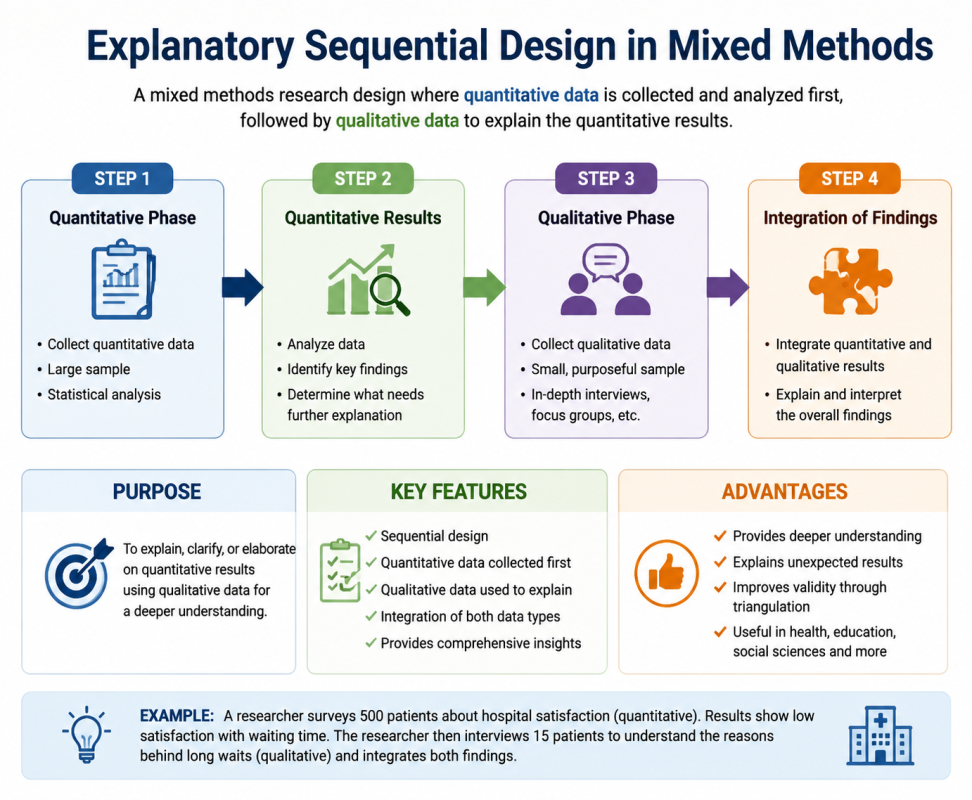
The fourth step is integrating both datasets. Researchers combine quantitative and qualitative findings to create a unified interpretation. This involves comparing results, identifying convergence or divergence, and building a coherent narrative explanation. In this stage of the explanatory sequential design in mixed methods, both strands are merged to produce a comprehensive understanding of the research problem.
This four-step structure makes the explanatory sequential design one of the most practical approaches in mixed methods research involves linking statistical results with human interpretation.
What are the Advantages and Disadvantages of Explanatory Sequential Design in Mixed Method Research?
The explanatory sequential design in mixed methods research is widely used because it provides both numerical precision and in-depth explanation. However, like all mixed methods research designs, it has strengths and limitations.
One of the main advantages of the explanatory sequential design is that it produces a comprehensive understanding of a phenomenon. By combining quantitative and qualitative data, researchers can first identify patterns and then explain them in detail. This dual approach strengthens interpretation and reduces gaps in understanding.
Another advantage is its ability to explain unexpected quantitative results. When statistical findings are unclear or surprising, the qualitative phase helps clarify the reasons behind them. This makes the explanatory sequential mixed methods approach highly valuable in exploratory and applied research.
The design also improves validity through integration. By combining quantitative and qualitative findings, researchers can check consistency across datasets. This strengthens convergence and improves the credibility of conclusions.
Additionally, the explanatory sequential design is highly structured. The step-by-step process—quantitative first, qualitative second—makes it easier for researchers to follow and implement. It is widely recommended in SAGE publications and by Creswell and Plano Clark as a standard sequential design in mixed methods research.
However, there are also disadvantages. One major limitation is time consumption. Because the design requires both quantitative and qualitative data collection and analysis, it takes significantly longer than single-method studies.
Another limitation is the need for advanced skills. Researchers must be competent in both quantitative research and qualitative research, including statistical analysis and interview techniques. Without this expertise, the quality of the explanatory sequential design in mixed methods may be reduced.
Resource demands are also high. The design often requires larger research teams, more funding, and additional tools for both phases. This can make it difficult to implement in small-scale studies.
There is also a risk of poor integration. If researchers fail to properly combine quantitative and qualitative data, the study may end up as two separate reports rather than one unified explanation. This weakens the purpose of the explanatory sequential design.
Participant fatigue is another issue. In some studies, participants are selected for both survey and interview phases, which may reduce engagement and affect data quality.
Despite these limitations, the explanatory sequential design in mixed methods research remains highly effective because it bridges numerical analysis with human explanation, producing richer and more meaningful insights.
Examples of Explanatory Sequential Design
The explanatory sequential design is widely applied across many disciplines because it allows researchers to combine quantitative and qualitative data for deeper understanding.
In health sciences, researchers often begin with quantitative data collection through patient surveys. For example, a study may measure hospital satisfaction levels using structured questionnaires. The quantitative findings may show low satisfaction scores. In the second phase, researchers conduct qualitative interviews with selected patients to explore reasons behind dissatisfaction, such as long waiting times or poor communication. This is a clear example of explanatory sequential design in mixed methods research.
In education, the same approach is used to study student performance. Researchers collect quantitative data from standardized test scores to identify performance gaps. When results show lower achievement in certain regions, the qualitative phase involves interviewing teachers and students. These qualitative findings may reveal lack of resources or teaching challenges, providing explanation for the statistical trends.
In organisational research, companies use the explanatory sequential design to study employee engagement. Surveys may show low motivation levels among staff. The qualitative phase then uses semi-structured interviews to explore workplace culture, leadership style, and communication issues. This helps explain the quantitative results in a meaningful way.
In technology adoption studies, researchers first collect quantitative data on app usage patterns. If results show low engagement among specific user groups, the qualitative phase explores usability issues or lack of digital literacy. This integration of quantitative and qualitative data helps improve product design and user experience.
