
Blog
How to Write Descriptive Research Design with Examples

What is Descriptive Research Design in Quantitative Research Designs?
- Descriptive Research Design in Quantitative Research Designs is a type of research design that focuses on systematically describing a population, situation, or phenomenon as it exists
- It is commonly used in quantitative research where the goal is to gather measurable, numerical information rather than explore deep subjective meanings
- The main purpose of Descriptive Research Design is to answer questions such as:
- who is involved in the study
- what is happening in the situation
- where it is occurring
- when it is occurring
- This form of descriptive research does not manipulate variables or attempt to establish cause-and-effect relationships
- Instead, it focuses on observing and documenting existing conditions in a structured way
- Researchers use descriptive research design to identify patterns, trends, and characteristics within a population
- The descriptive research design is widely used in survey research, cross-sectional studies, observational studies, and case studies
- It is considered one of the most common research designs in quantitative research because it is simple, practical, and effective for collecting real-world data
- Descriptive Research Design in Quantitative Research Designs is often applied when a researcher wants to understand the characteristics of a population without influencing it
- For example, a survey might be used to study the buying habits of consumers or the health behaviors of a community
- Researchers use structured data collection tools such as questionnaires, surveys, and observation checklists to gather information
- The data collected is usually in numerical form, which allows for statistical analysis using descriptive statistics like percentages, averages, and frequency distributions
- Descriptive research design is especially useful in market research, education, healthcare, and social sciences because it helps in understanding large populations efficiently
- In simple terms, Descriptive Research Design provides a clear picture of “what exists” at a specific point in time without trying to explain why it exists
Philosophical Assumptions of The Descriptive Research Design
- The philosophical foundation of Descriptive Research Design in Quantitative Research Designs is based on positivism
- Positivism assumes that reality is objective, measurable, and independent of human perception
- This means descriptive research assumes that facts can be observed, measured, and recorded accurately using structured research methods
- The researcher remains objective and does not allow personal bias to influence data collection or interpretation
- A key assumption of descriptive research design is that human behavior and social phenomena can be measured using quantitative data
- This allows researchers to study large populations and generalize findings
- Descriptive research design assumes that reality can be understood through observable evidence rather than personal interpretation
- This is why it relies heavily on surveys, questionnaires, and observational research methods
- Another philosophical assumption is that cause-and-effect relationships are not the primary focus
- Instead, the goal is to describe “what is happening” rather than “why it is happening”
- This clearly separates descriptive research from experimental research designs
- The descriptive research design also assumes that data can be collected at a specific point in time or across time
- Cross-sectional studies capture data at a single point in time, while longitudinal research can track changes over time
- Researchers assume that populations have measurable characteristics that can be analyzed statistically
- This is why descriptive statistics such as mean, median, mode, and frequency are commonly used
- Descriptive research design in quantitative research designs also assumes that individuals within a group can be studied collectively to identify patterns
- These patterns help researchers make generalizations about larger populations
- Another important assumption is that both qualitative and quantitative data can be used, but quantitative measurement remains central
- Overall, descriptive research assumes that systematic observation and structured measurement can provide accurate and reliable knowledge about real-world conditions
How To Conduct a Descriptive Research Design In 4 Easy Steps?
- Conducting Descriptive Research Design in Quantitative Research Designs follows a structured research process that ensures accuracy and reliability
- The process is usually simple but must be carefully planned to ensure valid results
- The first step is identifying the research problem and defining the research question
- The researcher must clearly determine what needs to be studied and why
- This includes identifying:
- the population or group of interest
- the variables that will be measured
- the scope of the study
- At this stage, there is no focus on cause-and-effect relationships or hypothesis testing
- Instead, the goal is to understand characteristics of a population or phenomenon
- A clear research question helps guide the entire descriptive research design process
- The second step is selecting the appropriate research design and method
- Researchers decide whether to use cross-sectional studies, longitudinal research, observational studies, or survey research
- The choice depends on the type of information needed and the time available for the study
- Cross-sectional studies collect data at a single point in time, while longitudinal research collects data over time to observe changes
- Observational studies allow researchers to study behavior in natural settings without interference
- Surveys are commonly used in descriptive research design because they allow efficient data collection from large populations
- The third step is data collection
- In this step, researchers gather information using structured tools such as questionnaires, surveys, interviews, and observation checklists
- The goal is to collect accurate and unbiased data from participants
- Researchers use observational methods to study individuals within a group in their natural environment
- This helps ensure that the data reflects real-world behavior
- Data collection in descriptive research design focuses on gathering numerical information but may also include qualitative insights
- The fourth step is data analysis and interpretation
- Once data is collected, researchers use descriptive statistics to analyze the results
- This includes calculating:
- frequencies
- percentages
- averages
- trends and patterns
- Data analysis helps researchers identify patterns and relationships within the data without establishing causality
- The findings are then interpreted to provide meaningful insights about the population studied
- Descriptive Research Design in Quantitative Research Designs ultimately provides a clear picture of “what is happening” and supports decision-making in various fields
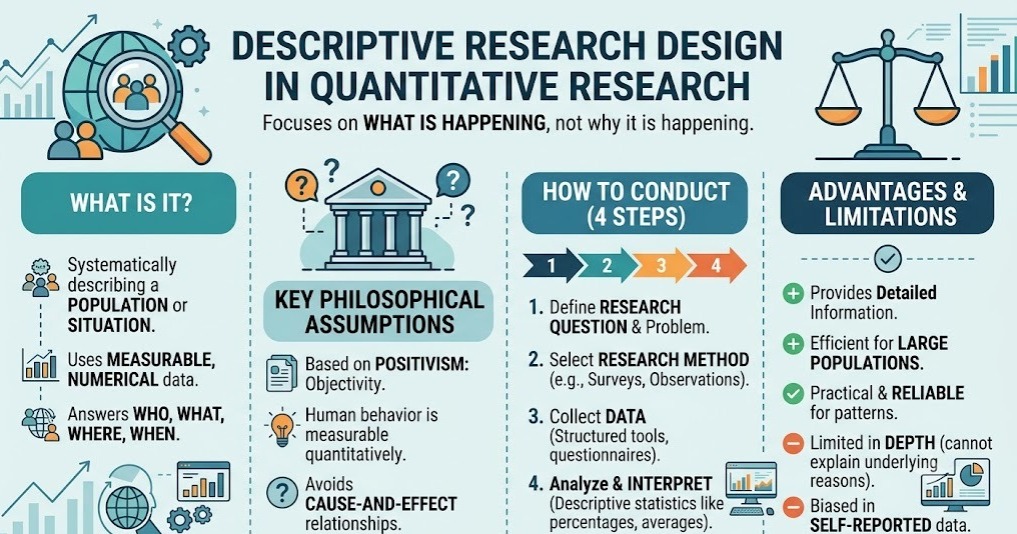
What are the Advantages and Disadvantages of Descriptive Research Design in Quantitative Research Designs?
- Descriptive Research Design in Quantitative Research Designs is widely used because of its simplicity, flexibility, and ability to provide useful insights
- However, like all research methods, it has both strengths and limitations
- One major advantage is that descriptive research provides detailed and accurate information about a population
- It helps researchers understand characteristics, behaviors, and patterns within groups
- This makes it useful for social sciences, healthcare, education, and business studies
- Another advantage is that it is highly suitable for large populations
- Researchers can use surveys and cross-sectional studies to collect data from many individuals efficiently
- This makes descriptive research design ideal for market research and public opinion studies
- It is also cost-effective and time-efficient compared to experimental research designs
- Data can be collected quickly using structured tools such as questionnaires and online surveys
- Descriptive research design also offers flexibility in data collection methods
- Researchers can use surveys, observational methods, and case studies depending on the research needs
- This flexibility improves the quality and depth of data collected
- Another advantage is that it helps identify patterns and trends in data
- Researchers can use descriptive statistics to understand behavior, preferences, and demographic characteristics
- This helps organizations make informed decisions
- Descriptive research design also supports decision-making in areas such as policy development, healthcare planning, and business strategy
- It helps resource allocation by providing accurate data about populations
- However, there are also several disadvantages
- One major limitation is that it cannot establish cause-and-effect relationships
- It only describes what is happening, not why it is happening
- Another disadvantage is limited depth of analysis
- While it provides surface-level information, it may not explain underlying reasons or motivations
- Descriptive research design also depends heavily on the quality of data collection tools
- Poorly designed surveys or questionnaires can lead to inaccurate results
- There is also a risk of bias in self-reported data
- Participants may not always provide honest or accurate responses in research surveys
- Another limitation is lack of control over variables
- Researchers do not manipulate independent variables, which limits hypothesis testing
- Cross-sectional studies only capture data at a single point in time
- This makes it difficult to understand changes over time unless longitudinal research is used
- Despite these limitations, Descriptive Research Design in Quantitative Research Designs remains one of the most widely used research methods because of its practicality and efficiency
Examples of Descriptive Research Design
- Descriptive Research Design in Quantitative Research Designs is used in many real-world situations where the goal is to describe populations or phenomena without manipulating variables
- In market research, companies use descriptive surveys to understand consumer behavior
- Researchers collect data on purchasing habits, preferences, and customer satisfaction
- This helps businesses improve products and services based on real feedback
- In education, descriptive research design is used to study student performance and learning behavior
- Researchers collect data on grades, attendance, and study habits to identify patterns within a student population
- This helps educators improve teaching methods and curriculum design
- In healthcare, descriptive research is used to study disease prevalence and patient characteristics
- For example, researchers may examine the number of people affected by diabetes in a specific region
- This helps healthcare providers plan interventions and allocate resources effectively
- In social sciences, descriptive research design is used to study behaviors and attitudes within a population
- Surveys may be conducted to understand social media usage patterns or public opinions on social issues
- This helps identify trends across different demographic groups
- Governments also use descriptive research design to collect data on unemployment, income levels, and population growth
- This information is used for policy development and economic planning
- In ecological studies, researchers use observational methods to study environmental conditions
- This may include tracking pollution levels or wildlife populations at a specific point in time
- Case studies are also a form of descriptive research when they focus on detailed observation without experimental manipulation
- They provide in-depth information about a single individual, group, or organization
- Across all these examples, Descriptive Research Design in Quantitative Research Designs is used to gather information, identify patterns, and support decision-making without establishing causality
- These examples of descriptive research show how widely applicable and practical this research design is in real-world settings
