
Grounded Theory Research Questions

Grounded theory research questions ask how or why a social process happens and aim to build a theory from the data rather than test one. They are open and process-focused, and they usually begin with how or what is going on.
This guide explains the grounded theory approach and its main versions, shows what makes a good grounded theory question, gives five steps for writing one with an example at every step, lists 20 examples, links each question to coding and sampling and shows common mistakes.
- The approach: what grounded theory is and why questions stay open.
- The method: five steps and 20 examples.
- The link: coding, sampling, memos and mistakes.
On this page
- What is grounded theory?
- Main versions of grounded theory
- What makes a good grounded theory research question?
- Step-by-step guide to writing grounded theory research questions
- 20 examples of grounded theory research questions
- Before and after: strengthening a grounded theory question
- Frequently asked questions about grounded theory research questions
Key takeaways
- Grounded theory research questions are open, process-focused and aim to build theory from data.
- Start with how or what is happening, not with a hypothesis or a fixed list of variables.
- The question may change as theoretical sampling and constant comparison reveal what matters.
- Plan sampling and coding (open, axial, selective) to fit the question.
What is grounded theory?
Grounded theory is a qualitative research approach that builds theory from systematic analysis of data.
- Origin: Glaser and Strauss introduced it in 1967 in The Discovery of Grounded Theory.
- Aim: a theory that explains a social process in a particular setting.
- Data: usually interviews, observations and documents.
- Method: data collection and analysis happen together, using constant comparison.
- Overview: see the general description of grounded theory.
Main versions of grounded theory
Researchers use different versions, and the version shapes the wording of your question.
| Version | Authors | Emphasis |
|---|---|---|
| Classic | Glaser | Emerging theory of a main concern; very open questions |
| Straussian | Strauss and Corbin | Structured coding paradigm with conditions, actions and consequences |
| Constructivist | Charmaz | Theory is co-constructed by researcher and participants; flexible coding |
What makes a good grounded theory research question?
Good questions share these features.
- Open: does not predict or name variables.
- Process-focused: asks how something happens or changes over time.
- Anchored in a setting: names the group and context.
- Allows theory: can be answered with an explanation, not only a description.
- Flexible: can be refined as concepts emerge.
- Free of heavy theory: avoids imposing concepts before data collection.
Step-by-step guide to writing grounded theory research questions
Follow these five steps. Each has an explanation and an example.
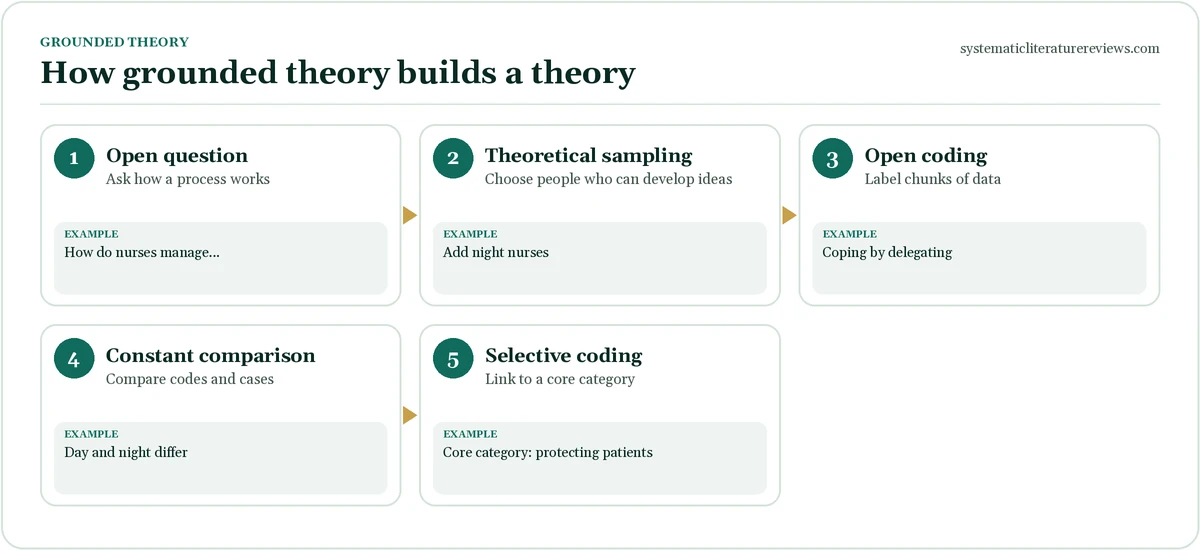
- Identify the area of interest. Choose a social process or problem where existing theory is thin. Read only enough to justify the area, and avoid fixing concepts before you collect data. Example: How new nurses adjust to intensive care.
- Name the group and setting. Say who is involved and where, so that you can sample appropriately. Example: Newly qualified nurses in adult intensive care units.
- Choose a process word. Use how, what is the process or what is going on, which invite a theory of process. Example: How do newly qualified nurses…
- Write an open central question. Combine the group, the process and the setting in one question with no variables. Example: How do newly qualified nurses navigate their first year in intensive care?
- Plan to refine. Expect the question to sharpen as you analyse data. Record changes in memos and report them in the methodology. Example: After eight interviews, focus the question on building confidence.
20 examples of grounded theory research questions
Use these as models and adapt them to your topic.
Health and nursing
- Q1: how do newly qualified nurses develop confidence in intensive care?
- Q2: what is the process by which patients with diabetes come to accept insulin?
- Q3: how do family carers manage the transition to a care home?
- Q4: how do nurses decide to speak up about unsafe practice?
- Q5: what is the process of recovery for people leaving mental health crisis services?
Education
- Q6: how do first-generation students construct a sense of belonging at university?
- Q7: what is the process by which teachers adopt new technology?
- Q8: how do doctoral students manage the transition to independent research?
- Q9: how do pupils negotiate identity after moving schools?
- Q10: how do mature students balance work, family and study?
Business and organisations
- Q11: how do first-time managers develop their leadership identity?
- Q12: what is the process of trust building in remote teams?
- Q13: how do small firms decide to adopt artificial intelligence tools?
- Q14: how do employees experience and respond to organisational change?
- Q15: how do entrepreneurs recover from business failure?
Social science and technology
- Q16: how do refugees rebuild social networks after resettlement?
- Q17: what is the process through which volunteers sustain commitment?
- Q18: how do software teams make decisions about technical debt?
- Q19: how do patients with chronic pain manage identity?
- Q20: how do online communities develop norms?
Before and after: strengthening a grounded theory question
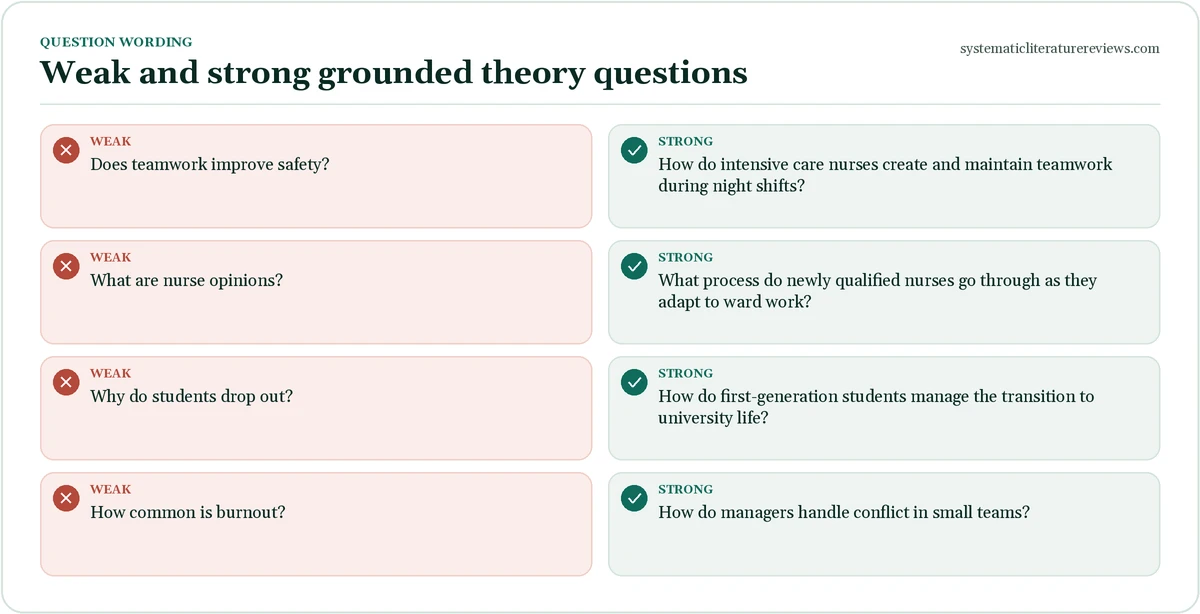
Compare weak questions with strong ones.
Grounded theory research question: rewrite
Weak
Does mentoring increase nurse retention?
This is a causal question with fixed variables, which suits an experiment rather than grounded theory.
Strong
How do newly qualified nurses experience mentoring as they decide whether to stay in intensive care?
Open, process-focused and tied to a group and a setting.
Weak
What are the types of leadership?
A descriptive list question without process or setting.
Strong
How do first-time managers develop their leadership identity in the first year?
Asks about a process and invites theory.
Linking the question to coding
Coding turns data into theory. Your question guides what you look for.
| Stage | What you do | Example |
|---|---|---|
| Open coding | Break data into small pieces and label them | Code: pretending to be confident |
| Axial coding | Link categories by conditions, actions and consequences | Condition: fear of mistakes; action: asking for help; consequence: growing trust |
| Selective coding | Choose a core category that explains most of the data | Core category: building credibility |
| Memo writing | Record ideas about codes and links | Memo: confidence depends on feedback |
- Constant comparison: compare each new piece of data with earlier data.
- Saturation: stop when new data no longer add new properties to categories.
Theoretical sampling and sample size
Sampling follows the emerging theory.
- Start with purposive sampling: recruit people who have lived the process.
- Move to theoretical sampling: recruit new participants to test and develop categories. Example: interview experienced nurses to see how confidence continues to develop.
- Sample size: grounded theory studies commonly include around 20 to 30 interviews, but saturation, not a number, decides.
- Report: explain how sampling changed during analysis.
- Document decisions: in memos.
The role of the literature
Versions differ about when to read.
- Classic view: delay the main literature review until the theory emerges.
- Straussian and constructivist views: a flexible early review is acceptable, if held lightly.
- Your decision: follow your supervisor and ethics committee’s guidance.
- Use of literature: integrate it later to compare with your theory.
- Report: explain your choice in the methodology.
Quality in grounded theory studies
Several criteria can show quality.
- Credibility: the theory fits the data and participants recognise it.
- Originality: the theory offers new insight.
- Resonance: it makes sense to people in the setting.
- Usefulness: it can inform practice or policy.
- Rigour: record decisions in memos and keep an audit trail.
Common mistakes with grounded theory research questions
Avoid these problems.
- Using variables or hypotheses: this belongs to testing designs. Example: keep the question open.
- Describing instead of theorising: a list of themes is not a theory. Example: explain the process.
- Starting with a fixed framework: it limits discovery. Example: let categories emerge.
- Stopping at open coding: the analysis stays descriptive. Example: move to axial and selective coding.
- No setting named: the theory has no context. Example: name the group and setting.
Related guides: phenomenological research questions and interpretive research questions.
Memo writing and the question
Memos link your data to your question.
- Write early: after the first interview.
- Record ideas: about codes, links and surprises.
- Ask questions of the data: what is going on here? What is this a case of?
- Track changes: note when the research question changes. Example: after interview eight, focus on confidence.
- Use memos in the write-up: they show how the theory developed.
An example from question to core category
This short example shows how a grounded theory question leads to a theory.
- Question: how do newly qualified nurses develop confidence in intensive care?
- Data: 18 interviews and 6 observation periods.
- Open codes: pretending to know, asking quietly, fear of blame, praise from seniors.
- Axial coding: fear of blame is the condition; asking quietly is the strategy; praise is a consequence that builds confidence.
- Core category: building credibility: nurses gain confidence by showing competence in small steps.
- Theory: confidence grows through repeated credibility cycles shaped by the response of seniors.
Tools for grounded theory
Software helps with organisation, but analysis remains yours.
- NVivo, Atlas.ti, MAXQDA: store transcripts, codes and memos.
- Spreadsheets: work for small studies.
- Diagrams: draw conceptual maps by hand or with software.
- Reference managers: keep a library; see reference management tools.
- Do not let software code for you: you must interpret.
Reporting a grounded theory study
Show how the theory grew from the data.
- Describe sampling: how it moved from purposive to theoretical.
- Present the theory: with a core category and a diagram.
- Use quotes: to ground each category.
- Discuss: how the theory compares with the literature.
- Limits: state the setting and sample.
Writing questions at different stages of the study
The question may change as the study moves on.
| Stage | Question form | Example |
|---|---|---|
| Start | Broad and open | What is going on for new nurses in intensive care? |
| Middle | Focused on emerging concepts | How do new nurses manage fear of blame? |
| End | Explains the core process | How do new nurses build credibility with senior colleagues? |
- Report the change: show how and why the question developed.
- Keep the data in view: changes should follow the data and not preferences.
Ethics in grounded theory studies
The design is flexible, which has ethical implications.
- Ethics approval: describe the flexible sampling and interview guide in the application.
- Amendments: request approval if you add new groups or topics.
- Consent: explain that the questions may change.
- Confidentiality: use pseudonyms and protect recordings.
- Support: offer information if topics are distressing.
Grounded theory compared with other qualitative approaches
Choose the approach that fits your question.
| Approach | Question | Output |
|---|---|---|
| Grounded theory | How does a process work? | A theory |
| Phenomenology | What is the lived experience? | The essence of the experience |
| Ethnography | How does a culture work? | A cultural description |
| Case study | What happened in this case? | An in-depth account |
| Narrative inquiry | What stories do people tell? | Storied accounts |
Frequently asked questions about grounded theory research questions
What are grounded theory research questions?
Grounded theory research questions are open questions that ask how or why a social process happens, with the aim of building a theory from the data rather than testing an existing one. They name a group and a setting but avoid fixed variables or hypotheses, and they often begin with how or what is going on. Examples include how newly qualified nurses develop confidence in intensive care. The question may be refined during the study as analysis shows which concepts matter most. Discuss the wording with your supervisor early.
How do I write a grounded theory research question?
Begin with a social process or problem where theory is thin, and name the group and the setting. Use a process word such as how, then write one open central question with no variables, for example how do first-generation students construct a sense of belonging at university. Keep the wording flexible and plan to refine it as you analyse data. Record changes in memos and explain them in your methodology so that readers can follow the development of your question. Ask a peer to read the question for clarity.
How many participants do I need for grounded theory?
There is no fixed number. Many grounded theory studies include around 20 to 30 interviews, but the real criterion is theoretical saturation, which means that new data no longer add new properties or relationships to your categories. Sampling is theoretical, so you recruit new participants to test and develop emerging concepts, not only to increase numbers. Explain in your report how you decided that saturation had been reached and how your sampling changed as the theory developed. Keep notes of every decision in your memos.
What is the difference between grounded theory and phenomenology questions?
A phenomenological question asks what it is like to live an experience and aims to describe its essence, for example what is the lived experience of caring for a relative with dementia. A grounded theory question asks how a social process works and aims to build a theory that explains it, for example how do family carers manage the transition to a care home. Phenomenology describes meaning, while grounded theory explains process, and each uses different sampling and analysis methods. Choose the approach that fits your aim and justify the choice.
Need expert help? Our experienced writers can handle the search, screening and write-up for you. Place your order in two minutes, or read how a systematic literature review works first.
Systematic Literature Reviews
Need strong research questions?
Research questions that fit your method and can be answered with your data.