
Blog
EQUATOR Network: Comprehensive Research Reporting Guidelines, Checklist and Standards

Understanding the EQUATOR Network and Its Impact on Research Reporting
The EQUATOR Network (Enhancing the Quality and Transparency of Health Research) is a global initiative aimed at improving the accuracy, transparency, and consistency of health research reporting. This initiative supports researchers, editors, and journals by providing comprehensive reporting guidelines. It plays a critical role in promoting good research practices across various study designs.
What is the EQUATOR Network and Why It Matters?
- The EQUATOR Network is a collaborative effort to improve the reporting of health research, ensuring that studies are transparent and reproducible.
- It focuses on providing reporting standards for diverse study types, including randomised trials, systematic reviews, and case reports.
- The EQUATOR Network encourages the use of reporting guidelines like CONSORT for clinical trials and STROBE for observational studies to strengthen the quality of reporting.
- David Moher, a key figure behind the EQUATOR Network, advocates for clear and accurate dissemination of research findings, which helps the scientific community assess the validity of published research.
- The EQUATOR Network is an essential resource for researchers and developers of reporting guidelines, ensuring that studies meet consistent standards and are published with integrity.
Get Expert Meta-Analysis Writing Help
Unlock the power of your research with professional meta-analysis writing services. Our experts provide high-quality, comprehensive analysis, ensuring clarity, precision, and actionable insights for impactful results. Contact us today!
How EQUATOR Network Promotes Accurate Health Research Reporting
- The EQUATOR Network provides a platform to disseminate new reporting guidelines, which help to standardize the reporting of research studies across disciplines.
- By supporting the development of new reporting guidelines, the EQUATOR Network helps researchers report their findings more accurately and transparently. These guidelines include the CONSORT statement for randomised trials, the STARD for diagnostic accuracy studies, and STROBE for observational studies.
- With the backing of key organizations like the Center for Open Science, BMJ, and University of Oxford, the EQUATOR Network ensures that peer review and reporting of health research are aligned with high standards.
- The EQUATOR Network encourages the implementation of robust reporting guidelines to improve the quality of medical research and biomedical studies, ensuring they provide accurate and complete information for medical professionals and researchers.
- By promoting transparent reporting, the EQUATOR Network helps bridge the gap between research findings and their practical applications in clinical settings, making it easier for healthcare professionals to implement evidence-based practices.
Key Study Types Covered by the EQUATOR Network Guidelines
- Controlled trials: The EQUATOR Network provides reporting guidelines for randomised trials, offering a detailed framework for ensuring the validity and transparency of findings in clinical research.
- Observational studies: Through STROBE and other guidelines, the EQUATOR Network strengthens the reporting of observational studies, ensuring researchers accurately capture and present their findings to the scientific community.
- Systematic reviews: The EQUATOR Network includes specific guidelines for systematic reviews, helping researchers follow rigorous standards in compiling, evaluating, and reporting evidence from multiple studies.
- Case reports: The EQUATOR Network has specific guidelines for case reports, enabling clinicians and researchers to effectively document and disseminate unique clinical experiences, enhancing the value of individual cases within broader medical research.
- Diagnostic accuracy studies: The EQUATOR Network supports the reporting of diagnostic accuracy studies through guidelines like STARD, promoting clear and reliable reporting for clinical diagnostics.
- The EQUATOR Network also includes online resources and additional guidelines for various types of research, from basic epidemiology studies to complex medical research designs.
By supporting transparent and accurate reporting of health research, the EQUATOR Network helps improve the overall quality of reporting, which ultimately contributes to stronger, more reliable healthcare practices. Its commitment to strengthening the reporting standards in health research ensures that published research can be trusted, verified, and applied effectively in real-world settings.
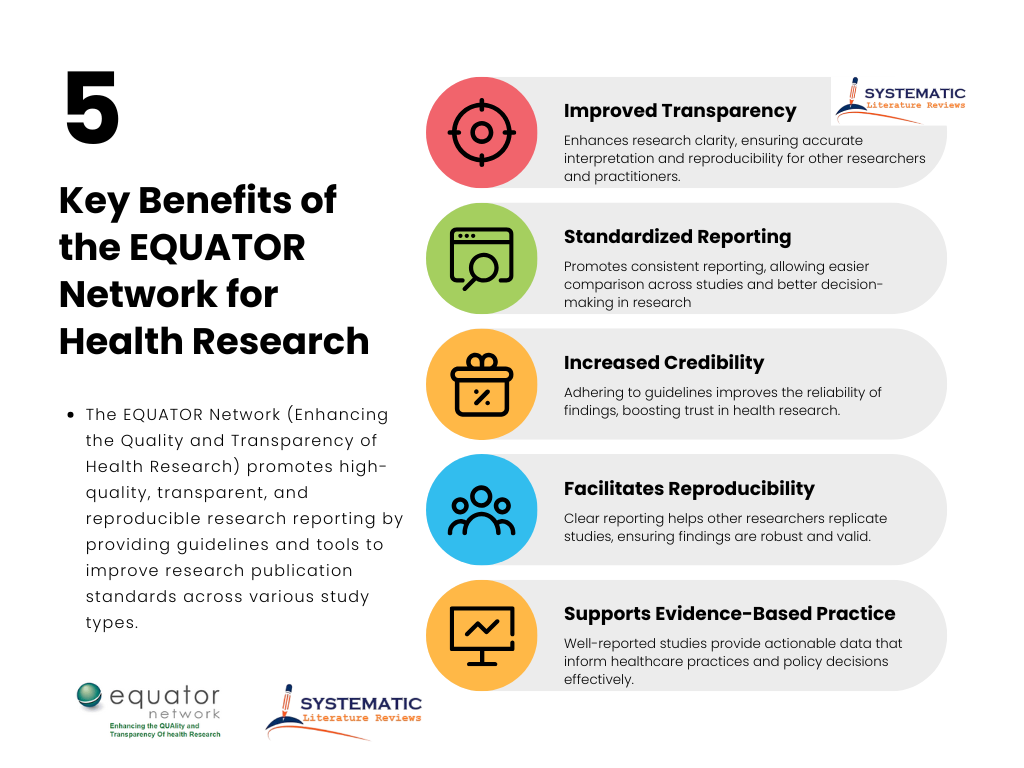
The Importance of Research Reporting Guidelines in Health Research
Research reporting guidelines are essential for ensuring the integrity, transparency, and reproducibility of scientific studies. These guidelines are particularly crucial in health research, where accurate and reliable information can directly impact patient care and public health outcomes. The EQUATOR Network plays a key role in promoting the use of these guidelines, supporting researchers, journal editors, and peer reviewers in ensuring high-quality, transparent, and accurate reporting of research findings.
Why Research Reporting Guidelines Are Essential for Scientific Integrity
- Promoting transparent and accurate reporting: Reporting guidelines, like those provided by the EQUATOR Network, help ensure that research findings are presented clearly and consistently. This transparency is essential for the scientific community to evaluate the reliability and applicability of research outcomes.
- Ensuring reproducibility: By following established guidelines, researchers provide enough detail to allow others to replicate the study, which is a cornerstone of scientific integrity. This is crucial in health research, where reproducibility can confirm the validity of treatment methods or diagnostic tools.
- Preventing bias and improving objectivity: Well-defined reporting guidelines help reduce the risk of selective reporting or data manipulation, ensuring that studies reflect the true results, whether positive or negative. The EQUATOR Network provides a foundation for good reporting of research, thereby mitigating these risks.
- Supporting data sharing: The EQUATOR Network emphasizes the importance of data sharing in health research, encouraging researchers to make their datasets available for independent validation, which further supports the reliability of the findings.
Common Reporting Guidelines for Various Study Types
- Randomized controlled trials (RCTs): The EQUATOR Network supports the CONSORT guidelines for randomized controlled trials, ensuring that these high-quality studies are reported with complete and transparent methods, which enhances the credibility of the research.
- Observational studies: For observational studies in epidemiology, the EQUATOR Network promotes the STROBE guidelines, which help researchers report the design, conduct, and analysis of observational studies with clarity and precision.
- Meta-analysis: The EQUATOR Network also promotes PRISMA (Preferred Reporting Items for Systematic Reviews and Meta-Analyses), which ensures that systematic reviews and meta-analyses follow a consistent structure, making the results more accessible and reliable to health professionals and policy makers.
- Case reports and diagnostic studies: The EQUATOR Network encourages the use of guidelines such as STARD for diagnostic accuracy studies and other frameworks for case reports, ensuring accurate, transparent, and consistent reporting of clinical data.
Ensuring Transparent and Reproducible Health Research Reporting
- Clearer research: By implementing the EQUATOR Network’s guidelines, health researchers can present their findings more clearly, making it easier for others to interpret and apply the research in practice. This enhances the overall quality of health sciences.
- Educational materials and resources: The EQUATOR Network offers resources and training for researchers, journal editors, and peer reviewers, helping them understand and implement items for reporting that contribute to better research quality. These resources include templates, checklists, and instructional materials.
- International initiative: The EQUATOR Network is a global effort that collaborates with funding bodies, journals, and research institutions, contributing to a movement toward better research practices. It includes experts like Douglas Altman, Iveta Simera, and Henrica C.W. who work to improve the reliability of medical research across the world.
- Journal editors and peer reviewers: The EQUATOR Network collaborates with journal editors and peer reviewers, guiding them in evaluating the quality of health research based on these standardized reporting guidelines. This helps ensure that published research meets the highest standards of integrity and reliability.
- Promoting wider dissemination and implementation: Through its educational initiatives, the EQUATOR Network helps facilitate the dissemination and implementation of these guidelines, ensuring they reach a global audience of researchers, policymakers, and clinicians.
The EQUATOR Network remains at the forefront of ensuring that health research meets the standards for transparency, reproducibility, and scientific integrity, providing vital support to researchers and the broader scientific community.
| Guideline | Description |
| CONSORT (Consolidated Standards of Reporting Trials) | Improves the reporting quality of randomized controlled trials (RCTs), including methodology, participant characteristics, and statistical analysis. |
| STROBE (Strengthening the Reporting of Observational Studies in Epidemiology) | Aims to improve the quality of reporting for observational studies (cohort, case-control, and cross-sectional studies). |
| PRISMA (Preferred Reporting Items for Systematic Reviews and Meta-Analyses) | Focuses on systematic reviews and meta-analyses, ensuring that reports include rationale, objectives, methods, results, and conclusions. |
| SPIRIT (Standard Protocol Items: Recommendations for Interventional Trials) | Improves the quality of clinical trial protocols, ensuring that trial protocols are clear, transparent, and reproducible. |
| AGREE (Appraisal of Guidelines for Research & Evaluation) | Assesses the quality and transparency of clinical practice guidelines, ensuring they are evidence-based and clear. |
| TREND (Transparent Reporting of Evaluations with Nonrandomized Designs) | Focuses on improving the reporting of non-randomized evaluations by encouraging clarity in design, methodology, and analysis. |
| CARE (Case Report Guidelines) | Provides guidelines for transparent reporting of case reports, including patient histories, diagnostics, interventions, and outcomes. |
| SQUIRE (Standards for QUality Improvement Reporting Excellence) | Focuses on quality improvement studies, encouraging detailed reporting of strategies used to assess effectiveness. |
| TIDieR (Template for Intervention Description and Replication) | Offers guidelines for reporting intervention details, making it easier for others to replicate and assess interventions. |
| Other Guidelines | Covers specific study types (e.g., animal research, diagnostic studies, economic evaluations) and tools to improve overall research reporting. |
Creating a Comprehensive Checklist for Effective Research Reporting
A comprehensive checklist is crucial for ensuring that research studies meet the highest standards of quality, transparency, and reproducibility. The EQUATOR Network plays an essential role in providing such checklists, which help researchers report their findings consistently and accurately. This section explores the key elements of an effective research reporting checklist, how to apply it to various study types, and how to improve health research reporting.
Key Elements of a Research Reporting Checklist
- Clarity and consistency: The EQUATOR Network emphasizes the need for clarity in research reporting. The checklist ensures that all elements of a study, such as research questions, study design, and data analysis methods, are presented in a consistent manner for easy understanding.
- Study design: A key element in the checklist is the clear definition of the research methods used, whether they are randomized controlled trials, observational studies, or meta-analyses. Each study type requires specific guidelines, which the EQUATOR Network provides through frameworks like CONSORT (for trials) and STROBE (for observational studies).
- Transparency in data reporting: The EQUATOR Network promotes transparent reporting of research findings, ensuring that data is shared openly, and the methodology is well-documented. This helps in the validation and reproducibility of results, essential for building trust within the scientific community.
- Reporting of key outcomes: The checklist must include reporting the primary and secondary outcomes of the study. This ensures that readers can easily assess the significance of the study’s findings and their implications for future research.
- Ethical considerations: Ethical aspects of the study, such as consent and approval from ethics committees, are also crucial elements in the checklist. The EQUATOR Network advocates for the inclusion of ethical reporting as a standard practice in all research studies.
How to Apply Research Reporting Guidelines to Your Study Types
- Randomized Controlled Trials (RCTs): Use the CONSORT guidelines, provided by the EQUATOR Network, for reporting RCTs. This checklist ensures that all aspects of the trial, from recruitment to randomization and statistical analysis, are documented transparently.
- Observational Studies: For observational studies, apply the STROBE guidelines. These guidelines help in reporting study methods, participant selection, and analysis techniques, contributing to clearer research findings. Henrica C.W. and other experts have significantly contributed to the development of STROBE under the EQUATOR Network.
- Meta-Analyses: The EQUATOR Network advocates for the use of PRISMA guidelines when reporting systematic reviews and meta-analyses. These guidelines ensure that the methodology, data collection, and synthesis of findings are presented clearly and comprehensively.
- Case Reports: The EQUATOR Network also offers reporting guidelines for case reports, ensuring that critical details are shared accurately, such as patient history, diagnosis, and treatment outcomes.
Improving Health Research Reporting with a Standardized Checklist
- Promoting better research practices: The EQUATOR Network and its associated projects, such as the EQUATOR Project, help maintain a comprehensive collection of reporting guidelines that promote good reporting of research. The checklist serves as a tool for researchers to implement best practices in their work, ensuring their studies are reliable and reproducible.
- Enhancing the reliability of research: By following the EQUATOR Network’s checklist, researchers can improve the reliability of medical and health sciences research, ensuring that the data is accurate and conclusions are supported by solid evidence.
- Collaboration and feedback: The EQUATOR Network works with prominent researchers like Douglas G. and Reitsma to continuously improve the quality of reporting. Their mutual interest in improving research reporting practices benefits the broader scientific community, especially in fields like healthcare and biomedical research.
- Support for researchers and journal editors: The EQUATOR Network provides educational materials and resources for both researchers and journal editors, assisting them in the development of clearer, more accurate research reports. This includes instructions for authors, guidelines for peer reviewers, and resources for effective dissemination of study findings.
Incorporating the EQUATOR Network’s checklist into your research reporting practices ensures that your study meets global standards for transparency and quality, contributing to the advancement of science and improving health research worldwide.
