
Blog
How to Conduct a Scoping Review: Guidance for Authors Choosing Between a Systematic Review or Scoping Review

Scoping Review vs. Systematic Review: Understanding the Key Differences
What is a Scoping Review and How is it Different from a Systematic Review?
- Definition of Scoping Reviews:
A scoping review is a type of evidence synthesis designed to explore the breadth and scope of available evidence on a specific topic. The main purpose is to identify gaps in knowledge, key concepts, and the types of evidence available.- Systematic reviews are typically more focused, examining a specific research question with rigorous methods to assess the quality and outcomes of interventions or treatments.
- Purpose:
The purpose of a scoping review is to map out existing literature, identify areas where evidence is lacking, and clarify concepts. It serves as an exploratory approach to evidence synthesis.- Systematic reviews, on the other hand, aim to provide a comprehensive, in-depth answer to a well-defined research question by synthesizing evidence using transparent, predefined methods.
- Scope and Focus:
A scoping review is broader in scope and aims to provide an overview of the field. It may include various types of evidence, from randomized controlled trials to qualitative studies.- Systematic reviews are narrower, focusing on specific research questions or interventions, and they often use rigorous data extraction methods and statistical analysis (e.g., meta-analysis).
- Methodological Approach:
Scoping reviews are characterized by a flexible methodology that can be adapted to the type of evidence available. They often do not involve quality assessment of the studies included.- Systematic reviews follow a more structured approach, usually including quality assessments of the studies based on pre-defined inclusion criteria.
- Reporting:
Scoping reviews often present a narrative synthesis of findings, summarizing the key concepts, evidence types, and the current state of research.- Systematic reviews use a detailed, structured synthesis and present findings that are often linked to evidence-based recommendations for practice.
Expert Scoping Review Writing Services
Need help with your scoping review? Our professional scoping review writing services offer tailored research, data extraction, and clear reporting. Let us guide you through the process—get in touch today for quality assistance!
Choosing the Right Review Type: Scoping Review or Systematic Review?
- Guidance for Authors When Choosing:
When deciding whether to conduct a scoping review or a systematic review, consider the following factors:- Review Question: A scoping review is suitable if you are exploring a broad topic or assessing the range of available evidence on a subject. If your question is highly specific and seeks to evaluate the effects of an intervention, a systematic review is more appropriate.
- Type of Evidence: If you are interested in summarizing a range of evidence types (e.g., studies of various designs), a scoping review is likely the best option. For questions focused on specific interventions or clinical outcomes, a systematic review may be more fitting.
- Stage of Research: A scoping review is often conducted at an early stage of research to map out existing evidence, whereas systematic reviews are typically used when there is enough literature to perform a thorough synthesis of evidence.
- Purpose of the Review:
- A scoping review aims to provide an overview of the existing body of literature, often without the need to evaluate the risk of bias or perform detailed analysis.
- A systematic review involves a more detailed, in-depth examination of the literature to assess the quality of the evidence and draw conclusions based on that analysis.
- Knowledge Synthesis Approaches:
- Scoping reviews tend to be more inclusive of different types of available evidence and do not require detailed analysis of study quality. They focus on providing a broad overview of the research landscape.
- Systematic reviews often involve evidence synthesis with rigorous methods, including data extraction, quality assessment, and sometimes meta-analysis to combine results across studies.
- Guidance from the Joanna Briggs Institute:
The Joanna Briggs Institute (JBI) provides methodological guidance for conducting scoping reviews through its scoping review protocol and JBI Evid Synth. These resources help authors ensure that the conduct of scoping reviews adheres to rigorous and transparent methods, similar to systematic reviews but with a broader scope.
| Aspect | Scoping Review | Systematic Review | Traditional Literature Review |
| Purpose | To map the literature, identify research gaps, and provide an overview of evidence. | To answer a specific research question by synthesizing evidence, often with a focus on interventions or outcomes. | To summarize existing literature, often in a narrative format, without systematic methodology. |
| Scope | Broad, exploratory; covers all types of evidence (qualitative, quantitative, mixed methods). | Narrower; focuses on specific research questions, often related to interventions or outcomes. | Often broad, but lacks a structured approach; may include general or selective literature. |
| Review Methods | Flexible, with broad inclusion criteria; focuses on identifying themes and patterns. | Rigid, structured with clear inclusion/exclusion criteria and quality assessment. | Less structured; varies widely in approach and quality control. |
| Data Synthesis | Descriptive synthesis of findings; no meta-analysis. | Quantitative synthesis (e.g., meta-analysis) and/or qualitative synthesis. | Descriptive summary; does not usually involve rigorous synthesis or statistical analysis. |
| Study Types Included | Includes all types of studies, including qualitative and mixed methods. | Primarily includes high-quality, peer-reviewed studies, often quantitative, focused on interventions. | Includes a broad range of sources, but without specific inclusion/exclusion criteria. |
| Quality Assessment | No detailed quality assessment of included studies. | Rigorous quality appraisal of studies included. | No systematic quality assessment; may vary depending on the reviewer. |
| Inclusion/Exclusion Criteria | Broad criteria to allow a wide range of evidence. | Strict inclusion/exclusion criteria, often predefined. | No standardized criteria; often includes studies based on availability or relevance. |
| Use of Meta-analysis | Not typically used; focuses on summarizing existing literature. | Frequently used for quantitative synthesis when appropriate. | Not used; typically does not include statistical analysis. |
| Reporting Guidelines | Follows PRISMA extension for scoping reviews for transparency and rigor. | Follows PRISMA guidelines for systematic reviews for transparency. | No standardized reporting guidelines; format and structure vary. |
| Time and Resources Required | Relatively quicker and less resource-intensive than systematic reviews. | Time-consuming and resource-intensive due to rigorous methodology and quality assessments. | Less time-intensive; varies depending on the scope and focus. |
| Outcome | Provides an overview of evidence, identifies gaps, and informs future research. | Provides comprehensive evidence-based answers to specific research questions. | Summarizes existing knowledge, often without providing definitive conclusions. |
| Example Use Case | Mapping research landscape, exploring broad topics, identifying evidence gaps. | Assessing the effectiveness of an intervention, evaluating clinical treatments. | Summarizing background literature for a research topic without a focused methodology. |
When to Conduct a Scoping Review for Your Research Question
- Exploratory Research:
A scoping review is ideal when the aim is to explore a topic that is broad or not well-defined. For instance, you may conduct a scoping review when the research question is not specific enough for a systematic review or when the body of literature is vast and diverse.- Systematic reviews are best when the research question is specific, and the focus is on evaluating evidence for a defined intervention or outcome.
- Mapping the Evidence:
Scoping reviews are particularly useful for identifying the types of available evidence, key themes, and research gaps. If the goal is to map a body of literature and identify areas where future research is needed, a scoping review is the best approach.- Systematic reviews may not be suitable for mapping evidence or identifying gaps in the literature.
- Preliminary Analysis:
A scoping review may be conducted early in the research process to provide an overview of existing studies and inform the design of future research. This is particularly important in fields where knowledge synthesis is still developing.- Systematic reviews often require more established bodies of literature, making them more appropriate for answering specific research questions with clear inclusion criteria.
- Identifying Research Gaps:
Scoping reviews help in identifying areas where further research is required. They provide a broad perspective on the research landscape and can highlight areas that have not been sufficiently explored.- Systematic reviews focus on synthesizing existing evidence rather than identifying gaps in research.
The Role of Review Teams in Conducting a Scoping Review
- Collaborative Approach:
Conducting a scoping review involves a team of researchers who work together to define the review question, establish inclusion criteria, conduct data extraction, and analyze the evidence. The role of the review team is critical to ensuring that the review process is thorough, transparent, and unbiased.- Systematic reviews may involve similar teams, but the process often requires a higher level of rigor, particularly in terms of quality assessment and data synthesis.
- Expertise Required:
Review teams for scoping reviews should consist of individuals with expertise in the relevant subject matter, research methods, and evidence synthesis. The team may include experts in evidence synthesis methods, data extraction, and the specific field of research.- For systematic reviews, the team needs to be particularly skilled in conducting systematic scoping and evaluating the risk of bias in the studies included.
- Roles in Data Extraction:
Data extraction is a crucial component of both scoping reviews and systematic reviews. However, in a scoping review, the focus is often on gathering broad themes and summarizing various types of evidence, while systematic reviews tend to involve more detailed data extraction to assess study quality.- Review teams must ensure that the extraction process is consistent and rigorous, especially when synthesizing large bodies of literature.
- Ensuring Transparency:
The Joanna Briggs Institute’s (JBI) guidelines for conducting and reporting scoping reviews stress the importance of transparency and consistency in the conduct and reporting of scoping reviews. A checklist and explanation of the review process ensure that all stages of the review are clear and reproducible.- Systematic reviews also require detailed documentation, particularly regarding preferred reporting items for systematic reviews (PRISMA).
How to Conduct a Scoping Review: A Step-by-Step Guide for Researchers
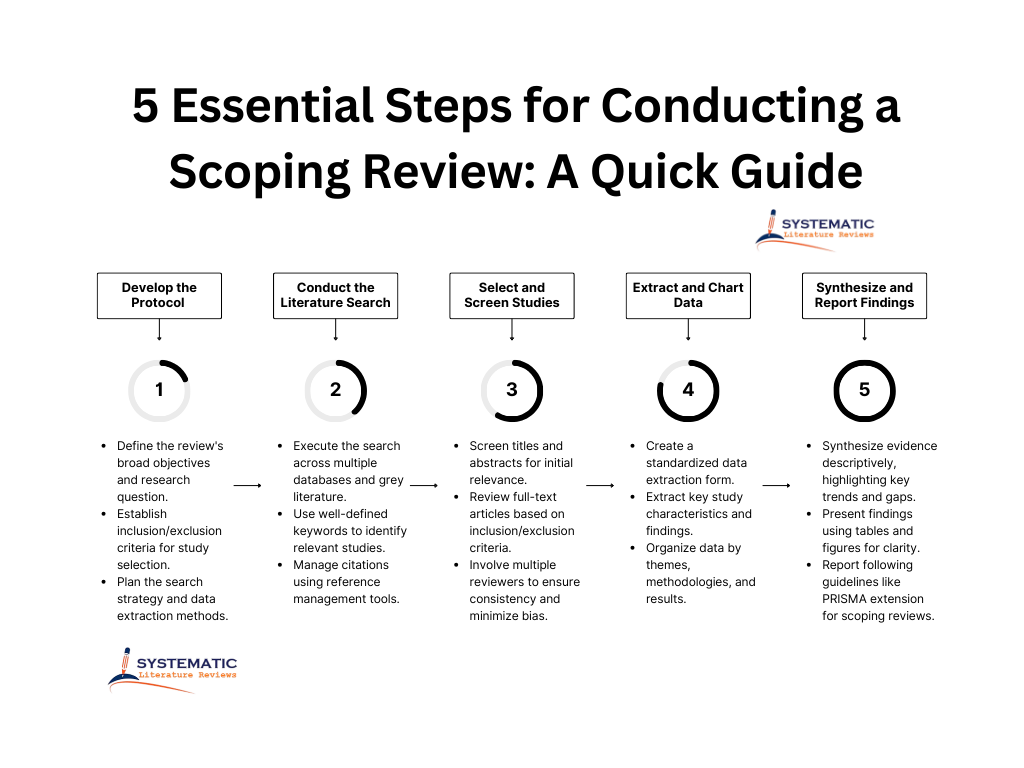
5 Essential Steps to Conduct a Scoping Review Methodology
Step 1: Develop the Protocol and Research Question
- Define the Objective and Question:
- The first step in conducting a scoping review is to clearly define the scope of your research. A well-defined research question will guide your entire review process. This is critical as a scoping review is typically broader and more exploratory than a systematic review, which often focuses on specific interventions.
- Identify the key objectives of the scoping review and formulate a research question that reflects the broad scope of evidence you plan to examine.
- Develop Inclusion/Exclusion Criteria:
- Establish specific inclusion/exclusion criteria to define the type of studies and evidence you will consider. This ensures your scoping review stays focused on the most relevant data.
- Determine factors such as the type of research, the form of evidence, the geographical location, and the timeframe of studies to be included in your review.
- Outline the Search Strategy:
- Develop a comprehensive search strategy that identifies the databases, keywords, and other resources you will use to locate studies.
- Consider academic databases like PubMed or Scopus, and non-traditional sources like grey literature to ensure a broad search. A scoping review requires extensive coverage to map the literature thoroughly.
- Plan for Data Extraction and Synthesis:
- Decide how you will extract relevant data from studies. This step involves identifying key characteristics of the studies, such as methods used, sample size, and major findings.
- Plan how you will organize and present the extracted data in a way that captures the breadth of existing literature.
- Register Your Protocol:
- Register your scoping review protocol with organizations like the Open Science Framework (OSF) to ensure transparency in your review process. Registration also prevents duplication of effort and adds credibility to your scoping review.
- Utilizing a prisma extension for scoping reviews ensures you follow standardized guidelines for transparent reporting of scoping reviews.
Step 2: Conduct the Literature Search
- Perform Comprehensive Searches:
- Execute the search strategy across multiple sources, including databases, grey literature, and other relevant resources. Ensure that you cast a wide net to capture all potentially relevant studies, as scoping reviews require a broad spectrum of evidence.
- Be diligent in searching for both systematic scoping reviews and other types of literature that may inform your research.
- Manage Citations:
- Use citation management tools (like EndNote or Zotero) to organize and manage the references you identify. This is essential when dealing with large volumes of literature, as scoping reviews often involve a considerable amount of studies.
Step 3: Select and Screen Studies
- Screen Titles and Abstracts:
- Begin by reviewing the titles and abstracts of the studies identified in your search. This will help you determine the initial relevance to your scoping review question. Be sure to use your inclusion/exclusion criteria at this stage to refine your search.
- Screen Full-Text Articles:
- After narrowing down studies based on titles and abstracts, you will need to read the full texts to verify their relevance. Apply the same inclusion/exclusion criteria to finalize which studies to include in your scoping review.
- Involve Multiple Reviewers:
- It’s essential to involve multiple reviewers to minimize bias and ensure consistency. Involving more than one reviewer improves the rigor of the scoping review and enhances the reliability of the selection process.
Step 4: Extract and Chart Data
- Create a Data Extraction Form:
- Develop a standardized data extraction form to consistently capture key data from each study. This is crucial for organizing your findings and ensuring that all necessary information is systematically extracted.
- Extract Data:
- Begin collecting key information such as study characteristics (author, year, location), study design, sample size, methods, and results.
- Data extraction in a scoping review aims to map the existing literature rather than providing a detailed synthesis of findings. Therefore, focus on broad themes and patterns.
Step 5: Synthesize and Report the Findings
- Synthesize Findings:
- Unlike systematic reviews, scoping reviews do not typically conduct meta-analysis or detailed statistical synthesis. Instead, the goal is to synthesize the information in a descriptive manner, summarizing the form of evidence and the key findings from the included studies.
- The synthesis process in a scoping review will typically focus on identifying major themes, patterns, and research gaps.
- Present the Results:
- Organize and present your findings clearly, using tables, charts, and graphs to summarize the literature. Presentation of results is essential in scoping reviews to ensure that the evidence is easily digestible for readers and stakeholders.
- Report the Review:
- Ensure that your scoping review follows appropriate reporting guidelines such as the PRISMA framework for scoping reviews. This will ensure that your scoping review is reported comprehensively and transparently.
- You may also consider reporting any systematic review approaches if your scoping review identifies areas that could be further explored with a more focused, systematic scoping review.
By following these five essential steps, researchers can effectively conduct a scoping review that maps the literature, identifies evidence gaps, and provides comprehensive insights on a given topic. This process helps advance knowledge in any field and forms the foundation for future systematic reviews or other research studies.
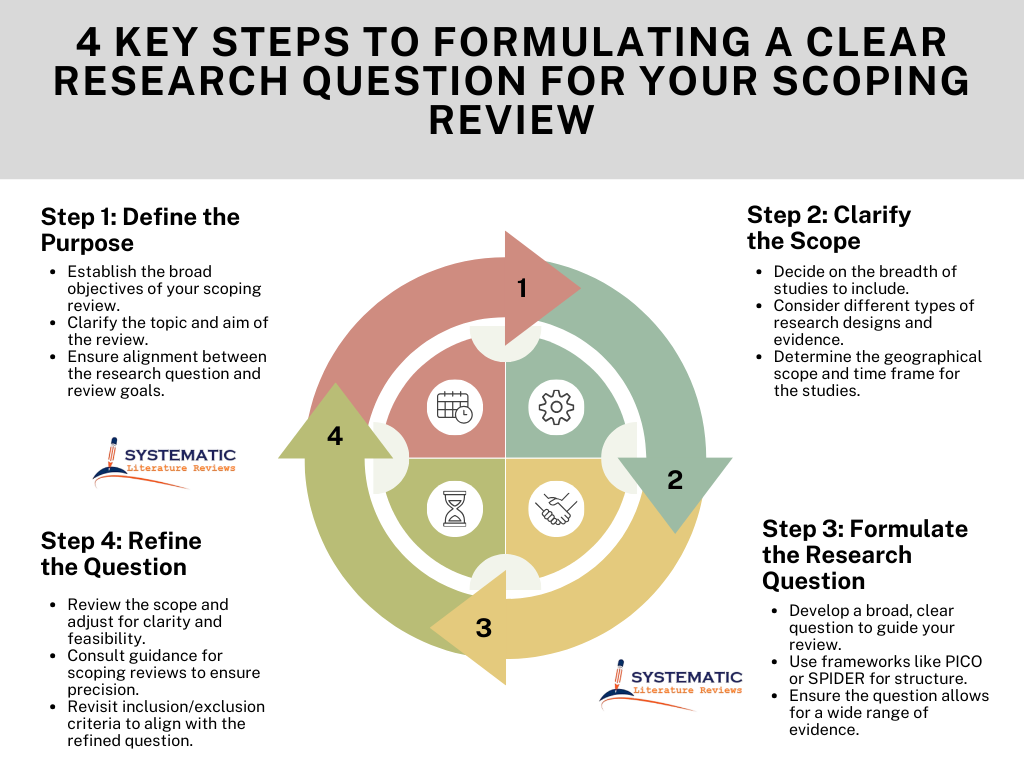
Formulating a Clear Research Question for Your Scoping Review
- Define the Purpose:
- A scoping review aims to map out the existing literature on a given topic. Therefore, the research question should be broad enough to allow for a wide range of studies.
- Ensure the research question reflects the scope of the review and aligns with the goal of providing an overview of evidence on a particular topic.
- Clarify the Scope:
- The scoping review question should be designed to identify key themes, trends, and gaps in the literature. It’s important to determine the type of research (e.g., qualitative, mixed methods, or quantitative) and decide which sources of evidence will be considered in the review.
- Unlike a systematic review, which narrows in on specific outcomes, the scoping review is more inclusive in examining the broader landscape of research.
- Key Characteristics of the Question:
- The research question should reflect the characteristics or factors related to the topic being studied, ensuring that it covers the most important aspects without being too specific.
- For instance, if your review involves healthcare interventions, you may include questions that address different types of interventions across various settings.
- Refining the Research Question:
- As part of the guidance for scoping reviews, refine the question based on the types of studies and evidence identified in your initial searches.
- Consider using frameworks like PICO (Population, Intervention, Comparison, Outcome) or SPIDER (Sample, Phenomenon of Interest, Design, Evaluation, Research type) to guide the formulation of a comprehensive question for the scoping review.
Scoping Review vs. Traditional Literature Reviews: What You Need to Know
- Purpose of Scoping Reviews:
- Scoping reviews are designed to provide a broad overview of a body of literature, identify research gaps, and map out the evidence.
- In contrast, traditional literature reviews often provide a more narrative summary of existing studies without a systematic methodology or specific inclusion criteria.
- Inclusivity of Evidence:
- One of the primary differences between a scoping review and traditional literature reviews is the scoping review’s inclusive approach to different types of evidence.
- Traditional reviews might limit themselves to specific study designs or types of data, while scoping reviews embrace a range of methodologies, including mixed methods, qualitative research, and quantitative studies.
- Methodological Rigor:
- A scoping review requires a more structured approach to data extraction and synthesis, often following established guidelines like the prisma extension for scoping reviews.
- Traditional literature reviews may lack standardized procedures, leading to inconsistent reporting and selection bias in the types of studies included.
- Use in Evidence Synthesis:
- Scoping reviews are often used to map evidence on a particular topic and are valuable for informing a systematic review or clinical guidelines.
- While traditional literature reviews may provide insight into a topic, they typically do not offer the same level of systematic evidence synthesis approaches as scoping reviews.
Performing a Systematic Review vs. Conducting a Scoping Review: Which is Right for Your Research?
- Systematic Review Focus:
- A systematic review is typically conducted when the research question is highly specific, and the aim is to assess the certainty of the evidence regarding a particular intervention or outcome.
- Systematic reviews of interventions are more focused and often involve data extraction, statistical analysis, and rigorous quality assessment of studies.
- Purpose of a Scoping Review:
- A scoping review is ideal when the goal is to map the literature and provide a broad overview of evidence. It is especially useful for understanding the range of evidence on a topic or when the research question is too broad for a systematic review.
- Scoping reviews are particularly valuable when you are in the early stages of research, providing an overview of existing studies that may inform a subsequent systematic review.
- Time and Resource Considerations:
- Scoping reviews tend to require less time and fewer resources than systematic reviews because they do not involve exhaustive data extraction or risk of bias assessment for each study.
- However, systematic reviews often provide a more detailed synthesis of evidence and can be more resource-intensive, requiring extensive search strategies and critical appraisal of studies.
- Review Methods Comparison:
- A systematic review follows a clearly defined review methodology, including a thorough process for evaluating study quality and applying specific inclusion/exclusion criteria.
- Scoping reviews, while also methodologically structured, allow for a more flexible approach in terms of study inclusion and are often more inclusive of various types of research designs.
- Guidance for Scoping Reviews:
- Guidance for scoping reviews includes following established reporting standards like the manual for evidence synthesis and using tools like the BMC Med Res Methodol for structuring your review.
- A scoping review can help produce statements to guide future systematic reviews by providing a comprehensive understanding of the available literature and identifying where additional research is needed.
By understanding the differences between systematic reviews and scoping reviews, researchers can choose the appropriate review method based on the scope of their research question, the type of evidence available, and the intended outcome of the review. Scoping reviews are particularly valuable for exploring broad research areas, while systematic reviews are more suited for in-depth, focused investigations.
