
Blog
How To Conduct Multiphase Design in Mixed Methods Research

What is Multiphase Design in Mixed Method Research?
- Multiphase Design is a mixed methods research design that uses several connected phases to answer a broad research problem comprehensively.
- In simple terms, Multiphase Design means that researchers do not rely on only one study, one method, or one stage of data collection. Instead, they conduct a set of related research activities that may include qualitative studies, quantitative studies, or full mixed methods studies.
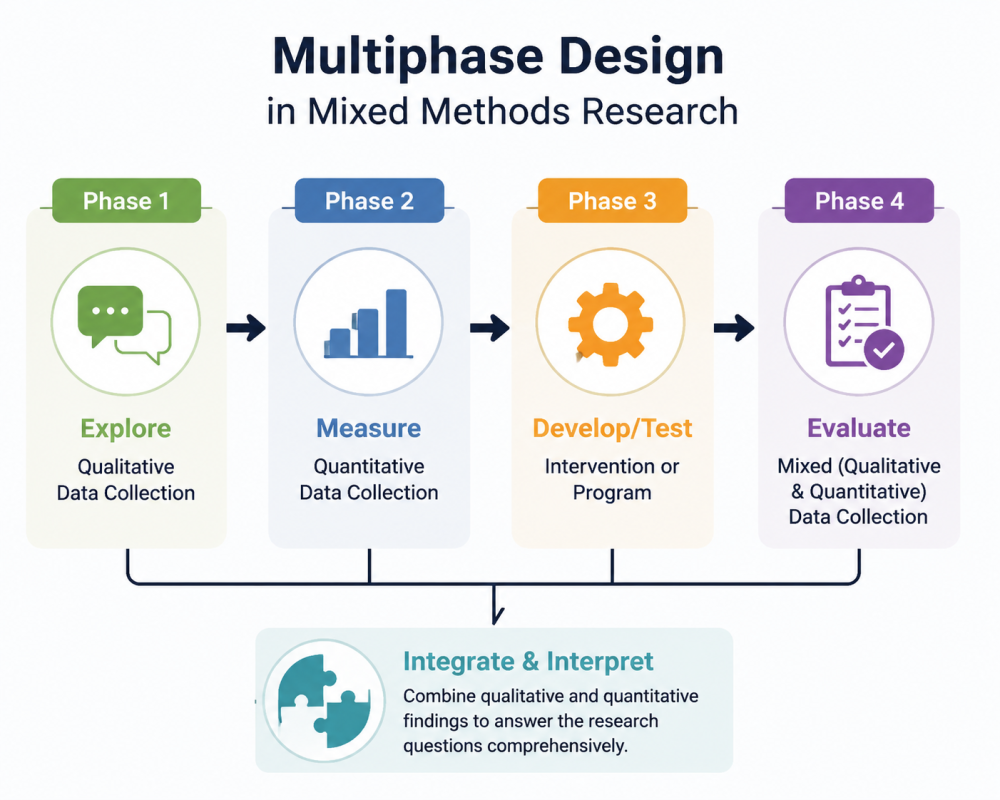
- This design is often used when the research questions are too complex to be answered through a single study. For example, a researcher may first explore a problem using interviews, then develop a survey, then test an intervention, and finally evaluate the results using both qualitative and quantitative data.
- A multiphase mixed methods project may include sequential designs, concurrent designs, or both. Some phases may happen sequentially, where one phase comes after another. Other phases may happen concurrently, where qualitative and quantitative methods are used at the same time.
- The main purpose of Multiphase Design is to help researchers understand a complex issue from different angles. The quantitative method may show patterns, trends, or measurable outcomes, while qualitative methods may explain experiences, meanings, and reasons behind those outcomes.
- This mixed methods approach is useful in health research, educational research, social science, business research, and community-based research projects. It works well when researchers need to develop, test, improve, and evaluate a programme, policy, tool, or intervention over time.
- Unlike a convergent parallel design, which usually collects qualitative and quantitative data during one major phase, Multiphase Design involves several phases that are connected by one larger purpose.
- Unlike an explanatory sequential design, which usually begins with quantitative data and then follows with qualitative data, a multiphase study may include many different methods across several stages.
- Unlike an embedded design, where one method supports another within one study, Multiphase Design may contain several smaller studies under one larger research process.
- Overall, Multiphase Design is best understood as a long-term and flexible mixed methods research design. It allows the research team to move step by step, analyze findings from one phase, and use those findings to guide the next phase.
Philosophical Assumptions of The Multiphase Design
- Multiphase Design is often based on pragmatism because it focuses on what works best for answering the research questions.
- A pragmatic worldview allows researchers to use qualitative and quantitative approaches together without being forced to choose only one way of knowing. The researcher selects the methods that best fit the research objectives.
- In mixed methods research, pragmatism supports the idea that both numbers and lived experiences can produce useful knowledge. Quantitative data can show what is happening, while qualitative data can explain why it is happening.
- Multiphase Design also supports an iterative view of research. This means that the study develops gradually, and each phase may shape the next phase. The research process is not always fixed from the beginning.
- For example, an exploratory phase may identify important themes. These themes may then be used to create a survey. The survey findings may then guide interviews, programme development, or evaluation.
- This design also assumes that complex problems require different methods. A single qualitative or quantitative method may not provide enough evidence to understand the full picture.
- In some cases, Multiphase Design may follow a transformative worldview. This happens when the research aims to address social inequality, improve services, support vulnerable groups, or create change.
- A transformative approach to mixed methods research may involve participants, communities, or stakeholders throughout the research process. Their voices help shape the study design, data collection, data analysis, and interpretation.
- Multiphase Design also assumes that integration of qualitative and quantitative data is essential. The study is not mixed methods simply because it contains both data types. It becomes mixed methods when the research team intentionally connects, compares, builds, or merges the data sets.
- Philosophically, this design accepts that no single method is complete on its own. Quantitative approaches can offer breadth, measurement, and general patterns. Qualitative and quantitative methods together can offer depth, explanation, and practical meaning.
- Therefore, Multiphase Design is guided by flexibility, practical problem-solving, integration, and the belief that complex research requires multiple forms of evidence.
How To Conduct a Multiphase Design In 4 Easy Steps
1. Define the overall research problem and related research questions
- Start by identifying the larger problem that cannot be answered through one study alone.
- A strong Multiphase Design begins with one broad research aim and a set of related research questions. These questions should connect clearly across all phases.
- For example, a researcher may want to understand why students struggle with online learning, develop a support programme, test the programme, and evaluate its impact.
- In this case, the research questions may ask what students experience, which factors affect performance, how a support tool can be designed, and whether the tool improves learning outcomes.
- At this stage, the research team should decide whether the project needs exploratory, explanatory, convergent, embedded, or sequential and concurrent elements.
- The team should also identify whether the study will include one qualitative and one quantitative phase, or several qualitative and quantitative studies.
2. Plan the phases and choose the methods for each stage
- After defining the research problem, map out the phases of the multiphase study.
- Each phase should have a clear purpose. One phase may explore the issue, another may measure it, another may test an intervention, and another may evaluate results.
- A common structure may begin with qualitative data collection, followed by quantitative data collection, and then another mixed-method phase.
- For example, Phase 1 may use interviews. Phase 2 may use a survey. Phase 3 may use an experiment or intervention. Phase 4 may use interviews and outcome data to evaluate the intervention.
- The researcher should decide whether each phase will happen sequentially or concurrently.
- In sequential designs, the results of one phase guide the next phase. In concurrent designs, qualitative and quantitative data are collected at the same time and then compared or integrated.
- Planning should also include sample selection, data collection tools, data analysis procedures, timelines, and ethical approval from an institutional review board where required.
3. Collect and analyze qualitative and quantitative data
- The next step is data collection and analysis across the planned phases.
- In the qualitative phase, researchers may use interviews, focus groups, observations, open-ended questionnaires, case studies, or document analysis.
- Qualitative data helps explain participant views, experiences, motivations, and contextual factors.
- In the quantitative phase, researchers may use surveys, experiments, tests, administrative records, or statistical data.
- Quantitative data collection helps measure patterns, relationships, differences, and outcomes.
- Each phase should be analyzed using methods that fit the data. Qualitative data may be analyzed through thematic analysis or content analysis. Quantitative data may be analyzed using descriptive statistics, regression, comparison tests, or other statistical methods.
- In Multiphase Design, the researcher should not treat each phase as separate and unrelated. Findings from one phase should inform later phases.
- For example, interview findings may help build survey questions. Survey results may identify groups for follow-up interviews. Evaluation results may guide future research or programme improvement.
4. Integrate the findings and explain the full research story
- The final step is integration of qualitative and quantitative data.
- Integration means connecting the findings so that the study gives a fuller answer than either method could provide alone.
- In a Multiphase Design, integration may happen at several points: during study design, during data collection, during data analysis, or during interpretation.
- The research team may integrate findings by comparing results, building one phase from another, merging data sets, or explaining quantitative results with qualitative findings.
- For example, if quantitative data shows that a programme improved student performance, qualitative interviews may explain why students found the programme helpful.
- The final report should show how all phases connect to the overall research objectives.
- A strong mixed methods research study does not simply list findings from each phase. It explains how the phases work together to answer the main research questions.
- The conclusion should also identify practical implications, limitations, and areas for future research.
Advantages and Disadvantages of Multiphase Design in Mixed Method Research
Advantages of Multiphase Design
- It provides a comprehensive understanding of complex problems.
Multiphase Design is useful for addressing complex research because it allows researchers to study a problem from several perspectives. Quantitative and qualitative data can be combined to explain both measurable outcomes and human experiences. - It supports stronger research design decisions.
Because the study develops across several phases, researchers can use early findings to improve later phases. This makes the research process more thoughtful and evidence-based. - It allows researchers to develop and test tools or interventions.
In many research projects, the first phase may explore a problem, the second phase may develop a tool, and later phases may test or evaluate that tool. This makes Multiphase Design useful for programme development and evaluation. - It works well for long-term research projects.
Some mixed methods studies need time to develop. A multiphase design allows the research team to conduct research sequentially, adjust the study design, and build deeper findings over time. - It improves integration of qualitative and quantitative methods.
When done well, Multiphase Design allows researchers to integrate qualitative and quantitative approaches at several points. This can create stronger interpretations and more useful conclusions. - It supports collaboration within a research team.
A multiphase mixed methods project often requires different skills. Some researchers may specialize in qualitative methods, while others may focus on quantitative approaches. This can improve the quality of the overall study. - It is flexible.
Researchers can combine exploratory, explanatory, convergent, embedded, sequential, and concurrent elements within a mixed methods research design. This flexibility helps the study match the needs of the problem.
Disadvantages of Multiphase Design
- It can be time-consuming.
Since Multiphase Design includes several phases, it usually takes longer than a single study. Data collection and analysis may continue over months or years. - It may require more funding and resources.
A multiphase study often needs a larger budget, more participants, more data collection tools, and a skilled research team. - It can be difficult to manage.
The research process may become complicated because each phase has its own methods, timelines, participants, and analysis procedures. - Integration can be challenging.
One of the biggest weaknesses of mixed methods research is poor integration. If the researcher fails to connect the qualitative and quantitative data clearly, the study may feel like separate studies placed together. - Ethical approval may be more complex.
A study with several phases may require detailed planning for recruitment, consent, privacy, and participant protection. Institutional review board approval may also need updates if later phases change. - The study may lose focus.
Because Multiphase Design includes different methods and phases, researchers must be careful not to collect unnecessary data. Every phase should connect to the main research questions. - It requires strong methodological knowledge.
Researchers need to understand qualitative and quantitative methods, mixed-method integration, data analysis, and reporting. Without this knowledge, the study design may become weak or confusing.
Examples of Multiphase Design
Example 1: Educational research on improving student engagement
- A research team wants to understand why university students are disengaged in online classes and how engagement can be improved.
- In Phase 1, the researchers conduct qualitative studies using interviews with students and lecturers.
- In Phase 2, they analyze the qualitative data and identify common themes such as poor interaction, unclear instructions, and lack of feedback.
- In Phase 3, they create a quantitative survey based on the interview findings and collect quantitative data from a larger student sample.
- In Phase 4, they use the results to design an online engagement intervention.
- In Phase 5, they test the intervention and collect both quantitative and qualitative data to evaluate whether it works.
- This is a strong example of Multiphase Design because each phase builds on the previous phase.
Example 2: Healthcare study on patient satisfaction
- A healthcare researcher wants to improve patient satisfaction in a community clinic.
- The first phase uses qualitative methods, such as interviews, to understand patient concerns.
- The second phase uses a quantitative method, such as a patient satisfaction survey, to measure how common those concerns are.
- The third phase uses the findings to develop a service improvement plan.
- The fourth phase evaluates the plan using quantitative data on waiting times and qualitative data from patient feedback.
- This multiphase design helps the clinic understand the problem, measure it, respond to it, and evaluate the solution.
Example 3: Public health programme evaluation
- A researcher wants to evaluate a national institutes of health-style public health programme designed to improve community health behaviours.
- In Phase 1, the research team reviews existing data and conducts interviews with community members.
- In Phase 2, they design a questionnaire and collect quantitative data from participants.
- In Phase 3, they implement a health education programme.
- In Phase 4, they collect outcome data and conduct follow-up interviews.
- In Phase 5, they integrate the qualitative and quantitative data to explain whether the programme worked and why.
- This example shows how Multiphase Design can support programme development, implementation, and evaluation within a mixed methods research study.
Example 4: Business research on customer experience
- A company wants to improve customer experience on its digital platform.
- In Phase 1, researchers conduct interviews with customers to explore pain points.
- In Phase 2, they analyze website analytics and survey responses to measure the scale of the problem.
- In Phase 3, they redesign the platform based on the findings.
- In Phase 4, they test the new design using quantitative and qualitative approaches, such as usability scores and customer feedback.
- This mixed-method process allows the company to make decisions based on both behaviour data and customer experience.
Final Thoughts
- Multiphase Design is one of the most useful approaches to mixed methods research when a problem requires several connected phases.
- It allows researchers to combine qualitative and quantitative methods, collect different types of data, and build findings gradually.
- A strong Multiphase Design should have clear research questions, well-planned phases, careful data collection and analysis, and meaningful integration of qualitative and quantitative data.
- When used correctly, this mixed methods design can help researchers answer complex questions more comprehensively than a single study or single method.
- For researchers conducting research in education, healthcare, public health, business, or social science, Multiphase Design offers a practical and flexible way to produce deeper, stronger, and more useful findings.
