
Blog
How To Write Exploratory Research Questions With Examples

What Are Exploratory Research Questions? Definition, Purpose, and Role in Exploratory Research
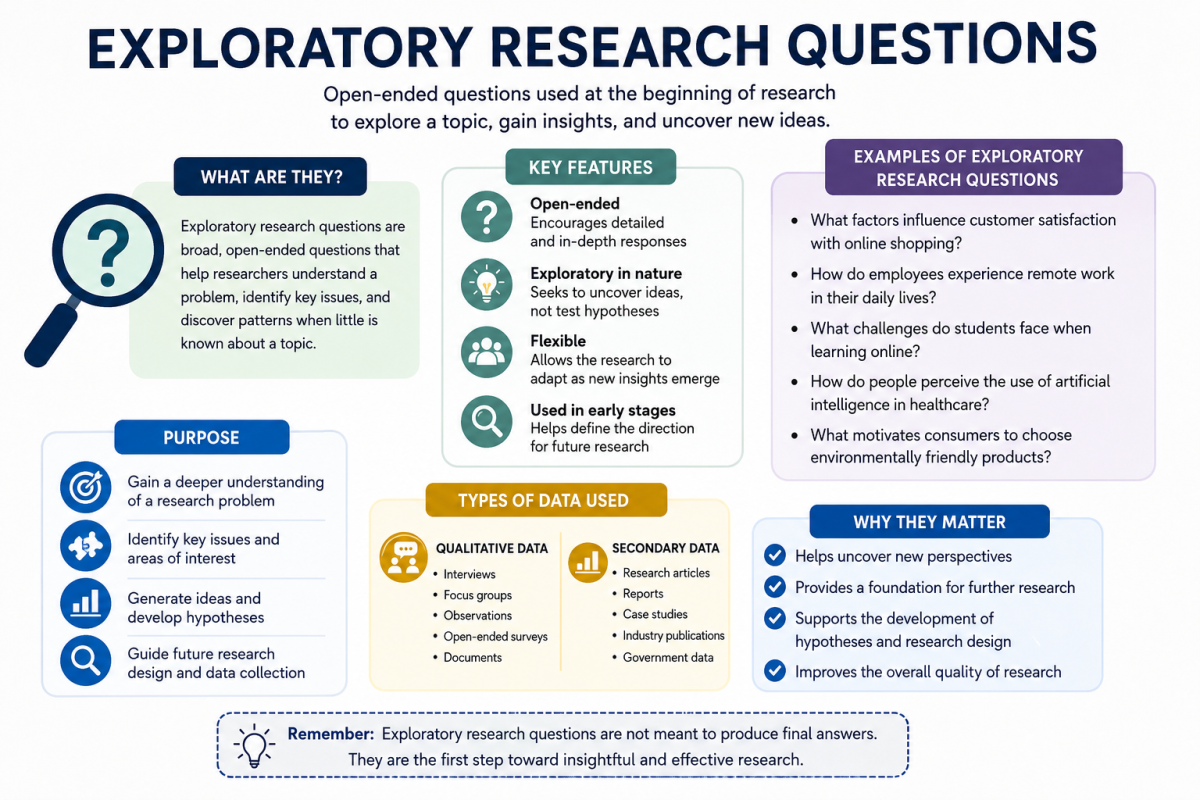
- Exploratory Research Questions are broad, flexible, and open-ended questions designed to investigate a research topic when limited information is available.
- In exploratory research, the main goal is not to confirm a hypothesis but to uncover ideas, identify patterns, and gain a deeper understanding of a research problem.
- Exploratory research questions are often used during the early stages of the research process because researchers may not yet know which variables are most important.
- This type of research is often qualitative in nature and focuses on understanding experiences, opinions, behaviors, and emerging issues.
- Exploratory research is often qualitative because it seeks rich explanations rather than numerical measurements.
- Unlike explanatory research, which attempts to test hypotheses and determine cause-and-effect relationships, exploratory research aims to discover new insights and generate ideas.
- Exploratory research lays the groundwork for future research by providing a foundation for further research and helping researchers refine their research objectives.
- A research question in exploratory studies usually begins with words such as:
- Why
- How
- What
- In what ways
- Because these questions are open-ended questions, participants are free to provide detailed responses instead of selecting predetermined answers.
- Exploratory research questions help researchers:
- Understand unfamiliar topics.
- Refine their research focus.
- Develop hypotheses for later studies.
- Identify gaps in existing research.
- Gain knowledge in the field.
- Improve effective research planning.
- Exploratory research can be used in many disciplines, including:
- Business research.
- Marketing.
- Healthcare.
- Education.
- Psychology.
- Sociology.
- Exploratory research design usually relies on qualitative research methods such as:
- Interviews.
- Focus group discussions.
- Observations.
- Case studies.
- Secondary research.
- Secondary research involves the analysis of:
- Journal articles.
- Books.
- Existing reports.
- Industry publications.
- Government statistics.
- Primary research methods involve collecting fresh information directly from participants.
- Common ways to collect primary data include:
- Interviews.
- Surveys with open-ended questions.
- Focus groups.
- Field observations.
- Exploratory research data may include:
- Written responses.
- Audio recordings.
- Notes from interviews.
- Qualitative data from observations.
- Although exploratory research is often qualitative, some studies may combine qualitative or quantitative methods depending on the research aims.
- Compared with descriptive research, exploratory research focuses more on discovering ideas rather than describing known characteristics.
- Exploratory vs explanatory research highlights how different approaches serve different purposes:
- Exploratory research seeks understanding.
- Explanatory research seeks explanations and relationships.
- Descriptive research focuses on describing characteristics.
- Because exploratory research helps researchers uncover hidden insights, it is frequently the first step in conducting exploratory studies.
How To Write Exploratory Research Questions With Examples: A 4-Step Process for Conducting Exploratory Research
Step 1: Identify the Research Problem
- The first step in conducting exploratory research is identifying a clear research problem.
- Researchers should ask themselves:
- What issue needs investigation?
- What information is currently missing?
- Why is this topic important?
- Reviewing existing research and performing a literature review can help identify gaps in knowledge.
- This stage allows researchers to refine their research topic and establish clear research objectives.
- Example: Research topic: Employee burnout among remote workers. Research problem: Limited understanding of the factors contributing to burnout in remote environments.
Step 2: Choose an Appropriate Research Approach
- Once the research problem is defined, researchers select a suitable research method.
- Exploratory research methods commonly include: Primary research methods
- Interviews.
- Focus group discussions.
- Surveys containing open-ended questions.
- Literature reviews.
- Published reports.
- Existing databases.
- Primary and secondary research methods can be combined to obtain broader insights.
- Researchers must decide whether qualitative or quantitative methods are appropriate.
- Since exploratory research is often qualitative in nature, many studies rely heavily on qualitative data.
- In some cases, exploratory research using mixed approaches may include quantitative data from a survey together with interview findings.
Step 3: Formulate Open-Ended Exploratory Questions
- A strong research question should:
- Be clear.
- Be specific.
- Encourage detailed responses.
- Align with research aims.
- Researchers should formulate exploratory questions that encourage participants to explain their experiences.
- Effective exploratory questions avoid simple yes-or-no answers.
- Examples of open-ended questions include:
- What factors influence employee burnout in remote work settings?
- How do consumers perceive environmentally friendly products?
- Why do students experience anxiety during online learning?
- These questions help identify themes and develop hypotheses for future research.
- Unlike explanatory research questions, exploratory questions do not attempt to test hypotheses immediately.
Step 4: Collect and Analyze Data
- After creating Exploratory Research Questions, researchers begin data collection and analysis.
- Data collection methods may include:
- Interviews.
- Focus groups.
- Observations.
- Surveys.
- Sample size in exploratory studies is often smaller than studies using quantitative research because the focus is depth rather than breadth.
- Researchers conduct data analysis to:
- Identify patterns.
- Discover themes.
- Interpret participant experiences.
- Interpretive research techniques are commonly used when analyzing qualitative data.
- Findings from exploratory research can help researchers:
- Refine their research objectives.
- Develop hypotheses.
- Design future quantitative studies.
- Strengthen insightful research.
- This step in conducting exploratory research creates a strong foundation for further research.
How To Write Exploratory Research Questions With Examples: Exploratory Research Question Examples for Qualitative Research and Data Collection
- Good Exploratory Research Questions are broad enough to encourage discovery while remaining focused on a specific issue.
Business Research
Examples of exploratory research questions:
- What factors influence customer loyalty toward online retailers?
- How do small businesses adapt to economic uncertainty?
- Why do consumers prefer certain brands over competitors?
Education Research
Exploratory research question examples include:
- How do students perceive hybrid learning environments?
- What challenges do teachers encounter when implementing digital instruction?
- Why do some students engage more actively in online classes?
Healthcare Research
Examples:
- How do patients describe their experiences with telemedicine?
- What concerns influence people’s decisions about preventive healthcare?
- How do healthcare workers cope with workplace stress?
Social Media Research
Examples:
- How does social media affect the communication habits of teenagers?
- Why do users trust information shared by influencers?
- What motivates individuals to participate in online communities?
Workplace Research
Examples:
- What factors contribute to employee satisfaction?
- How do leadership styles affect workplace culture?
- Why do employees choose flexible work arrangements?
Consumer Behavior Research
Examples:
- How do purchasing decisions change during economic uncertainty?
- What influences customer perceptions of sustainability?
- Why do consumers adopt new technologies?
Environmental Research
Examples:
- How do communities respond to climate change initiatives?
- What motivates households to reduce energy consumption?
- How do people perceive environmental policies?
- These research question examples demonstrate how Exploratory Research Questions can help identify previously unknown issues.
- Researchers often use exploratory research questions before moving toward explanatory research questions or quantitative research studies.
- Findings from exploratory studies may later be used to test hypotheses using larger sample sizes and quantitative methods.
How To Write Exploratory Research Questions With Examples: Advantages and Disadvantages of Exploratory Research
Advantages of Exploratory Research
1. Provides New Insights
- Exploratory research helps uncover hidden trends and ideas.
- Researchers gain deeper knowledge in the field.
- It helps identify issues that were previously overlooked.
2. Helps Refine Research Objectives
- Researchers can refine their research focus before conducting larger studies.
- Exploratory research can help improve overall research design.
3. Supports Hypothesis Development
- Findings can develop hypotheses for future studies.
- Researchers are better prepared to test hypotheses later.
4. Flexible Research Approach
- Exploratory research design allows adjustments during the research process.
- New directions can emerge as information becomes available.
5. Encourages Rich Data Collection
- Open-ended questions generate detailed qualitative data.
- Participants can express opinions freely.
6. Serves as a Foundation for Further Research
- Exploratory research lays the groundwork for advanced investigations.
- Results support future research and larger quantitative research projects.
Disadvantages of Exploratory Research
1. Limited Generalizability
- Small sample size may prevent findings from representing larger populations.
2. Results Can Be Subjective
- Because exploratory research is often qualitative, interpretations may vary among researchers.
3. Inability to Establish Cause-and-Effect Relationships
- Exploratory studies focus on understanding rather than proving relationships.
4. Findings May Require Additional Research
- Results frequently need confirmation through quantitative methods.
5. Time-Consuming Data Analysis
- Analyzing qualitative data often requires extensive coding and interpretation.
6. Limited Statistical Evidence
- Since research is often qualitative, numerical conclusions may be limited.
Final Thoughts
- Exploratory Research Questions are essential tools for investigating unfamiliar topics and understanding complex issues.
- Exploratory research is conducted to discover ideas, identify patterns, and generate valuable insights.
- Whether researchers use qualitative or quantitative methods, exploratory studies provide a strong starting point for effective research.
- By conducting exploratory research, scholars can refine their research questions, improve research design, and establish a solid foundation for further research.
