
Blog
Types of Mixed Methods Research Designs With Examples

What is Mixed Method Research Design?
- A mixed method research design is a research design that combines qualitative methods and quantitative methods in one study.
- It allows researchers to collect, analyse, and integrate both numerical and non-numerical data to understand a research problem more deeply.
- In simple terms, mixed methods research helps a researcher answer a research question using two methods instead of relying on either qualitative or quantitative research alone.
- Mixed Methods Research Designs are useful when quantitative data can show patterns, trends, or relationships, while qualitative data can explain the meaning behind those patterns.
- For example, a quantitative survey may show that students are dissatisfied with online learning, but qualitative interviews can explain why they feel that way.
- This makes mixed methods research valuable in health sciences, social sciences, education, business, psychology, and health services research.
- A mixed methods approach is especially helpful when the research problem is complex and cannot be fully understood through one research method only.
- In quantitative research, the researcher usually works with numbers, statistics, measurable variables, and structured instruments.
- In qualitative research, the researcher focuses on experiences, opinions, behaviour, meaning, and context through qualitative interviews, in-depth interviews, observations, or focus groups.
- A mixed methods research design brings these two approaches together within the same research process.
- The goal is not simply to collect data from both sides, but to integrate qualitative and quantitative data during data collection and analysis.
- This integration gives the researcher a deeper understanding of the research question.
- According to common research guide explanations and scholars such as Creswell, conducting mixed methods research requires careful planning because the researcher must decide which type of data comes first, how the two types of data will connect, and how the findings will be interpreted together.
- Mixed Methods Research Designs can be basic mixed designs or more advanced mixed methods designs, depending on the purpose of the study.
- For example, some studies begin by collecting quantitative data and are followed by qualitative interviews to explain the quantitative findings.
- Other studies collect qualitative and quantitative data at the same time and compare the results.
- Therefore, mixed methods research is an approach to research that uses the strengths of qualitative and quantitative research methods to produce a more complete understanding of the research problem.
Types of Mixed Methods Research Designs
- There are several types of mixed methods research designs, and each type of design serves a different purpose.
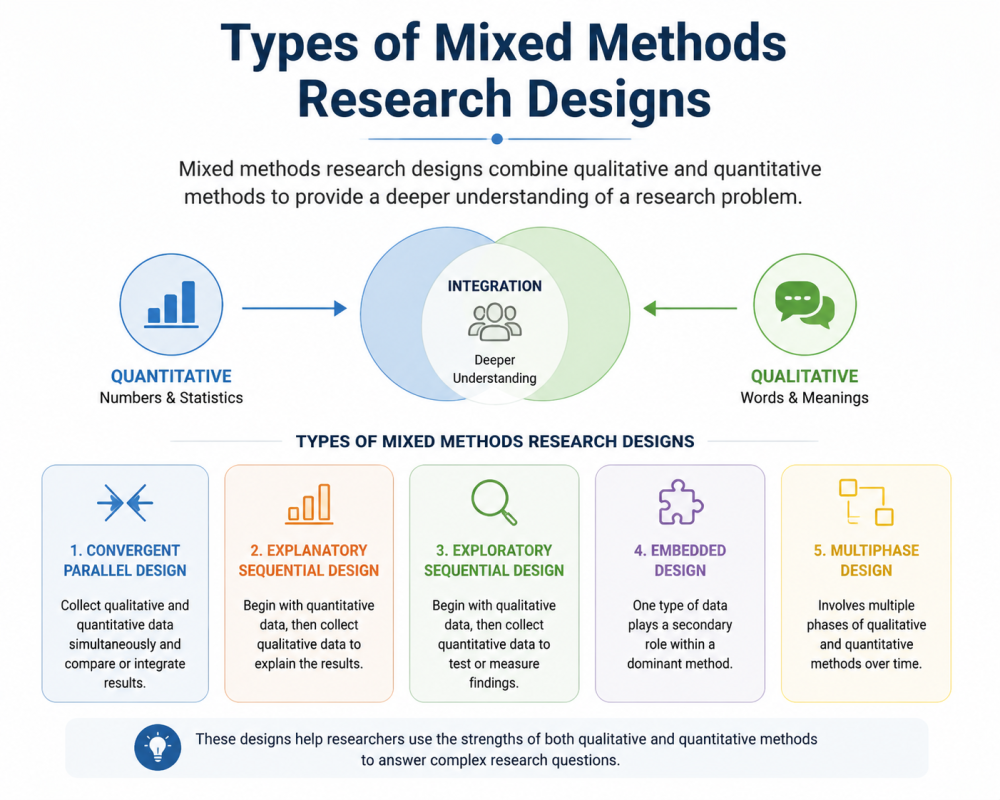
- The most common Mixed Methods Research Designs include convergent parallel design, explanatory sequential design, exploratory sequential design, embedded design, and multiphase design.
1. Convergent Parallel Design
- A convergent parallel design is used when qualitative and quantitative data are collected simultaneously.
- In this mixed methods research design, the researcher gives equal importance to both types of data.
- The researcher may collect quantitative data through a survey and collect qualitative data through interviews or focus groups during the same phase of the study.
- After data collection, the researcher analyses both datasets separately and then compares or integrates the results.
- This design is useful when the researcher wants to confirm, compare, or expand findings from different sources.
- For example, a school of public health may use a convergent parallel design to study patient satisfaction by collecting survey scores and focus group responses at the same time.
- The strength of this design is that it gives a balanced view of the research problem.
- However, it can be challenging because the researcher must manage qualitative data collection and quantitative data collection together.
2. Explanatory Sequential Design
- An explanatory sequential design begins with quantitative data collection and analysis, followed by qualitative data collection and analysis.
- This means the researcher first collects numerical data, analyses the results, and then uses qualitative data to explain the quantitative findings.
- It is especially useful when the researcher wants to understand why certain statistical results occurred.
- For example, a researcher may conduct a quantitative survey on employee burnout and find that nurses report high stress levels.
- The researcher may then conduct qualitative interviews to understand the reasons behind the stress.
- In this design, qualitative data to explain quantitative results is the main purpose.
- Explanatory sequential design is common in health sciences, education, business research, and social sciences.
- This is one of the most widely used Mixed Methods Research Designs because it creates a clear flow from numbers to explanations.
3. Exploratory Sequential Design
- An exploratory sequential design begins with qualitative data collection and analysis, followed by quantitative data collection and analysis.
- This design is useful when the researcher does not yet fully understand the research problem.
- The researcher may begin with in-depth interviews or focus groups to explore participants’ experiences.
- After identifying themes, the researcher may create a quantitative survey to test those themes with a larger group.
- For example, a researcher studying patient trust in telehealth may first interview patients and then design a survey based on the themes found.
- A study that used an exploratory sequential design may be helpful when there is limited existing research on a topic.
- Exploratory mixed methods designs are often used in new or under-researched areas.
- This type of mixed method research is useful for developing instruments, building theories, or understanding complex research issues.
4. Embedded Mixed Methods Design
- An embedded design is used when one research method supports another main research method.
- In this design, either qualitative or quantitative data plays a secondary role.
- For example, a researcher may conduct a clinical trial using quantitative data as the main method but include qualitative interviews to understand participants’ experiences.
- This design is useful when the researcher needs additional information without making both methods equal.
- Embedded designs are common in methods research in the health sciences because clinical studies often need both outcome data and patient experience data.
- This design helps researchers understand both the effectiveness of an intervention and how participants experienced the intervention.
5. Multiphase Mixed Methods Design
- A multiphase design includes several connected phases of qualitative and quantitative research.
- It is often used in large research programmes, policy studies, public health projects, and long-term evaluations.
- For example, researchers may begin with qualitative interviews, develop a survey, test an intervention, and later conduct follow-up focus groups.
- This design is useful when the research process happens over time and includes several stages.
- Multiphase Mixed Methods Research Designs are powerful but require strong planning, time, funding, and research training.
Philosophical Assumptions of Types of Mixed Methods Research Designs
- The philosophical assumptions behind Mixed Methods Research Designs explain how researchers think about knowledge, reality, evidence, and the role of the researcher.
- Mixed methods research is often linked to pragmatism because pragmatism focuses on solving the research problem using the most useful methods.
- In a pragmatic approach, the researcher is not limited to either quantitative or qualitative research.
- Instead, the researcher chooses the method research strategy that best answers the research question.
- This makes mixed methods approach flexible and practical.
- Another important idea is that different research paradigms can work together.
- Quantitative research is often linked to postpositivist assumptions because it focuses on measurement, objectivity, variables, and statistical evidence.
- Qualitative research is often linked to constructivist assumptions because it focuses on meaning, context, experience, and participant perspectives.
- Mixed Methods Research Designs allow researchers to combine these assumptions carefully.
- The researcher may believe that quantitative data can show the size or strength of a problem, while qualitative findings can explain how people experience that problem.
- In social sciences and health sciences, this is useful because human problems are rarely simple.
- For example, a quantitative or qualitative research method alone may not fully explain why patients avoid preventive screening.
- Quantitative data may show low screening rates, while qualitative interviews may reveal fear, cost, stigma, or lack of information.
- Researchers also need to consider how participants in the research process are represented.
- Qualitative methods can give participants a voice, while quantitative methods can show how widespread certain patterns are.
- This balance is one reason designing and conducting mixed methods research is respected in many academic settings, including the Journal of Mixed Methods Research, SAGE Publications resources, the National Institutes of Health, and the University of Michigan Mixed Methods Program.
- Overall, philosophical assumptions help the researcher decide how to collect data, integrate findings, and explain the final understanding of the research problem.
How To Conduct Types of Mixed Methods Research Designs In 4 Easy Steps
Step 1: Define the Research Problem and Research Question
- Start by identifying a clear research problem that needs both qualitative and quantitative data.
- A good mixed methods research question should show why one research method alone is not enough.
- For example, instead of asking only, “How many students use online learning?” the researcher may ask, “How many students use online learning, and how do they describe their learning experience?”
- This question needs both numerical and non-numerical data.
- At this stage, the researcher should decide whether the study needs a sequential design, exploratory design, explanatory design, or convergent design.
- This step gives direction to the whole research methodology.
Step 2: Choose the Best Mixed Methods Research Design
- The next step is choosing the best design for the study.
- Choose a convergent parallel design when data are collected simultaneously and the researcher wants to compare qualitative and quantitative findings.
- Choose an explanatory sequential design when the study should begin by collecting quantitative data and then be followed by qualitative interviews.
- Choose an exploratory sequential design when the study should begin with qualitative findings and then use quantitative data collection to test or measure those findings.
- Choose an embedded design when one method supports the main method.
- Choose a multiphase design when the research process has several connected stages.
- Choosing the right type of design helps the researcher avoid confusion during data collection and analysis.
Step 3: Collect and Analyse the Data
- After selecting the design, the researcher should plan both qualitative data collection and quantitative data collection.
- Quantitative data collection may include surveys, tests, questionnaires, experiments, or existing numerical records.
- Qualitative data collection may include interviews, focus groups, observations, open-ended questions, or document analysis.
- The researcher must decide when to collect data, who will participate, and how the data will be managed.
- In some mixed methods studies, qualitative and quantitative data are collected at the same time.
- In other studies, one type of data is collected first and the second type is collected later.
- Quantitative data collection and analysis may involve statistics, percentages, averages, correlations, or regression.
- Qualitative data collection and analysis may involve coding, themes, patterns, and interpretation.
Step 4: Integrate the Findings and Present the Results
- The final step is integration.
- Integration means bringing the qualitative and quantitative data together to answer the research question.
- The researcher may compare the findings, explain one set of findings with another, or combine both findings into one final interpretation.
- For example, if a survey shows that patients are dissatisfied with waiting times, interviews or focus groups may explain that poor communication makes the waiting feel worse.
- Good mixed methods research does not present two separate studies without connection.
- Instead, it shows how the two types of data work together.
- This is the key to conducting mixed methods research successfully.
What are the Advantages and Disadvantages of Types of Mixed Methods Research Designs?
Advantages
- Mixed Methods Research Designs provide a deeper understanding.
They help researchers understand both the size of a problem and the reasons behind it. - They combine the strengths of qualitative and quantitative methods.
Quantitative research gives measurable evidence, while qualitative research gives detailed explanations. - They help answer complex research questions.
Some research problems in health sciences, social sciences, education, and business are too complex for one method. - They improve the quality of interpretation.
When quantitative findings and qualitative findings support each other, the results become more convincing. - They help explain unexpected results.
If a survey result is surprising, qualitative interviews can help explain why it happened. - They support better decision-making.
In health services research, mixed methods research can help leaders understand both patient outcomes and patient experiences. - They make research more practical.
A mixed methods approach allows researchers to use the best tools for the research problem instead of forcing the study into one method. - They are useful for developing surveys and interventions.
Exploratory sequential designs can help researchers use qualitative findings to create better quantitative instruments.
Disadvantages
- Mixed Methods Research Designs can take more time.
The researcher must plan, collect, analyse, and integrate two types of data. - They can be more expensive.
Conducting interviews, focus groups, surveys, and statistical analysis may require more resources. - They require stronger research training.
A researcher needs skills in both quantitative and qualitative research methods. - Data integration can be difficult.
It is not always easy to combine numerical and non-numerical data into one clear interpretation. - The research design can become too broad.
If the researcher does not narrow the research question, the study may become confusing. - Different findings may conflict.
Quantitative findings may show one result, while qualitative findings may suggest another explanation. - Participants may become tired.
In some mixed methods studies, participants may complete surveys and also take part in interviews or focus groups. - Writing the final report can be challenging.
The researcher must explain the quantitative data, qualitative data, integration process, and final conclusions clearly. - Even with these challenges, Mixed Methods Research Designs remain useful because they offer a complete and balanced approach to research.
Examples of Types of Mixed Methods Research Designs
Example 1: Explanatory Sequential Design in Health Sciences
- A researcher wants to study why patients miss follow-up appointments after hospital discharge.
- The study begins with quantitative data from hospital records and appointment attendance rates.
- The researcher identifies that younger patients miss appointments more often.
- The study is then followed by qualitative interviews with patients.
- The interviews show that transportation problems, work schedules, and unclear discharge instructions affect attendance.
- This design helps the researcher explain the quantitative findings using qualitative data.
Example 2: Exploratory Sequential Design in Education
- A researcher wants to understand why first-year university students struggle with academic writing.
- The researcher begins with focus groups and in-depth interviews.
- Students explain that they struggle with referencing, research structure, and feedback interpretation.
- The researcher then creates a quantitative survey based on these themes.
- The survey is distributed to a larger student population.
- This exploratory sequential design helps the researcher move from qualitative findings to quantitative measurement.
Example 3: Convergent Parallel Design in Social Sciences
- A researcher wants to understand community attitudes toward public safety.
- The researcher collects survey data and interview data during the same period.
- The quantitative survey measures levels of trust in local safety programmes.
- The qualitative interviews explain why some residents trust the programmes and others do not.
- Since data are collected simultaneously, the researcher compares the results during analysis.
- This type of design gives a complete overview of mixed methods research in a community setting.
Example 4: Embedded Design in Health Services Research
- A researcher tests a new patient education programme.
- The main study uses quantitative data collection and analysis to measure patient knowledge before and after the programme.
- The researcher also conducts qualitative interviews with a smaller group of patients.
- The interviews explain how patients experienced the education programme.
- This embedded design allows qualitative data to support the main quantitative research method.
Example 5: Multiphase Design in Public Health
- A school of public health wants to design and test a community nutrition programme.
- Researchers first collect qualitative data from community members.
- They then use the findings to create a quantitative survey.
- After that, they design an intervention and evaluate its outcomes.
- Finally, they conduct interviews or focus groups to understand participant experiences.
- This example shows how Mixed Methods Research Designs can support long-term research in the health sciences.
Conclusion
- Mixed Methods Research Designs help researchers combine qualitative and quantitative data in a clear and useful way.
- They are valuable because they connect numbers with human experiences.
- Whether a researcher uses exploratory sequential, explanatory sequential, convergent parallel, embedded, or multiphase designs, the main goal is to integrate the findings.
- When used correctly, mixed methods research gives a stronger understanding of the research problem and supports better academic, professional, and practical decisions.
