
Blog
How To Conduct Convergent Parallel Design with Examples

What is Convergent Parallel Design in Mixed Method Research?
- Convergent Parallel Design is a mixed methods research design where researchers collect quantitative and qualitative data during the same phase of the research process.
- This means that the researcher does not collect one type of data first and then use it to guide the next stage, as seen in explanatory sequential design or exploratory sequential design.
- Instead, Convergent Parallel Design involves the simultaneous collection of different but complementary data. The aim is to understand the same research topic from more than one angle.
- In this research approach, quantitative data and qualitative data are given equal or near-equal importance.
- Quantitative research helps the researcher measure patterns, relationships, frequencies, scores, or trends.
- Qualitative research helps the researcher understand meanings, experiences, opinions, behaviours, and explanations behind the numbers.
- For example, a researcher studying student satisfaction may collect survey responses using closed-ended questions and also conduct interviews and surveys with study participants.
- The quantitative findings may show that 70% of students are satisfied with online learning.
- The qualitative results may explain why students feel satisfied, such as flexible learning time, easier access to materials, or better communication with teachers.
- The main purpose of Convergent Parallel Design is triangulation. Triangulation means comparing different types of data to see whether they support, expand, or contradict each other.
- This design is useful when one research method alone cannot fully answer the research questions.
- For instance, quantitative methods may show that a health programme improved patient outcomes, but qualitative data collection may explain how patients experienced the programme.
- In mixed methods research, this design is often used when researchers want to evaluate complex research problems.
- It is especially useful in education, healthcare, business, psychology, social science, action research, and programme evaluation.
- Unlike sequential mixed methods designs, Convergent Parallel Design collects both quantitative and qualitative data at the same time.
- The two data sets are usually analyzed separately first.
- After analyzing the data, the researchers compare and integrate the study results.
- This integration helps the research team produce a stronger and more complete interpretation.
- In simple terms, Convergent Parallel Design allows researchers to answer one major question using both numbers and real-life explanations.
- It is one of the most common types of mixed methods research because it is practical, balanced, and strong for comparing qualitative and quantitative data.
Philosophical Assumptions of The Convergent Parallel Design
- Convergent Parallel Design is usually connected to pragmatism.
- Pragmatism is a philosophical view that focuses on what works best for answering the research questions.
- Instead of arguing whether quantitative research or qualitative research is better, pragmatism allows the researcher to use both.
- This is important because mixed methods research accepts that social, educational, health, and business problems are often too complex for one method alone.
- The pragmatic assumption is that both numerical evidence and personal experiences can provide valid knowledge.
- For example, quantitative data may show how many people support a policy, while qualitative data may explain why they support or reject it.
- This makes Convergent Parallel Design flexible and practical.
- Another philosophical assumption is that reality can be understood in multiple ways.
- Quantitative methods often assume that reality can be measured through numbers, variables, and statistical analysis.
- Qualitative methods often assume that reality is shaped by people’s experiences, meanings, and social contexts.
- In a convergent parallel research design, both views are respected.
- The researcher does not treat one type of evidence as automatically superior.
- Instead, the researcher uses qualitative and quantitative methods to build a fuller picture of the research topic.
- Another assumption is that data collection and analysis should be systematic.
- This means that both quantitative data collection and qualitative data collection must be planned carefully.
- The research team must decide what types of data are needed, who the study participants will be, what data collection method will be used, and how the findings will be integrated.
- Research ethics are also important in this design.
- Since the researcher may collect different forms of information from the same participants, informed consent must be clear.
- Participants should understand whether they are answering surveys, joining focus groups, taking part in interviews, or being observed in an observational study.
- Confidentiality should also be protected during qualitative and quantitative data collection.
- Another key assumption is that integration is central to mixed methods research design.
- The researcher should not simply report quantitative findings in one section and qualitative results in another without connecting them.
- The real value of Convergent Parallel Design comes when researchers integrate the two data sets.
- This integration can confirm findings, explain differences, or reveal new insights.
- For example, if quantitative data shows low employee satisfaction but qualitative results show strong loyalty to the company, the researcher must evaluate why the two findings appear different.
- This process reduces research bias because one source of data can balance the limitations of another.
- Therefore, the philosophical foundation of Convergent Parallel Design supports openness, balance, practical problem-solving, and the use of both qualitative and quantitative data.
How To Conduct a Convergent Parallel Design In 4 Easy Steps
- Step 1: Define the research problem and research questions clearly.
- The first step in Convergent Parallel Design is to identify a research topic that needs both quantitative and qualitative evidence.
- The topic should be broad enough to require more than one type of data, but focused enough to be studied clearly.
- Good research questions should allow the researcher to collect quantitative and qualitative data about the same issue.
- For example, instead of asking only, “How many patients are satisfied with telehealth services?” the researcher may ask, “What is the level of patient satisfaction with telehealth services, and how do patients describe their experiences?”
- This question allows the researcher to collect quantitative data through surveys and qualitative data through interviews or focus groups.
- The research team should also decide whether both forms of data will have equal weight.
- In most parallel designs, both types of data are equally important.
- The researcher should also identify the population, sample, setting, and purpose of the study.
- At this stage, the researcher should review previous studies, including any systematic review related to the topic, to understand what is already known.
- Step 2: Plan and conduct data collection simultaneously.
- The second step is data collection.
- Convergent Parallel Design involves the simultaneous collection of quantitative and qualitative data.
- This means that the researcher collects data simultaneously instead of waiting for one phase to finish before starting another.
- Quantitative data collection may include closed-ended questionnaires, tests, rating scales, experiments, service records, or numerical observations.
- Qualitative data collection may include interviews, focus groups, open-ended survey questions, field notes, document review, or participant observation.
- The data collection method should match the research questions.
- For example, if the study is about employee burnout, quantitative data collection can measure stress levels using a survey scale.
- At the same time, qualitative data collection and analysis can explore how employees describe workload, leadership support, and workplace pressure.
- Collecting both quantitative and qualitative data at the same time saves time compared to sequential designs.
- However, it also requires careful planning because the researcher may need different tools, timelines, and analysis methods.
- The research team must also make sure that the participants understand the full research process.
- This is especially important when the same study participants are involved in both parts of the study.
- Step 3: Analyze the quantitative and qualitative data separately.
- The third step is analyzing the data.
- In Convergent Parallel Design, the two data sets are usually analyzed separately before integration.
- Quantitative data collection and analysis may involve descriptive statistics, percentages, averages, correlations, regression, or comparison of groups.
- Qualitative data collection and analysis may involve coding, categorising responses, and identifying thematic patterns.
- Thematic analysis is useful because it helps the researcher find repeated ideas, meanings, and experiences in the qualitative data.
- For example, survey responses may show that 60% of teachers feel overwhelmed by digital teaching tools.
- The qualitative results may reveal themes such as lack of training, poor internet access, increased workload, and limited technical support.
- Keeping the data sets separate at first helps protect the quality of each research method.
- The researcher should avoid forcing qualitative findings to match the numbers too early.
- Each data set should be analyzed using the correct analysis methods.
- This strengthens the credibility of the study results.
- Step 4: Compare, integrate, and interpret the findings.
- The final step is integration.
- This is where researchers compare the quantitative findings and qualitative results.
- They look for areas where the findings agree, disagree, or add to each other.
- If the findings agree, the researcher can say that the results support each other.
- If the findings disagree, the researcher should explain the possible reason.
- If one data set adds new insight to the other, the researcher should show how the findings expand understanding.
- Researchers to integrate findings may use joint displays, comparison tables, side-by-side discussion, data transformation, or narrative integration.
- Data transformation can involve turning qualitative themes into counts or changing quantitative results into categories for comparison.
- For example, interview themes may be counted to show how many participants mentioned each issue.
- The analysis of both quantitative and qualitative data helps the researcher answer the research questions more fully.
- The final report should clearly show how the mixed methods research design improved the study.
- A strong Convergent Parallel Design report does not simply place two results beside each other.
- It explains what the combined findings mean.
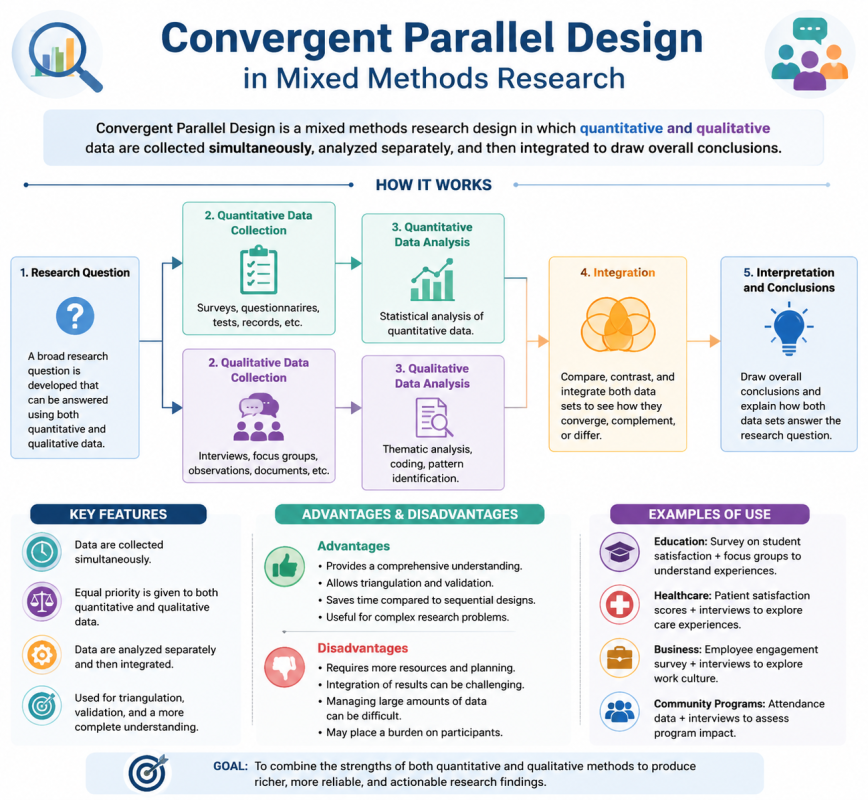
What are the Advantages and Disadvantages of Convergent Parallel Design in Mixed Method Research?
- One major advantage of Convergent Parallel Design is that it gives a complete understanding of the research topic.
- Quantitative data can show patterns, trends, and relationships.
- Qualitative data can explain feelings, experiences, and meanings behind those patterns.
- This makes the design useful for complex research where one research method may not be enough.
- For example, in healthcare research, quantitative findings can show that patients missed appointments.
- Qualitative results can explain that patients missed appointments because of transport problems, cost, fear, or poor communication.
- Another advantage is triangulation.
- Triangulation helps researchers compare qualitative and quantitative data to improve confidence in the findings.
- If both types of data point to the same conclusion, the study results become stronger.
- If the findings are different, the researcher gains a chance to discover deeper issues.
- This makes Convergent Parallel Design valuable in mixed methods research.
- Another advantage is that data collection can be faster than sequential designs.
- In explanatory sequential design, the researcher collects quantitative data first and then follows up with qualitative data.
- In exploratory sequential design, the researcher collects qualitative data first and then builds quantitative tools later.
- In Convergent Parallel Design, both forms of data are collected during the same period.
- This saves time in the research process.
- It is useful when researchers have limited time but still need both qualitative and quantitative methods.
- Another advantage is that it supports balanced evidence.
- The researcher does not depend only on statistics or only on personal stories.
- This balance can reduce research bias.
- Numbers can prevent the researcher from relying too much on a few personal opinions.
- Personal explanations can prevent the researcher from misinterpreting numbers.
- Another advantage is that it works well with many types of mixed methods research.
- It can be used in education studies, business research, nursing studies, public health, social science, community studies, and action research.
- It can also be used in an observational study where researchers compare measured behaviour with participant explanations.
- Another advantage is that it helps evaluate programmes and interventions.
- For example, a school may use this design to evaluate a new reading programme.
- Test scores can provide quantitative data.
- Teacher interviews and student focus groups can provide qualitative data.
- The school can then compare both types of data to understand whether the programme worked and why.
- However, Convergent Parallel Design also has disadvantages.
- One disadvantage is that it can be difficult to manage.
- The research team must plan quantitative and qualitative data collection at the same time.
- This may require more time, money, training, and coordination.
- The researcher may need skills in both quantitative research and qualitative research.
- If the researcher is weak in one area, the study may become unbalanced.
- Another disadvantage is that integration can be challenging.
- Sometimes quantitative findings and qualitative results do not match.
- For example, survey responses may show that most employees are satisfied, but interviews may reveal frustration and stress.
- The researcher must then explain why the data sets are different.
- This requires careful thinking and strong analysis methods.
- Another disadvantage is that the design can create too much data.
- Collecting and analyzing both forms of data can be demanding.
- The researcher may collect many survey responses, interview transcripts, focus group notes, and observation records.
- Without proper organisation, the research process can become confusing.
- Another disadvantage is that unequal data quality can weaken the study.
- If the quantitative data is strong but the qualitative data is weak, the final interpretation may be limited.
- If the qualitative data is rich but the quantitative data is poorly designed, the study may not answer the research questions well.
- This is why careful planning is important.
- Another disadvantage is participant burden.
- Study participants may be asked to complete surveys and also take part in interviews or focus groups.
- If the process is too long, participants may lose interest or provide rushed answers.
- Research ethics require the researcher to respect participants’ time, privacy, and comfort.
- Another disadvantage is that reporting the findings can be difficult.
- The researcher must explain quantitative data collection and analysis, qualitative data collection and analysis, integration, and interpretation.
- This can make the final report longer and more complex.
- Still, when conducted properly, Convergent Parallel Design is one of the strongest mixed methods designs for studying real-world problems.
Examples of Convergent Parallel Design
- Example 1: Education research
- A researcher may study the effectiveness of online learning among university students.
- The quantitative data collection method may involve a closed-ended survey measuring satisfaction, engagement, grades, and attendance.
- At the same time, the researcher may collect qualitative data through focus groups with students.
- The quantitative findings may show that students have high satisfaction but lower participation.
- The qualitative results may explain that students like the flexibility of online learning but struggle with motivation, distractions, and internet access.
- By using Convergent Parallel Design, the researcher can understand both the level of satisfaction and the reasons behind student behaviour.
- This gives a stronger result than using only one research method.
- Example 2: Healthcare research
- A hospital may evaluate patient experiences with a new appointment booking system.
- Quantitative data may be collected through survey responses about waiting time, ease of booking, and satisfaction scores.
- Qualitative data may be collected through interviews with patients and staff.
- The numbers may show that waiting time reduced by 30%.
- However, interviews may show that older patients still find the digital system difficult to use.
- The analysis of both quantitative and qualitative data helps the hospital improve the system.
- This example shows how Convergent Parallel Design can support practical decision-making.
- Example 3: Business research
- A company may evaluate employee satisfaction after introducing hybrid work.
- The research team may collect quantitative data using rating scales on productivity, communication, stress, and job satisfaction.
- At the same time, qualitative data collection may involve focus groups with employees from different departments.
- The quantitative findings may show that productivity increased.
- The qualitative results may show that some employees feel isolated or disconnected from the team.
- Through triangulation, the company can understand both the benefits and hidden challenges of hybrid work.
- This makes the mixed methods research design useful for leadership and human resource planning.
- Example 4: Community action research
- A community organisation may use Convergent Parallel Design to evaluate a youth mentorship programme.
- Quantitative methods may measure attendance, school performance, and behaviour reports.
- Qualitative and quantitative data collection may also include interviews with mentors, parents, and young people.
- The quantitative data may show improved attendance.
- The qualitative data may explain that young people feel more supported, confident, and motivated.
- This helps the organisation evaluate whether the programme is working and how it can be improved.
- Example 5: Public health research
- A public health researcher may study why people do or do not attend health screening.
- Quantitative data collection may include a survey with closed-ended questions about age, income, education, health knowledge, and screening history.
- Qualitative data collection may include interviews and surveys with community members.
- The survey may show that people with higher health knowledge attend screening more often.
- The interviews may reveal barriers such as fear, transport costs, cultural beliefs, or lack of trust.
- By collecting both quantitative and qualitative data, the researcher can design better health campaigns.
- Example 6: Workplace observational study
- A researcher may conduct an observational study on workplace safety.
- Quantitative data may include accident records, safety checklist scores, and training completion rates.
- Qualitative data may include worker interviews about safety culture and management support.
- The quantitative findings may show fewer accidents after training.
- The qualitative results may show that workers still feel unsafe because managers do not always enforce safety rules.
- This example shows why Convergent Parallel Design is useful in complex research.
- The design allows researchers to integrate different but complementary data and produce more useful conclusions.
- Overall, Convergent Parallel Design helps researchers collect, compare, and integrate qualitative and quantitative data in a clear and balanced way.
- It is one of the most practical types of mixed methods research because it supports strong evidence, deeper explanation, and better decision-making.
