
Blog
How To Conduct Transformative Mixed Methods Research Design

What is Transformative Mixed Methods in Mixed Method Research?
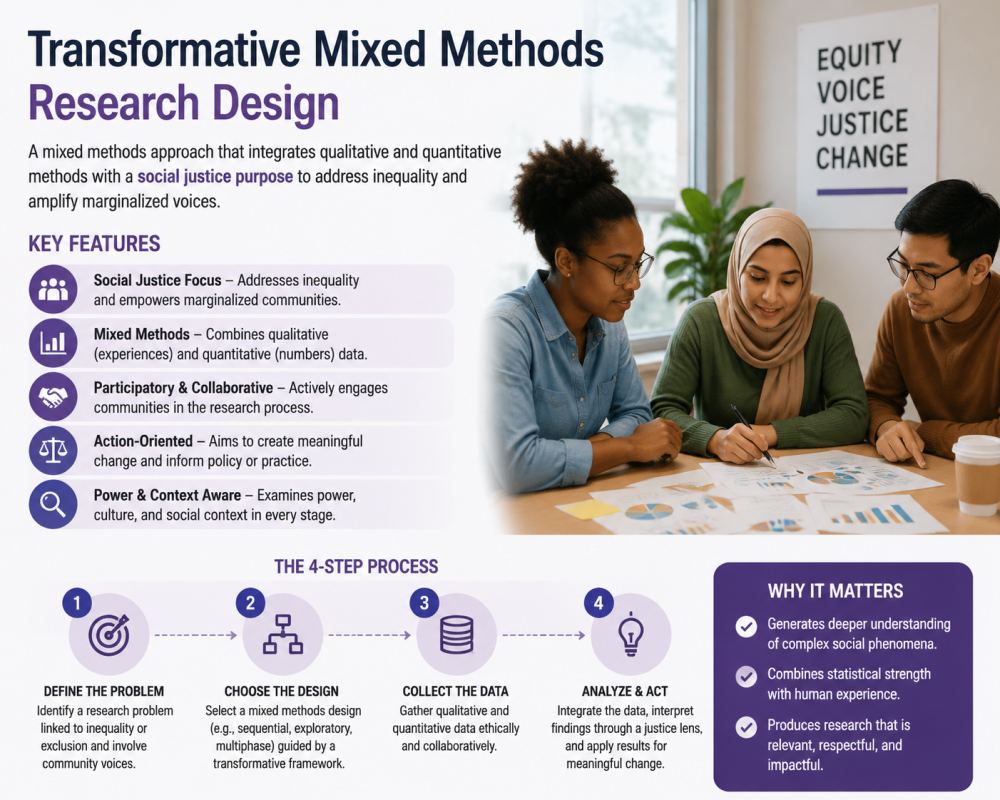
- Transformative Mixed Methods is a mixed method research design that combines qualitative and quantitative methods while being guided by a clear social justice purpose.
- Unlike a basic mixed methods design that may only focus on collecting and comparing qualitative and quantitative data, Transformative Mixed Methods places the needs, voices, and lived experiences of marginalized communities at the centre of the research process.
- In mixed methods research, the researcher uses multiple methods to understand a research problem more fully. This may include interviews, surveys, focus groups, observations, document reviews, or statistical data analysis.
- The transformative mixed methods approach goes further by asking an important question:
How can this research help address inequality, exclusion, discrimination, or unfair treatment? - This means the research question is not only academic. It is also action-oriented. The study design should help produce research findings that can support change, improve services, influence policy, or empower underrepresented groups.
- A Transformative Mixed Methods study often includes both qualitative data and quantitative data. For example, a researcher may first conduct qualitative inquiry through interviews with marginalized groups, then use those findings to design a survey for wider quantitative data collection.
- In another case, the researcher may begin with quantitative data collection and analysis to identify patterns of inequality, then follow up with qualitative data collection and analysis to understand the personal experiences behind those patterns.
- The key feature of this research methodology is the use of a transformative framework. This framework helps the researcher examine power, privilege, culture, voice, access, and social justice issues throughout the design and implementation of the study.
- Scholars such as Mertens, Creswell, and Plano Clark are commonly associated with discussions about transformative mixed methods research designs. Their work highlights how mixed methods research can be used to study complex social phenomena while actively engaging research participants.
- Therefore, Transformative Mixed Methods is not just about combining numbers and stories. It is about using qualitative and quantitative evidence to understand a problem and support fairer outcomes.
- This makes the transformative mixed methods design especially useful in educational research, health research, community development, disability studies, gender studies, public policy, and other social science fields where inequality and marginalized voices matter.
Philosophical Assumptions of The Transformative Mixed Methods Research Design
- Transformative Mixed Methods is based on the transformative paradigm. This paradigm argues that research should not be neutral when people are affected by injustice, exclusion, or unequal power relations.
- The transformative paradigm assumes that knowledge is shaped by social, cultural, historical, political, and economic conditions. This means that research findings cannot be separated from the realities of the people being studied.
- One important assumption is that power and knowledge are connected. Researchers must ask who controls the research process, whose voices are heard, and whose experiences are ignored.
- In this type of mixed methods study, the researcher does not treat participants as passive sources of information. Instead, research participants may be actively involved in shaping the research question, reviewing tools, interpreting data, or applying the findings.
- The transformative framework also assumes that marginalized communities often have valuable knowledge that is missing from traditional research. This is why participatory research and collaborative research are important in this approach.
- Another assumption is that research should be culturally responsive. The role of cultural values, language, history, identity, and community norms must be considered during data collection and analysis.
- For example, a researcher working directly with the community should build trust with participants before collecting sensitive information. Trust is important because some participants may have experienced discrimination, exploitation, or exclusion in previous human research.
- Transformative Mixed Methods also assumes that both qualitative and quantitative methods have value. Quantitative data can show the size, frequency, or pattern of a problem. Qualitative data can explain meaning, context, emotion, and lived experience.
- This makes the mixed methods approach useful because it brings together broad evidence and deep personal insight. The qualitative and quantitative parts support each other rather than compete.
- The transformative approach also accepts that research should lead to action. This does not mean the researcher must become biased. It means the researcher should be clear about the ethical purpose of the study and how the findings may help address social justice issues.
- Creswell and Plano Clark describe mixed methods research as a way of integrating qualitative and quantitative data to produce stronger understanding. In a transformative mixed methods design, this integration is guided by values such as fairness, inclusion, empowerment, and respect.
- Mertens also emphasizes that the transformative paradigm is useful when research involves marginalized groups because it encourages researchers to examine inequality and create more inclusive research activities.
- Therefore, the philosophical assumptions of Transformative Mixed Methods focus on justice, participation, culture, power, and meaningful change.
How To Conduct Transformative Mixed Methods Research Design In 4 Easy Steps
- Step 1: Identify a research problem connected to inequality or exclusion
- Start by choosing a research problem that affects marginalized communities, underrepresented groups, or people whose voices are often ignored.
- The problem should be clear, specific, and connected to real social conditions. For example, a researcher may study why students with disabilities experience lower access to digital learning tools.
- A good research question should show both the academic and social purpose of the study. It should not only ask what is happening, but also why it matters and how the findings can support improvement.
- In Transformative Mixed Methods, the researcher should consider the community’s needs before deciding the final study design.
- This may involve a mixed methods needs assessment, early consultation with stakeholders, or discussions with community representatives.
- At this stage, the researcher should ask:
- Who is affected by the problem?
- Which voices are often missing?
- What forms of inequality are present?
- What change could the research support?
- Step 2: Choose the most suitable mixed methods design
- After defining the research problem, select a mixed methods design that fits the purpose of the study.
- A sequential design may be useful when one phase needs to inform the next phase. For example, qualitative data may be collected first through interviews, then used to develop a quantitative survey.
- This is similar to an exploratory sequential design because the researcher explores lived experiences first, then measures the issue more broadly.
- In other cases, quantitative data collection may happen first to identify patterns. The researcher may then conduct interviews to explain the numbers.
- A multiphase design may be useful when the study has several connected stages, such as needs assessment, intervention design, implementation, and evaluation.
- The selected research design should clearly explain how qualitative and quantitative data will be collected, connected, and interpreted.
- In a transformative mixed methods study, the transformative framework must guide the entire design and implementation, not only the introduction section.
- Step 3: Collect qualitative and quantitative data ethically
- Data collection should be respectful, inclusive, and culturally appropriate.
- Qualitative data collection may include interviews, focus groups, storytelling, participant observation, or open-ended questionnaire responses.
- Quantitative data collection may include surveys, tests, records, rating scales, demographic data, or statistical indicators.
- The researcher should make sure that research participants understand the purpose of the study and how their information will be used.
- Since Transformative Mixed Methods often involves marginalized groups, the researcher must pay close attention to informed consent, confidentiality, language access, accessibility, and emotional safety.
- The researcher should also avoid extractive research. This means the study should not only take information from the community without giving anything useful back.
- Working directly with the community can improve trust, increase participation, and make the data more meaningful.
- Step 4: Integrate data analysis with action-oriented findings
- Data analysis should bring qualitative and quantitative findings together.
- Quantitative data analysis may show patterns, differences, relationships, or trends. For example, it may show that students from low-income backgrounds have less access to learning technology.
- Qualitative data analysis may explain the reasons behind the numbers. For example, interviews may reveal issues such as lack of internet access, language barriers, poor school support, or family financial pressure.
- The researcher should compare, connect, or merge the findings depending on the selected mixed methods approach.
- In Transformative Mixed Methods, the final interpretation should include an analysis of power, inequality, culture, and social context.
- The research findings should be written in a way that is useful for the community, policymakers, educators, health workers, or service providers.
- The final report should explain practical recommendations. These may include policy changes, programme improvements, training needs, funding priorities, or community-led solutions.
- The goal is not only to complete a research study. The goal is to produce knowledge that can support fair and meaningful change.
What are the Advantages and Disadvantages of Transformative Mixed Methods in Mixed Method Research?
- Advantage: It gives voice to marginalized communities
- One major strength of Transformative Mixed Methods is that it places marginalized voices at the centre of the research process.
- Instead of studying people from a distance, the researcher can actively engage participants and include their views in the design, data collection, data analysis, and interpretation.
- This makes the research more respectful and relevant.
- Advantage: It combines strong evidence with lived experience
- Quantitative data helps show the size or scale of a problem.
- Qualitative data helps explain how people experience that problem in real life.
- When qualitative and quantitative methods are combined, the researcher can produce stronger and more complete research findings.
- Advantage: It supports social justice and practical change
- Transformative Mixed Methods is useful when the aim is to address social justice issues.
- The findings can help improve policies, services, educational systems, healthcare access, or community programmes.
- This makes the research more action-oriented than many traditional research designs.
- Advantage: It improves cultural understanding
- The transformative mixed methods approach encourages the researcher to consider culture, language, identity, history, and local experience.
- This is especially important in human research involving communities that have been underrepresented or misunderstood.
- Advantage: It encourages collaboration
- Participatory research and collaborative research can improve trust with participants.
- Community involvement can also help the researcher ask better questions, use better tools, and interpret findings more accurately.
- Advantage: It is flexible
- This design can be used with sequential design, exploratory design, multiphase design, or other mixed methods research designs.
- Because of this flexibility, researchers can adapt the study design to the needs of the research problem and the community.
- Disadvantage: It can be time-consuming
- Transformative Mixed Methods often requires more time than a qualitative study or a purely quantitative study.
- The researcher may need to consult stakeholders, collect multiple forms of data, conduct several rounds of analysis, and return findings to the community.
- Disadvantage: It requires strong methodological skill
- The researcher must understand both qualitative and quantitative data collection and analysis.
- They must also understand mixed methods research, integration strategies, ethical research practice, and the transformative paradigm.
- Without strong methodological planning, the study can become confusing or poorly connected.
- Disadvantage: It may be difficult to balance advocacy and objectivity
- Because transformative research is connected to social justice, some critics may question whether the researcher is too close to the issue.
- To avoid this problem, the researcher should be transparent about the framework, methods, assumptions, and limitations.
- Disadvantage: Community participation can be complex
- Collaborative research sounds ideal, but it can be difficult in practice.
- Community members may have different opinions, limited time, or concerns about how the research will be used.
- Building trust takes patience and respect.
- Disadvantage: It may require more resources
- A transformative mixed methods study may need funding, translation, transport, participant support, data management tools, and trained research assistants.
- These needs can make the research process more expensive.
- Disadvantage: Data integration can be challenging
- Mixing qualitative and quantitative data is not just placing results side by side.
- The researcher must explain how the two types of data connect and what they mean together.
- Weak integration can reduce the quality of the mixed methods study.
Examples of Transformative Mixed Methods Research Design
- Example 1: Digital learning access among students with disabilities
- A researcher may use Transformative Mixed Methods to study how students with disabilities experience online learning.
- The qualitative phase may include interviews with students, parents, and teachers to understand barriers such as inaccessible platforms, lack of assistive technology, or limited teacher training.
- The quantitative phase may include a survey measuring how many students have access to devices, internet, learning support, and accessible materials.
- The findings can help schools improve digital inclusion policies and support services.
- Example 2: Healthcare access among marginalized communities
- A public health researcher may study why a marginalized community has lower access to primary healthcare.
- Quantitative data may show patterns in appointment attendance, insurance coverage, travel distance, waiting time, or treatment outcomes.
- Qualitative data may reveal fear, language barriers, discrimination, lack of trust, or cultural concerns.
- This transformative mixed methods research can support better healthcare communication, outreach, and service design.
- Example 3: Gender inequality in workplace promotion
- A researcher may examine why women or other underrepresented groups are promoted less often in an organization.
- Quantitative data collection may involve promotion rates, salary data, performance scores, and staff demographics.
- Qualitative inquiry may involve interviews about workplace culture, mentorship, bias, leadership access, and family responsibilities.
- The study can produce recommendations for fair promotion systems, leadership training, and transparent evaluation policies.
- Example 4: Educational research on low-income learners
- A transformative mixed methods study may explore why low-income learners perform poorly in a specific subject.
- Test scores and attendance records can provide quantitative data.
- Interviews and focus groups can provide qualitative data about hunger, transport problems, home responsibilities, school resources, and teacher support.
- The mixed methods approach helps explain both the measurable performance gap and the lived experience behind it.
- Example 5: Community safety and youth participation
- A social science researcher may use a transformative mixed methods approach to study youth violence prevention.
- Surveys may measure young people’s exposure to violence, school attendance, employment status, and access to support programmes.
- Focus groups may allow young people to explain their experiences, fears, needs, and hopes.
- The findings may guide community-based interventions that are designed with youth rather than only for youth.
- Example 6: Mixed methods needs assessment for migrant families
- A researcher may conduct a mixed methods needs assessment to understand the needs of migrant families in a new community.
- Quantitative data collection and analysis may show needs related to housing, education, healthcare, employment, and language support.
- Qualitative data collection and analysis may explain the emotional, cultural, and social challenges families face.
- This type of Transformative Mixed Methods research can help local organizations design services that are more inclusive and culturally responsive.
- Overall, these examples show that Transformative Mixed Methods is useful when a research study needs both evidence and empathy.
- It is especially valuable when the research interests involve inequality, marginalized groups, underrepresented communities, or the need for practical change.
- A strong transformative mixed methods design does not only ask what the problem is. It asks who is affected, why the problem continues, and how research can help create fairer outcomes.
