
CIMO Framework: Context, Intervention, Mechanisms, Outcomes

The CIMO framework is a four-part structure for writing a research question or review question about what works, for whom, in what circumstances and why. CIMO stands for Context, Intervention, Mechanisms and Outcomes. It was proposed by Denyer, Tranfield and van Aken for reviews in management and organisation studies, and it is used wherever the question is about how an intervention produces results in a particular setting.
This guide explains each CIMO element, gives a six-step method with an example at every step, shows how to write a CIMO design proposition, build the search and set eligibility criteria, and compares CIMO with PICO, PICOC and SPICE.
- The elements: Context, Intervention, Mechanisms and Outcomes explained.
- The method: six steps and a design proposition.
- The choice: when CIMO fits and when another framework is better.
On this page
- What is the CIMO framework?
- The CIMO framework elements
- Step-by-step guide to using the CIMO framework
- CIMO framework examples across fields
- Turning the CIMO framework into a search strategy
- From the CIMO framework to inclusion and exclusion criteria
- Frequently asked questions about the CIMO framework
Key takeaways
- CIMO stands for Context, Intervention, Mechanisms and Outcomes.
- The Mechanisms element asks why an intervention works, which PICO does not.
- A CIMO design proposition reads: in this context, use this intervention to trigger this mechanism and produce this outcome.
- CIMO suits management, education and organisational questions where settings differ.
What is the CIMO framework?
A CIMO question names the setting, the action taken, the process that makes it work and the result.
- Definition: CIMO stands for Context, Intervention, Mechanisms and Outcomes.
- Origin: the framework was proposed by Denyer, Tranfield and van Aken in the management literature, drawing on ideas from realist evaluation and design science.
- What is new: the Mechanisms element explains why the intervention produces the outcome, not only whether it does.
- Where it is used: management, organisational behaviour, education, public policy and complex-intervention reviews.
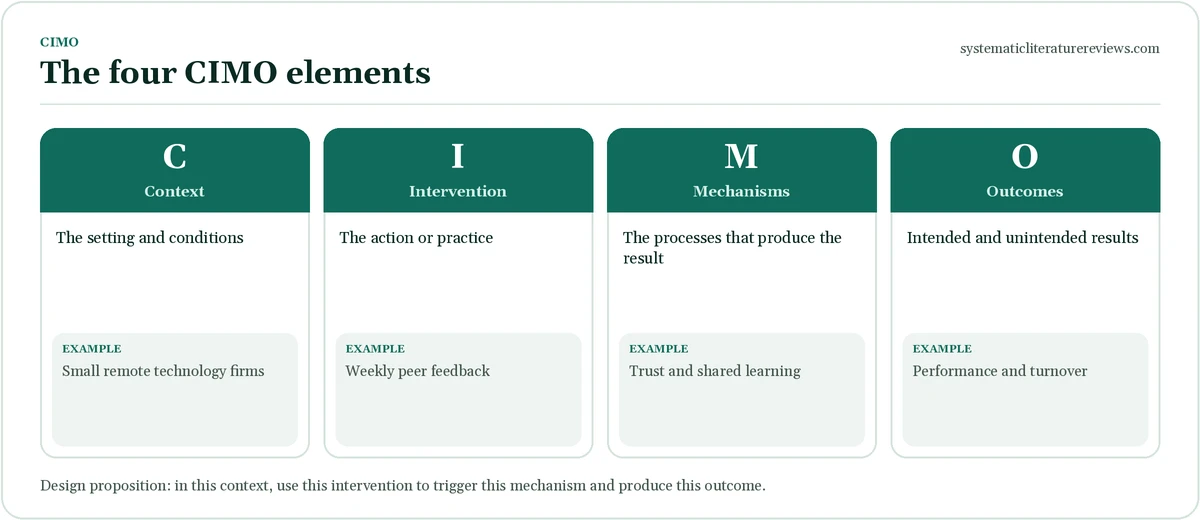
The CIMO framework elements
Each element answers one question about your study.
- C: Context: the setting and conditions in which the intervention is used, inside and outside the organisation. Example: small technology firms with remote teams.
- I: Intervention: the action, programme or management practice. Example: a weekly peer-feedback routine.
- M: Mechanisms: the processes triggered by the intervention that produce the outcome, such as trust, motivation or learning. Example: trust and shared learning among team members.
- O: Outcomes: the intended and unintended results. Example: team performance and staff turnover.
Mechanisms are often not stated in studies. Reviewers infer them from the authors’ explanations and the data.
Step-by-step guide to using the CIMO framework
These steps take you from a general interest to a precise question and a search you can run.
- Start with the problem. Write one plain sentence about what you want to know. Example: Why do some remote teams improve after feedback routines and others do not?
- Describe the Context. Name the setting, the people, the culture and the constraints that may matter. Example: Small technology firms with fully remote teams.
- Define the Intervention. State one action or practice, clearly enough to repeat. Example: A weekly, structured peer-feedback session.
- Propose the Mechanisms. List the processes that could explain the result, based on theory and earlier studies. Example: Trust, psychological safety and shared learning.
- Choose the Outcomes. Name intended and unintended results, with measures where possible. Example: Team performance ratings, staff turnover and meeting load.
- Write the question and the design proposition. Combine the parts in one question and in one if-then statement. Example: In small remote technology firms, use weekly peer feedback to build trust and learning, so that performance improves.
CIMO framework examples across fields
The table shows how the framework adapts to different disciplines. Each row becomes one question.
| Field | Context | Intervention | Mechanisms | Outcomes |
|---|---|---|---|---|
| Management | Remote technology teams | Weekly peer feedback | Trust, learning | Team performance |
| Education | Large first-year lectures | Peer instruction | Active processing, discussion | Exam results |
| Health services | Busy emergency departments | Triage nurse protocol | Faster decisions | Waiting times |
| Public policy | Local councils | Open data portal | Transparency, scrutiny | Citizen trust |
| Nursing | Night shifts on acute wards | Structured handover | Shared understanding | Medication errors |
Each row can be written as a design proposition: in this context, use this intervention to trigger this mechanism and produce this outcome.
Turning the CIMO framework into a search strategy
List synonyms for each element, join them with OR, then join the blocks with AND.
- Context block: (“small firm*” OR SME* OR start-up*) AND (remote OR “virtual team*”)
- Intervention block: (“peer feedback” OR “feedback session*” OR “peer review”)
- Mechanism block: (trust OR “psychological safety” OR learning) — optional
- Outcome block: (performance OR productivity OR turnover)
- Combine: join the blocks with AND, then record the date, the database and the records found.
Mechanisms are rarely indexed, so search on Context, Intervention and Outcome, and extract mechanisms from the full text. See the guides to the literature search strategy and Boolean operators.
From the CIMO framework to inclusion and exclusion criteria
Each element becomes an eligibility rule, written before you screen.
- Context: small technology firms with remote teams. Example: Exclude large corporations.
- Intervention: a structured, repeated peer-feedback practice. Example: Exclude one-off training.
- Mechanisms: studies that describe or test at least one explanatory process. Example: Record the mechanisms in a data extraction table.
- Outcomes: performance, turnover or satisfaction reported. Example: Exclude studies with no outcome data.
- Design: empirical studies, qualitative or quantitative.
The guide to inclusion and exclusion criteria explains how to justify each rule.
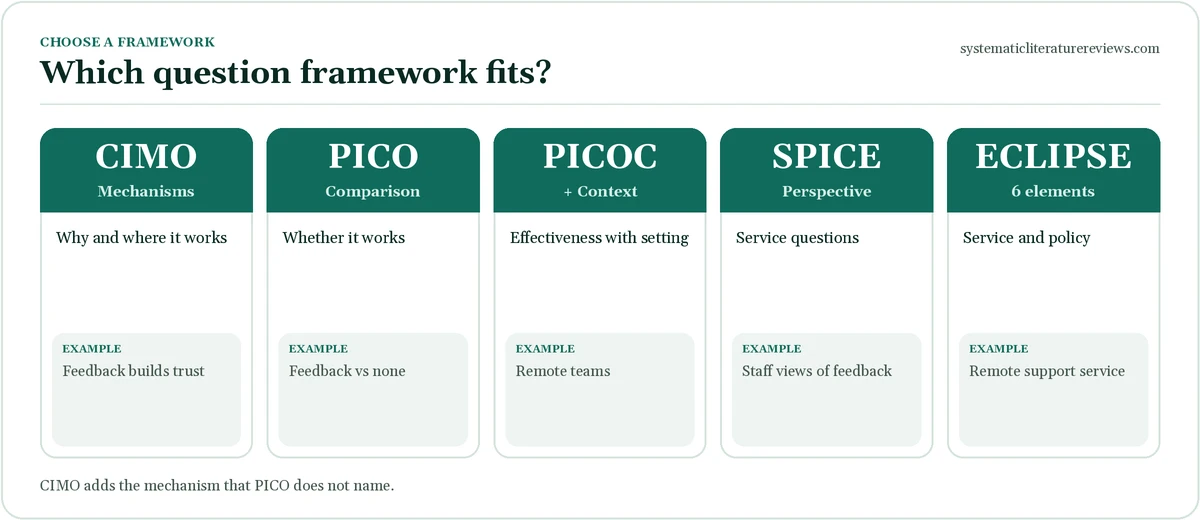
CIMO framework vs other question frameworks
Pick the framework that matches the kind of question you ask.
| Framework | Elements | Best for |
|---|---|---|
| CIMO | Context, Intervention, Mechanisms, Outcomes | Why and in what setting an intervention works |
| PICO | Population, Intervention, Comparison, Outcome | Whether an intervention works |
| PICOC | PICO plus Context | Effectiveness with setting |
| SPICE | Setting, Perspective, Intervention or Interest, Comparison, Evaluation | Service and social science reviews |
| ECLIPSE | Expectation, Client group, Location, Impact, Professionals, Service | Health service questions |
CIMO is not built to compare two options, so it has no C for Comparison. If you must compare, add a comparison in the Intervention element or use PICOC.
How to write a CIMO design proposition
A design proposition turns your findings into advice that others can apply.
Template
In [context], use [intervention] to trigger [mechanism], which produces [outcome].
- Test it: ask whether the data support each link in the chain.
- Revise: change the proposition when a mechanism or context fails.
- Report: present the final propositions in a table.
CIMO and realist thinking
CIMO shares an idea with realist evaluation: the same intervention can work differently in different contexts because it triggers different mechanisms.
- Realist question: what works, for whom, in what circumstances and why?
- Link to CIMO: context, mechanism and outcome appear in both.
- Evidence: include qualitative and quantitative studies, because explanations come from both.
- Theory: state a draft theory first, then test and refine it against the evidence.
For qualitative evidence, see the PICo framework; for mixed designs, see mixed methods research designs.
When to choose CIMO
Use CIMO when you care about why an intervention works in a particular setting.
- Complex interventions: many parts and many settings.
- Management and organisations: practices that depend on culture and structure.
- Education and policy: programmes that work for some groups but not others.
- Not for simple effect questions: if you only want an effect size, use PICO.
Test the finished question with the FINER criteria.
Weak and strong CIMO questions
Compare vague questions with focused ones.
CIMO question: feedback and leadership
Weak
Does feedback work?
No context, mechanism or outcome.
Strong
In small remote technology firms, how does weekly peer feedback, through trust and shared learning, affect team performance and turnover?
Names all four CIMO elements.
Weak
Do leadership programmes help?
Vague setting and process.
Strong
In public hospitals under budget pressure, does a leadership coaching programme improve staff retention by increasing perceived support?
Defines context, intervention, mechanism and outcome.
Common mistakes with the CIMO framework
Avoid these problems.
- Leaving out Mechanisms: you report only whether it works. Example: state the processes you expect.
- Vague Context: the finding cannot transfer. Example: describe the setting in enough detail.
- Mixing several interventions: you cannot tell which works. Example: split the questions.
- Assuming one mechanism: there are many. Example: list alternatives and test them.
- Skipping outcomes that are unintended: you miss harm. Example: record unintended outcomes.
CIMO framework checklist
Run your question through these checks before you search.
- Context: is the setting described precisely?
- Intervention: is it one action that can be repeated?
- Mechanisms: are the explanatory processes named?
- Outcomes: intended and unintended results listed?
- Proposition: does the if-then statement hold together?
- Criteria: each element written as a rule?
CIMO question template
Fill in the blanks to draft your question.
Template
In [context], how does [intervention], through [mechanism], affect [outcome]?
Practical tips for using the CIMO framework
These habits make the framework easier to apply.
- Draw the chain: sketch context, intervention, mechanism and outcome as boxes and arrows.
- Extract mechanisms: add a column for them in your data extraction form.
- Compare contexts: tabulate settings and see where results differ.
- Keep a decision log: record every change to a proposition, with the date and reason.
When the question is ready, see how it fits into a full systematic literature review, and plan the search with the guides to the literature search strategy and Boolean operators. For background reading, see systematic reviews.
Related question frameworks
Choose the framework that matches your question, not the one you met first. This table links to every question framework in our library.
| Framework | Elements | Best for |
|---|---|---|
| PICO framework | Population, Intervention, Comparison, Outcome | Treatment and effectiveness questions |
| PICOT framework | PICO plus Time | Clinical questions with a follow-up period |
| PICOS framework | PICO plus Study design | Reviews that limit eligible study designs |
| PICOC framework | PICO plus Context | Reviews where the setting changes the answer |
| PICOTT framework | PICO plus Time and Type | Nursing and evidence-based practice questions |
| PIO framework | Population, Intervention or Interest, Outcome | Descriptive questions without a comparison |
| PEO framework | Population, Exposure, Outcome | Risk factors and experiences |
| PICo framework | Population, phenomenon of Interest, Context | Qualitative review questions |
| SPIDER framework | Sample, Phenomenon of Interest, Design, Evaluation, Research type | Qualitative and mixed-methods evidence |
| SPICE framework | Setting, Perspective, Intervention or Interest, Comparison, Evaluation | Service and social science reviews |
| PCC framework | Population, Concept, Context | Scoping reviews |
| ECLIPSE framework | Expectation, Client group, Location, Impact, Professionals, Service | Health service and policy questions |
| CLIP framework | Client group, Location, Improvement or Innovation, Professionals | Short service and policy searches |
| PIRD framework | Population, Index test, Reference test, Diagnosis | Diagnostic accuracy reviews |
| BeHEMoTh framework | Behaviour, Health context, Exclusions, Models or Theories | Searching for theory in reviews |
To test a finished question, use the FINER criteria, and for example questions see sample research questions.
Frequently asked questions about the CIMO framework
What does CIMO stand for?
CIMO stands for Context, Intervention, Mechanisms and Outcomes. It is a framework for writing a question about what works, in what setting and why. The Context is the setting and conditions, the Intervention is the action or practice, the Mechanisms are the processes that the intervention triggers, and the Outcomes are the results, intended or not. It was proposed for management and organisational reviews, and it is used for any question about how an intervention produces results in a given setting.
How is CIMO different from PICO?
PICO asks whether an intervention works compared with an alternative in a defined population. CIMO asks why and in what setting it works. It replaces Population and Comparison with Context and adds Mechanisms, which explain the link between the intervention and the outcome. CIMO is therefore more useful for complex interventions in organisations and policy, where the same practice can succeed or fail depending on setting. PICO is better when you want an effect estimate that can be pooled in a meta-analysis.
What is a mechanism in CIMO?
A mechanism is a process that the intervention triggers in a particular context and that leads to the outcome. For example, a peer-feedback routine might build trust, which leads to more open discussion and better team performance. Mechanisms are often not measured directly. Reviewers infer them from the authors’ explanations, from qualitative data and from theory. Naming possible mechanisms at the start helps you extract the right information from each study and test whether the evidence supports the explanation.
Can I use CIMO outside management research?
Yes. CIMO suits any field where the same intervention works differently in different settings. It is used in education, health services, public policy and social care, especially when reviewers want to build theory about how programmes work. If your question is a simple one about the effect of a treatment on an outcome in a defined group, a framework such as PICO is easier. If setting and explanation matter, CIMO gives you a structure for both.
Need expert help? Our experienced writers can handle the search, screening and write-up for you. Place your order in two minutes, or read how a systematic literature review works first.
Systematic Literature Reviews
Need help framing your research question?
Get a PICO, SPIDER, SPICE or PCC question and matching search strategy from experienced review writers.