
PICOC Framework: Population, Intervention, Comparison, Outcome, Context

The PICOC framework is a five-part structure for writing a review question: Population, Intervention, Comparison, Outcome and Context. It is PICO with an extra C for Context, the setting, system or circumstances in which the intervention takes place. It is often credited to Petticrew and Roberts, who proposed it for systematic reviews in the social sciences.
This guide explains each PICOC element, gives a six-step method with an example at every step, shows how to handle Context in the search and in eligibility rules, and compares PICOC with PICO, PICOS and SPICE.
- The elements: Population, Intervention, Comparison, Outcome and Context explained.
- The method: six steps from a topic to a searchable question.
- The choice: when context matters and which framework to use instead if it does not.
On this page
- What is the PICOC framework?
- The PICOC framework elements
- Step-by-step guide to using the PICOC framework
- PICOC framework examples across fields
- Turning the PICOC framework into a search strategy
- From the PICOC framework to inclusion and exclusion criteria
- Frequently asked questions about the PICOC framework
Key takeaways
- PICOC stands for Population, Intervention, Comparison, Outcome and Context.
- Context is the setting or conditions in which the intervention works, such as a country, a type of school or a health system.
- PICOC suits social science, education and management reviews where setting changes the result.
- Treat Context as an eligibility rule, not as a keyword to search for.
What is the PICOC framework?
A good question names who is studied, what was done, what it was compared with, what was measured and where it took place.
- Definition: PICOC stands for Population, Intervention, Comparison, Outcome and Context.
- Origin: the framework is associated with Petticrew and Roberts, authors of a textbook on systematic reviews in the social sciences.
- Why context matters: the same intervention can work in one setting and fail in another, for example a reading programme in well-funded and in under-resourced schools.
- Where it is used: education, social policy, public health and management reviews.
The PICOC framework elements
Each element answers one question about your study.
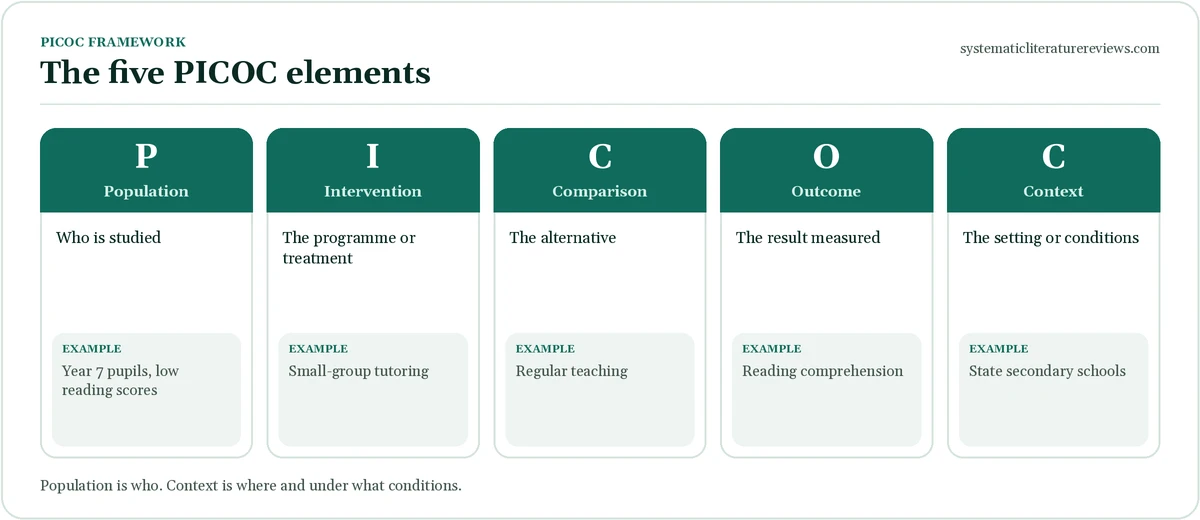
- P: Population: who is studied, with age, condition and role. Example: Year 7 pupils with low reading scores.
- I: Intervention: the programme, treatment or approach. Example: small-group phonics tutoring.
- C: Comparison: what it is compared with. Example: regular classroom teaching.
- O: Outcome: the result you measure. Example: reading comprehension score.
- C: Context: the setting, system or conditions. Example: state secondary schools in low-income areas.
Context is not the same as Population. The Population is who; the Context is where and under what conditions.
Step-by-step guide to using the PICOC framework
These steps take you from a general interest to a precise question and a search you can run.
- Start with the problem. Write one sentence about what you want to know. Example: Does tutoring help struggling readers?
- Define the Population. Name the group precisely. Example: Year 7 pupils with reading scores below the expected level.
- Name the Intervention and the Comparison. State one intervention and its comparator. Example: Small-group tutoring compared with regular teaching.
- Choose the Outcome. Name outcomes that studies report. Example: Reading comprehension, measured with a standard test.
- Define the Context. Say where and in what conditions the intervention is delivered, and decide whether to limit by it. Example: State secondary schools in England, delivered during school hours.
- Write the question and test the search. Combine the five parts and test in one database. Example: In Year 7 pupils with low reading scores in state secondary schools, is small-group tutoring more effective than regular teaching at improving reading comprehension?
PICOC framework examples across fields
The table shows how the framework adapts to different disciplines. Each row becomes one question.
| Field | Population | Intervention | Comparison | Outcome | Context |
|---|---|---|---|---|---|
| Education | Year 7 pupils | Small-group tutoring | Regular teaching | Reading score | State secondary schools |
| Nursing | Older adults after hip surgery | Early rehabilitation | Usual care | Walking independence | Rural hospitals |
| Public health | Adults who smoke | Quitline support | No support | Quit rate | Low-income countries |
| Business | Software teams | Pair programming | Solo coding | Defect rate | Small start-ups |
| Social care | Foster carers | Peer support groups | No groups | Placement stability | Local authority services |
Context lets you ask whether findings from one setting transfer to another.
Turning the PICOC framework into a search strategy
List synonyms for each element, join them with OR, then join the blocks with AND.
- Population block: (pupil* OR student* OR “school child*”)
- Intervention block: (tutor* OR “small group” OR phonics)
- Outcome block: (reading OR literacy OR comprehension)
- Context block: (school* OR “secondary education”) — optional
- Combine: join the blocks with AND, record the date and the number of records.
Context terms are often vague in titles and abstracts, so use them as a screening rule rather than as a hard filter. For help, see the guides to the literature search strategy and Boolean operators.
From the PICOC framework to inclusion and exclusion criteria
Each element becomes an eligibility rule, written before you screen.
- Population: pupils aged 11 to 12. Example: Exclude adult learners.
- Intervention: tutoring in small groups. Example: Exclude whole-class interventions.
- Comparison: regular teaching. Example: Exclude studies with no comparison.
- Outcome: a standardised reading measure. Example: Exclude attitude surveys.
- Context: state secondary schools. Example: Exclude private tutoring centres.
The guide to inclusion and exclusion criteria explains how to justify each rule.
PICOC framework vs other question frameworks
Pick the framework that matches the kind of question you ask.
| Framework | Elements | Best for |
|---|---|---|
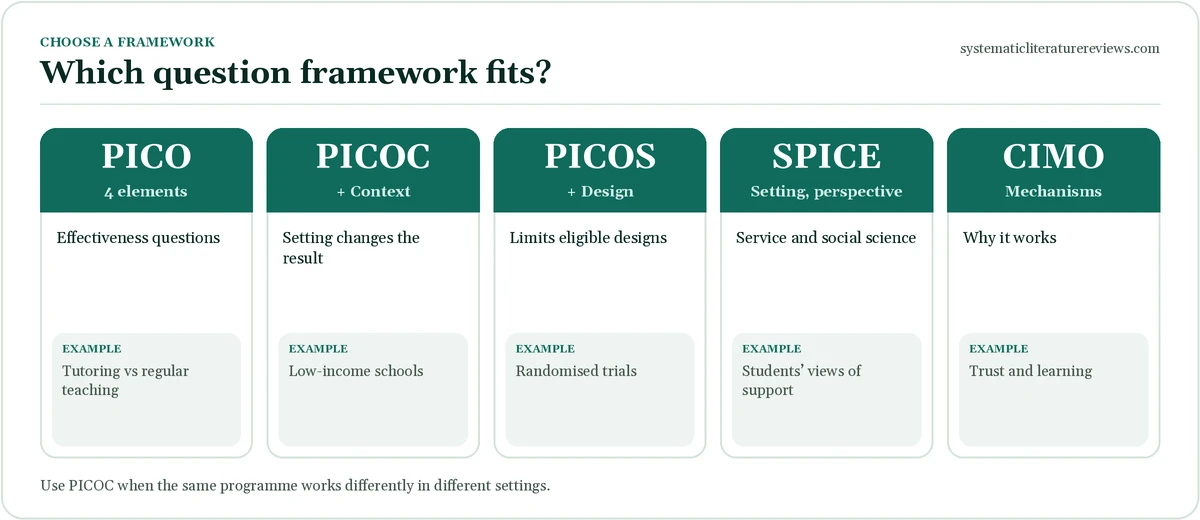
| PICO | Population, Intervention, Comparison, Outcome | Effectiveness questions |
| PICOC | PICO plus Context | Reviews where setting changes the answer |
| PICOS | PICO plus Study design | Reviews that limit eligible designs |
| SPICE | Setting, Perspective, Intervention or Interest, Comparison, Evaluation | Service and social science reviews |
| CIMO | Context, Intervention, Mechanisms, Outcomes | Management and organisational research |
PICOC and SPICE both include setting. SPICE also names the perspective and an evaluation, while the CIMO framework adds the mechanism that explains why the intervention works.
What counts as Context in PICOC?
Context can mean several things. Choose the meaning that fits your review.
| Kind of context | Example | How to use it |
|---|---|---|
| Place | Rural clinics, urban schools | Eligibility rule |
| System | Public or private health care | Subgroup |
| Time | During a pandemic | Eligibility rule |
| Culture | A particular country | Subgroup or discussion |
| Organisation | Small firms or large firms | Subgroup |
Decide in the protocol whether Context limits the review or only describes it.
Using Context to judge whether results transfer
Context helps readers decide whether findings apply to them.
- Describe: record the setting of each included study in a table.
- Compare: look at whether results differ by setting.
- Judge: state the limits to transfer in the discussion.
- Advise: tell readers which contexts the evidence covers and which it does not.
For pooled results, see what a meta-analysis is.
When to choose PICOC
Use PICOC when the setting changes the meaning of the result.
- Education and social policy: findings depend on school type, region or funding.
- Global health: health systems differ between countries.
- Organisational research: company size and sector matter.
- Not needed: when the setting is the same for all studies, plain PICO is enough.
Questions about experiences instead of effectiveness fit the PICo framework better.
Weak and strong PICOC questions
Compare vague questions with focused ones.
PICOC question: tutoring and mentoring
Weak
Does tutoring work?
No population, comparison, outcome or context.
Strong
In Year 7 pupils with low reading scores in state secondary schools, is small-group tutoring more effective than regular teaching at improving reading comprehension?
Names all five elements.
Weak
Are mentoring schemes useful?
Vague group, outcome and setting.
Strong
In first-year university students at large urban universities, does peer mentoring improve retention compared with no mentoring?
Defines the group, the comparison and the setting.
Common mistakes with the PICOC framework
Avoid these problems.
- Confusing Context with Population: the same words appear twice. Example: use Population for who, Context for where.
- Over-narrow Context: few studies match. Example: widen the setting or treat it as a subgroup.
- Ignoring Context in the search: you retrieve irrelevant studies. Example: screen for it with a rule.
- A vague Comparison: results are unclear. Example: name the comparator.
- Skipping synonyms: relevant studies are missed. Example: list at least three terms per element.
PICOC framework checklist
Run your question through these checks before you search.
- Population: who is studied, with age and role?
- Intervention: one intervention, clearly defined?
- Comparison: named comparator?
- Outcome: measurable and reported?
- Context: setting defined, and is it a limit or a subgroup?
- Criteria: each element written as a rule?
PICOC question template
Fill in the blanks to draft your question.
Template
In [population] in [context], is [intervention] more effective than [comparison] at [outcome]?
Practical tips for using the PICOC framework
These habits make the framework easier to apply.
- Write it on one page: put all five elements and the question on one sheet.
- Tabulate settings: record the context of every included study.
- Pilot the search: read the first twenty titles to test the Context rule.
- Keep a decision log: record each change, with the date and reason.
When the question is ready, see how it fits into a full systematic literature review, and plan the search with the guides to the literature search strategy and Boolean operators. For background reading, see the PICO process.
Related question frameworks
Choose the framework that matches your question, not the one you met first. This table links to every question framework in our library.
| Framework | Elements | Best for |
|---|---|---|
| PICO framework | Population, Intervention, Comparison, Outcome | Treatment and effectiveness questions |
| PICOT framework | PICO plus Time | Clinical questions with a follow-up period |
| PICOS framework | PICO plus Study design | Reviews that limit eligible study designs |
| PICOTT framework | PICO plus Time and Type | Nursing and evidence-based practice questions |
| PIO framework | Population, Intervention or Interest, Outcome | Descriptive questions without a comparison |
| PEO framework | Population, Exposure, Outcome | Risk factors and experiences |
| PICo framework | Population, phenomenon of Interest, Context | Qualitative review questions |
| SPIDER framework | Sample, Phenomenon of Interest, Design, Evaluation, Research type | Qualitative and mixed-methods evidence |
| SPICE framework | Setting, Perspective, Intervention or Interest, Comparison, Evaluation | Service and social science reviews |
| PCC framework | Population, Concept, Context | Scoping reviews |
| CIMO framework | Context, Intervention, Mechanisms, Outcomes | Management and organisational research |
| ECLIPSE framework | Expectation, Client group, Location, Impact, Professionals, Service | Health service and policy questions |
| CLIP framework | Client group, Location, Improvement or Innovation, Professionals | Short service and policy searches |
| PIRD framework | Population, Index test, Reference test, Diagnosis | Diagnostic accuracy reviews |
| BeHEMoTh framework | Behaviour, Health context, Exclusions, Models or Theories | Searching for theory in reviews |
To test a finished question, use the FINER criteria, and for example questions see sample research questions.
Frequently asked questions about the PICOC framework
What does PICOC stand for?
PICOC stands for Population, Intervention, Comparison, Outcome and Context. It extends PICO by adding the setting or conditions in which the intervention is delivered. For example, a review might ask whether small-group tutoring improves reading comprehension in Year 7 pupils in state secondary schools. The Context element reminds reviewers that results can differ between settings, and it gives a clear rule for deciding which studies to include or how to group them in the analysis.
What is the difference between PICOC and PICO?
PICO has four elements: Population, Intervention, Comparison and Outcome. PICOC adds a fifth, Context, which describes where and under what conditions the intervention takes place. Use PICO when setting is the same across studies or does not matter. Use PICOC when settings differ in ways that could change the effect, such as country, type of school, health system or size of firm. The extra element makes the question, the criteria and the discussion of transferability more precise.
How is Context different from Population?
Population describes who is studied: their age, condition, role or other characteristics. Context describes where and in what circumstances: the country, type of institution, health system or time period. A group of nurses is a Population; a rural hospital in a low-income country is a Context. Keeping them separate makes the search and the eligibility rules clearer, and it lets you compare results across settings when the same population appears in different contexts.
Should Context be a search term?
Often not. Context words are used inconsistently in titles and abstracts, so a context block can remove relevant records. A safer approach is to search for the Population and Intervention, and apply the Context rule during screening. If the context is a clear, indexed term, such as a country name or a school level, you can add it with care and test the search with known studies. Record the decision in your protocol and check that the search still finds your key papers.
Need expert help? Our experienced writers can handle the search, screening and write-up for you. Place your order in two minutes, or read how a systematic literature review works first.
Systematic Literature Reviews
Need help framing your research question?
Get a PICO, SPIDER, SPICE or PCC question and matching search strategy from experienced review writers.