
PICOS Framework: Population, Intervention, Comparison, Outcome, Study Design

The PICOS framework is a five-part structure for writing a focused question for a systematic review: Population, Intervention, Comparison, Outcome and Study design. It is PICO with one extra element, S, which tells you which kinds of studies are eligible. Because eligibility rules are so important in a review, PICOS is widely used to write the inclusion criteria.
This guide explains each PICOS element, gives a six-step method with an example at every step, shows how to build a search string and eligibility criteria, and compares PICOS with PICO, PICOC and PICOT so that you can choose the right one for your review or dissertation.
- The elements: Population, Intervention, Comparison, Outcome and Study design explained.
- The method: six steps from a topic to a searchable question.
- The choice: when PICOS helps and when another framework fits better.
On this page
- What is the PICOS framework?
- The PICOS framework elements
- Step-by-step guide to using the PICOS framework
- PICOS framework examples across fields
- Turning the PICOS framework into a search strategy
- From the PICOS framework to inclusion and exclusion criteria
- Frequently asked questions about the PICOS framework
Key takeaways
- PICOS stands for Population, Intervention, Comparison, Outcome and Study design.
- The S says which study designs you will include, such as randomised trials.
- PICOS suits effectiveness questions where design decides how strong the evidence is.
- Write each element as an eligibility rule before you screen.
What is the PICOS framework?
A clear review question names who you are studying, what was done, what it was compared with, what was measured and which study designs count.
- Definition: PICOS stands for Population, Intervention, Comparison, Outcome and Study design.
- Relation to PICO: PICO has four elements; PICOS adds the Study design so that the design limit is stated in the question itself.
- Where it is used: systematic reviews of treatments, programmes and exposures, in nursing, medicine, education and the social sciences.
- Reporting: the PRISMA 2009 statement referred to PICOS when it asked authors to describe study characteristics; see the PRISMA flow diagram guide.
The PICOS framework elements
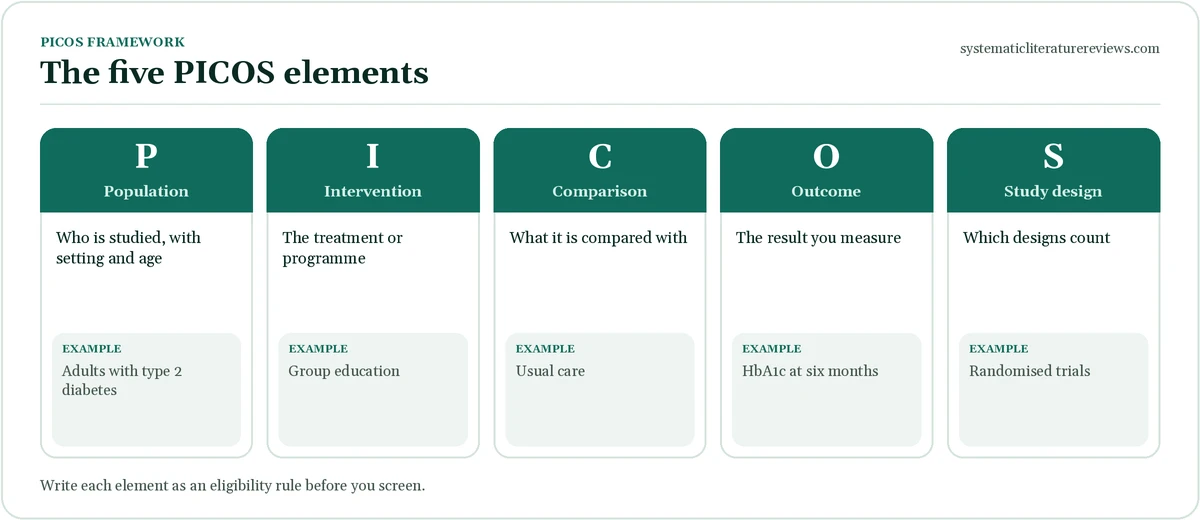
Each element answers one question about your study.
- P: Population: who is studied, with the details that change the answer, such as age, condition and setting. Example: adults with type 2 diabetes in primary care.
- I: Intervention: the treatment, programme or exposure you are evaluating. Example: a structured education programme.
- C: Comparison: what the intervention is compared with: usual care, placebo, no treatment or another intervention. Example: usual care.
- O: Outcome: the result you will measure, with the measure named where you can. Example: HbA1c after six months.
- S: Study design: the kinds of study you will include, chosen to fit the question. Example: randomised controlled trials.
If you cannot name the comparison, you probably need the PIO framework instead.
Step-by-step guide to using the PICOS framework
These steps take you from a general interest to a precise question and a search you can run.
- Start with the problem. Write one plain sentence about what you want to know. It is a topic, not yet a question. Example: Does diabetes education help adults control their blood sugar?
- Define the Population. Name the group as precisely as the literature allows, including setting and age range. Example: Adults aged 18 and over with type 2 diabetes managed in primary care.
- Name the Intervention and the Comparison. State one specific intervention and what it is compared with. Two interventions mean two questions. Example: Group education programme compared with usual care.
- Choose the Outcome. Pick outcomes that studies report and that matter to your readers. Name the measure. Example: HbA1c at three to twelve months.
- Choose the Study design. Match the design to the question. Effectiveness questions usually need randomised trials, and harms may need cohort studies. Example: Randomised controlled trials.
- Write the question and test the search. Combine the five parts in one sentence, build the search, and read the first twenty records. Example: In adults with type 2 diabetes in primary care, are group education programmes more effective than usual care at lowering HbA1c in randomised controlled trials?
PICOS framework examples across fields
The table shows how the framework adapts to different disciplines. Each row becomes one question.
| Field | Population | Intervention | Comparison | Outcome | Study design |
|---|---|---|---|---|---|
| Nursing | Hospitalised older adults | Early mobilisation | Usual bed rest | Length of stay | Randomised trials |
| Education | Secondary students | Weekly quizzes | No quizzes | Exam scores | Randomised or quasi-experimental |
| Public health | Adults who smoke | Text-message support | No messages | Quit rates at six months | Randomised trials |
| Mental health | University students | Mindfulness course | Waiting list | Anxiety scores | Randomised trials |
| Business | Remote staff | Flexible hours | Fixed hours | Job satisfaction | Controlled before-and-after studies |
The design column shows that PICOS is not only for trials. The right design depends on the question.
Turning the PICOS framework into a search strategy
List synonyms for each element, join them with OR, then join the blocks with AND.
- Population block: (adult* OR “older adult*” OR “Aged”[MeSH])
- Intervention block: (“early mobili?ation” OR ambulation OR “Early Ambulation”[MeSH])
- Comparison block: (“usual care” OR “standard care” OR control*)
- Outcome block: (“length of stay” OR “hospital stay” OR “Length of Stay”[MeSH])
- Study design block: (randomi?ed OR “randomized controlled trial”[pt] OR trial*) — use with care
Many search experts advise against adding the Comparison and Study design blocks, because they can hide relevant records. Search on Population and Intervention (and Outcome if needed), then apply the design rule during screening. See the guides to the literature search strategy and Boolean operators.
From the PICOS framework to inclusion and exclusion criteria
Each element becomes an eligibility rule, written before you screen.
- Population: adults aged 65 or over in acute hospital wards. Example: Exclude day-case surgery.
- Intervention: a structured early-mobilisation programme. Example: Exclude single advice leaflets.
- Comparison: usual care or no programme. Example: Exclude studies with no comparison group.
- Outcome: length of stay reported in days. Example: Exclude studies that report only satisfaction.
- Study design: randomised controlled trials. Example: Exclude case reports and opinion pieces.
The guide to inclusion and exclusion criteria explains how to justify each rule.
PICOS framework vs other question frameworks
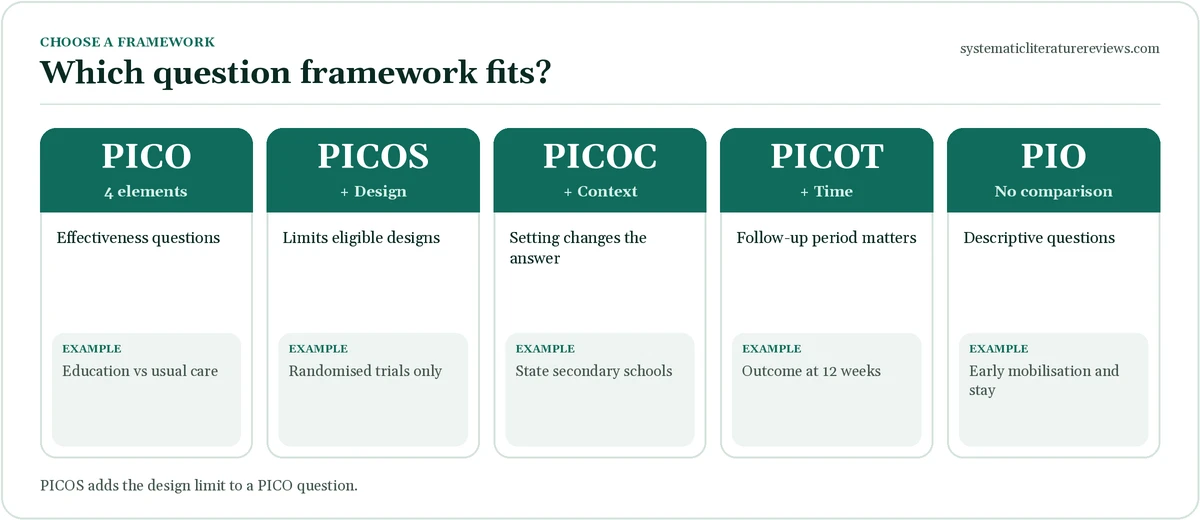
Pick the framework that matches the kind of question you ask.
| Framework | Elements | Best for |
|---|---|---|
| PICO | Population, Intervention, Comparison, Outcome | Effectiveness questions when design is set elsewhere |
| PICOS | PICO plus Study design | Systematic reviews that limit eligible designs |
| PICOC | PICO plus Context | Reviews where setting matters |
| PICOT | PICO plus Time | Clinical questions with a follow-up period |
| PIO | Population, Intervention or Interest, Outcome | Descriptive questions without a comparison |
If time is the missing piece, use the PICOT framework. If setting matters more than design, use the PICOC framework.
Choosing the S in PICOS: study designs by question
The design you include should fit the kind of question you ask.
| Question type | Typical design | Why |
|---|---|---|
| Effectiveness of an intervention | Randomised controlled trial | Randomisation reduces bias |
| Harms and rare side effects | Cohort or case-control study | Large samples and long follow-up |
| Prognosis | Cohort study | Follows people over time |
| Experiences | Qualitative study | Explores meaning |
| Accuracy of a test | Cross-sectional diagnostic study | Compares test and reference |
For qualitative questions, see the SPIDER framework.
When a design limit helps and when it hurts
A design limit saves screening time, but it can remove useful evidence.
- Helps: when many randomised trials exist and you want the strongest evidence.
- Hurts: when trials are few and observational studies add information.
- Compromise: include randomised trials first and list other designs as a sensitivity or secondary question.
- Record: state the limit and your reason in the protocol.
Using PICOS in a review protocol
PICOS fits neatly into the eligibility section of a protocol.
- Table: list each element, the rule and the reason in a table.
- Registration: copy the final question into a register such as PROSPERO.
- Screening form: add one row per element.
- Report: repeat the same elements in the methods section of the review.
See the full process in our guide to the systematic literature review.
Weak and strong PICOS questions
Compare vague questions with focused ones.
PICOS question: apps and health
Weak
Does yoga help?
Too broad: no population, comparison, outcome or design.
Strong
In adults with chronic low back pain, is yoga more effective than usual care at reducing pain in randomised controlled trials?
Names all five elements.
Weak
Do apps change behaviour?
Vague intervention and outcome.
Strong
In adolescents with asthma, does a symptom-tracking app reduce emergency visits compared with a paper diary in randomised trials?
Defines the group, comparison and design.
Common mistakes with the PICOS framework
Avoid these problems.
- Treating Study design as a keyword: you add a design filter and miss records. Example: screen for design instead of searching for it.
- Missing comparison: a vague contrast gives vague results. Example: name the comparator.
- Over-narrow Population: few studies exist. Example: relax age or setting limits.
- Mixing designs without a plan: results cannot be pooled. Example: state how designs will be handled.
- Skipping synonyms: relevant studies are missed. Example: list at least three terms per element.
PICOS framework checklist
Run your question through these checks before you search.
- Population: is the group specific, with setting and age?
- Intervention: is it one intervention?
- Comparison: is the comparator named?
- Outcome: is it measurable and reported in studies?
- Study design: does it fit the question and exist in the literature?
- Criteria: is each element written as a rule?
PICOS question template
Fill in the blanks to draft your question.
Template
In [population], is [intervention] more effective than [comparison] at [outcome] in [study design]?
Practical tips for using the PICOS framework
These habits make the framework easier to apply.
- Write it on one page: put all five elements and the question on a single sheet for your supervisor.
- Pilot the search: run it in one database and read the first twenty titles.
- Keep a decision log: record each change to an element, with the date and reason.
- Decide the design rule early: a late change to design can force you to start again.
When the question is ready, see how it fits into a full systematic literature review, and plan the search with the guides to the literature search strategy and Boolean operators. For background reading, see the Cochrane Handbook chapter on defining the review question.
Related question frameworks
Choose the framework that matches your question, not the one you met first. This table links to every question framework in our library.
| Framework | Elements | Best for |
|---|---|---|
| PICO framework | Population, Intervention, Comparison, Outcome | Treatment and effectiveness questions |
| PICOT framework | PICO plus Time | Clinical questions with a follow-up period |
| PICOC framework | PICO plus Context | Reviews where the setting changes the answer |
| PICOTT framework | PICO plus Time and Type | Nursing and evidence-based practice questions |
| PIO framework | Population, Intervention or Interest, Outcome | Descriptive questions without a comparison |
| PEO framework | Population, Exposure, Outcome | Risk factors and experiences |
| PICo framework | Population, phenomenon of Interest, Context | Qualitative review questions |
| SPIDER framework | Sample, Phenomenon of Interest, Design, Evaluation, Research type | Qualitative and mixed-methods evidence |
| SPICE framework | Setting, Perspective, Intervention or Interest, Comparison, Evaluation | Service and social science reviews |
| PCC framework | Population, Concept, Context | Scoping reviews |
| CIMO framework | Context, Intervention, Mechanisms, Outcomes | Management and organisational research |
| ECLIPSE framework | Expectation, Client group, Location, Impact, Professionals, Service | Health service and policy questions |
| CLIP framework | Client group, Location, Improvement or Innovation, Professionals | Short service and policy searches |
| PIRD framework | Population, Index test, Reference test, Diagnosis | Diagnostic accuracy reviews |
| BeHEMoTh framework | Behaviour, Health context, Exclusions, Models or Theories | Searching for theory in reviews |
To test a finished question, use the FINER criteria, and for example questions see sample research questions.
Frequently asked questions about the PICOS framework
What does PICOS stand for?
PICOS stands for Population, Intervention, Comparison, Outcome and Study design. It extends PICO by adding the kind of study that you will accept as evidence. For example, a review of group education for type 2 diabetes might include only randomised controlled trials in adults in primary care, comparing education with usual care, and measuring HbA1c. Writing the design into the question helps you plan the search, write the eligibility criteria and keep screening decisions consistent between reviewers.
What is the difference between PICO and PICOS?
PICO has four elements: Population, Intervention, Comparison and Outcome. PICOS adds a fifth, the Study design. Both help you write a focused question about an intervention, but PICOS states the design limit explicitly, which is useful in a systematic review where reviewers must agree which studies to include. If you do not intend to limit by design, PICO is enough. If time of follow-up matters too, consider PICOT or PICOTT. Whichever you choose, use the same elements in the protocol, the search, the screening form and the final report.
Should I put study design in my search string?
Usually it is safer not to. Design filters can miss relevant records because abstracts and indexing are not always consistent. Many information specialists recommend searching for the Population and Intervention, sometimes with the Outcome, and then applying the design rule during title and abstract screening. If you do use a design filter, use a validated one, such as those published for randomised trials, and record exactly what you used so that others can repeat the search.
Can I use PICOS for qualitative questions?
PICOS is built for questions about interventions and comparisons, so it fits qualitative questions poorly. For experiences and meanings, use PICo, PEO or SPIDER, which have a Phenomenon of Interest or an Exposure instead of an Intervention and Comparison. Some mixed-methods reviews use PICOS for the quantitative part and a qualitative framework for the rest. Choose the framework that matches each question and explain the choice in your protocol, so that readers can see why the elements differ between the strands of the study.
Need expert help? Our experienced writers can handle the search, screening and write-up for you. Place your order in two minutes, or read how a systematic literature review works first.
Systematic Literature Reviews
Need help framing your research question?
Get a PICO, SPIDER, SPICE or PCC question and matching search strategy from experienced review writers.