
Blog
How To Write Theoretical Framework |Best Example

Introduction to Theoretical Framework: Definitions and Importance in Research
- Definition of Theoretical Framework
- A theoretical framework is a structured system of concepts and theories that a researcher uses to guide a research study.
- It provides a systematic view of phenomena, helping researchers understand and interpret the research problem.
- The framework often stems from existing theory, prior research studies, and specific theories relevant to the research topic.
- Purpose and Importance
- The theoretical framework provides the foundation for the study by linking the research question to existing knowledge.
- It helps in understanding the research problem systematically, guiding the research methodology and data collection and analysis.
- In academic research, it ensures that the study contributes to the knowledge base and supports the creation of new insights.
- Role in Social Sciences and Research Studies
- In qualitative research, it helps interpret complex human behaviors, social phenomena, and contexts.
- In quantitative research, it defines variables and predicts relationships between them.
- It acts as a system of concepts that guides the researcher in making decisions about hypotheses, choice of research methods, and analysis of the research.
- Connection with Research Process
- Every research project begins with a review of the literature, which informs the conceptual and theoretical framework.
- The framework supports understanding the research problem, specifying research aims, and defining testable hypotheses.
- It ensures that the research design is coherent, consistent, and aligned with existing knowledge.
How To Write Theoretical Framework: A 7-Step Process for Your Research Paper
- Identify Your Research Problem and Research Questions
- Begin by clearly stating the research problem and research questions.
- The theoretical framework could guide how these questions are structured and which aspects are prioritized.
- Specify the variables and constructs that are central to your study.
- Review Existing Theories and Prior Research Studies
- Conduct a review of the literature to find relevant theories and concepts.
- Determine which specific theories or learning theories are relevant to your research topic.
- Examples of theoretical frameworks like Maslow’s Hierarchy of Needs or student learning theories can illustrate how a theory applies to your context.
- Select a Relevant Theory
- Choose a chosen theoretical framework that aligns with your research aims.
- Consider whether the theory supports and informs your research and can guide your research methodology.
- Ensure that the theory is well-established, credible, and relevant to the social sciences or the field of study.
- Define Key Concepts and Constructs
- Identify and define the concepts that are relevant to your research problem.
- Outline the relationships between variables and how they support hypotheses and choice of research methods.
- Clarify any assumptions or predictions derived from previous studies.
- Develop a Conceptual and Theoretical Framework Diagram (Optional but Recommended)
- Visual diagrams can illustrate frameworks in your research.
- Show how concepts, variables, and hypotheses interrelate.
- Highlight the structure that can hold or support a theory, making the systematic view of phenomena clear.
- Link the Framework to Your Research Methodology
- Use the framework to guide your research design, data collection, and data analysis.
- Specify whether the study will use qualitative research, quantitative research, or mixed methods.
- Ensure that the framework provides a rationale for the choice of research methods and supports the research process.
- Interpret and Apply the Framework
- During data collection and analysis, refer back to the framework to interpret the data.
- A strong theoretical framework allows you to draw conclusions, test hypotheses, and generate new knowledge and understanding.
- Use the framework to connect your findings with existing knowledge, highlighting contributions to theory and practice.
Understanding Conceptual and Theoretical Framework: Key Concepts and Constructs
- Conceptual Framework vs. Theoretical Framework
- A conceptual framework may provide a visual or narrative representation of relationships between variables based on existing theory.
- The theoretical framework is grounded in established theories and prior research studies, guiding the research methodology and hypotheses.
- Together, they form the conceptual and theoretical framework that underpins a research study.
- Key Concepts and Constructs
- Constructs are the building blocks of the framework, representing abstract ideas like motivation, learning, or behavior.
- They help in specifying the research problem, identifying variables, and developing testable hypotheses.
- The framework may integrate multiple constructs to provide a systematic view of phenomena.
- Relevance to Research Design
- The framework helps the researcher determine which research method is most suitable.
- It ensures that data collection and analysis are aligned with the research aims.
- Provides a philosophy of research for academic research, ensuring the study is systematic, coherent, and replicable.
Difference Between Conceptual Framework and Theoretical Framework Explained
- Definitions and Purpose
- A conceptual framework is often derived from literature reviews, student learning theories, or existing knowledge. It may include diagrams or models that describe expected relationships.
- A theoretical framework is built on existing theory, providing a systematic view of phenomena and guiding the research process from hypothesis formation to data interpretation.
- Role in Research Studies
- The conceptual framework may illustrate the relationship between variables in a specific research context.
- The theoretical framework could guide the choice of research methods, data collection, and analysis of the research.
- Both frameworks support and inform your research, but the theoretical framework provides a stronger foundation based on prior research studies.
- Examples of Theoretical and Conceptual Frameworks
- Maslow’s Hierarchy of Needs is a theoretical framework often used in social sciences to explain motivation.
- A conceptual framework may diagram how student learning is influenced by motivation, teaching methods, and environment.
- Frameworks in your research may combine both types to guide your research, ensure clarity, and strengthen your research design.
- Integration and Application
- Understanding the difference between conceptual and theoretical frameworks ensures that the research methodology aligns with the theory of a research study.
- It helps the researcher structure the research paper, justify the research design, and interpret research findings systematically.
- A well-chosen framework enhances the knowledge and understanding of the research problem, leading to new knowledge and understanding in the field.
The Role of Theoretical Frameworks in Research: Strengthening Your Study
- Foundation for Understanding the Research Problem
- A theoretical framework provides a systematic view of phenomena, helping researchers clearly define the research problem.
- It supports the researcher in developing research questions that are specific, focused, and aligned with prior research studies.
- By grounding the study in existing theory, the framework ensures the research methodology is coherent and consistent.
- Guiding Research Design and Methodology
- The framework guides the selection of research methods, whether qualitative research, quantitative research, or mixed methods.
- It informs data collection and analysis, helping the researcher decide which variables might be measured and which constructs are central.
- A chosen theoretical framework ensures that the research design aligns with the research aims and supports testable hypotheses.
- Supporting Hypotheses and Choice of Research Methods
- The framework allows the researcher to formulate hypotheses based on assumptions or predictions derived from prior studies.
- Theoretical frameworks provide the rationale for why certain research methods are selected and how data will be interpreted.
- It links theories and concepts to specific research, providing a foundation for analysis of the research.
- Enhancing Interpretation of Data
- During data collection and analysis, a theoretical framework might be used to interpret findings systematically.
- It ensures that conclusions are grounded in relevant theory and existing knowledge, not just descriptive statistics or anecdotal evidence.
- By integrating concepts that are relevant, the framework helps identify relationships between variables and guides new knowledge and understanding.
- Strengthening Academic Research and Knowledge Base
- Using a theoretical framework enhances the credibility and rigor of a research study in academic research.
- It supports the development of a knowledge base, enabling future researchers to build upon prior research studies and previous studies.
- Frameworks in your research can bridge theory and practice, ensuring the study contributes meaningfully to the social sciences or other disciplines.
Examples of Theoretical Frameworks in Research Across Social Sciences
- Maslow’s Hierarchy of Needs
- Often used in student learning research, motivation studies, and organizational behavior in the social sciences.
- Provides a system of concepts to explain human motivation, guiding both qualitative research and quantitative research.
- Demonstrates how a good theory in the social sciences can support and inform your research systematically.
- Learning Theories
- The learning theory framework guides researchers studying cognitive development, pedagogy, and educational outcomes.
- It helps interpret the data collected on student performance and engagement and shapes hypotheses and choice of research methods.
- Provides structure that can hold multiple variables, such as instructional techniques, learner motivation, and environmental factors.
- Conceptual and Theoretical Framework in Social Psychology
- For research exploring phenomena like group behavior or social identity, frameworks integrate specific theories like social identity theory and prior research studies.
- These frameworks guide research, ensuring that both data collection and analysis are consistent with theoretical predictions.
- Supports the research process by linking research findings to existing knowledge, leading to new knowledge and understanding.
- Organizational Behavior Frameworks
- The theoretical framework could include constructs like leadership, motivation, and team dynamics.
- Helps the researcher identify variables might influence outcomes and guides quantitative research with measurable indicators.
- Ensures interpretation of the data is grounded in theory of a research study rather than anecdotal observations.
- Healthcare and Public Policy Frameworks
- Research on healthcare interventions or policy implementation uses frameworks in your research to define constructs, research aims, and research methodology.
- Provides a systematic view of phenomena such as patient behavior, program outcomes, or policy effects.
- Demonstrates how to write a theoretical framework that integrates both existing theory and practical application.
How To Write Theoretical Framework: Common Mistakes and Best Practices
- Common Mistakes
- Vague or Undefined Concepts: Not specifying the constructs or variables leads to weak research design.
- Ignoring Existing Theory: Omitting relevant theory or prior research studies reduces credibility and scholarly rigor.
- Mixing Frameworks Unsystematically: Combining conceptual framework and theoretical framework without clear linkage can confuse data analysis.
- Overgeneralizing: Applying a theory beyond its relevant phenomenon or context diminishes reliability of findings.
- Neglecting Methodology Alignment: Selecting research methods inconsistent with the chosen theoretical framework undermines study coherence.
- Best Practices
- Start with a Clear Research Problem and Research Question: Define exactly what you aim to study and which variables are central.
- Conduct a Thorough Literature Review: Identify existing theory, prior studies, and specific theories relevant to your topic.
- Define Key Constructs: Clearly specify concepts that are relevant, linking them to hypotheses and choice of research.
- Develop a Diagrammatic Representation (Optional): Illustrate frameworks in your research, showing relationships between variables and constructs.
- Align with Methodology: Ensure data collection and analysis methods match the framework provides guidance for your research.
- Iterate and Refine: Review and update the framework as you gather research findings, ensuring it reflects new knowledge and understanding.
- Use Established Theories When Possible: Choose a relevant theory like Maslow’s Hierarchy of Needs or learning theory for credibility.
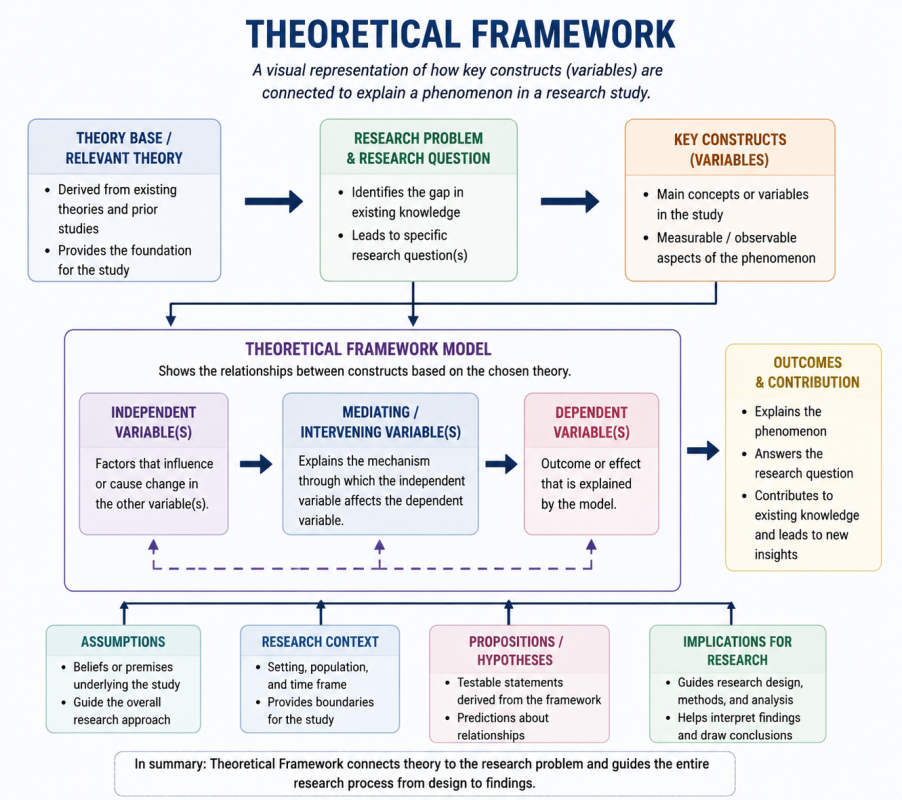
Integrating Conceptual and Theoretical Frameworks in Your Research Paper
- Combining the Two Types of Frameworks
- A conceptual framework may visually represent relationships between variables based on existing theory.
- A theoretical framework provides the underlying philosophy of research, linking research questions to existing knowledge.
- Together, the conceptual and theoretical framework ensures the research methodology is grounded in theory and practice.
- Application in the Research Process
- Use the framework to guide research design, specifying research methods, data collection, and data analysis.
- Helps interpret the data by linking findings to predictions derived from previous studies.
- Supports analysis of the research, ensuring that results are connected to relevant theory and contribute to the knowledge base.
- Benefits for Academic Research
- Integrating frameworks enhances knowledge and understanding of the research problem.
- Provides a systematic view of phenomena, making the research process transparent and replicable.
- Allows the researcher to generate new knowledge and understanding, building on previous studies and contributing to social sciences or discipline-specific knowledge.
- Practical Tips for Integration
- Align concepts that are relevant with the chosen theoretical framework.
- Use the framework to guide research hypotheses, ensuring testable predictions.
- Ensure consistency between the conceptual framework diagram and research methodology, reinforcing frameworks in your research.
