
SPIDER Framework for Qualitative Research Questions

The SPIDER framework is a structured tool for turning a qualitative or mixed-methods research question into a clear, searchable plan. It was created for evidence synthesis, where the familiar PICO format often fits badly because there is no treatment to compare and no single measurable outcome.
This guide defines each of the five elements, walks through a six-step method with an example at every step, shows how to build the database search and compares SPIDER with PICO, PEO and SPICE.
- The elements: what each of the five letters asks you to decide.
- The method: six steps, each with an explanation and an example.
- The search: a worked search string, a comparison table and common mistakes.
On this page
- What is the SPIDER framework?
- Why PICO often fails for qualitative questions
- The five SPIDER framework elements explained
- Step-by-step guide to using the SPIDER framework
- SPIDER framework examples
- Turning the SPIDER framework into a search strategy
- Frequently asked questions about the SPIDER framework
Key takeaways
- Use SPIDER when your question is about experience, not the effect of a treatment.
- Decide Sample, Phenomenon of Interest, Design, Evaluation and Research type before you search.
- Search mainly on Sample and Phenomenon of Interest, and screen on the other three.
- Write the five elements into your protocol so your choices are transparent.
What is the SPIDER framework?
SPIDER stands for Sample, Phenomenon of Interest, Design, Evaluation and Research type. Read the points below for the essentials.
- Origin: Cooke, Smith and Booth proposed it in 2012 as an adaptation of PICO for qualitative evidence synthesis (Cooke et al., 2012).
- Purpose: it gives reviewers a structured way to search for qualitative studies, as PICO does for trials.
- Core idea: instead of asking which treatment works, it asks who was studied, what they experienced, how the study was designed and what was reported.
- Where it is used: systematic reviews, thesis literature reviews, grant proposals, and any project that needs a vague idea sharpened into an answerable question.
Why PICO often fails for qualitative questions
PICO was built for clinical questions about interventions. It breaks down when the question is about experience.
- No intervention to compare: a question such as how carers experience a parent moving into residential care has no treatment arm.
- No scale-based outcome: experiences, views and meanings are described in words, not measured on a scale.
- Poor search terms: forcing the topic into PICO produces awkward keywords and many irrelevant records.
- A better fit: SPIDER names the people and the phenomenon first and treats design and research type as part of the question.
The five SPIDER framework elements explained
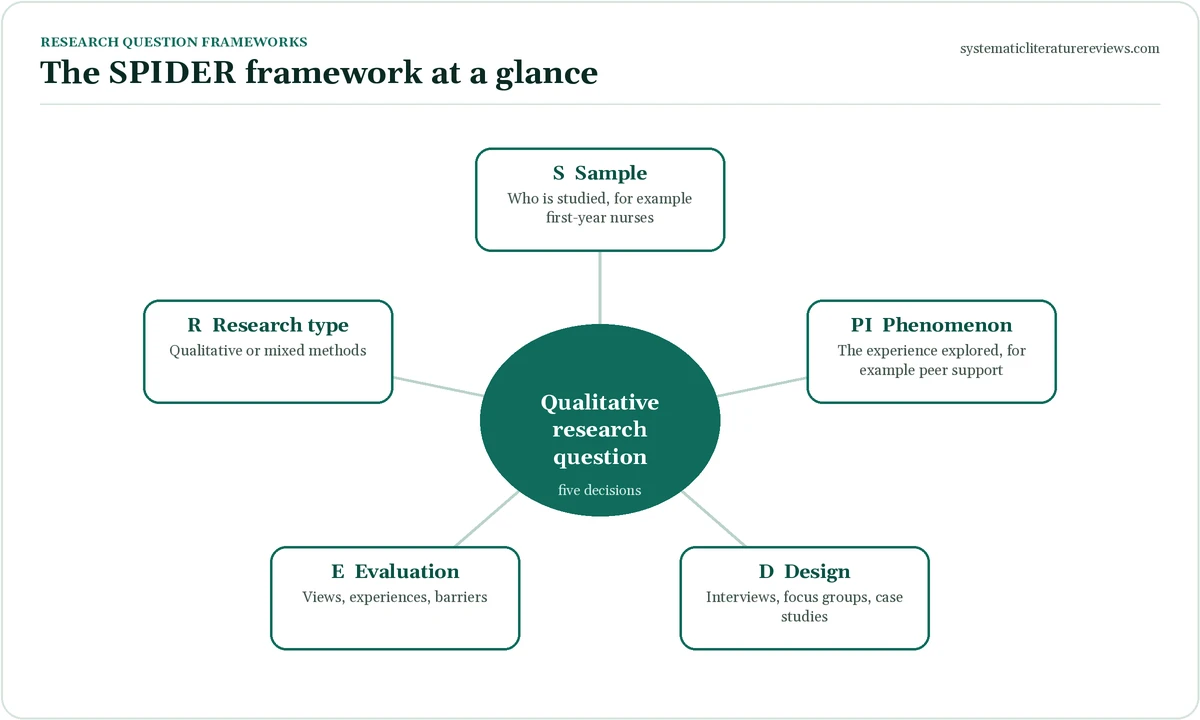
Each letter prompts one decision. Write each decision down and your review becomes easier to search, screen and defend.
- S: Sample: the people whose views you want, described by the features that matter, such as role, condition or setting. Example: newly qualified midwives, or first-generation university students.
- PI: Phenomenon of Interest: the experience, behaviour, decision or process you want to understand. It is the heart of the question. Example: medication adherence, peer support or return to work.
- D: Design: the study designs you will accept, because design tells you what evidence to expect. Example: interviews, focus groups, ethnography, phenomenology or grounded theory.
- E: Evaluation: the outcomes, which in qualitative work are views, perceptions, attitudes, experiences, barriers and facilitators. Example: perceived barriers to attending antenatal classes.
- R: Research type: whether you include qualitative, quantitative or mixed-methods studies. Example: qualitative and mixed-methods papers.
Notice that there is no Comparison. If you want to compare groups or settings, add that rule to your criteria or use the SPICE framework.
Step-by-step guide to using the SPIDER framework
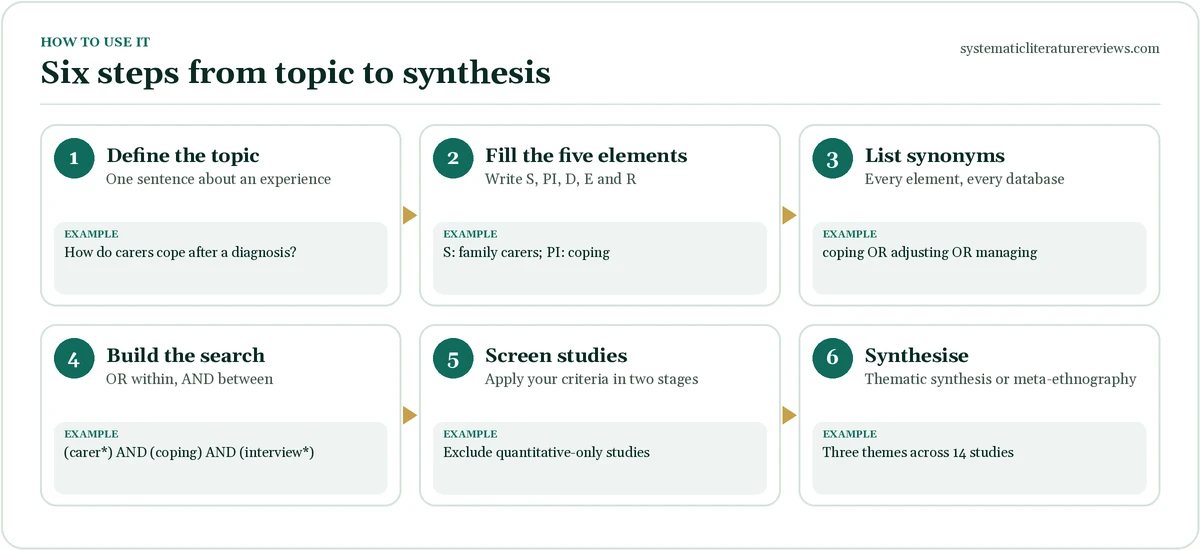
Follow the six steps in order. Each one has an explanation and an example you can copy.
- Define your topic in one sentence. Write the experience you care about in plain words. If the sentence needs two clauses, you probably have two questions. Example: How do women with postnatal depression experience peer support groups?
- Fill in the five elements. Write S, PI, D, E and R on one page. Keep each answer short. If you cannot name the Sample or the Phenomenon of Interest, the question is not yet specific enough. Example: S: women with postnatal depression; PI: peer support groups; D: interviews and focus groups; E: experiences, benefits and barriers; R: qualitative and mixed methods.
- List synonyms for each element. Qualitative studies use inconsistent vocabulary, so list alternatives and check each database thesaurus or MeSH. Example: peer support, support group, mutual aid, befriending.
- Build the search string. Join synonyms within an element with OR and join the elements with AND. Most searches use only Sample and Phenomenon of Interest. Example: (“postnatal depression” OR “postpartum depression”) AND (“peer support” OR “support group*”).
- Screen studies against your criteria. Turn each element into an eligibility rule and apply it to titles, abstracts and full texts, ideally with two independent reviewers. Example: Exclude a paper that reports only questionnaire scores with no participant accounts.
- Synthesise the findings. Choose a qualitative synthesis method that suits your aim and report it clearly. Example: Thematic synthesis of 14 studies produced three themes: belonging, stigma and practical help.
SPIDER framework examples
The table shows two complete examples. Each row is one decision you would record in your protocol.
| Element | Example 1: Health | Example 2: Education |
|---|---|---|
| Sample | Women with postnatal depression | First-year university students |
| Phenomenon of Interest | Peer support groups | Online peer mentoring |
| Design | Interviews, focus groups | Interviews, open-ended surveys |
| Evaluation | Experiences, benefits and barriers | Sense of belonging, perceived support |
| Research type | Qualitative and mixed methods | Qualitative and mixed methods |
- Question 1: what are the experiences of women with postnatal depression of attending peer support groups?
- Question 2: how do first-year university students experience online peer mentoring?
- Why they work: every term is defined, so a second reviewer would make the same screening decisions.
Turning the SPIDER framework into a search strategy
List synonyms for each element, join them with OR, and combine the blocks with AND.
- Sample string: (“postnatal depression” OR “postpartum depression” OR “perinatal depression”)
- Phenomenon string: (“peer support” OR “support group*” OR “mutual aid”)
- Design and evaluation string: (interview* OR “focus group*” OR qualitative OR experience*)
- Final search: combine the three blocks with AND in PubMed, CINAHL or PsycINFO.
- Check: run the search without the design block and compare, because qualitative studies are indexed inconsistently.
Record each database, the date, the exact string and the number of records. Our guides to the literature search strategy and Boolean operators explain the documentation, and the PRISMA flow diagram shows how to report it.
SPIDER framework vs PICO, PEO and SPICE
No framework suits every question. A comparison of search tools found PICO more sensitive and SPIDER more specific (Methley et al., 2014).
| Framework | Stands for | Best for |
|---|---|---|
| SPIDER | Sample, Phenomenon of Interest, Design, Evaluation, Research type | Qualitative and mixed-methods questions about experience |
| PICO | Population, Intervention, Comparison, Outcome | Clinical questions about effectiveness |
| PEO | Population, Exposure, Outcome | Risk factors and experiences |
| SPICE | Setting, Perspective, Intervention, Comparison, Evaluation | Service and programme evaluation |
See also the PICO framework and the PIO framework.
Common mistakes when using the SPIDER framework
Most problems come from writing the question too quickly. Use the fixes below.
- Sample too narrow: a single hospital may return no studies. Example: broaden to hospital-based midwives in one country.
- Using outcome vocabulary: qualitative papers rarely say outcome. Example: search for experience, perception, view and attitude instead.
- Over-filtering by design: terms such as phenomenological appear in few abstracts. Example: use broad design words or none, and screen instead.
- Ignoring grey literature: theses and reports hold rich qualitative data. Example: add a thesis database and Google Scholar.
- Changing the question mid-review: it introduces bias. Example: record any change and the reason in your methods.
Using the SPIDER framework in a thesis or dissertation
You do not need a full systematic review to benefit from SPIDER.
- Literature review chapter: state the framework in your methods, list the five elements and give search strings in an appendix.
- Primary research: map the elements onto your sampling plan (Sample), topic guide (Phenomenon of Interest), method (Design) and analysis focus (Evaluation).
- Appraisal: use a qualitative checklist such as CASP once you have your final set, and report with a standard such as ENTREQ from the EQUATOR Network.
- Methods sentence: the review question was framed with SPIDER: Sample, community pharmacists; Phenomenon of Interest, medication counselling; Design, interviews or focus groups; Evaluation, barriers and facilitators; Research type, qualitative or mixed methods.
Appraising and reporting studies found with the SPIDER framework
Finding studies is only half of the work. The points below show how to judge and report them.
- Appraise quality: use a checklist designed for qualitative research, such as the CASP qualitative checklist, to judge aims, method, sampling, data collection, analysis and the value of the findings. Example: a paper that does not explain how participants were chosen would score lower on sampling.
- Use two reviewers: two people screen and appraise independently, then discuss disagreements. Example: agreement can be reported as a simple percentage or with a kappa statistic.
- Choose a synthesis method: thematic synthesis, meta-ethnography and framework synthesis all suit SPIDER-based reviews. Example: thematic synthesis codes each paper line by line and groups codes into themes.
- Report transparently: describe the five elements, the search and the screening in your methods, and show the flow of records with a diagram. Example: a PRISMA-style flow chart with counts at each stage.
- State limitations: explain that qualitative indexing is inconsistent, so some relevant studies may be missed. Example: mention that you searched two extra sources to reduce this risk.
When to adapt or combine the SPIDER framework
Frameworks are tools, not rules. Adapt them when your question needs it.
- Mixed-methods reviews: use PICO for the quantitative strand and SPIDER for the qualitative strand, then integrate the two.
- Add a Comparison: if you want to compare experiences between groups, such as urban and rural carers, write that into the Sample or the eligibility rules.
- Add a Setting or Time: if context matters, add a line for it, or move to the SPICE framework, which has a Setting element.
- Scoping reviews: if you are mapping a broad topic rather than answering a narrow question, the PCC framework is often a better fit.
- Always document: whatever you change, record the change and the reason in your protocol.
A full SPIDER framework example: from question to eligibility rules
This example follows one nursing question all the way to screening rules, so you can see how each letter changes what you do.
| Element | Decision | How it is used |
|---|---|---|
| Sample | Family carers of people with dementia, any age, any country | Search term and screening rule |
| Phenomenon of Interest | Experience of respite care services | Search term and screening rule |
| Design | Interviews, focus groups, open-ended surveys | Screening rule only; not in the search |
| Evaluation | Views, barriers, facilitators, perceived benefit | Data extraction focus |
| Research type | Qualitative and mixed methods (qualitative strand) | Screening rule |
- Question: how do family carers of people with dementia experience respite care services?
- Search block 1: (“family carer*” OR caregiver* OR “informal carer*”) AND dementia
- Search block 2: (“respite care” OR “short break*” OR “day care” OR “respite service*”)
- Final search: block 1 AND block 2, then test against five papers you already know are relevant.
- Include: primary qualitative or mixed-methods studies reporting carers’ own accounts. Example: a paper with carers’ quotations about a day centre.
- Exclude: studies that report only caregiver burden scores, or the views of professionals only. Example: a survey that reports only a burden scale total.
- Extract: participant details, setting, service type, themes and illustrative quotations.
Related question frameworks
Choose the framework that matches your question, not the one you met first. This table links to every question framework in our library.
| Framework | Elements | Best for |
|---|---|---|
| PICO framework | Population, Intervention, Comparison, Outcome | Treatment and effectiveness questions |
| PICOT framework | PICO plus Time | Clinical questions with a follow-up period |
| PICOS framework | PICO plus Study design | Reviews that limit eligible study designs |
| PICOC framework | PICO plus Context | Reviews where the setting changes the answer |
| PICOTT framework | PICO plus Time and Type | Nursing and evidence-based practice questions |
| PIO framework | Population, Intervention or Interest, Outcome | Descriptive questions without a comparison |
| PEO framework | Population, Exposure, Outcome | Risk factors and experiences |
| PICo framework | Population, phenomenon of Interest, Context | Qualitative review questions |
| SPICE framework | Setting, Perspective, Intervention or Interest, Comparison, Evaluation | Service and social science reviews |
| PCC framework | Population, Concept, Context | Scoping reviews |
| CIMO framework | Context, Intervention, Mechanisms, Outcomes | Management and organisational research |
| ECLIPSE framework | Expectation, Client group, Location, Impact, Professionals, Service | Health service and policy questions |
| CLIP framework | Client group, Location, Improvement or Innovation, Professionals | Short service and policy searches |
| PIRD framework | Population, Index test, Reference test, Diagnosis | Diagnostic accuracy reviews |
| BeHEMoTh framework | Behaviour, Health context, Exclusions, Models or Theories | Searching for theory in reviews |
To test a finished question, use the FINER criteria, and for example questions see sample research questions.
Frequently asked questions about the SPIDER framework
Is the SPIDER framework only for qualitative reviews?
It was designed for qualitative and mixed-methods evidence, and that is where it works best. The five prompts can still help you frame any question about experience, such as how patients feel about a new service or how teachers describe a change in policy. If your question compares treatments or measures an outcome on a scale, PICO or PIO is usually a better choice. Many teams use both in a mixed-methods review: PICO for the quantitative strand and SPIDER for the qualitative strand, then they integrate the findings in a final synthesis section.
Do I have to use all five elements in the search?
No. Many reviewers search only on Sample and Phenomenon of Interest, because Design, Evaluation and Research type are indexed inconsistently in qualitative research. Adding them can hide relevant papers. A safer approach is to use all five elements to define the question and the screening rules, then put only the first two or three into the database search. Test the result against a short list of papers you already know are relevant, and make sure every one of them appears before you accept the search as final.
How is SPIDER different from PICO?
PICO has Population, Intervention, Comparison and Outcome, and it assumes there is a treatment to compare and a measurable result. SPIDER replaces those with Sample, Phenomenon of Interest, Design, Evaluation and Research type, which describe experiences instead of effects. PICO tends to be more sensitive, so it finds more records, while SPIDER is more specific and returns fewer irrelevant ones. Choose PICO for questions about whether something works, and SPIDER for questions about what something is like for the people involved.
Which databases should I search with the SPIDER framework?
Use at least two subject databases that suit your field, plus citation searching and grey literature. For health topics, PubMed or MEDLINE, CINAHL and PsycINFO are common. For education, use ERIC; for social science, try Scopus or Web of Science. Add a thesis source and Google Scholar to catch unpublished qualitative work. Record each database, the date and the exact search string, because a reproducible search is a core requirement of a systematic review and of reporting standards such as PRISMA.
Need expert help? Our experienced writers can handle the search, screening and write-up for you. Place your order in two minutes, or read how a systematic literature review works first.
Systematic Literature Reviews
Need help framing your research question?
Get a PICO, SPIDER, SPICE or PCC question and matching search strategy from experienced review writers.