
Blog
How Long Are Literature Reviews |Best Example

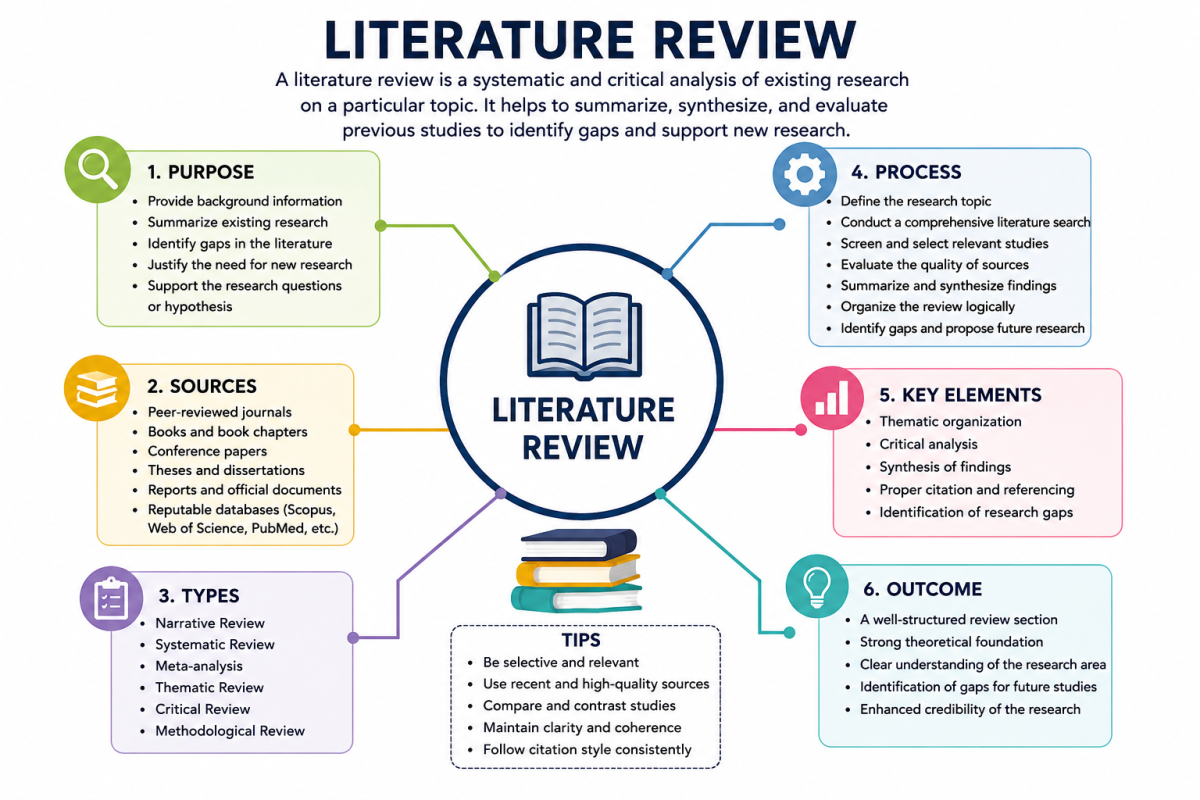
What Are Literature Reviews? Introduction, Definitions, and Their Purpose in Research
- Literature Reviews are structured evaluations of existing research
- Literature Reviews examine and analyze published studies, articles, books, and peer-reviewed sources related to a particular topic or research area.
- The main objective is to summarize and synthesize research findings from different authors in a clear and organized way.
- A literature review does not simply describe sources individually. Instead, it integrates ideas, compares evidence, and identifies patterns, disagreements, and identifying gaps within the research literature.
- In many cases, a lit review helps graduate students understand how previous scholars approached a subject area and which research methods were commonly used.
- A literature review is an essential part of academic research
- Most research papers, dissertations, and thesis projects include a literature review section.
- Writing the literature review provides background information and establishes the relevance of the current study.
- It helps researchers characterize the literature as a whole and explain how their work contributes to new research.
- In science and health sciences, Literature Reviews are especially important because they help researchers appraise research evidence before conducting primary research.
- Literature Reviews involve more than summarizing articles
- Students often think they only need to summarize articles published in their database search results.
- However, a strong literature review must summarize and synthesize information instead of listing studies one after another.
- Researchers must selectively choose the most important information related to the topic area.
- A good review process evaluates methodology, study designs, statistical findings, and the quality of citation evidence.
- Common purposes of Literature Reviews
- Explain what is already known about a research area.
- Identify inconsistencies in existing literature.
- Highlight limitations in previous reviews in the field.
- Support the thesis statement or hypothesis.
- Show the relevance of the current research paper.
- Provide an organizational framework for the study.
- Compare qualitative research and quantitative approaches.
- Help readers understand research findings within a broader context.
- Different types of literature reviews
- There are several review types used across academic disciplines.
- The types of literature reviews include:
- Systematic review
- Uses a highly structured search process and comprehensive search strategy.
- Often includes tabular summaries and statistically analyzed data.
- Common in health sciences and science research.
- Critical review
- Evaluates strengths and weaknesses of existing research.
- Researchers appraise and critique methodology and research methods.
- Thematic review
- Organizes studies according to themes or concepts instead of chronology.
- Useful for reviewing literature in broad research areas.
- Methodological review
- Focuses on the methodology and study designs used by researchers.
- Helps compare qualitative research and quantitative methods.
- Annotated bibliography
- Includes short summaries and evaluations of sources.
- Often used during the early stages of reviewing literature.
- Narrative review
- Provides a broad discussion of existing research without strict systematic literature procedures.
- Systematic review
- Why Literature Reviews are important for graduate students
- Graduate students use Literature Reviews to develop expertise in their area of interest.
- A literature search helps students locate peer-reviewed articles, research evidence, and primary research studies.
- Reviewing literature allows researchers to understand the history and development of a given field.
- The review may also help students refine their thesis statement and research questions.
- Strong Literature Reviews improve the credibility of a thesis and demonstrate academic understanding.
- Key characteristics of effective Literature Reviews
- Clear organizational structure.
- Accurate citation practices.
- Logical subsections and transitions.
- Balanced synthesis of research literature.
- Evidence-based analysis.
- Integration of different study findings.
- Sensitive search strategies using reliable database systems.
- Focus on relevance and research gaps.
How Long Are Literature Reviews? A 7-Step Process for Writing the Literature Review
Step 1: Define the Research Area and Main Objective
- Before attempting to write a literature review, researchers must define the particular topic clearly.
- The topic area should not be too broad or too narrow.
- Graduate students should identify:
- Their research area.
- The subject area being investigated.
- The thesis statement or research question.
- The main objective of the review process.
- For example:
- A weak topic: “Social Media”
- A stronger topic: “Effects of Social Media on Mental Health Among Graduate Students”
- A focused research area improves the literature search and helps researchers selectively identify relevant studies.
Step 2: Conduct a Comprehensive Literature Search
- Literature Reviews depend heavily on a strong search process.
- Researchers should use trusted database platforms such as:
- PubMed
- Scopus
- Google Scholar
- Web of Science
- JSTOR
- The literature search should include:
- Peer-reviewed journal articles.
- Primary research studies.
- Different types of review articles.
- Articles published recently within the given field.
- Researchers conducting systematic literature searches often use:
- Keywords
- Boolean operators
- Sensitive search strategies
- Citation tracking
- A comprehensive search ensures the review may capture all important information related to the topic.
Step 3: Evaluate and Appraise Sources
- Not every source found in a database is reliable.
- Researchers must appraise the quality and relevance of each study.
- During appraisal, researchers should examine:
- Methodology
- Sample size
- Study designs
- Statistical validity
- Biases
- Research methods
- In health sciences and science disciplines, evidence-based appraisal is especially important.
- A critical review requires deeper evaluation of weaknesses and strengths in existing research.
Step 4: Organize the Research Literature
- After collecting studies, researchers should organize the literature as a whole.
- Organizational strategies include:
- Chronological structure
- Thematic structure
- Methodological structure
- Conceptual typology
- Using subsections makes Literature Reviews easier to read and understand.
- Many researchers create:
- Research tables
- Tabular evidence summaries
- Annotated bibliography notes
- Organized reviewing literature helps researchers integrate findings more effectively.
Step 5: Summarize and Synthesize Research Findings
- One of the hardest parts of writing the literature review is learning to synthesize information.
- Researchers must summarize and synthesize instead of describing studies separately.
- Good synthesis involves:
- Comparing findings.
- Identifying patterns.
- Discussing contradictions.
- Explaining methodological differences.
- Integrating qualitative research and quantitative evidence.
- Example:
- Instead of stating what each article says individually, researchers explain broader trends across the research literature.
- Literature Reviews become stronger when they connect studies logically and analytically.
Step 6: Identify Gaps and Explain Relevance
- Literature Reviews should identify areas where existing research is incomplete.
- Identifying gaps helps justify the need for new research.
- Common gaps include:
- Small sample sizes
- Limited populations
- Weak methodology
- Lack of recent studies
- Insufficient qualitative research
- Researchers should explain how their research paper contributes to the field.
- This section strengthens the relevance of the study and demonstrates academic contribution.
Step 7: Write, Edit, and Properly Cite Sources
- The final step is writing the literature review clearly and professionally.
- Researchers should:
- Use formal academic language.
- Maintain logical flow between subsections.
- Integrate citation evidence correctly.
- Avoid plagiarism.
- Revise multiple drafts.
- Proper citation practices improve credibility and allow readers to verify sources.
- Effective Literature Reviews balance clarity, detail, and critical analysis.
How Long Are Literature Reviews in Science Graduate Research Projects?
- The length of Literature Reviews varies depending on:
- Academic level
- Research area
- Department requirements
- Types of literature reviews
- Complexity of the topic
- Undergraduate research papers
- Literature Reviews are usually shorter.
- Common length:
- 1,000–3,000 words
- 3–10 pages
- The focus is mainly on summarizing background information and demonstrating understanding of the research area.
- Master’s thesis projects
- A master’s thesis often includes a more detailed lit review.
- Common length:
- 3,000–8,000 words
- 10–30 pages
- Students must synthesize a larger body of existing literature and demonstrate stronger critical thinking.
- Doctoral dissertation Literature Reviews
- Doctoral Literature Reviews are usually extensive and highly analytical.
- Common length:
- 8,000–20,000+ words
- 30–80 pages
- PhD students are expected to characterize reviews in the field comprehensively and identify significant research gaps.
- Science and health sciences projects
- Science disciplines often require highly detailed systematic literature reviews.
- Literature Reviews in science may be longer because researchers must:
- Analyze quantitative evidence.
- Compare study designs.
- Evaluate methodology statistically.
- Discuss research evidence carefully.
- Health information studies frequently use systematic review structures and evidence-based appraisal methods.
- Factors influencing Literature Reviews length
- Scope of the research area.
- Availability of peer-reviewed sources.
- Number of research findings analyzed.
- Complexity of research methods.
- Whether the review includes qualitative research or quantitative analysis.
- Institutional guidelines.
- Purpose of the research paper or thesis.
- Typical structure of long Literature Reviews
- Introduction
- Background information
- Thematic subsections
- Methodological analysis
- Research gaps
- Critical discussion
- Summary and conclusion
- Longer Literature Reviews often contain multiple organizational subsections to improve readability.
- How to determine the right length
- Researchers should focus on quality rather than word count alone.
- A good literature review includes enough detail to:
- Summarize and synthesize existing research.
- Explain relevance.
- Support the thesis statement.
- Demonstrate understanding of the subject area.
- Avoid unnecessary repetition or overly descriptive summaries.
- Best practices for managing review length
- Focus selectively on highly relevant studies.
- Avoid discussing unrelated articles published outside the topic area.
- Use tabular summaries when comparing multiple studies.
- Integrate evidence logically instead of repeating findings.
- Maintain balance between breadth and depth.
- Final insight on Literature Reviews length
- Literature Reviews should be long enough to thoroughly evaluate the existing literature but concise enough to remain focused.
- Whether conducting a systematic review, critical review, or narrative review, the goal is always to synthesize knowledge clearly and effectively.
- Strong Literature Reviews help graduate students contribute meaningful insights to their given field while supporting credible and evidence-based research.
Types of Literature Reviews and Their Recommended Lengths
- Literature Reviews vary depending on their purpose and academic context
- Different types of Literature Reviews serve different research objectives.
- Some review types focus on summarizing research findings, while others emphasize critical analysis, synthesis, or methodology evaluation.
- The length of Literature Reviews often depends on:
- The research area
- The complexity of the subject area
- The amount of existing literature
- The expectations within a given field
- Systematic Review
- A systematic review follows a structured and transparent review process.
- Researchers conduct a comprehensive search across multiple database platforms using a sensitive search strategy.
- Systematic literature reviews are common in science and health sciences because they evaluate research evidence carefully and statistically.
- Features of a systematic review:
- Clearly defined research question
- Detailed search process
- Inclusion and exclusion criteria
- Appraisal of peer-reviewed studies
- Tabular presentation of findings
- Quantitative or qualitative synthesis
- Recommended length:
- 5,000–15,000+ words depending on the scope of the research paper or thesis.
- These Literature Reviews are usually longer because researchers must summarize and synthesize large amounts of existing research.
- Critical Review
- A critical review goes beyond summarizing studies.
- Researchers appraise methodology, study designs, citation quality, and research methods.
- The main objective is to characterize strengths and weaknesses in the literature as a whole.
- Critical reviews in the field often include:
- Evaluation of contradictions
- Comparison of research findings
- Assessment of relevance
- Identifying gaps
- Recommended length:
- 3,000–8,000 words.
- This type of literature review is common among graduate students preparing a thesis or dissertation.
- Thematic Literature Review
- A thematic literature review organizes information according to themes rather than publication dates.
- Researchers integrate studies discussing similar concepts within a topic area.
- This approach improves organizational clarity and makes reviewing literature easier for readers.
- Common thematic subsections may include:
- Social factors
- Economic factors
- Technological influences
- Methodological differences
- Recommended length:
- 2,500–7,000 words depending on the research area.
- Methodological Review
- Methodological Literature Reviews focus on research methods and methodology instead of findings alone.
- Researchers compare:
- Qualitative research
- Quantitative approaches
- Data collection tools
- Study designs
- These reviews are useful for identifying the most effective methods for a particular topic.
- Recommended length:
- 3,000–6,000 words.
- Narrative Review
- Narrative Literature Reviews provide broad background information about a subject area.
- They summarize articles published on a particular topic without following strict systematic literature procedures.
- Narrative reviews are easier to read but may lack the rigorous appraisal found in systematic review methods.
- Recommended length:
- 2,000–5,000 words.
- Annotated Bibliography
- An annotated bibliography contains short summaries and evaluations of sources.
- It is often used before writing the literature review.
- Each source includes:
- Citation details
- Summary
- Relevance
- Evaluation
- Recommended length:
- Usually shorter than full Literature Reviews.
- Often 100–300 words per source.
- Meta-Analysis
- Meta-analysis is a statistical extension of a systematic review.
- Researchers combine quantitative findings from multiple studies statistically.
- Common in health sciences and science disciplines.
- Recommended length:
- 8,000–20,000+ words depending on data complexity.
Key Factors That Determine the Length of a Literature Review
- Academic level
- The educational level strongly affects Literature Reviews length.
- Undergraduate lit review sections are shorter because students mainly summarize background information.
- Graduate students preparing a thesis or dissertation must synthesize complex research literature in greater depth.
- PhD-level Literature Reviews often require extensive reviewing literature and identifying gaps.
- Research area complexity
- Some subject areas naturally require longer Literature Reviews.
- Science, health information, and health sciences often involve:
- Large amounts of primary research
- Complex methodology
- Statistical analysis
- Multiple study designs
- Humanity disciplines may emphasize theoretical analysis and interpretation instead.
- Amount of existing literature
- Topics with extensive existing research require longer discussions.
- A broad research area may contain thousands of peer-reviewed articles published over decades.
- Researchers must selectively choose the most relevant studies while maintaining strong synthesis.
- Type of review
- Different types of literature reviews require different levels of detail.
- A systematic review is usually longer than a narrative review because of the detailed search process and appraisal requirements.
- Critical review and methodological review structures also increase overall length.
- Research objectives and thesis statement
- A focused thesis statement may reduce unnecessary discussion.
- Broad research questions usually produce longer Literature Reviews because researchers must cover more research findings and reviews in the field.
- Methodology and research methods
- Complex methodology sections increase length.
- Researchers comparing qualitative research and quantitative methods need additional subsections and methodological explanations.
- Institutional requirements
- Universities often provide research guides explaining expected word counts.
- Departments may specify:
- Minimum page counts
- Citation style
- Organizational format
- Number of sources required
- Need for synthesis and analysis
- Strong Literature Reviews prioritize analysis over simple description.
- The need to summarize and synthesize research findings adds depth and length to the review process.
Common Mistakes to Avoid When Writing the Literature Review
- Simply summarizing instead of analyzing
- One of the biggest mistakes in writing the literature review is describing studies individually without synthesis.
- Effective Literature Reviews integrate evidence and compare ideas across studies.
- Researchers should summarize and synthesize instead of creating isolated summaries.
- Using weak or unreliable sources
- Students sometimes use non-peer-reviewed websites or outdated articles.
- Strong Literature Reviews rely on:
- Peer-reviewed journals
- Primary research
- Trusted database sources
- High-quality research evidence
- Failing to identify gaps
- Literature Reviews should explain what is missing in existing research.
- Without identifying gaps, the review may fail to justify the relevance of the research paper.
- Poor organizational structure
- Weak organizational planning makes Literature Reviews difficult to follow.
- Researchers should use:
- Clear subsections
- Thematic categories
- Logical transitions
- Consistent formatting
- A strong organizational structure improves readability and flow.
- Ignoring methodology differences
- Different study designs produce different research findings.
- Researchers should appraise and compare methodology carefully instead of treating all studies equally.
- Overloading the review with unnecessary studies
- Including too many unrelated articles published outside the topic area weakens focus.
- Researchers should selectively include studies with direct relevance.
- Weak citation practices
- Missing citation details can damage credibility.
- Proper citation allows readers to trace sources and verify claims.
- Lack of critical review
- Literature Reviews should evaluate strengths and weaknesses instead of accepting findings uncritically.
- Critical review improves academic quality and demonstrates deeper understanding.
- Ignoring contradictory findings
- Some students only discuss studies supporting their thesis statement.
- Strong reviewing literature includes conflicting evidence and explains possible reasons for disagreements.
- Poor literature search strategy
- Weak search process methods may overlook important information.
- Researchers should conduct a comprehensive search using:
- Multiple database systems
- Keywords
- Citation tracking
- Sensitive search techniques
How Long Are Literature Reviews Compared Across Different Academic Fields?
- Science disciplines
- Science Literature Reviews are often extensive because they analyze quantitative data and research evidence.
- Common features include:
- Statistical comparisons
- Methodological analysis
- Systematic literature procedures
- Detailed appraisal of study designs
- Typical length:
- 5,000–20,000 words depending on the thesis level.
- Health sciences
- Health sciences frequently require systematic review methods.
- Researchers conduct comprehensive search procedures across medical database systems.
- Health information studies emphasize evidence-based appraisal and statistically supported conclusions.
- Typical length:
- 6,000–15,000+ words.
- Humanity and social sciences
- Humanity disciplines focus more on interpretation, theory, and qualitative research.
- Literature Reviews in these fields may discuss:
- Historical context
- Conceptual frameworks
- Thematic analysis
- Existing literature debates
- Typical length:
- 3,000–10,000 words.
- Business and management
- Business-related Literature Reviews often integrate practical and theoretical perspectives.
- Researchers may compare research methods, organizational theories, and industry findings.
- Typical length:
- 3,000–8,000 words.
- Engineering and technology
- Engineering Literature Reviews often focus on:
- Technical methodology
- Innovation trends
- Experimental findings
- Research methods
- Reviews may include tabular summaries comparing technologies or models.
- Typical length:
- 4,000–12,000 words.
- Engineering Literature Reviews often focus on:
- Education research
- Education Literature Reviews frequently combine qualitative research and quantitative evidence.
- Researchers explore teaching theories, policies, and classroom outcomes.
- Typical length:
- 3,000–9,000 words.
Best Practices for the Review Process and Structuring Strong Literature Reviews
- Begin with a focused literature search
- A focused literature search improves efficiency and relevance.
- Researchers should define:
- Keywords
- Topic area
- Subject area
- Research objectives
- Using multiple database systems improves access to important information.
- Use peer-reviewed and credible sources
- Strong Literature Reviews rely on trusted and peer-reviewed materials.
- Primary research articles provide stronger research evidence than opinion-based sources.
- Develop a clear organizational structure
- Good organizational planning improves readability.
- Researchers should divide the review into logical subsections.
- Effective structures include:
- Thematic
- Chronological
- Methodological
- Conceptual typology
- Integrate synthesis throughout the review
- Researchers should connect ideas instead of listing studies individually.
- Strong synthesis helps readers understand literature as a whole.
- Literature Reviews become more persuasive when they integrate findings logically.
- Use tabular summaries when necessary
- Tabular formats help summarize large amounts of research findings quickly.
- Tables may include:
- Authors
- Methodology
- Sample sizes
- Main findings
- Relevance
- Maintain balance between breadth and depth
- Effective Literature Reviews cover enough studies without becoming repetitive.
- Researchers should focus on the most relevant research literature.
- Appraise studies critically
- Strong reviewing literature involves appraisal, not just description.
- Researchers should evaluate:
- Validity
- Biases
- Methodology
- Research methods
- Limitations
- Update the review with new research
- Academic fields change rapidly.
- Literature Reviews should include recent articles published within the given field whenever possible.
- Revise and edit carefully
- Writing the literature review requires multiple revisions.
- Editing improves:
- Clarity
- Flow
- Citation accuracy
- Consistency
- Organizational quality
- Focus on relevance and contribution
- Every section of the lit review should connect directly to the research area and thesis statement.
- Strong Literature Reviews explain how existing research informs the current study and contributes to new research within the field.
