
Blog
How Many Sources Should A Literature Review Have?

How Many Sources Should A Literature Review Have? Expert Guide to Finding Peer-Reviewed Sources
Understanding a Literature Review: Definitions, Types of Reviews, and Types of Sources
- A Literature Review is a detailed examination and critical analysis of existing research on a specific research topic or research area.
- The purpose of a literature review is not simply to summarize research studies. Instead, it helps researchers synthesize knowledge, evaluate previous research findings, identify gaps, and provide an overview of the literature as a whole.
- In academic writing, a literature review forms an essential part of the research process because it demonstrates your understanding of the body of research within a given field.
- A good lit review also helps readers understand:
- What has already been studied
- Which research methods were used
- What conclusions researchers reached
- Where contradictions or research gaps exist
- How new research can contribute to the field
Key Definition of a Literature Review
- A literature review can be described as:
- A collection of scholarly sources analyzed together
- A synthesis of scholarly arguments and research findings
- A critical evaluation of previous research on a given topic
- A descriptive account of trends, debates, and different aspects of a research area
- In many cases, the literature review process involves:
- Conducting a literature search
- Finding sources relevant to the research question
- Evaluating the credibility of sources of information
- Organizing ideas into themes or categories
- Using citation methods correctly
- Drawing conclusions from the literature as a whole
Types of Reviews
There are several types of reviews used in academic research and scholarly writing.
Narrative Literature Review
- A narrative literature review provides a broad discussion of research on a topic.
- It often summarizes and interprets scholarly work without following a rigid research design.
- Common in social sciences and humanities.
- Useful when discussing broad key concepts and theories.
Systematic Review
- A systematic review follows a structured and exhaustive review process.
- Researchers use a predefined search strategy to collect studies.
- Sources are selected using strict inclusion and exclusion criteria.
- Often used in health sciences, psychology, education, and quantitative studies.
- Helps minimize bias and validate conclusions.
- Many systematic review studies include a meta-analysis.
Meta-Analysis
- A meta-analysis combines numerical data from multiple primary studies.
- Researchers statistically analyze research findings to identify patterns.
- Often used in quantitative research.
- Helpful for measuring the effectiveness of treatments, interventions, or study designs.
Scoping Review
- A scoping review maps available research on a given topic.
- It identifies major themes, trends, and research gaps.
- Useful when studying emerging or broad research areas.
Integrative Review
- Combines findings from qualitative research and quantitative research.
- Helps researchers synthesize different forms of evidence.
Types of Sources Used in a Literature Review
Understanding the types of sources is critical when deciding the need for your literature review.
Primary Sources
- A primary source contains original research or primary data collected directly by researchers.
- Examples include:
- Original papers
- Research studies
- Conference papers
- Journal article publications
- Dissertation research
- Observational studies
- Experimental studies that randomize participants
- Primary and secondary sources are both valuable, but primary studies are often considered stronger evidence because they present firsthand findings.
Secondary Sources
- Secondary sources analyze or interpret primary studies.
- Examples include:
- Review articles
- Review papers
- Literature review articles
- Scholarly books
- Commentary papers
- Secondary sources help researchers understand the literature as a whole and identify trends across a body of research.
Tertiary Sources
- Tertiary sources summarize information from primary and secondary sources.
- Examples include:
- Encyclopedia entries
- Textbook materials
- Bibliography databases
- LibGuides
- These sources are useful during the early stages of the literature review process because they provide background information and key concepts.
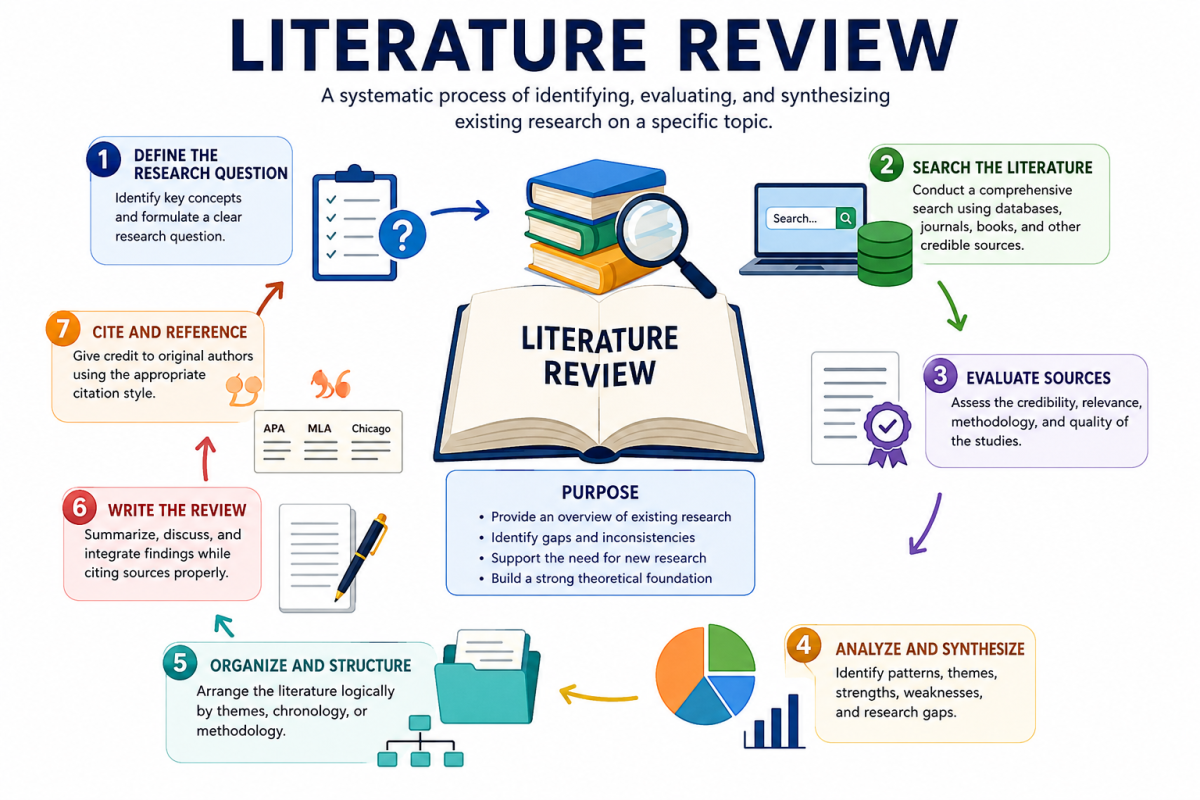
How Many Sources Should A Literature Review Have? A 7-Step Literature Review Process to Formulate a Strong Research Question
Step 1: Identify and Formulate Your Research Question
- Every successful Literature Review begins with a clear research question.
- Your research question should:
- Be focused and specific
- Address a research gap
- Relate to a meaningful research topic
- Be manageable within your research process
- For example:
- Weak question: “What is education?”
- Strong question: “How does online learning affect student performance in higher education?”
- A strong research question helps:
- Guide the literature search
- Narrow down types of sources
- Improve organizational structure
- Support critical analysis
Step 2: Conduct a Comprehensive Literature Search
- The next stage in the literature review process is finding sources.
- Researchers should use multiple sources of information to collect relevant scholarly materials.
Common Databases and Platforms
- Google Scholar
- JSTOR
- PubMed
- Scopus
- University library databases
- LibGuides
Effective Search Strategy Tips
- Use keywords connected to your research topic
- Search using synonyms and related terms
- Combine terms with Boolean operators:
- AND
- OR
- NOT
- Example:
- “social media AND academic performance”
- “qualitative research AND education”
Step 3: Evaluate the Credibility of Sources
- Not every source is reliable or peer-reviewed.
- During the review process, researchers must evaluate each source carefully.
Important Evaluation Criteria
- Is the journal article peer reviewed?
- Is the research recent?
- Are the research methods reliable?
- Does the abstract clearly explain the study?
- Are the conclusions supported by evidence?
- Recent articles are often preferred because they reflect new research and updated research findings.
Step 4: Organize and Categorize Sources
- Organizing sources improves the literature review process.
- Researchers can group materials based on:
- Themes
- Study designs
- Research methods
- Theoretical perspectives
- Chronological order
- Organizational methods help readers understand different aspects of the research area.
Step 5: Analyze and Synthesize the Literature
- A strong Literature Review does more than summarize studies.
- Researchers must synthesize information by comparing and connecting findings.
Questions to Ask During Synthesis
- Which studies agree?
- Which findings contradict each other?
- What patterns appear across the body of research?
- Which research methods are most effective?
- What gaps remain unanswered?
- This stage requires critical evaluation and critical analysis.
Step 6: Develop a Clear Structure
- A literature review should flow naturally.
- Common organizational formats include:
- Thematic structure
- Chronological structure
- Methodological structure
- A good structure helps provide an overview of the literature clearly and logically.
Step 7: Use Proper Citation and Final Review
- Correct citation is essential in scholarly writing.
- Citation helps:
- Avoid plagiarism
- Credit original authors
- Strengthen academic credibility
- Before submission:
- Proofread the review
- Check bibliography formatting
- Confirm all sources are cited correctly
- Ensure arguments align with the research question
How Many Sources Should A Literature Review Have? Choosing Between Primary and Secondary Sources
- One common challenge in writing a Literature Review is deciding whether to use primary or secondary sources.
When to Use Primary Sources
Primary sources are best when:
- You need original evidence
- You want direct access to primary data
- You are analyzing research methods
- You want firsthand research findings
Examples include:
- Experimental studies
- Observational studies
- Qualitative research interviews
- Quantitative surveys
- Original journal article publications
Advantages of Primary Sources
- Provide direct evidence
- Offer detailed methodology
- Increase research credibility
- Help validate claims
Limitations of Primary Sources
- Can be difficult to interpret
- Often technical and time-consuming
- May focus on narrow study populations
When to Use Secondary Sources
Secondary sources are useful when:
- You need summaries of existing evidence
- You want broader understanding
- You are studying literature as a whole
Examples include:
- Systematic review articles
- Meta-analysis papers
- Review articles
- Scholarly books
Advantages of Secondary Sources
- Save time during finding sources
- Help summarize large amounts of information
- Identify major themes and debates
- Provide synthesis across multiple studies
Limitations of Secondary Sources
- May contain author bias
- Could overlook important primary studies
- Sometimes outdated
Best Practice: Use Both Primary and Secondary Sources
- Most researchers should combine primary and secondary sources.
- A balanced Literature Review often includes:
- Primary studies for evidence
- Secondary sources for broader interpretation
- Tertiary materials for background understanding
Finding Sources for a Literature Review: Using Peer-Reviewed Journal Articles, Review Articles, and Tertiary Sources
- Finding high-quality sources is one of the most important parts of the literature review process.
Using Peer-Reviewed Journal Articles
- Peer-reviewed sources are evaluated by experts before publication.
- Peer-reviewed journal article publications are considered highly credible.
Why Peer-Reviewed Sources Matter
- They improve academic quality
- They support critical evaluation
- They provide reliable research findings
- They strengthen scholarly credibility
How to Find Articles Efficiently
Researchers can find articles by:
- Using Google Scholar
- Searching academic databases
- Reviewing reference lists
- Reading conference papers
- Exploring bibliography sections
Understanding Review Articles and Review Papers
- Review articles summarize research on a topic.
- They help researchers:
- Identify trends
- Understand major debates
- Discover influential studies
- Many review papers are excellent starting points for beginners.
Using Tertiary Sources Carefully
- Tertiary sources such as encyclopedia entries and textbook materials can help explain key concepts.
- However, they should not dominate a scholarly Literature Review.
Tips for Effective Finding Sources
Use Multiple Databases
- Avoid relying on one database alone.
- Different databases index different types of document collections.
Focus on Recent Articles
- Recent articles reflect new research and updated perspectives.
Read Abstracts First
- The abstract helps determine whether the source matches your research topic.
Track Important Authors
- Leading scholars often publish multiple influential studies within a given field.
Save Sources Properly
- Use citation managers to organize:
- PDFs
- Notes
- Bibliography entries
- Citation records
Final Thoughts on Finding Sources
- The quality of your Literature Review depends heavily on the quality of sources you collect.
- Strong scholarly sources help:
- Support arguments
- Strengthen synthesis
- Improve critical analysis
- Answer research questions effectively
- A well-developed literature review demonstrates your ability to evaluate, synthesize, and organize research on a topic professionally and academically.
How Many Sources Should A Literature Review Have? Factors That Determine the Right Number of Citations
- One of the most common questions students ask during the literature review process is: “How many sources should a Literature Review have?”
- There is no single universal answer because the number of citations depends on several academic and practical factors.
- A strong Literature Review focuses more on the quality, relevance, and scholarly value of sources rather than simply reaching a specific number.
The Academic Level of Your Work Matters
The type of academic project strongly influences the need for your literature review and the number of sources required.
Undergraduate Assignments
- Short essays or introductory lit review assignments may require:
- 10–20 scholarly sources
- Mostly peer-reviewed journal article references
- A mixture of primary and secondary sources
- In many social sciences courses, instructors prioritize:
- Clear synthesis
- Proper citation
- Understanding of key concepts
- Ability to summarize research findings
Master’s Dissertation
- A dissertation literature review usually requires:
- 30–80 sources
- A broader collection of scholarly materials
- More detailed critical evaluation
- Students are expected to:
- Synthesize literature as a whole
- Compare different research methods
- Evaluate study designs
- Discuss different aspects of the research area
Doctoral Research
- Doctoral-level research studies often include:
- 100+ sources
- Exhaustive literature search strategies
- Systematic review methods
- Extensive critical analysis
- PhD researchers must demonstrate mastery of:
- The body of research
- Existing theories
- Research gaps
- New research trends in a given field
The Complexity of the Research Topic
- The complexity of your research question directly affects the number of citations needed.
Broad Research Topics
- Broad topics require more sources because they cover many perspectives.
- Example:
- “Technology in education” is extremely broad.
- It may involve:
- Qualitative research
- Quantitative studies
- Observational research
- Different study designs
- Researchers may need review articles, original papers, conference papers, and systematic review studies to provide an overview.
Narrow Research Topics
- Narrow topics often require fewer but highly focused sources.
- Example:
- “Effects of AI feedback tools on postgraduate writing performance”
- This type of Literature Review may rely heavily on:
- Recent articles
- Primary studies
- Peer-reviewed journal article publications
Types of Reviews Influence Citation Numbers
Different types of reviews require different numbers of sources.
Narrative Literature Review
- A narrative Literature Review may use:
- 20–50 sources
- Flexible organizational methods
- Broad discussion of research findings
Systematic Review
- A systematic review often includes:
- Hundreds of studies
- Detailed search strategy documentation
- Clear inclusion and exclusion criteria
- Researchers conducting systematic review studies often:
- Collect large amounts of primary data
- Evaluate research methods carefully
- Validate conclusions using rigorous standards
Meta-Analysis
- A meta-analysis requires enough quantitative data from primary studies to produce meaningful conclusions.
- Researchers may randomize studies into categories for comparison.
The Availability of Research in Your Research Area
- Some research areas contain extensive literature, while others are still developing.
Well-Established Research Areas
- Topics in medicine, psychology, and education often have:
- Large collections of scholarly publications
- Extensive review papers
- Multiple journal article databases
- Researchers can easily find articles through:
- Google Scholar
- LibGuides
- University databases
Emerging Research Areas
- New or highly specialized topics may have limited sources of information.
- In these cases:
- Quality matters more than quantity
- Researchers may rely on conference papers and recent articles
The Importance of Source Quality
- A Literature Review filled with weak sources is less effective than one with fewer but credible references.
Strong Scholarly Sources Include:
- Peer-reviewed journal article publications
- Original papers
- Primary studies
- Review articles
- Meta-analysis studies
- Scholarly books
Weak Sources Often Include:
- Unverified websites
- Non-scholarly blogs
- Outdated textbook references
- Unsupported opinion pieces
Balancing Primary and Secondary Sources
- Most strong Literature Review sections combine:
- Primary source materials
- Secondary sources
- Limited tertiary references
Why This Balance Matters
- Primary and secondary sources serve different purposes.
- Primary data supports original evidence.
- Secondary sources help summarize broader trends and synthesize research on a topic.
Final Thought on Citation Numbers
- There is no perfect number of citations for every Literature Review.
- Instead, researchers should focus on:
- Relevance
- Scholarly credibility
- Depth of critical evaluation
- Strong synthesis
- Clear answers to these questions:
- What is already known?
- What remains unknown?
- What gaps require new research?
Common Mistakes in the Literature Review Process and How to Avoid Weak Secondary Sources
- Many students struggle during the literature review process because they misunderstand the purpose of a Literature Review.
- Avoiding common mistakes can dramatically improve the quality of your research process.
Mistake 1: Using Too Few Sources
- A weak Literature Review often lacks enough scholarly evidence.
- Using only a few citations can:
- Limit critical analysis
- Reduce credibility
- Prevent proper synthesis
How to Avoid This Mistake
- Conduct an exhaustive literature search
- Use multiple databases
- Find articles from different perspectives
- Include both classic and recent articles
Mistake 2: Relying Too Much on Secondary Sources
- Secondary sources are useful, but overusing them weakens originality.
- Students sometimes depend entirely on:
- Review papers
- Encyclopedia entries
- Textbook materials
Why This Is a Problem
- Secondary sources summarize existing findings instead of presenting primary data.
- A strong Literature Review should include original research studies and primary studies.
Better Approach
- Combine:
- Primary and secondary sources
- Peer-reviewed original papers
- Review articles for context
Mistake 3: Failing to Synthesize Information
- Many students simply summarize one source after another.
- This creates a descriptive account instead of a true synthesis.
Example of Weak Writing
- “Author A found this. Author B found that.”
Better Approach
- Compare findings across studies
- Evaluate similarities and differences
- Discuss patterns in the body of research
- A strong Literature Review should synthesize evidence rather than list disconnected summaries.
Mistake 4: Ignoring Research Gaps
- A lit review should identify unanswered questions.
- Some students fail to explain:
- Why their research topic matters
- What gaps exist
- How their research question contributes new knowledge
How to Improve
- Analyze the literature as a whole
- Identify contradictions
- Discuss underexplored areas
Mistake 5: Using Outdated Sources
- In rapidly changing fields, outdated sources weaken research quality.
Better Practice
- Include recent articles whenever possible
- Use new research to support current discussions
- Balance foundational studies with updated findings
Mistake 6: Poor Citation and Bibliography Management
- Incorrect citation formatting damages academic credibility.
Common Problems
- Missing bibliography entries
- Inconsistent citation styles
- Incorrect author names
- Missing journal article details
Helpful Tools
- Citation managers
- Google Scholar citation tools
- University LibGuides
Mistake 7: Weak Search Strategy
- Poor finding sources methods can limit the quality of research.
Strong Search Strategy Tips
- Use specific keywords
- Search using Boolean operators
- Explore multiple sources of information
- Read abstracts before downloading papers
How Many Sources Should A Literature Review Have? Best Practices for Citation, Organization, and the Research Process
- A successful Literature Review requires strong organizational skills and careful planning.
- Good organization improves readability and strengthens scholarly arguments.
Start with a Clear Research Question
- Every Literature Review should begin with a focused research question.
- A focused question helps:
- Formulate objectives
- Guide the literature search
- Narrow the research area
Use a Structured Organizational Method
Different organizational approaches can improve clarity.
Thematic Organization
- Groups studies by themes or key concepts.
- Common in social sciences and qualitative research.
Chronological Organization
- Discusses studies based on publication date.
- Useful for tracking developments in a given field.
Methodological Organization
- Organizes studies according to research methods or study designs.
Keep Detailed Notes During the Research Process
- Researchers should collect and organize:
- Citations
- Abstract summaries
- Research findings
- Methodological notes
Use Citation Consistently
- Citation consistency demonstrates professionalism.
- Always follow the required academic style:
- APA
- MLA
- Chicago
- Harvard
Focus on Scholarly Sources
- Strong Literature Review sections rely heavily on:
- Peer-reviewed studies
- Journal article publications
- Primary studies
- Review articles
Evaluate Every Source Critically
Before using a source, ask:
- Is it peer reviewed?
- Is it relevant to the research topic?
- Does it provide reliable primary data?
- Are the research methods sound?
Include Multiple Types of Sources
- Combining different types of sources improves depth.
Examples include:
- Original papers
- Conference papers
- Review papers
- Meta-analysis studies
- Systematic review articles
Maintain Logical Flow
- Ideas should connect naturally between paragraphs and sections.
- A good Literature Review should provide an overview while maintaining strong analytical flow.
Strengthening Your Literature Review with Credible Primary Sources and a Clear Review Process
- Strong scholarly writing depends heavily on source credibility and a well-structured review process.
Why Primary Sources Matter
- A primary source presents direct evidence from original research.
- Examples include:
- Experimental research studies
- Observational studies
- Survey data
- Qualitative interviews
Benefits of Primary Sources
Primary studies help:
- Validate arguments
- Strengthen critical evaluation
- Improve academic credibility
- Support research findings with firsthand evidence
Combining Qualitative and Quantitative Research
- Many modern Literature Review projects include:
- Qualitative research
- Quantitative analysis
Qualitative Research
- Focuses on experiences, meanings, and interpretations.
- Common in social sciences.
Quantitative Research
- Uses numerical analysis and statistical methods.
- Often used in systematic review and meta-analysis studies.
Importance of a Clear Review Process
- A structured literature review process improves consistency and reliability.
Effective Review Process Steps
- Formulate the research question
- Conduct the literature search
- Evaluate sources critically
- Organize findings logically
- Synthesize research findings
- Write clearly and analytically
- Review citation accuracy
Conduct Critical Analysis Instead of Simple Summary
- Strong Literature Review writing goes beyond simple description.
- Researchers should:
- Compare study designs
- Evaluate methodologies
- Discuss limitations
- Analyze contradictions
Use Credible Sources of Information
Reliable sources include:
- Peer-reviewed journal article publications
- Scholarly databases
- University repositories
- Dissertation archives
- Collection of scholarly books
Final Thoughts
- A successful Literature Review is not determined only by the number of citations.
- Instead, quality depends on:
- Strong synthesis
- Scholarly credibility
- Effective citation
- Thorough literature search
- Balanced use of primary and secondary sources
- Clear organizational structure
- When researchers carefully evaluate evidence, synthesize findings, and maintain a structured research process, they create a Literature Review that contributes meaningful insights to their given topic and broader research area.
