
Blog
What Is a Literature Review?

What Is a Literature Review? Introduction, Meaning, and Purpose in a Research Paper
- Many students often ask, what is a literature review? A literature review is an organized discussion of existing literature related to a specific research topic or research area. It examines academic articles, books, reports, and other scholarly sources connected to a particular subject area.
- In simple terms, when asking what is a literature review?, it is important to understand that a literature review is a summary of previous work, but it also goes beyond simple description. A strong review of literature combines both summary and synthesis to present a clear understanding of a body of knowledge.
- The focus of a literature review is to:
- Identify key themes and key concepts
- Analyze previous work
- Discuss major debates in the field of knowledge
- Highlight gaps in the research
- Show how your research question fits into the scholarly conversation
- A literature review helps readers understand:
- Existing research on a topic
- Important theories and theoretical framework
- Methods used in previous studies
- The direction of academic research in a field of study
- When people ask, what is a literature review?, they should know that it is not simply copying information from sources cited. Instead, it requires critical analysis of the literature and careful reviewing literature from different perspectives.
- A good lit review should:
- Summarize and synthesize findings
- Compare arguments and ideas of others
- Analyze patterns and contradictions
- Present a new interpretation of old material
- Combine new with old interpretations
- In many disciplines such as social sciences, humanity, business, and education, the literature review forms an important section of a larger paper or research paper.
- The body of the literature review is usually divided into subsections that organize information clearly. These subsections may be arranged:
- Chronologically
- Thematically
- Methodologically
- Theoretically
- A systematic review is another type of literature review that follows a structured search strategy to identify and analyze all relevant information in a particular subject.
- A literature review also improves the credibility of the writer because it demonstrates familiarity with seminal works and major academic articles in the field.
- Students searching for answers to what is a literature review? should understand that the process involves:
- Reading sources carefully
- Taking notes
- Annotating sources
- Organizing ideas
- Comparing viewpoints
- Synthesizing information
- Many university research guides and writing center resources explain that synthesis is a re-organization of ideas from different studies into a logical discussion.
- Instead of listing studies one after another, effective writers summarize and synthesize the arguments to create a meaningful discussion.
- This means a literature review:
- Combines both summary and synthesis
- Connects related studies
- Shows relationships between concepts
- Identifies weaknesses and strengths in existing research
- Another reason why students ask what is a literature review? is because they confuse it with an annotated bibliography. However, the two are different:
- An annotated bibliography briefly summarizes each source separately
- A literature review connects and synthesizes multiple sources into one discussion
- The number of sources included in a literature review depends on:
- The breadth of the research topic
- The academic level
- The field of study
- The purpose of the research process
- In academic research, the review of literature helps researchers narrow down the topic and identify a research question worth investigating.
- A strong literature review also reveals:
- Gaps in the research
- Conflicting findings
- Areas needing further exploration
- Opportunities for creating a new argument
- Understanding what is a literature review? is essential because it forms the foundation for meaningful academic writing and helps position your study within the wider body of knowledge.
How To Write Literature Review in 7 Simple Steps
Step 1: Understand the Research Topic
- The first step in learning how to write a literature review is understanding your research topic clearly.
- Before beginning, ask yourself:
- What is the main research question?
- What particular subject area am I studying?
- What information do I need to collect?
- A focused topic makes reviewing literature easier and prevents confusion during the research process.
- If the topic is too broad, narrow down the topic into a manageable research area.
Step 2: Develop a Search Strategy
- A good search strategy helps you locate relevant information efficiently.
- Use:
- Academic databases
- Google Scholar
- Research guides
- Library catalogs
- Journals and academic articles
- Search using keywords related to your research topic and key concepts.
- Focus on:
- Seminal studies
- Recent publications
- Peer-reviewed sources
- Existing literature
- While searching, annotate useful findings and organize sources carefully.
Step 3: Read and Analyze Sources
- Once sources are collected, begin analyzing existing research carefully.
- Do not only summarize sources cited. Instead:
- Analyze methods
- Compare findings
- Examine arguments
- Identify patterns
- Evaluate strengths and weaknesses
- Critical analysis of the literature helps you understand how studies relate to one another.
- This stage is important because a literature review is not simply a summary of information.
Step 4: Organize the Literature
- After reading sources, organize the material into logical sections.
- Common organizational methods include:
- Thematically
- Chronologically
- Methodologically
- By theory
- Group similar arguments and ideas together.
- Creating subsections improves readability and strengthens the body of the literature review.
- Good organizational structure helps readers follow the scholarly conversation clearly.
Step 5: Summarize and Synthesize Information
- One major skill needed to write a literature review is learning how to summarize and synthesize information effectively.
- Many students ask, what is a literature review? The answer becomes clearer here because synthesis is a re-organization of information from multiple studies into one connected discussion.
- To summarize and synthesize:
- Compare viewpoints
- Discuss agreements and disagreements
- Connect related findings
- Explain trends in the field of knowledge
- Effective writers synthesize the arguments and ideas rather than discussing one source at a time.
Step 6: Write the First Draft
- Begin writing the literature review using your organized notes.
- Include:
- Introduction
- Main body
- Conclusion
- The body of the literature review should:
- Present key themes
- Discuss previous work
- Analyze important findings
- Explain gaps in the research
- Use proper citation style throughout the research paper.
- Maintain logical flow between paragraphs and subsections.
Step 7: Revise and Edit Carefully
- Revision improves clarity, coherence, and quality.
- During editing:
- Check grammar
- Remove repetition
- Improve transitions
- Verify citation accuracy
- Ensure ideas flow naturally
- Review whether your literature review:
- Answers the research question
- Includes relevant information
- Demonstrates critical thinking
- Supports your theoretical framework
- Many students searching what is a literature review? realize during revision that the strongest reviews are balanced, analytical, and well organized.
How To Write Literature Review| Best Example for a Strong Research Paper
- A strong literature review example demonstrates how to connect multiple studies into one meaningful discussion.
- Example topic:
- The impact of social media on academic performance among university students.
- Weak approach:
- Listing one study after another without connections.
- Strong approach:
- Summarizing and synthesizing findings from several studies together.
Example Structure
Introduction
- Introduce the research topic
- Explain the research question
- Define key concepts
- State the purpose of the review of literature
Main Discussion
- Discuss positive effects of social media
- Analyze negative impacts on concentration
- Compare conflicting findings
- Identify gaps in the research
Conclusion
- Summarize major findings
- Highlight unanswered questions
- Suggest areas for future academic research
- A strong literature review combines both summary and synthesis rather than simple description.
- The best reviews:
- Summarize and synthesize the arguments
- Compare arguments and ideas of others
- Connect existing research on a topic
- Present a new argument supported by evidence
- Good examples also include:
- Proper citation
- Logical organizational structure
- Clear transitions
- Balanced discussion
- When students ask, what is a literature review?, examples help them understand how ideas are connected within a scholarly conversation.
Common Mistakes to Avoid When You Write a Literature Review
1. Only Summarizing Sources
- One of the biggest mistakes is treating the literature review as a simple summary.
- Remember:
- Literature review is a summary, but it also requires analysis and synthesis.
- Avoid discussing each source separately without connections.
2. Using Weak Sources
- Avoid unreliable websites or unsupported opinions.
- Use:
- Academic articles
- Peer-reviewed journals
- Scholarly books
- Trusted databases
- Strong sources improve the credibility of the writer.
3. Poor Organization
- Disorganized writing confuses readers.
- Use:
- Clear subsections
- Logical flow
- Consistent structure
- Organize information thematically or chronologically for better readability.
4. Ignoring Gaps in the Research
- Many weak reviews fail to identify gaps in the research.
- A strong review explains:
- What previous work has covered
- What still needs investigation
- Why the study matters
5. Lack of Critical Analysis
- Another common mistake is failing to analyze sources deeply.
- Good reviewing literature involves:
- Evaluating evidence
- Comparing viewpoints
- Examining research methods
- Discussing limitations
- Critical analysis of the literature strengthens the overall research paper.
6. Weak Citation Practices
- Missing or incorrect citation creates academic problems.
- Always:
- Credit sources cited
- Follow required formatting style
- Include a bibliography
- Accurate citation demonstrates professionalism and ethical academic research.
7. Including Too Many Irrelevant Sources
- More sources do not always improve quality.
- Focus on:
- Relevant information
- Seminal works
- Important academic articles
- Studies directly connected to the research topic
- The number of sources should match the scope and breadth of the study.
8. Failing to Connect Studies
- A literature review should not read like isolated summaries.
- Instead:
- Synthesize the arguments and ideas
- Show relationships between studies
- Discuss key themes
- Explain major debates
- Effective reshuffling of ideas creates a stronger and more engaging discussion.
- Many students continue asking, what is a literature review? because they struggle with synthesis. However, understanding that synthesis is a re-organization of ideas helps improve writing quality significantly.
How To Write Literature Review| Best Example Using a Systematic Review Approach
- Many students searching what is a literature review? often encounter the term systematic review during academic research. A systematic review is a highly structured and organized type of review of literature that follows a clear step-by-step guide for identifying, selecting, and analyzing existing research on a topic.
- Unlike a traditional lit review, a systematic review uses a defined search strategy to reduce bias and improve accuracy.
- A systematic review is especially common in:
- Social sciences
- Medicine
- Education
- Psychology
- Humanity
- Scientific research fields
- When learning what is a literature review?, it is important to understand that a systematic review combines both summary and synthesis while following strict research procedures.
- The focus of a literature review using this method is to:
- Collect relevant information
- Analyze previous work
- Identify key themes
- Highlight gaps in the research
- Compare findings across studies
- Build a stronger body of knowledge
Step 1: Define the Research Question
- Every systematic review begins with a clear research question.
- A focused research question helps:
- Narrow down the topic
- Identify the research area
- Improve the research process
- Guide the search strategy
- Example:
- How does online learning affect academic performance among university students?
- A strong research question improves the organizational structure of the entire literature review.
- Many students asking what is a literature review? struggle because their topic is too broad. Defining the question early makes reviewing literature easier and more effective.
Step 2: Develop a Search Strategy
- A search strategy determines how sources will be collected.
- Use:
- Academic databases
- Google Scholar
- University research guides
- Writing center resources
- Journals and academic articles
- Focus on:
- Seminal studies
- Peer-reviewed research
- Existing literature
- Relevant information in a particular subject
- Keywords should include:
- Research topic
- Key concepts
- Related theories
- Synonyms connected to the field of study
- Good search strategies improve the credibility of the writer because they demonstrate careful reviewing literature.
Step 3: Select and Organize Sources
- After collecting studies, begin filtering sources carefully.
- Include:
- Reliable academic articles
- Recent studies
- Previous work relevant to the research area
- Exclude:
- Weak sources
- Unverified opinions
- Irrelevant materials
- Organize studies:
- Thematically
- Chronologically
- Methodologically
- Proper reshuffling of information helps readers understand relationships between studies.
- Many learners asking what is a literature review? misunderstand organization. A strong review is not random; it follows a logical structure.
Step 4: Analyze and Synthesize Findings
- This is one of the most important stages when learning how to write a literature review.
- Students should not only summarize sources cited. Instead, they should:
- Analyze patterns
- Compare arguments
- Evaluate strengths and weaknesses
- Identify contradictions
- Discuss key themes
- Critical analysis of the literature strengthens the overall research paper.
- Remember:
- Literature review is a summary, but it also requires synthesis.
- Synthesis is a re-organization of ideas from different studies into one connected discussion.
- Effective writers summarize and synthesize the arguments instead of discussing one source at a time.
- This means:
- Connecting arguments and ideas of others
- Combining new with old interpretations
- Creating a new interpretation of old material
- A systematic review also helps identify:
- Gaps in the research
- Areas requiring further study
- Major debates in the field of knowledge
Step 5: Present the Findings Clearly
- The body of the literature review should contain clear subsections that improve readability.
- Each subsection should:
- Focus on a key theme
- Explain major findings
- Discuss similarities and differences
- Support the theoretical framework
- Good literature reviews summarize and synthesize the arguments while maintaining smooth flow between paragraphs.
- Proper citation is important throughout the research paper because it acknowledges sources cited and improves academic integrity.
- Many people still ask, what is a literature review? The best answer is that it is a structured discussion of existing research on a topic that combines analysis, synthesis, and interpretation.
Best Strategies to Analyze Sources in a Literature Review
- One major challenge students face when learning what is a literature review? is understanding how to analyze sources effectively.
- Strong reviewing literature requires more than reading articles. It involves deep evaluation of information, methods, findings, and arguments.
1. Read Sources Actively
- Do not read passively.
- While reading:
- Annotate key points
- Highlight important arguments
- Record useful citation details
- Identify major themes
- Annotating sources improves understanding and makes writing easier later.
- Some students create an annotated bibliography before drafting the body of the literature review.
2. Identify Key Concepts
- Every research topic contains important key concepts.
- Identify:
- Definitions
- Theories
- Models
- Recurring ideas
- These concepts help organize the literature review logically.
- Many students asking what is a literature review? fail to notice patterns connecting different studies.
3. Compare Arguments and Findings
- Effective literature reviews compare arguments and ideas of others.
- Ask:
- Which studies agree?
- Which studies disagree?
- Why do findings differ?
- This comparison helps synthesize the arguments and ideas into a meaningful discussion.
- Good writers summarize and synthesize findings instead of simply listing studies.
4. Evaluate Research Methods
- Critical analysis of the literature requires evaluating research methods.
- Consider:
- Sample size
- Data collection methods
- Reliability
- Biases
- Limitations
- Evaluating methods improves the quality of academic research.
5. Identify Gaps in the Research
- One purpose of analyzing existing research is identifying gaps in the research.
- Look for:
- Understudied populations
- Conflicting results
- Outdated findings
- Missing perspectives
- Gaps create opportunities for a new argument or future research.
- Many students searching what is a literature review? do not realize that identifying research gaps is one of the most valuable parts of the research process.
6. Group Studies by Themes
- Organizing studies thematically improves clarity.
- Common thematic categories include:
- Causes
- Effects
- Theories
- Research methods
- Historical development
- Thematic organization creates better flow in the body of the literature review.
7. Maintain Objectivity
- Avoid personal opinions unsupported by evidence.
- Base conclusions on:
- Existing literature
- Academic articles
- Reliable evidence
- Sources cited
- Objectivity increases the credibility of the writer and strengthens the scholarly conversation.
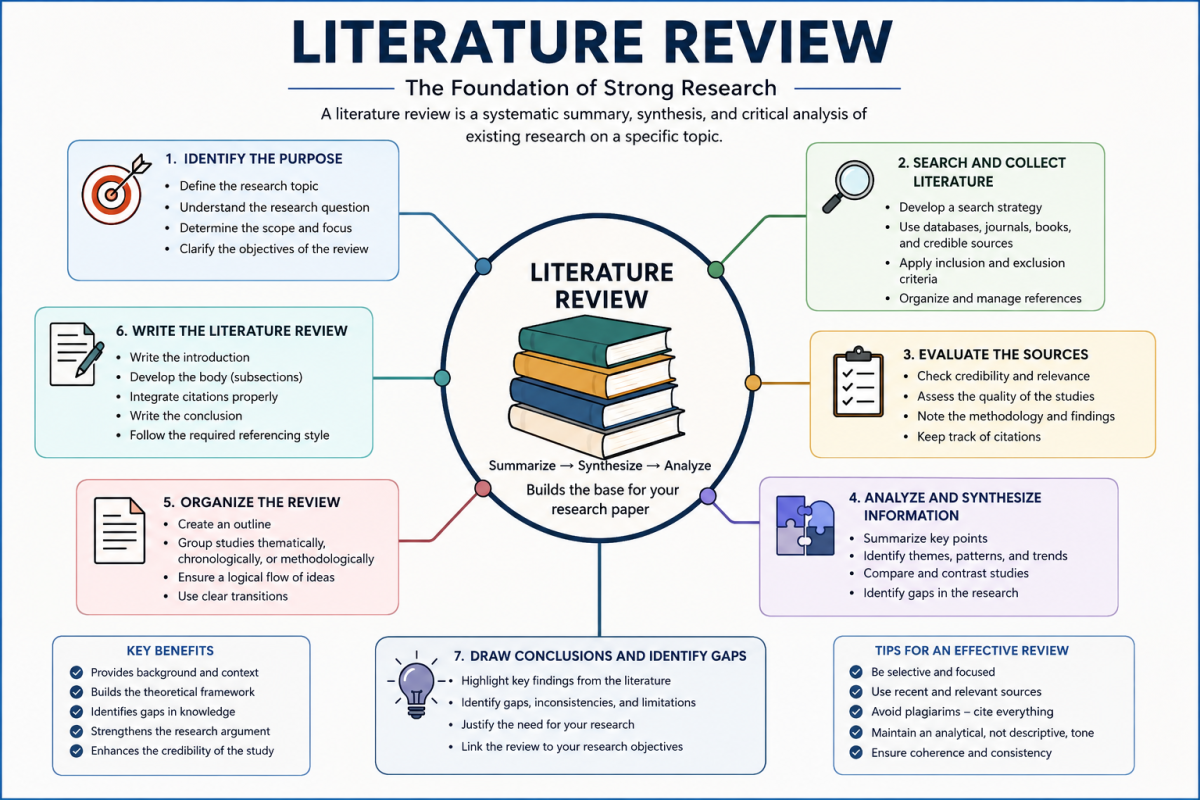
Types of Literature Review and Their Role in Academic Research
- Many students asking what is a literature review? are surprised to learn that there are different types of literature review used in academic research.
- Each type serves a different purpose depending on the field of study and research question.
1. Traditional Literature Review
- This is the most common type.
- It provides:
- A broad overview of previous work
- Analysis of existing literature
- Discussion of major theories
- Traditional reviews are common in:
- Social sciences
- Humanity
- Education
- The focus of a literature review here is usually broad understanding of a particular subject area.
2. Systematic Review
- A systematic review follows strict methods for collecting and analyzing studies.
- It aims to:
- Reduce bias
- Improve reliability
- Provide comprehensive findings
- Systematic reviews are highly structured and often include a comprehensive list of studies.
3. Scoping Review
- A scoping review examines the breadth of research available on a topic.
- It helps:
- Identify gaps in the research
- Explore emerging research areas
- Understand the field of knowledge
- This type is useful when little research exists on a particular subject.
4. Theoretical Review
- This type focuses on theories and theoretical framework.
- It examines:
- Key concepts
- Existing models
- Relationships between theories
- Theoretical reviews help researchers develop stronger arguments in a larger paper.
5. Historical Review
- Historical reviews organize information chronologically.
- They explain:
- How ideas evolved
- Changes in academic research over time
- Development of major debates
- This type is common in humanity and history-related fields.
6. Critical Review
- A critical review emphasizes evaluation and interpretation.
- It goes beyond summary by:
- Challenging assumptions
- Analyzing strengths and weaknesses
- Presenting a new argument
- This type requires strong critical analysis of the literature.
7. Annotated Bibliography
- Although slightly different from a full lit review, an annotated bibliography helps organize sources during the research process.
- Each source includes:
- Summary
- Evaluation
- Relevance to the research topic
- Annotated bibliographies often help students understand what is a literature review? before writing the complete paper.
How To Write Literature Review Tips for a Clear Conclusion
- Many students spend too much time on the introduction and body of the literature review while ignoring the conclusion.
- However, the conclusion is important because it connects the entire review of literature together.
1. Restate the Main Focus
- Begin by reminding readers about:
- The research question
- The research topic
- The focus of a literature review
- Keep this section concise and direct.
2. Summarize Key Findings
- A strong conclusion should summarize major points from the review.
- Focus on:
- Key themes
- Important findings
- Major debates
- Patterns in existing research on a topic
- Effective writers summarize and synthesize the arguments clearly.
3. Highlight Gaps in the Research
- Discuss areas needing further study.
- Mention:
- Missing evidence
- Underexplored topics
- Weaknesses in previous work
- Identifying gaps in the research strengthens the overall research paper.
4. Connect Findings to the Research Question
- Explain how the literature review supports the research question.
- Show how the existing literature contributes to understanding the topic.
- Many students asking what is a literature review? overlook this connection, making their conclusions weak.
5. Avoid Introducing New Information
- Do not introduce entirely new studies or arguments.
- Instead:
- Reinforce existing discussion
- Clarify important insights
- Conclude logically
6. Emphasize the Importance of the Topic
- Explain why the research area matters within the wider body of knowledge.
- Discuss:
- Relevance to academic research
- Impact on the field of study
- Importance for future studies
7. End with a Strong Final Statement
- Finish confidently.
- A strong final statement should:
- Reinforce the purpose of the review
- Highlight the importance of analyzing existing research
- Encourage future scholarly conversation
- Understanding what is a literature review? becomes easier when students learn that a good conclusion ties together analysis, synthesis, organization, and interpretation into one complete academic discussion.
