
Blog
How to Write a Literature Review |Best Example

What Is a Literature Review? Introduction, Definitions, and Purpose in a Thesis
- A literature review is a critical part of academic writing that examines, evaluates, and discusses existing research on a topic. It helps readers understand the current state of research within a particular field of knowledge and shows how scholars’ ideas connect, differ, or develop over time.
- In simple terms, a literature review is a critical analysis of published studies, books, peer-reviewed journal articles, government reports, and other academic materials related to a chosen topic. Rather than simply listing studies, the review is a critical analysis that requires analyzing and synthesizing information from multiple sources.
- Many students learn how to write a literature review during undergraduate or postgraduate studies because literature reviews are often included in a thesis, dissertation, research paper, or standalone piece of academic work. A lit review may also appear as part of a larger paper to support the main argument and explain the research methodology used in the study.
- The purpose of a review of literature is to:
- Summarize and synthesize current research.
- Identify gaps in existing knowledge.
- Show the current state of research on a research topic.
- Explain the theoretical framework connected to a study.
- Support a research question or hypothesis.
- Provide a critical understanding of different methodological approaches.
- Demonstrate knowledge in the field through analysis and synthesis.
- Literature review in research is important because it prevents duplication of studies and helps researchers discover areas that require further investigation. By reviewing recent literature, researchers can identify weaknesses, contradictions, and opportunities for new research.
- A strong literature review provides readers with a clear understanding of how a research problem developed. It also demonstrates why the study matters within the broader field of knowledge.
- When students write a literature review, they are expected to do more than summarize sources. They must:
- Compare viewpoints from different disciplines.
- Analyze research methods used by scholars.
- Evaluate the strengths and weaknesses of studies.
- Synthesize findings from multiple sources.
- Add your own interpretations based on evidence.
- For example, if a thesis focuses on online education, the literature review process may involve reviewing peer-reviewed journal articles about student engagement, qualitative learning experiences, digital teaching methodology, and technological challenges in academic environments.
- In many thesis or dissertation projects, the literature review appears near the beginning because it establishes the background of the study. It explains what existing research on a topic already says and where the researcher intends to contribute new knowledge.
- A literature review is also closely connected to conducting research because it guides the writing process and helps researchers refine their research question. During the review sections, researchers may discover:
- Missing evidence in current research.
- Contradictory conclusions from scholars’ work.
- Weak methodological approaches.
- Emerging trends in recent literature.
- The process of analyzing and synthesizing sources requires organization and planning. Researchers often use grouping methods to categorize studies according to:
- Themes.
- Research methods.
- Time periods.
- Theoretical framework.
- Geographic focus.
- Findings and conclusions.
- A literature review may include both qualitative and quantitative studies depending on the research topic. Qualitative studies often explore experiences, opinions, or behaviors, while quantitative studies focus on numerical analysis and measurable data.
- Understanding how to write a literature review correctly is essential because literature review is a critical component of research credibility. Poor organization or weak synthesis can make a thesis appear incomplete or unsupported.
- Students who learn how to write effective review sections improve their ability to present a logical thesis statement, build a convincing main body, and support their main argument with evidence from peer-reviewed sources.
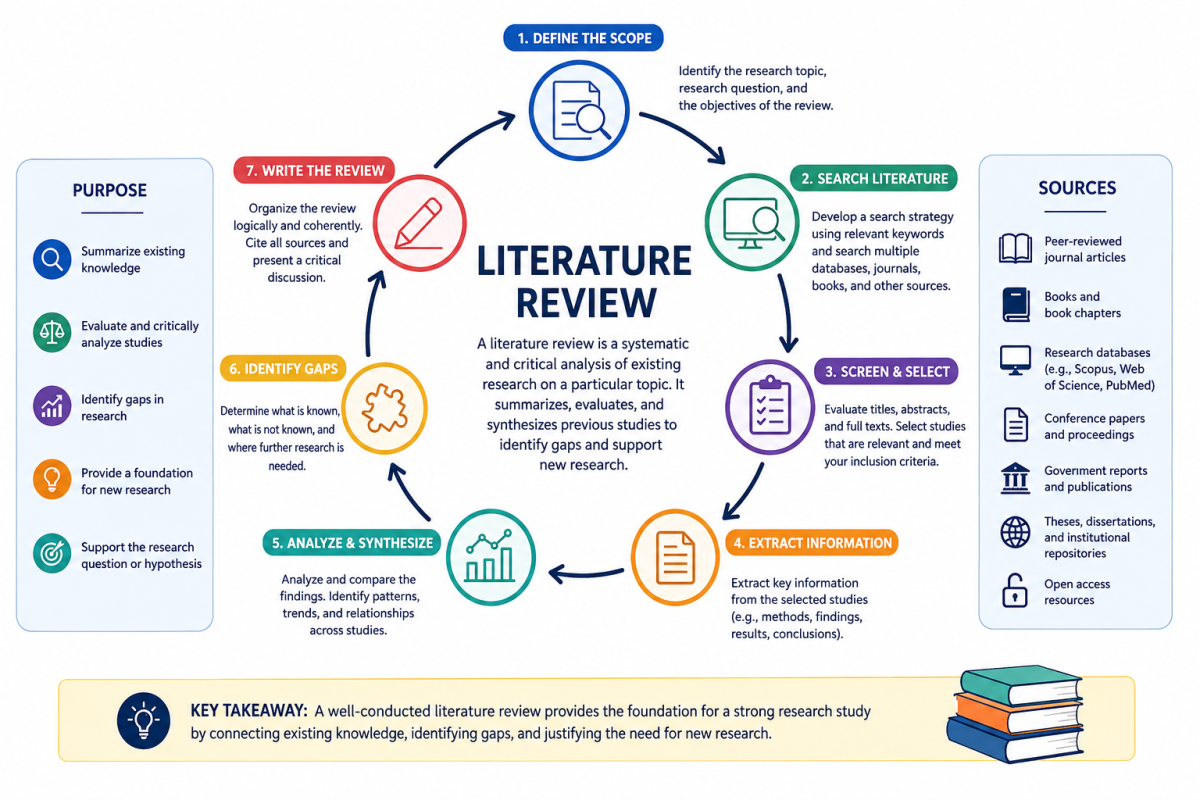
How to Write a Literature Review: 7-Step Literature Review Process
Step 1: Understand the Research Topic and Research Problem
- The first step in learning how to write a literature review is understanding the chosen topic clearly. Before searching for sources, researchers must define:
- The research problem.
- The research question.
- The thesis statement.
- The overall purpose of the study.
- A clear focus prevents the literature review process from becoming too broad or confusing. For example, instead of researching “education,” a more focused topic could be “the impact of online learning on university student performance.”
- At this stage, researchers should also form a preliminary hypothesis to guide conducting research.
Step 2: Develop a Search Strategy
- A strong search strategy helps researchers locate reliable and relevant information efficiently. This step involves selecting:
- Relevant keywords.
- Academic databases.
- Peer-reviewed sources.
- Open access materials.
- Common databases used during conducting research include:
- PubMed.
- Google Scholar.
- JSTOR.
- Scopus.
- University repository systems.
- Researchers should use multiple databases because different platforms index different peer-reviewed journal articles and journal article collections.
- Effective keyword combinations improve search results. For example:
- “online learning AND academic performance.”
- “qualitative methodology in higher education.”
- “student engagement systematic review.”
Step 3: Evaluate and Select Sources
- Not every source is academically reliable. During this stage, researchers evaluate whether sources are:
- Peer-reviewed journal articles.
- Current research publications.
- Relevant to the research topic.
- Credible and evidence-based.
- High-quality literature reviews are often built from peer-reviewed journal articles, government reports, academic books, and systematic review publications.
- Researchers should avoid relying heavily on outdated or unsupported sources because literature review provides an overview of the current state of research.
Step 4: Read, Analyze, and Take Notes
- Once sources are selected, researchers begin analyzing and synthesizing information carefully.
- Instead of copying information directly, students should:
- Summarize important findings.
- Paraphrase arguments accurately.
- Record citation details.
- Identify patterns and contradictions.
- Many researchers create an annotated bibliography during this stage. An annotated bibliography includes a short summary and evaluation of each source.
- Citation management tools like Zotero and EndNote are extremely useful because they help organize citation information and automatically generate references.
Step 5: Categorize and Group the Literature
- One of the most important parts of the literature review process is learning how to categorize studies effectively.
- Researchers often use grouping techniques based on:
- Themes.
- Research methods.
- Chronology.
- Findings.
- Methodological approaches.
- This organizational structure improves clarity and allows the review to flow naturally.
- For example, a review about healthcare technology may contain subsections discussing:
- Patient satisfaction.
- Artificial intelligence tools.
- Ethical concerns.
- Clinical efficiency.
Step 6: Synthesize Information and Build Arguments
- Synthesis is different from simple summary writing. Instead of discussing sources separately, researchers combine findings from multiple sources to identify relationships and broader conclusions.
- During synthesis, researchers:
- Compare scholars’ viewpoints.
- Explain agreements and disagreements.
- Discuss research methodology differences.
- Identify gaps requiring further investigation.
- This stage is essential because review is a critical analysis, not merely a collection of summaries.
- Strong synthesis demonstrates deep understanding of existing knowledge and current research within the field.
Step 7: Write and Revise the First Draft
- The final stage involves preparing the first draft of the literature review.
- Most review sections include:
- Introduction.
- Main body.
- Conclusion.
- The introduction explains the research topic and outlines the purpose of the review.
- The main body presents organized synthesis and critical analysis of studies.
- The conclusion summarizes major findings, highlights gaps, and explains how the literature review supports the thesis or dissertation.
- The writing process is not always a linear process. Researchers usually revise several times to improve:
- Clarity.
- Flow.
- Citation accuracy.
- Academic writing style.
- Analysis and synthesis quality.
How to Write a Literature Review for a Thesis Successfully
- Writing a literature review for a thesis requires careful planning, strong organization, and consistent critical thinking.
- One important strategy is maintaining focus on the research question throughout the writing process. Every source included should contribute directly to the thesis or dissertation objectives.
- Successful researchers avoid describing studies individually without connection. Instead, they summarize and synthesize ideas from multiple sources to create a coherent discussion.
- A strong thesis literature review should:
- Provide a critical discussion of existing research.
- Support the theoretical framework.
- Explain relevant methodological approaches.
- Connect evidence to the main argument.
- Students should also balance breadth and depth. Including too many unrelated sources weakens the organizational structure and confuses readers.
- During academic writing, transitions between subsections should feel smooth and logical. Each paragraph should connect clearly to the next.
- Another important aspect of how to write a literature review successfully is maintaining proper citation practices. Every paraphrase, summary, or quotation must cite the original author correctly.
- Researchers should also avoid excessive quotation because literature reviews focus mainly on analysis and synthesis rather than copying source material.
- Editing is equally important. Before submission, researchers should check:
- Grammar and clarity.
- Citation formatting.
- Logical flow.
- Repetition.
- Consistency in terminology.
- A successful literature review demonstrates both subject knowledge and the ability to provide a critical interpretation of existing research on a topic.
Best Sources to Use When You Write a Literature Review
- Choosing reliable sources is one of the most important aspects of learning how to write a literature review effectively.
- The best sources usually include peer-reviewed journal articles because they undergo expert evaluation before publication.
- Common high-quality sources include:
- Peer-reviewed journal articles.
- Academic books.
- Government reports.
- Systematic review studies.
- Conference papers.
- University repository materials.
- Open access research publications.
- Journal article databases are essential during conducting research because they provide access to current research and recent literature.
- Popular databases include:
- PubMed.
- Scopus.
- Web of Science.
- Google Scholar.
- JSTOR.
- Researchers should use multiple databases to ensure comprehensive coverage of the field of knowledge.
- Government reports are also valuable because they often provide large-scale statistical findings and policy analysis related to a particular topic.
- Researchers should prioritize recent literature whenever possible because the current state of research changes continuously through new research developments.
- However, older foundational studies may still be important if they shaped the theoretical framework or introduced influential research methods.
- Reliable sources strengthen the credibility of a literature review and improve the overall quality of the thesis, dissertation, or research paper.
- Learning how to write a literature review properly involves understanding not only how to find sources, but also how to evaluate their authority, relevance, methodology, and contribution to existing knowledge.
How to Categorize Sources and Themes in a Literature Review
- One of the most important parts of learning how to write a literature review is understanding how to categorize sources and organize themes correctly. Many students collect dozens of peer-reviewed journal articles, books, and government reports but struggle to arrange them into a logical structure.
- A literature review is a critical discussion of existing research on a topic, which means organization is essential. Without proper grouping and synthesis, the review sections may appear disconnected and difficult to follow.
- When researchers write a literature review, they should avoid discussing one journal article after another without connection. Instead, they should summarize and synthesize findings from multiple sources to create a smooth and meaningful discussion.
- The literature review process becomes easier when researchers first identify the main themes connected to the research topic. Themes usually emerge during conducting research and reviewing current research from multiple databases.
- Common ways to categorize literature include:
- Thematic grouping.
- Chronological grouping.
- Methodological grouping.
- Theoretical grouping.
- Geographic grouping.
Thematic Grouping
- Thematic grouping is one of the most effective methods used in academic writing. Researchers organize studies according to recurring ideas or themes related to the chosen topic.
- For example, a literature review in research about online learning may contain subsections discussing:
- Student engagement.
- Academic performance.
- Digital accessibility.
- Teaching methodology.
- Qualitative learning experiences.
- This method allows researchers to summarize and synthesize scholars’ viewpoints while comparing different methodological approaches.
- Thematic grouping also strengthens analysis and synthesis because it highlights patterns, contradictions, and identify gaps within existing knowledge.
Chronological Grouping
- Chronological organization arranges studies according to publication dates or historical development.
- This method works well when researchers want to explain how existing research on a topic evolved over time.
- For example:
- Early studies may focus on traditional research methods.
- Recent literature may explore advanced technology or new research trends.
- Chronological organization helps readers understand the current state of research and how scholars’ perspectives changed within the field of knowledge.
Methodological Grouping
- Researchers may also categorize studies based on research methodology and research methods.
- Common categories include:
- Qualitative studies.
- Quantitative studies.
- Mixed-methods studies.
- Systematic review publications.
- This organizational approach is useful when comparing strengths and weaknesses of different methodological approaches.
- For instance, qualitative studies may provide deeper insights into human experiences, while quantitative studies may offer statistical evidence related to a research problem.
Theoretical Grouping
- Some literature reviews are structured around a theoretical framework.
- In this approach, researchers compare scholars’ theories, concepts, and interpretations related to a particular topic.
- This helps support the thesis statement and strengthen the main argument within a thesis or dissertation.
Geographic Grouping
- Geographic grouping categorizes studies according to countries, regions, or populations studied.
- This is especially useful when conducting research involving education, healthcare, economics, or policy analysis across different disciplines.
How to Organize Sources Efficiently
- During the writing process, researchers should maintain organized records of all sources.
- Helpful organizational techniques include:
- Creating spreadsheets.
- Using annotated bibliography notes.
- Highlighting relevant keywords.
- Using citation management tools like Zotero and EndNote.
- Saving sources in a repository folder.
- Citation management tools like Zotero are particularly useful because they help researchers:
- Store citation details.
- Generate references automatically.
- Categorize peer-reviewed sources.
- Organize journal article files.
- Researchers should also use multiple databases such as PubMed, JSTOR, Scopus, and Google Scholar to locate peer-reviewed journal articles and open access materials.
- Effective categorization improves the main body of the literature review because readers can follow the discussion logically and understand how different studies connect.
- A strong literature review provides more than simple summaries. It must provide a critical understanding of the current state of research while demonstrating analysis and synthesis of multiple sources.
- Learning how to write a literature review successfully requires patience because the literature review process is not always a linear process. Researchers often reorganize subsections several times before completing the first draft.
Common Mistakes to Avoid When Learning How to Write a Literature Review
- Many students struggle when learning how to write a literature review because they misunderstand the purpose of a review of literature.
- A literature review is a critical analysis of existing research on a topic, not a simple list of summaries from journal articles.
- One major mistake is describing studies individually without synthesis. Some students summarize one source after another without comparing or connecting ideas.
- Instead, researchers should summarize and synthesize information from multiple sources while identifying similarities, differences, and contradictions.
Failing to Focus on the Research Question
- A common problem in academic writing is including unrelated studies that do not support the research question.
- Every source included in the literature review should contribute directly to:
- The research problem.
- The thesis statement.
- Theoretical framework.
- Main argument.
- Including irrelevant information weakens the organizational structure and distracts readers from the chosen topic.
Using Weak or Unreliable Sources
- Another major mistake is relying on weak sources instead of peer-reviewed journal articles and peer-reviewed sources.
- Researchers should avoid:
- Unverified websites.
- Unsupported opinions.
- Outdated studies without relevance.
- Non-academic materials lacking citation information.
- Strong literature reviews are often based on:
- Peer-reviewed journal articles.
- Government reports.
- Open access academic sources.
- Systematic review publications.
- Academic books.
Poor Search Strategy
- Ineffective search strategy techniques can limit the quality of conducting research.
- Some students use only one database, which reduces access to current research and recent literature.
- Researchers should use multiple databases including:
- PubMed.
- JSTOR.
- Google Scholar.
- Scopus.
- Using relevant keywords improves search accuracy and helps researchers identify gaps in existing knowledge.
Lack of Critical Analysis
- Another frequent mistake is failing to provide a critical discussion of studies.
- Review is a critical analysis, meaning researchers should:
- Evaluate research methods.
- Compare methodological approaches.
- Analyze strengths and weaknesses.
- Discuss conflicting findings.
- Students who only paraphrase sources without analysis fail to demonstrate knowledge in the field.
Weak Organization and Grouping
- Poor grouping and weak subsections make literature reviews difficult to read.
- Researchers should categorize studies logically to improve flow within review sections.
- Strong organizational techniques make it easier for readers to understand the literature review process.
Citation and Referencing Errors
- Incorrect citation formatting is another common issue in thesis or dissertation writing.
- Researchers must cite every summarized or paraphrased idea correctly.
- Citation mistakes may lead to plagiarism concerns and reduce academic credibility.
- Citation management tools like Zotero and EndNote help reduce errors during the writing process.
Writing Without Revision
- Many students submit the first draft without proper editing.
- However, the writing process requires multiple revisions to improve:
- Clarity.
- Grammar.
- Analysis and synthesis.
- Organizational structure.
- Citation accuracy.
- Researchers should remember that literature reviews are often revised several times before final submission.
How to Write a Literature Review |Best Example for Students and Researchers
- Understanding how to write a literature review becomes easier when students examine a practical example.
- Below is a simplified example showing how researchers can summarize, synthesize, and analyze studies naturally.
Example Topic
- Research topic: “The impact of social media on academic performance among university students.”
Weak Example
- “Smith (2022) studied social media use among students. Johnson (2023) researched online distractions. Brown (2021) examined study habits.”
- This example lacks synthesis because it only lists studies separately.
Strong Example
- “Existing research on a topic suggests that excessive social media use negatively affects academic performance among university students. Smith (2022) found that prolonged online activity reduced study concentration, while Johnson (2023) linked digital distractions to lower examination performance. However, Brown (2021) argued that educational social platforms may improve collaborative learning experiences. These findings demonstrate conflicting perspectives that require further investigation.”
Why the Strong Example Works
- The stronger version succeeds because it:
- Summarize and synthesize multiple sources.
- Demonstrates critical analysis.
- Connects scholars’ findings.
- Highlights contradictions.
- Identifies areas requiring new research.
- This is important because literature review provides readers with a clear understanding of existing knowledge and the current state of research.
Example Structure for a Strong Literature Review
- Introduction.
- Introduce the research problem.
- Explain the research question.
- Present the thesis statement.
- Main body.
- Organize studies into subsections.
- Compare findings from multiple sources.
- Discuss research methodology and research methods.
- Add your own interpretations carefully.
- Conclusion.
- Summarize key findings.
- Identify gaps in current research.
- Explain future research opportunities.
- Students learning how to write a literature review should understand that strong synthesis requires analyzing and synthesizing evidence instead of repeating source information mechanically.
Final Tips for a Strong Thesis Literature Review
- Writing a strong literature review for a thesis or dissertation requires consistency, organization, and critical thinking.
- Researchers should remember that literature review is a critical component of academic writing because it demonstrates knowledge in the field and supports the larger paper.
Focus on Quality Rather Than Quantity
- Adding too many sources without analysis weakens the review.
- Researchers should focus on high-quality peer-reviewed journal articles and relevant peer-reviewed sources instead of collecting unnecessary material.
Maintain a Clear Structure
- Strong review sections should flow logically from one idea to another.
- Researchers should:
- Use clear subsections.
- Categorize studies effectively.
- Connect themes smoothly.
- Maintain strong organizational structure.
Prioritize Analysis and Synthesis
- One of the most important lessons in learning how to write a literature review is understanding that analysis and synthesis matter more than summary alone.
- Researchers should:
- Compare studies.
- Explain contradictions.
- Evaluate methodological approaches.
- Discuss implications for future research.
Stay Connected to the Research Question
- Every paragraph should support the research question and main argument.
- Irrelevant information weakens the literature review in research and distracts from the research problem.
Revise the Draft Carefully
- The first draft is rarely perfect.
- Researchers should revise repeatedly to improve:
- Flow.
- Grammar.
- Citation formatting.
- Clarity.
- Critical analysis.
Use Proper Citation Techniques
- Researchers must cite sources correctly whenever they paraphrase, summarize, or discuss findings.
- Accurate citation strengthens academic credibility and protects against plagiarism.
Continue Exploring New Research
- Current research changes continuously, especially in fast-moving fields.
- Researchers should review recent literature regularly and update sources before submitting the final thesis or dissertation.
Understand That the Process Takes Time
- The literature review process is rarely a simple linear process.
- Researchers often reorganize ideas, revise subsections, update citation details, and improve synthesis throughout the writing process.
- Students who learn how to write a literature review effectively develop stronger academic writing skills and improve their ability to conduct meaningful research across different disciplines.
